Eric Brown
ALLIANCE MEMBER
- Joined
- Jun 14, 2024
- Messages
- 695


 www.garagejournal.com
Sorry if I misunderstood. The alligator above the Hawkeye is "The K&B Co." "Newhaven CT." It is also marked "SAXON" and has the threading sizes of 5/16-18, 1/2-13, 3/8-16. No markings on other side. The two are very similar except the K&B is slightly larger. Can't tell unless you put one on top of the other. The Hawkeye is marked "HAWKEYE WRENCH CO", "MARSHALLTOWN IA.", "THE HAWKEYE", MADE IN USA", same thread sizes as above, and also has the "PAT. NO. 720554".I think 4.c may have meant the other double "alligator"/re-threader, which looks like a Kilborn & Bishop to me.
You think I should re-group and repost on the other thread? I looked and mine is a Never Stall, Mathews Dayton Ohio (where I live). It also says patented and drop forged steel on other side.Nice windmill tool. I have one and I haven't seen too many others. I'm curious if it's a Never-Stall or one of the later mfgrs.
Also curious about the branding on the wedge adjusts. I have a Fitz-All and some SUL/Hacomer's from Solingen.
Nice Elgin, Bonney, Fastnut, and Wizard, too.
I may have mentioned this before, when we were talking over on the hacksaw thread, and you said you collected other things, but given your penchant for "unusuals", I want to make sure you know that we have a thread exclusively dedicated to adjustable wrenches that explicitly do not use a screw or worm-gear, i.e., anything and everything except your typical monkey, pipe, or crescent-type wrenches.
The Ancient and Independent Order of Oddfellows (Adjustables, that is...)
INTRO... Two weeks ago I found an antique “FITZ-ALL” adjustable wrench at the flea market and just last week I found a “H and E” (pronounced “Handy”). Those finds got me thinking categorically about these types of wrenches as a collecting niche unto itself, and that sent me rummaging around...
We also have a thread for Masterenches (Lynchmead and later Heller) if you're interested in seeing more, with references, etc.
I wasn't making any recommendations to that effect, Eric, just letting you know we had a thread you may be interested in, since you clearly share a passion for oddities, in case you wanted to see other examples of wrenches you have, see wrenches in that category you may not know about, and find information you may not already have, etc.You think I should re-group and repost on the other thread?
Perfect!I looked and mine is a Never Stall, Mathews Dayton Ohio (where I live).

I looked at my wedge ones. The small one is marked "SUL", did not see anything else. The large one is badly rusted, and no markings can be seen.I wasn't making any recommendations to that effect, Eric, just letting you know we had a thread you may be interested in, since you clearly share a passion for oddities, in case you wanted to see other examples of wrenches you have, see wrenches in that category you may not know about, and find information you may not already have, etc.
Perfect!
Brother!The small one is marked "SUL"

I'm going to take a second, more selfish stab at that question.You think I should re-group and repost on the other thread?
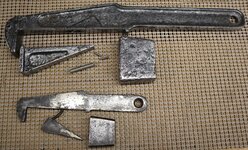
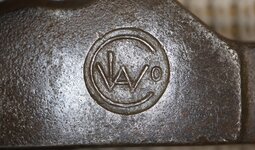
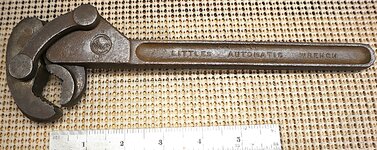
)Stated working on the SUL wrenches. The small one was marked but the big one was so covered with rust I wasn't sure if it was a SUL or not. First issue was getting them apart. Found out with the small one that holding the jaw closed allows the tapered sleeve to be removed. Big one was totally frozen. Worked it with PB Blaster and some other things until I finally got it apart. Spring was rusted in half, so I bought a new one. Cleaning it up carefully, I could not find any markings. Cleaned up more to some degree, but it will never be good. Even the tapered sleeve is cracked. So, I will probably paint the inside flats black. That will make it look a little better. Before, after, apart pictures.Wrench to the left of the Boos is a William A. Little Automatic Wrench of Cresson PA. It is marked with the patent date of Apr 17, 1912, but that is wrong. It was patented June 11, 1912 (#1029074). It has a "10" indicating length. It also has a logo, but it looks confusing to me. Like a big "C" and inside that is maybe "VA/o" maybe for chrome vanadium? Other than a few chipped teeth it's in pretty good condition.
The wrench on the far right is an Andrew B. Allen pipe wrench of Lockland OH. Patent #1896437 (Feb 7, 1933) Also marked "RED HEAD".
The one you call a flare nut wrench is actually a Gearwrench MFG Co Houston USA size 0 Titan Valve wheel wrench VWO. Basically a cheater bar for valve handwheels.
Belated thanks! I have never seen one of these before. I could be wrong, but that might be a FOAK for the site. There's none on the 'Oddfellows' thread and a search of GJ came up nil. Please post close-ups.Wrench to the left of the Boos is a William A. Little Automatic Wrench of Cresson PA. It is marked with the patent date of Apr 17, 1912, but that is wrong. It was patented June 11, 1912 (#1029074). It has a "10" indicating length. It also has a logo, but it looks confusing to me. Like a big "C" and inside that is maybe "VA/o" maybe for chrome vanadium? Other than a few chipped teeth it's in pretty good condition.
Thanks.The wrench on the far right is an Andrew B. Allen pipe wrench of Lockland OH. Patent #1896437 (Feb 7, 1933) Also marked "RED HEAD".
The one you call a flare nut wrench is actually a Gearwrench MFG Co Houston USA size 0 Titan Valve wheel wrench VWO. Basically a cheater bar for valve handwheels.
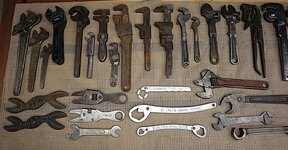
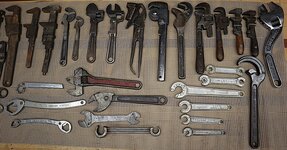
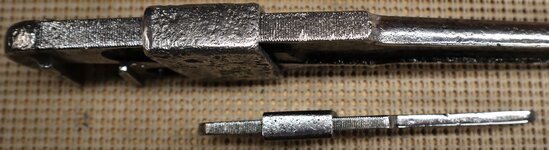
Per request, more pictures of the William A. Little Automatic Wrench. Patent 1029074 (Jun 11, 1912). The wrench shows a different patent date. The patent indicates it is for pipes or rods, but the patent drawing shows curved jaws. This one has a more squarish shape jaws, so it could also be used on nuts/bolts.Here are a couple pictures of most of my unusual wrenches. Enjoy.
Thanks. That's a byoot.Per request, more pictures of the William A. Little Automatic Wrench
Looks like a monogram type logo to me, Eric. The largest "C" goes with the small "o", with an overlapping "L" and "W" (and the crossing of the foot of the "L" and the middle peak of the "W" inside also forming an "A"), for Little Automatic Wrench Co.Like a big "C" and inside that is maybe "VA/o" maybe for chrome vanadium?
I like your description. Sounds like a good interpretation.Thanks. That's a byoot.
Looks like a monogram type logo to me, Eric. The largest "C" goes with the small "o", with an overlapping "L" and "W" (and the crossing of the foot of the "L" and the middle peak of the "W" inside also forming an "A"), for Little Automatic Wrench Co.
April 17, 1912 was a Wednesday, not a Tuesday (when patents were issued), so the date doesn't refer to a different patent. We've seen this before and it's almost always a foreign patent, a trademark date (issued from the same office), the date they got some kind of notification from the USPTO about the patent being granted, or a mistake.The wrench shows a different patent date.

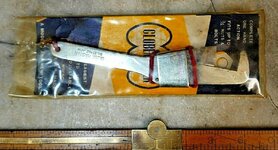
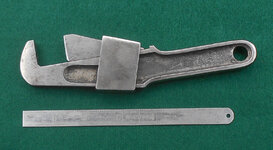
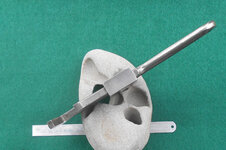
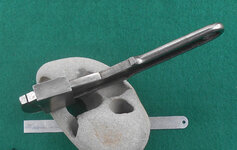
Here is an update on my SUL wrenches. After removing the rust. the big one looked very rough. (Craters of the moon). So I decided to paint the inside to make it look a little better. The spring was rusted through, so I got a replacement at McMaster Carr https://www.mcmaster.com/94135K281/Stated working on the SUL wrenches. The small one was marked but the big one was so covered with rust I wasn't sure if it was a SUL or not. First issue was getting them apart. Found out with the small one that holding the jaw closed allows the tapered sleeve to be removed. Big one was totally frozen. Worked it with PB Blaster and some other things until I finally got it apart. Spring was rusted in half, so I bought a new one. Cleaning it up carefully, I could not find any markings. Cleaned up more to some degree, but it will never be good. Even the tapered sleeve is cracked. So, I will probably paint the inside flats black. That will make it look a little better. Before, after, apart pictures.
The trick is to hold the jaws closed. That allows the sleeve to go over the stop. I suggest you do that just to clean and oil the spring. FYI, the pins holding the springs are 1/16" diameter.^ I had NO idea you could take that gizmo apart!
mine looks to be in fairly good shape, though.. .I don't think I'll be disassembling it!
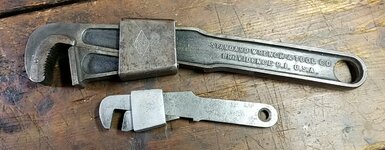
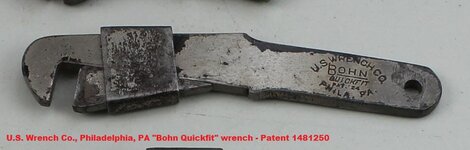
I think the wedge-adjust you're calling "the big one" is a Long patent (890,146 / 1908; 955,974 / 1910) made by Rogers, Printz & Co., considerably older than the "SUL" unit, which is an example of postwar Germany reviving turn of the century American hand tools. Check out the DATAMP page here and click on the ill-named "Patent Pictures" 2 link to see an example. Pretty sure your "big one" has the same profile. I have a similar Standard Wrench and Tool Co. "FITZ-ALL" (which is also a type of Long patent but bearing the name of the similar Fitzgerald patent (1,004,561 / 1911). You can search the "Oddfellows" thread for much more detail, where I also posted this photo of both of them together.After removing the rust. the big one looked very rough.