To avoid these ads, REGISTER NOW!

Upgrading air compressor plumbing, any advice?

OccupantRJ

Well-known member
Joined
May 15, 2009
Messages
11,085
Location
Eastern North Carolina
Thanks for posting pictures. What size pipe are you using? I figure the more info everyone has the better. The only suggestion I have so far would be to add a union to your up and over drops (on the tee), then you can take it down to add to it or change something with ease. I was going to add valves to my trunk line, but now that I have played with it, I don't think they are needed. I just shut off the valve at the compressor and open one of the drain valves on a drop, it lets the air out of the piping system really quickly. I actually wish I had not put the valves at the top of my drops, I may move them. I figure the system is a living thing, at least in my shop, and it will evolve as I learn what works for me.

I have had workshops for so long that I have generally found out what works for me and what doesn't. There is pair of unions on each section to allow me to easily handle any modifications. I made up the sections on the floor, then hung them on the wall by myself by resting the piping on 3 inch deck screws driven in strategic places. I used a string line to set the pitch of the piping path, then used the screws as temporary resting points. The straps were then attached with no stressing involved. The screws will be removed later. The trunk line is 3/4 pipe, and the drops are both 1/2" and 3/4", depending on what they are feeding. After about 40 feet of run, the trunk will drop to 1/2", as It will have passed by my blasting cabinets by then. Each drop will have a condensate drain at it's lower end. System will be powered by two 5 hp Saylor Beall compressors with 80 gallon tanks piped in parallel.
 
Last edited:
To avoid these ads, REGISTER NOW!

myfinishingtouch

Well-known member
Joined
Aug 23, 2013
Messages
52
I was off at Tractor Supply looking at pieces/parts for my setup I'm getting ready to install and noticed a rubber horse stall mat. 3/4" thick and seemed like a perfect thing to cut pieces from for under my air compressor feet. Anybody else use something like this? It is only $40 for a 4'x6' sheet of the rubber. Specs say each sheet is 100 pounds.

Dave
 
OP
S

Strouty

Well-known member
Joined
Mar 21, 2010
Messages
38,215
Location
Southern Maine
I was off at Tractor Supply looking at pieces/parts for my setup I'm getting ready to install and noticed a rubber horse stall mat. 3/4" thick and seemed like a perfect thing to cut pieces from for under my air compressor feet. Anybody else use something like this? It is only $40 for a 4'x6' sheet of the rubber. Specs say each sheet is 100 pounds.

Dave

I wonder if you could just cut it to fit under the compressor and let it sit on the mat? I don't have anything under mine, but I will be doing something, I am just not sure what.
 

sberry

Banned
Joined
Jun 18, 2005
Messages
35,747
Location
Brethren, Michigan
I think his system is going to work well without over the top drops. The water has to go somewhere, in this case if it migrates to the drop that's what its intended for? It drips down. Big pipe on these systems is ok but I would be inclined to hit a happy medium and run all I could one size or go 1/2 at the drops.

I am not sure why strouty had leak issues but a couple things compound it. I installed one in the ceiling this spring, 40 ft all screwed and I tighten it tight, real good long time, tight till its ready to bust and then some, with one inch it can take a lot, really get on it with a 24. With 1/2 often shank couplings right out till they are near friction welded and since it was so handy we pressure tested before erection.

BTW while I might encourage simplicity I also leave a drop in favor if its practical, often as simple as using a T and plug in place of elbow or worst case have to unscrew a drop.
 
Last edited:

CNGsaves

Well-known member
Joined
Sep 26, 2012
Messages
13,233
Location
KS and OK
^ ^ Much better advice to put up airline system in stages, so they can be pressure tested. That's great idea, especially if not as flexible as OP's with all the unions.

Thus, design in segments and pressure test overnight while on floor, or rough install on wall. Then move on to next segment once the prior segment(s) are all proven not to leak. As it goes together, do a bunch of soapy water tests for leaks. :thumbup:
 

myfinishingtouch

Well-known member
Joined
Aug 23, 2013
Messages
52
Any thoughts on where to find a 1" flexible hose to attach my compressor to my air lines? My Quincy 340 has a 1 inch outlet and my main line is 1 inch black pipe with 3/4 inch take offs.
Thanks,
Dave
 

CNGsaves

Well-known member
Joined
Sep 26, 2012
Messages
13,233
Location
KS and OK
Any thoughts on where to find a 1" flexible hose to attach my compressor to my air lines? My Quincy 340 has a 1 inch outlet and my main line is 1 inch black pipe with 3/4 inch take offs.
Thanks, Dave

Although not 1" here's 3/4" hydraulic hose (high pressure that will work great at 3 ft length) for $25 at Tractor Supply. Can also go to a hydraulic shop in your area and have a custom 1" hose made (likely more $$).
http://www.tractorsupply.com/en/store/hydraulic-hose-assembly-3-4-in-x-36-in
 

myfinishingtouch

Well-known member
Joined
Aug 23, 2013
Messages
52
Thanks. I saw that last night when I was at TSC...If I was running 3/4" mains I would have bought it but I'm sizing my main based upon the outlet from my Quincy which is 1 inch
 

FTG-05

Well-known member
Joined
Oct 11, 2012
Messages
1,535
Location
TN
Any thoughts on where to find a 1" flexible hose to attach my compressor to my air lines? My Quincy 340 has a 1 inch outlet and my main line is 1 inch black pipe with 3/4 inch take offs.
Thanks,
Dave

If it's coming off the compressor itself, or close to it, I'd be looking at a higher temp hose, not just pressure.

Here's 250 psi at 450 degree low pressure steam hose for around $6/foot: 5301K13 at McMaster.com.

good luck.
 

SeattleKent

Well-known member
Joined
Sep 30, 2011
Messages
236
Location
Redmond, Washington
Any thoughts on where to find a 1" flexible hose to attach my compressor to my air lines?

Find a "Parker Store". I had never heard of them when doing my compressor. Found a recommendation on this board. They were great. Told them what I needed and they made it up in a couple of hours. Very high quality.

See Parker Store national website and store locater

Search GarageJournal for "Parker Store" for more information.
 

e-tek

Well-known member
Joined
Dec 19, 2007
Messages
10,690
Location
Saskatoon, SK
Thank you for the support. I have decided that not only will my air tools go under the reels, but I will make a section for all cordless tools too. It just seems like the right thing to do. I am debating if I should also keep grinders and all the supplies in that area too, it kind of goes with the theme.

I've split my shop into various work sections and find it works out fairly well in keeping the dirt and dust contained:

113_5113.JPG


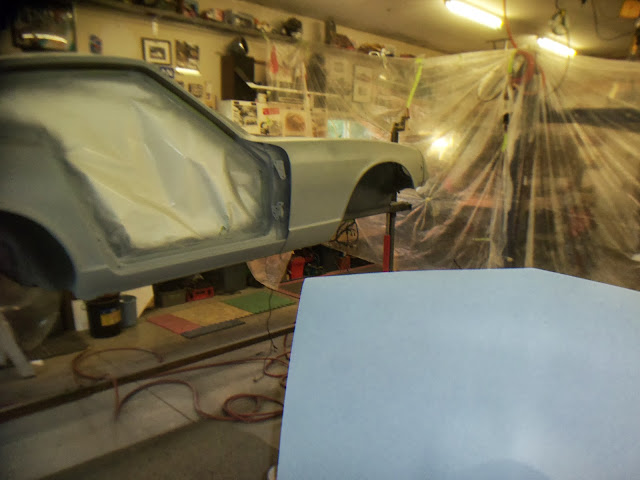
When the dust or paint is really flying I run a plastic sheet across the shop on a length of aircraft wire I have stretched across to separate the two halfs.

113_4908.JPG
 
OP
S

Strouty

Well-known member
Joined
Mar 21, 2010
Messages
38,215
Location
Southern Maine
I've split my shop into various work sections and find it works out fairly well in keeping the dirt and dust contained:

113_5113.JPG


When the dust or paint is really flying I run a plastic sheet across the shop on a length of aircraft wire I have stretched across to separate the two halfs.

113_4908.JPG

I bought a zip wall system to use for doing the drywall but since my ceiling is not finished the dust still made it over it. My shop is 60 wide by 30 deep with two doors on the 60 foot side. I am planning on putting up two walls to essentially make three separate shops. The stock room and clean room will be 14 by 30, the automotive section will be 30 by 30 and the welding and fab will be 14 by 30. Last year we did a lot of aluminum fab on one of my trucks and boy did that make a mess. I tried to partition off with plastic and covered important things, but the aluminum dust got everywhere. It will not go through the walls (I hope).
 

sberry

Banned
Joined
Jun 18, 2005
Messages
35,747
Location
Brethren, Michigan
Thanks. I saw that last night when I was at TSC...If I was running 3/4" mains I would have bought it but I'm sizing my main based upon the outlet from my Quincy which is 1 inch
There is no reason this hose has to be inch, the 3/4 would also be ideal.
 

myfinishingtouch

Well-known member
Joined
Aug 23, 2013
Messages
52
I've seen in a couple of spots that the main line should be the same diameter as the outlet of the compressor. That's why I'm using 1" main lines.
 
OP
S

Strouty

Well-known member
Joined
Mar 21, 2010
Messages
38,215
Location
Southern Maine
I've seen in a couple of spots that the main line should be the same diameter as the outlet of the compressor. That's why I'm using 1" main lines.

No reason to worry about undersized for a short distance. Do you have a NAPA near you? They made a couple of my lines, they did not have 1" line in stock, so I had to go to the local hydraulic hose place. As suggested look for a parker store or hydraulic shop. If you are not in a rush NAPA can get the right air hose for you. It is what they use for a jackhammer. If I remember the fittings were about $15 each and the hose was like a $1 a foot.
 

myfinishingtouch

Well-known member
Joined
Aug 23, 2013
Messages
52
Thanks. We have a Napa and a Parker. I'll be calling them tomorrow.

I admit I don't understand the pipe diameter requirements but if I'm supposed to run the main line at 1 inch because that's the diameter of the compressor tank outlet, wouldn't using a 3/4 inch flex hose render using 1 inch pipes a waste? And if using the 3/4 flex connector would I then only use 3/4 for the main lines?

Thanks,
Dave
 
To avoid these ads, REGISTER NOW!
OP
S

Strouty

Well-known member
Joined
Mar 21, 2010
Messages
38,215
Location
Southern Maine
Thanks. We have a Napa and a Parker. I'll be calling them tomorrow.

I admit I don't understand the pipe diameter requirements but if I'm supposed to run the main line at 1 inch because that's the diameter of the compressor tank outlet, wouldn't using a 3/4 inch flex hose render using 1 inch pipes a waste? And if using the 3/4 flex connector would I then only use 3/4 for the main lines?

Thanks,
Dave

The pipe size is more for how long a run you need to go. This depends on how much CFM your compressor puts out. If you have a large compressor than it would be much more important to have the 1" flex. That being said, I wanted to match my trunk line size with my flex, but I started out with a nice free 1" stainless flex line. To give you an idea, the compressor that had the 1" flex was good for 100 CFM and the compressor that I currently have is about 24 CFM, I am way overkill. I have attached a chart that is a good reference for sizing based on flow and distance.
 

Attachments

  • Piping charts.pdf
    81.4 KB · Views: 157

myfinishingtouch

Well-known member
Joined
Aug 23, 2013
Messages
52
I looked at the owner's manual for the Quincy F340 and it says the compressor puts out 26 CFM at 175 psi. The chart you send doesn't show the psi for the CFM calculations and maybe it doesn't matter? My run is very short now...2 car garage.

Thanks,
Dave
 

byoungblood

Well-known member
Joined
Apr 6, 2011
Messages
2,590
Location
Berryville, VA
One last thing. My posts were focused on systems that are permanently installed and connected with pipe.

For the other extreme, small portable systems with rubber hose connections.

Small systems usually heat up a lot more because they have to work so much harder. Once the receiver tank becomes hot from use, it's difficult to get all the moisture to coalesce inside the tank. You can use the same principals and get decent results.

Make up a vertical pipe manifold of 3/4 or 1" pipe of about 4-6' length, the more mass (surface area) the better. Put a tee in it about 6"-8" from the bottom, connect the side of the tee to your air source, this could be a hose connection. On the bottom of the manifold put a drip leg ****** and drain valve. Install tee's near the top of the manifold, to attach your quick couplers to. Mount the manifold on the wall near where you park your compressor.

You will be surprised on how much water you can trap over time with this simple setup. Make sure you remember to drain it as well as your tank. When you forget to drain it and the drip leg fills up to the inlet tees. It will let you know, because your blow gun or tool will begin spraying water to remind you.

Sounds very much like the set up I have at home. Since I seldom run the compressor continuously, most of the water tends to accumulate in the tank. Opening up the tank drain right before I use it seems to remove most water, then a little more condenses in the filter. I will crack open the drain at the bottom of my main manifold pipe (about 6' of 3/4" pipe) if it has to run much, but I still get only a small amount of water there. Almost nothing comes out of the drain on the opposite side of the piping system, which is about 25-30' of pipe from the manifold.

Compressor to the manifold is about 3-4', most of the distance spanned by some 200 psi 5/8" hose, arched upward, so any moisture from the tank has to be forced up that hose.

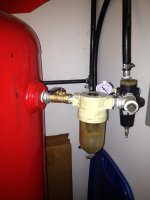
Here is a so-so picture from right off my compressor.
 

Attachments

  • image.jpg
    image.jpg
    135.4 KB · Views: 181

DekeT

Well-known member
Joined
Aug 12, 2011
Messages
2,234
Location
USA
This go's against the common school of thought, such as provided by the sample link you provided.

And here is the reasoning...


Slope Pipe. My method is a little different. I just use the main trunk piping to cool the air.

Sloped back towards the compressor is more ideal, this is where the moisture is coming form


3) Turn the trunk take-off drop tees down. Pointing the tees up as in the sample drawing is a bad idea. The thing you are trying to accomplish is get the condensation out of the piping trunk as quickly as possible, not force it completely across the entire system as suggested it the sample drawing. Again this go's against conventional wisdom.

On the drop pipes, install a tee, and always take air off of the side, never on the bottom. The bottom should always have a decent length 6" or more drip leg, and a drain valve. This is the part that is shown correctly in the sample drawing.
And yet as I stated earlier, this flies in the face of conventional wisdom, as can be seen by the numerous systems installed exactly like the sample drawing.

;)

Flying in the face of conventional wisdom is an understatement. It flies in the face of every industry and supplier recommended design I have read. These people have some rather smart engineers on hand to design their systems. All of them disagree with your design. You have some good ideas but I think I will stick with the manufacturers recommendations.
 

e-tek

Well-known member
Joined
Dec 19, 2007
Messages
10,690
Location
Saskatoon, SK
I bought a zip wall system to use for doing the drywall but since my ceiling is not finished the dust still made it over it. My shop is 60 wide by 30 deep with two doors on the 60 foot side. I am planning on putting up two walls to essentially make three separate shops. The stock room and clean room will be 14 by 30, the automotive section will be 30 by 30 and the welding and fab will be 14 by 30. Last year we did a lot of aluminum fab on one of my trucks and boy did that make a mess. I tried to partition off with plastic and covered important things, but the aluminum dust got everywhere. It will not go through the walls (I hope).

That sounds like an ideal set-up. Of course my plastic "partition" is just a half-measure. When I do full-on body work the dust coats the entire shop. I would love to have a real dedicated area like you are planning and have often thought of bulding an add-on just for sanding and paint.

I looked at the owner's manual for the Quincy F340 and it says the compressor puts out 26 CFM at 175 psi. The chart you send doesn't show the psi for the CFM calculations and maybe it doesn't matter? My run is very short now...2 car garage.

Thanks,
Dave

That's enough air for a 4 man production shop! :rocker:
 
OP
S

Strouty

Well-known member
Joined
Mar 21, 2010
Messages
38,215
Location
Southern Maine
I looked at the owner's manual for the Quincy F340 and it says the compressor puts out 26 CFM at 175 psi. The chart you send doesn't show the psi for the CFM calculations and maybe it doesn't matter? My run is very short now...2 car garage.

Thanks,
Dave

That will get it done! You could easily use 3/4" for a short run, mine was going to have about 100' plus and I went to 1". I am pretty sure PSI has no relation to CFM. If you had 350 PSI it may change the type of material you would use. Black iron pipe is rated for 150 PSI unless you get the heavy version, then it is rated at 300. I went with the 150 even though my compressor says it can do 175, I have pressure relief valves so it should never get that high.

Flying in the face of conventional wisdom is an understatement. It flies in the face of every industry and supplier recommended design I have read. These people have some rather smart engineers on hand to design their systems. All of them disagree with your design. You have some good ideas but I think I will stick with the manufacturers recommendations.

Down with the MAN! I am trying this way, it makes sense to me and I wanted to see how it works.

That sounds like an ideal set-up. Of course my plastic "partition" is just a half-measure. When I do full-on body work the dust coats the entire shop. I would love to have a real dedicated area like you are planning and have often thought of bulding an add-on just for sanding and paint.
SNIP

I was worried about the fab shop only being 14 feet mode, but a local welder that does everything has a similar sized section for his fab work. I figure I can always use the automotive section to weld bigger things if I need to. What do you have for a compressor setup?
 

myfinishingtouch

Well-known member
Joined
Aug 23, 2013
Messages
52
So I'm still confused. If I attach my compressor to my air lines with a 3/4 hose would that defeat the purpose of using 1" pipe for the main line. Or put another way, if you start off with 3/4 should you stay with 3/4 for the rest of the system?

Or put another way, the TSC hydraulic hose (3/4 x 36") is $25. I checked with the local Parker distributor and they can make me a 1"x36" 300 psi air hose with npt ends for about $50. Is it worth the extra $25 to get the 1" connector hose?
 

DekeT

Well-known member
Joined
Aug 12, 2011
Messages
2,234
Location
USA
So I'm still confused. If I attach my compressor to my air lines with a 3/4 hose would that defeat the purpose of using 1" pipe for the main line. Or put another way, if you start off with 3/4 should you stay with 3/4 for the rest of the system?

Or put another way, the TSC hydraulic hose (3/4 x 36") is $25. I checked with the local Parker distributor and they can make me a 1"x36" 300 psi air hose with npt ends for about $50. Is it worth the extra $25 to get the 1" connector hose?

No, no, and no.
 

theknurl

Banned
Joined
Dec 18, 2010
Messages
921
Location
SoCal
i used 3/4" PVC schedule 40, minimum burst@ 73* 1540PSI working pressure 289PSI
cheap, easy to modify and NO rust, dirt:thumbup:

http://www.engineeringtoolbox.com/pvc-cpvc-pipes-pressures-d_796.html

myfinishingtouch;
don't sweat the 3/4" fitting.....you're not using what it will flow @175PSI home shop/small workshop, you have a bunch of people using air tools and a sand blast cabinet at the same time different deal
check Bernouilli's Equation in any Engineering Manual
 

DekeT

Well-known member
Joined
Aug 12, 2011
Messages
2,234
Location
USA
i used 3/4" PVC schedule 40, minimum burst@ 73* 1540PSI working pressure 289PSI
cheap, easy to modify and NO rust, dirt:thumbup:

http://www.engineeringtoolbox.com/pvc-cpvc-pipes-pressures-d_796.html

myfinishingtouch;
don't sweat the 3/4" fitting.....you're not using what it will flow @175PSI home shop/small workshop, you have a bunch of people using air tools and a sand blast cabinet at the same time different deal
check Bernouilli's Equation in any Engineering Manual

:lol_hitti I guess you don't believe in manufacturers recommendations either.
 

theknurl

Banned
Joined
Dec 18, 2010
Messages
921
Location
SoCal
:lol_hitti I guess you don't believe in manufacturers recommendations either.

depends on what they are, as I reverse engineer everything, I make MY own decisions......i'm not stupid just old

here is an example;
my MV Agusta motorcycles have a single sided swingarm.....
the recommended torque on the hub pinch bolts is 28-32 Nm
28Nm is 20.65lbft
at 18lbft the inner race starts collapsing, at 28Nm its down -0.001
the internal clearance on a 3810-2RS is spec'd at 0.0010"-0.0016"
there have been many catastrophic failures......
WTF they are trying to put 140-200HP through a robotics bearing designed for 1-2HP DC stepper motors

i went to my friend Charlie he has a bearing house and supplies all the off road folks......

"a what number bearing...... long silence......WTF, that won't work"

he got me a looser fit one......sold 100's, NEVER a failure, torqued to 15lbft

you go to buy a 3810-2RS $96........I sell them for $34

i helped my friend Mitch in OZ redesign the rear hub with real ball bearings for lateral location

I ***** slapped all the nay sayers.......his bullet proof hub is ~$750 CNC'd out of 7075, not the hollow cast stock POS for $580
he gave me prototype #2 and production model#6

CNC people/forum members have approached me about making hubs too

my comment "don't you ******* dare, Mitch is my friend and did all the work"
I can have them made for 25% of that.......but I won't, Mitch is my friend

Nor OSHA safety requirements... :wtf:

nope, because 99.9% are politically driven feel good BS:lol_hitti

I have been using the same Purox OO, oxy/acet torch since I was 12.......it is illegal because it uses push on hoses by OSHA regs

the American aircraft industry built the middle class in the USA in WWll, Purox OOs and Victor AirCrafters were the backbone of welding in the aircraft industry that won WWll for us

so far in 54 years......it hasn't caused any problems:thumbup:
the torch and 5 tips weigh 10.8 oz
it runs on 1-5 PSI give me a break:lol_hitti

and they say lead is toxic right???? look it up in the Merck Index, hum, not soluble in blood or gastric fluids so how are you going to ingest it?????????

does my worm drive have the lower guard on it????

no, but it will swing a cut down 9" blade when cutting stair treads out of 1 1/8" plywood allowing me to cut an extra piece:thumbup:

ooooh thats not OSHA legal either :lol_hitti
 

Outlawmws

Well-known member
Joined
Aug 9, 2011
Messages
39,243
Location
The Badlands
theknurlm, here is a simple little test for you that even you can understand Re: PVC and compressed air gasses:

Take one PVC fitting, one hammer, and your concrete floor. rap the PVC fitting with said hammer. It will shatter, (So wear safety glasses, but you probably don't believe in those either...) Now sweep up all those shards (there will be many) and look them over carefully.

That will give you an idea of PVC in failure mode. Sure its rated for way more pressure than you are likely to give it, but something falling against a pressurized pipe or fitting, something snagging on one and pulling it sideways, whatever, and the PVC fails and shatters and all those razor sharp shards just became shrapnel.

Now imagine one of your family with a face full of that ****. Maybe they still have eyes, maybe they are lucky and are simply scarred for life.

Using PVC for compressed air is an accident waiting to happen. No amount of "reverse engineering" or "I'm smarter than those stupid politicians at OSHA" will change that fact.

Please don't respond until after you have done the test. All it costs you is one old PVC fitting. it can even be used...

I used to recommend PVC. but not any more...
 
Last edited:

Just_George

Well-known member
Joined
Nov 11, 2012
Messages
265
Location
Ypsilanti, MI
Guys, I'm a relative newbie here and perhaps it's not my place, but...this has been a very good, very informative thread so far. Can we not ruin it by re-hashing the pvc piping debate? That horse has been thoroughly beaten to death elsewhere, many times - let's keep this thread useful and relevant, please!
 

CNGsaves

Well-known member
Joined
Sep 26, 2012
Messages
13,233
Location
KS and OK
^ ^ Amen to that. Well said from a newby with 72 posts. Too bad TheKnurl didn't learn as much in his nearly 400 posts and 3 YEARS on GJ !! :D

Hope the Knurl is next to his PVC when it blows, so Darwin can be the teacher!
 
Last edited:
OP
S

Strouty

Well-known member
Joined
Mar 21, 2010
Messages
38,215
Location
Southern Maine
i used 3/4" PVC schedule 40, minimum burst@ 73* 1540PSI working pressure 289PSI
cheap, easy to modify and NO rust, dirt:thumbup:

http://www.engineeringtoolbox.com/pvc-cpvc-pipes-pressures-d_796.html

myfinishingtouch;
don't sweat the 3/4" fitting.....you're not using what it will flow @175PSI home shop/small workshop, you have a bunch of people using air tools and a sand blast cabinet at the same time different deal
check Bernouilli's Equation in any Engineering Manual

Did you read the notes?

Note! The maximum operating pressures derates with temperature. At the maximum operating temperature for PVC - 140oF (60oC) - the strength is derated to approximately 20% of the strength at 73oF (23oC).

Be aware that maximum operating pressures varies with the fittings design. Consult the manufacturing data.


All of that "information" is related to ASTM D1785 and this is the info that goes with it:

ASTM D1785

Abstract

This specification covers poly(vinyl chloride) (PVC) plastic pipe, schedules 40, 80, and 120 for use with the distribution of pressurized liquids only. This specification also includes classification criteria, nomenclature system, test methods, requirements, workmanship, dimensions, sustained pressure, burst pressure, flattening, extrusion quality, finish, appearance, and marking methods for PVC plastic pipe. PVC pipe covered are marked with one of six type/grade/design stress designation and defined by four hydrostatic design stresses. PVC plastics are categorized by short-term and long term-strength tests.

This abstract is a brief summary of the referenced standard. It is informational only and not an official part of the standard; the full text of the standard itself must be referred to for its use and application. ASTM does not give any warranty express or implied or make any representation that the contents of this abstract are accurate, complete or up to date.

1. Scope

1.1 This specification covers poly(vinyl chloride) (PVC) pipe made in Schedule 40, 80, and 120 sizes and pressure-rated for water (see Appendix X1). Included are criteria for classifying PVC plastic pipe materials and PVC plastic pipe, a system of nomenclature for PVC plastic pipe, and requirements and test methods for materials, workmanship, dimensions, sustained pressure, burst pressure, flattening, and extrusion quality. Methods of marking are also given.

1.2 The products covered by this specification are intended for use with the distribution of pressurized liquids only, which are chemically compatible with the piping materials. Due to inherent hazards associated with testing components and systems with compressed air or other compressed gases some manufacturers do not allow pneumatic testing of their products. Consult with specific product/component manufacturers for their specific testing procedures prior to pneumatic testing.

Note 1—Pressurized (compressed) air or other compressed gases contain large amounts of stored energy which present serious saftey hazards should a system fail for any reason.

Note 2—This standard specifies dimensional, performance and test requirements for plumbing and fluid handling applications, but does not address venting of combustion gases.

1.3 The text of this specification references notes, footnotes, and appendixes which provide explanatory material. These notes and footnotes (excluding those in tables and figures) shall not be considered as requirements of the specification.

1.4 The values stated in inch-pound units are to be regarded as standard. The values given in parentheses are mathematical conversions to SI units that are provided for information only and are not considered standard.

1.5 The following safety hazards caveat pertains only to the test methods portion, Section 8, of this specification: This standard does not purport to address all of the safety concerns, if any, associated with its use. It is the responsibility of the user of this standard to establish appropriate safety and health practices and determine the applicability of regulatory limitations prior to use. A specific precautionary statement is given in Note 9.

Note 3—CPVC plastic pipes, Schedules 40 and 80, which were formerly included in this specification, are now covered by Specification F441/F441M.

Note 4—The sustained and burst pressure test requirements, and the pressure ratings in the Appendix X1, are calculated from stress values obtained from tests made on pipe 4 in. (100 mm) and smaller. However, tests conducted on pipe as large as 24-in. (600-mm) diameter have shown these stress values to be valid for larger diameter PVC pipe.

Note 5—PVC pipe made to this specification is often belled for use as line pipe. For details of the solvent cement bell, see Specification D2672 and for details of belled elastomeric joints, see Specifications D3139 and D3212.
 

WhoWhatNow

Well-known member
Joined
Feb 22, 2011
Messages
1,889
Location
Collegeville, PA
depends on what they are, as I reverse engineer everything, I make MY own decisions......i'm not stupid just old

here is an example;
my MV Agusta motorcycles have a single sided swingarm.....
the recommended torque on the hub pinch bolts is 28-32 Nm
28Nm is 20.65lbft
at 18lbft the inner race starts collapsing, at 28Nm its down -0.001
the internal clearance on a 3810-2RS is spec'd at 0.0010"-0.0016"
there have been many catastrophic failures......
WTF they are trying to put 140-200HP through a robotics bearing designed for 1-2HP DC stepper motors

i went to my friend Charlie he has a bearing house and supplies all the off road folks......

"a what number bearing...... long silence......WTF, that won't work"

he got me a looser fit one......sold 100's, NEVER a failure, torqued to 15lbft

you go to buy a 3810-2RS $96........I sell them for $34

i helped my friend Mitch in OZ redesign the rear hub with real ball bearings for lateral location

I ***** slapped all the nay sayers.......his bullet proof hub is ~$750 CNC'd out of 7075, not the hollow cast stock POS for $580
he gave me prototype #2 and production model#6

CNC people/forum members have approached me about making hubs too

my comment "don't you ******* dare, Mitch is my friend and did all the work"
I can have them made for 25% of that.......but I won't, Mitch is my friend


nope, because 99.9% are politically driven feel good BS:lol_hitti

I have been using the same Purox OO, oxy/acet torch since I was 12.......it is illegal because it uses push on hoses by OSHA regs

the American aircraft industry built the middle class in the USA in WWll, Purox OOs and Victor AirCrafters were the backbone of welding in the aircraft industry that won WWll for us

so far in 54 years......it hasn't caused any problems:thumbup:
the torch and 5 tips weigh 10.8 oz
it runs on 1-5 PSI give me a break:lol_hitti

and they say lead is toxic right???? look it up in the Merck Index, hum, not soluble in blood or gastric fluids so how are you going to ingest it?????????
does my worm drive have the lower guard on it????

no, but it will swing a cut down 9" blade when cutting stair treads out of 1 1/8" plywood allowing me to cut an extra piece:thumbup:

ooooh thats not OSHA legal either :lol_hitti

Pure lead may not be soluble in water but lead acetate and other Pb2+ compounds are. That is most likely how it is ingested and becomes bioavailable. Once ingested it displaces zinc and calcium in multiple proteins and in most cases causes dysregulation of whatever systems those proteins are part of. Lead is poisonous regardless of concentration. There are no blood levels of lead that are safe.
 

FTG-05

Well-known member
Joined
Oct 11, 2012
Messages
1,535
Location
TN
[snip]

Would be so cool if a black pipe manufacturer would develop a shaped piece that would go up out of T and back down to wall for the straight pipe of drop (ie the piece would be overly bent "shepherd's hook" shape). This would eliminate all those fittings to accomplish that shape.

Ask and ye shall receive:

3/4 Pipe Size, 180 Degree Bend $16 for the 3/4" version, much more expensive when you get above 1".

That's the 3/4" fitting, the rest of the sizes are here: http://www.mcmaster.com/#standard-metal-pipe-fittings/=okzyb1
 

myfinishingtouch

Well-known member
Joined
Aug 23, 2013
Messages
52
Went to Parker yesterday and looked at the 1" 801 air hose. 200 psi rating. The hose itself isn't terribly expensive but the barb fittings are crazy expensive. I had thought I'd get 24" of it so in case I needed to pull my air compressor back to do any maintenance on the back side I wouldn't have to disconnect the air hose. But at that length when making the bend the hose would kink and I thought that would create too much of a restriction.

Now I'm thinking I'll just turn 90 right out of the tank (horizontal tank) followed by a ball valve and then a union. Then a 1" stainless braided hose going back to my vertical air line that will be anchored on the wall.

Started to wire up the rotary phase converter and 3-phase load center tonight.

Interesting about the 180 degree bend coupling. I haven't plumbed in the air lines so will need to check my plumbing supply house to see if they have those in stock.
 
To avoid these ads, REGISTER NOW!
Top Bottom