To avoid these ads, REGISTER NOW!

venting enclosed air compressor

danielbuck

Well-known member
Joined
Apr 15, 2014
Messages
917
I'm making space in my 1 car garage by moving the air compressor outside. I'm going to enclose it in this 36x24 "shed". Tank is 60 gallons, compressor is a single stage single piston 240 volt 4 hp oiled motor. "industrial air" I believe the brand was, but it's probably the same as any 60 gallon compressor under $1000.

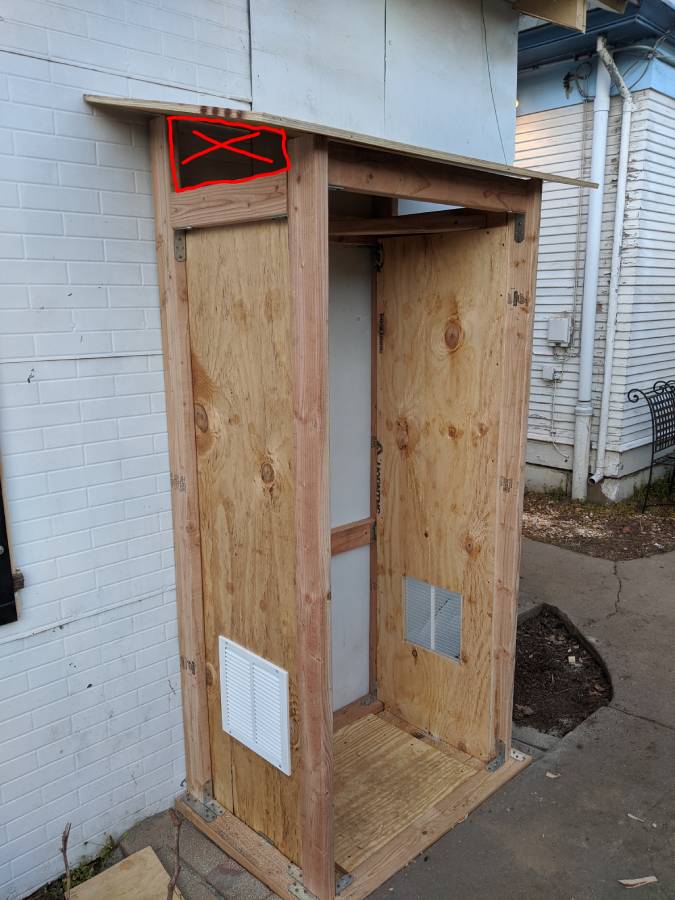
I've added lower vents to bring in cool fresh air, (there will be one on the door as well) and my initial plan was to add a fan and somewhat of a "chimney" to help the hot air escape.

After I got this far on making it (the roof will be mounted better, and have roofing on it), I started wondering if I just put some mesh at the top in the gaps between the roof and the sides, would this alone be enough to keep their compressor cool? Or should I still look into a fan? I've outlined the gap in red, the same gap is on the other side. I've made it about a foot taller than needed, and about 2 feet wider, to give more air inside, and also a place to store yard tools (rakes, shovel, and so on) But for the most part it will be just the compressor and tank.

I had a fan and a chimney before when I had the compressor sort of enclosed in somewhat of a box in my old garage, but I had the fan always running when I had the garage lights on. I don't want to have it running all the time, and I haven't figured out a good way to wire up the fan so that it turns on when the compressor starts, but keeps running for a set amount of time after the compressor stops. Ideally if there's a fan, I think it should run for a good while after the compressor stops. The other alternative would be a temperature switch I guess.

The compressor will not run continuously for very long. Usually it cycles then stops, and repeats. for the work I do, I don't normally have the compressor running continuously for much longer than about 10 minutes when I'm really using alot of air. (lots of angle grinding, or when I'm using alot of air to clean up the garage/carport). And I do keep it compressed over night, I never drain it, so it never has to start from completely empty. I do purge some air out of the bottom with an electrically operated valve to drain the water out every time I start and finish working for the day.

Thoughts?
vent.jpg
 
Last edited:
To avoid these ads, REGISTER NOW!

Harry6

Member
Joined
Apr 29, 2011
Messages
21
"I started wondering if I just put some mesh at the top in the gaps between the roof and the sides, would this alone be enough to keep their compressor cool? Or should I still look into a fan?"..... I don't normally have the compressor running continuously for much longer than about 10 minutes when I'm really using alot of air.

-------------------------------------------------------------

Hi Danielbuck,

Compressing air can generate a lot of waste heat - heating up your compressor, air in the tank, and air in your enclosure. The amount of heat depends on factors including pressure and volume, as well as the temp of the incoming air.

Since you describe not using the compressor continously for more then ten minutes, I tend to agree with K'ledgeBldr: Your probably won't need a fan to cool your compressor / bring in outside air if the duty cycle is very short and you only once in a while run up to 10 minutes or so.

But if you find the compressor heating up, then of course the better solution will be increased airflow over the compressor's cooling fins as well as drawing more fresh air cooling air in. Also, if it's hot in the enclosure only once in a while, you can obviously just leave the door open rather then design for worst case.
 
OP
D

danielbuck

Well-known member
Joined
Apr 15, 2014
Messages
917
I think that's what I'm going to do, run it with no fan and see how hot it gets. I can always add a fan later if needed. How would I know if it's getting too hot? I've got a temperature gun, should I be looking at the tank itself? Or just the ambient air temperature? Is there a temperature range I should be looking for?

And for the air intake for the compressor itself, I've made a plate (where the original filter used to be) with two ******* on it that I used to have hoses attached to, so that I could run them elsewhere to put the filters/mufflers farther away to keep noise down. Now that it will be out of the garage, I don't care about noise quite so much. But I could still use short hoses and pull fresh air from outside the shed. Might that be worth doing?
 
Last edited:

niget2002

Well-known member
Joined
Oct 2, 2012
Messages
11,115
Location
Josephine, TX
I think that's what I'm going to do, run it with no fan and see how hot it gets. I can always add a fan later if needed. How would I know if it's getting too hot? I've got a temperature gun, should I be looking at the tank itself? Or just the ambient air temperature? Is there a temperature range I should be looking for?

And for the air intake for the compressor itself, I've made a plate (where the original filter used to be) with two ******* on it that I used to have hoses attached to, so that I could run them elsewhere to put the filters/mufflers farther away to keep noise down. Now that it will be out of the garage, I don't care about noise quite so much. But I could still use short hoses and pull fresh air from outside the shed. Might that be worth doing?

I'm no expert, but I'd expect that the manual should have some type of safe operating temperatures in it. I'd try to keep the max air temp 80% or so of whatever is stated in the manual. I find that works well with most heat producing items I have in my shop. You could simply get a temperature controller and run it to an exhaust fan mounted on the side of the enclosure. I've used a few different ones sold by Inkbird on Amazon for various similar situations.
 

rattle_snake

Well-known member
Joined
Jun 25, 2015
Messages
5,145
Location
Chandler, AZ
You should be good with that level of venting given your use. The comp will be fine.

I instrumented my enclosure with temp sensors and it didn't get as hot as I would have thought. If you're worried put a thermometer in it and see what it does. Adapt as needed.
 
OP
D

danielbuck

Well-known member
Joined
Apr 15, 2014
Messages
917
I'm no expert, but I'd expect that the manual should have some type of safe operating temperatures in it. I'd try to keep the max air temp 80% or so of whatever is stated in the manual. I find that works well with most heat producing items I have in my shop. You could simply get a temperature controller and run it to an exhaust fan mounted on the side of the enclosure. I've used a few different ones sold by Inkbird on Amazon for various similar situations.

The manual doesn't list any temperatures or anything.


You should be good with that level of venting given your use. The comp will be fine.

I instrumented my enclosure with temp sensors and it didn't get as hot as I would have thought. If you're worried put a thermometer in it and see what it does. Adapt as needed.

I'm definitely going to put a thermometer inside, (one with a probe, so the gauge is visible from the outside) just to see how hot its getting in there. Or something like a BBQ thermometer that I can just drill a small hole on the side of the wall and insert it there.

And just for testing purposes since I can't find any temperatures listed anywhere, before I enclose the compressor I'm going to run for a while to get it good and warmed up. Then spot check the tank, compressor fins, and a few other areas so I at least have a baseline of what the 'normal' temperatures are before I enclose it. At least that way I can verify if it's running hotter than normal. I do know the compressor itself does get rocket hot, but that's been my experience with all compressors.


Anyway, thanks for the replies fellas :)
 

ford33

Well-known member
Joined
Feb 26, 2011
Messages
2,118
Location
Chicago, IL. USA
If you need to replace a belt, solenoid, or some other item at the top rear how do you plan to access the part? How do you plan to change oil or check oil levels? How about replacing the air filter?

It looks like the shed is about the same size as a vertical compressor and does not provide working space for maintenance.

Is noise a concern as well? You could add some foam sound deadening material to reduce the sound waves from bouncing around the hard wooden surfaces then out the grilles.

Finally, it is not clear how the shed is attached to the wall of the building. Is the compressor attached to the shed or to the building? You don't want it falling over if it is only resting on a few landscape bricks which may sink into the ground over time due to the weight of the compressor and soil compression.

Good luck and show us a picture when it is finished.
 
To avoid these ads, REGISTER NOW!
OP
D

danielbuck

Well-known member
Joined
Apr 15, 2014
Messages
917
If you need to replace a belt, solenoid, or some other item at the top rear how do you plan to access the part? How do you plan to change oil or check oil levels? How about replacing the air filter?

It looks like the shed is about the same size as a vertical compressor and does not provide working space for maintenance.

Is noise a concern as well? You could add some foam sound deadening material to reduce the sound waves from bouncing around the hard wooden surfaces then out the grilles.

Finally, it is not clear how the shed is attached to the wall of the building. Is the compressor attached to the shed or to the building? You don't want it falling over if it is only resting on a few landscape bricks which may sink into the ground over time due to the weight of the compressor and soil compression.

Good luck and show us a picture when it is finished.

it's probably taller and wider than it looks. It's 3 feet wide, which I think should provide enough access to the belt. It would be anoying to change, but it probably won't be needed very often. I've been running the same link belt on there for years. The front opening is 6 feet tall, just enough for me to walk under.

The oil is changed from the front, so no problems there. The electrical components and pressure valve are located on the front as well. Air filters/mufflers are on top, should be very easy to take them off, there should be about a foot of head room above the cylinder head. I'm using threaded mufflers/filters that are either right on top, or if I wish to use hoses I can locate them anywhere (I may do this if the ambient temperature inside gets hot)

The structure is on pavers with 2" of tamped sand below them, and over 6" of tamped gravel below that. The bricks on the side are just sitting on sand just because we had extra sand and bricks.

The structure is bolted into the studs of the garage. That's a good point though, I suppose I could use a few water heater style earthquake straps on the tank itself, going into the studs of the garage. I don't intend on bolting the tank down, I'm going to run it on rubber & cork isolators, I've never had them move on me, but the earthquake straps are probably a good idea.

Sound isn't really a big concern, I don't really intend on trying to soundproof it quieter than what the structure itself does. But if it's louder than I want, I'll look into doing more. Using the mufflers on the intake made a pretty big difference over how it was from the factory. If I run them on hoses I can run them into the attic of the garage to reduce the intake noise even more. I did that in my previous garage, the difference was quite substantial :)

Hopefully I'll finish the roof and door next weekend, then move the tank in, and work on the electrical and air plumbing. I'll post an update when I get to it :)
 
Last edited:

lis2323

Well-known member
Joined
Dec 25, 2016
Messages
3,234
Probably too late now but personally I would have doubled the size of your enclosure for better heat dissipation. You are on the right track though. [emoji106]
 

Turbo442

Well-known member
Joined
Dec 2, 2018
Messages
85
Location
NW USA
These compressors will run too hot in an enclosed space and usually if your lucky trip the thermal switch on the motor. I have seen compressors in a small room like 10x20 generate enough heat after cycling 3 or 4 times to trip it. Plus the compressor will generate a huge amount of water if the air intake is exposed to out side air. Even if your not going to use it very much it will be pretty hard on it. Remember it’s not just the electric motor that generates heat but also the compressing of the air, the belt, air compressor. You should move it to the living room actually and just use it to heat the house.
 
OP
D

danielbuck

Well-known member
Joined
Apr 15, 2014
Messages
917
These compressors will run too hot in an enclosed space and usually if your lucky trip the thermal switch on the motor. I have seen compressors in a small room like 10x20 generate enough heat after cycling 3 or 4 times to trip it. Plus the compressor will generate a huge amount of water if the air intake is exposed to out side air. Even if your not going to use it very much it will be pretty hard on it. Remember it’s not just the electric motor that generates heat but also the compressing of the air, the belt, air compressor. You should move it to the living room actually and just use it to heat the house.

I've been looking for a way to determine if the compressor is over heating, do you have any insight on that? As in, what part of the tank or compressor I should be monitoring temperature on, and what temperature would be considered too hot?

I can't seem to find any information on this, so I'm just going to take before and after readings (ambient, tank, and compressor fins), and use my own judgement to determine if I think additional cooling steps are needed.
 
OP
D

danielbuck

Well-known member
Joined
Apr 15, 2014
Messages
917
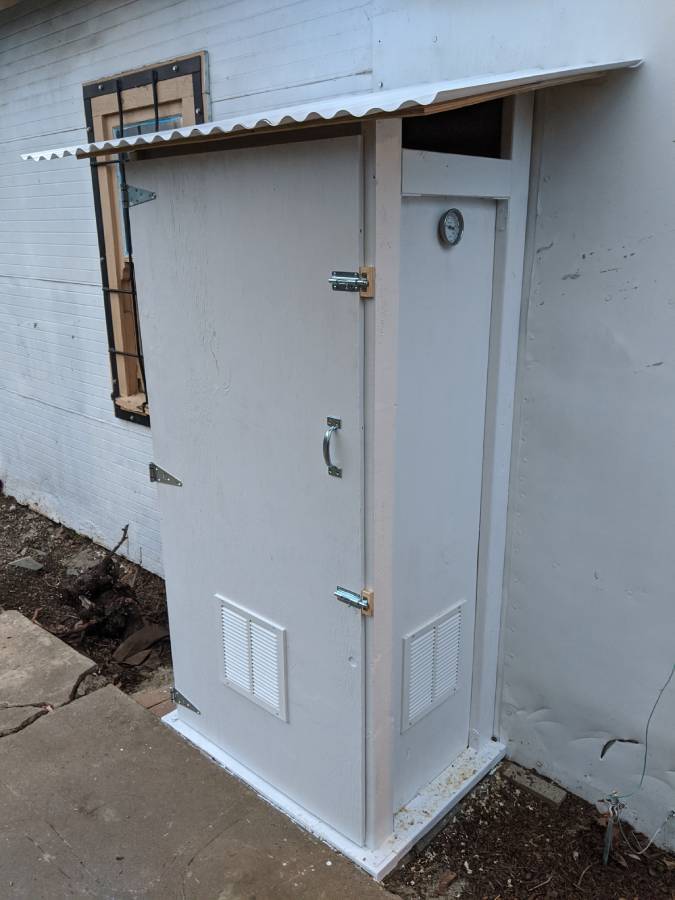
And got the door mounted. A few little things I want to do to finish it all off, but it's pretty much done.

I also put on a 3/4" ball valve on the side of the tank, I'm going to run 3/4" main air line, and probably a 1/2" reel for vehicle work, and then my existing 3/8" reel for air use inside the garage (which is mostly using the blow gun to blow away chips) should be a nice step up for the tools, which all already have Milton V connectors in anticipation of eventually having larger air lines.

I put 1 ambient thermometer sticking through the wall there on the side, and for giggles I found a probe with a remote (wired) display, I'm going to fix that probe up to the side of the compressor motor, should arrive today.

Also ran the drain line out the side, and will wire up a light-switch on the inside of the garage that opens up that valve.

I ran the tank last night just to fill it up to verify that the elbow and ball valve isn't leaking. If I'm standing right next to the structure, it's definitely not quiet, but I'm generally not on this side of the garage. Inside the garage it's just a low hum, and on the other side of the garage (where I'm usually working) it's just a hardly noticeable background noise.

Once I get the rest of the air line run, I'll start doing some temperature testing.

It's small, but there's plenty of access to change the belt and slide the motor for tension.

I hate painting. haha! But it didn't turn out too bad.


tank_02.jpg
 
Last edited:
OP
D

danielbuck

Well-known member
Joined
Apr 15, 2014
Messages
917
I wired up the compressor and the purge drain valve so that I can control them from inside the garage.

The switch for the compressor just powers the automatic solenoid, which turns on and off at set PSI. If I forget to turn it off at the end of the day, it's not a problem. The compressor may just cycle once or twice over night, depending on how air-tight my plumbing ends up being.

The switch for the purge drain valve activates the valve. If I leave the switch on, the valve will stay open for about 10 seconds (that's adjustable on the valve controller itself), if I turn the switch off before the 10 seconds is up, the valve closes immediately. In my old garage, I would normally just blip the valve for a second or two when I started working, and also when I stopped working and closed up shop for the night.


tank_03.jpg
 
Last edited:
OP
D

danielbuck

Well-known member
Joined
Apr 15, 2014
Messages
917
I've been working on other areas of the garage, I'll be getting back to the compressor later. But during that time I've left the tank sitting at 150psi to check my first short run of plumbing and the initial cut-off ball valve. it's been a few days now, and it's still at 150 psi. So that's good :)

My compressor cuts off at around 160psi, but it quickly dropped to 150 (an hour or two). I'm guessing that this is due to the fact that the ambient air was about 45 degrees, and the warm air in the tank was cooling off, dropping the pressure. Once it hit 150, it hasn't budged after a few days.

Previously I had always hooked my air hose reel and water separator directly to the tank since it was right there in the garage, but now that it's outside I'll be running hard lines, so I want to make sure they aren't leaking.
 
To avoid these ads, REGISTER NOW!
Top Bottom