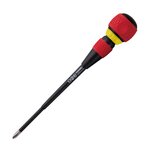
And that one has the knurling and that's really, really nice.Me, I use the turquoise/aqua handle ones on Phillips screws and they work great. I bought the #1, 2, and 3 size — love them for Phillips and other screws with recesses that are Phillips-ish in shape. (What? No, I'm not a mechanic in anybody's shop. Just a DIY homeowner.)
I find this hard to believe. I also own all three. I bought one like the first one pictured after seeing the praise on here and honestly, I was disappointed. It's better the the Craftsman, but the Craftsman screw drivers have never been great. However, it's no where near the quality of my Snap On. I almost never use it as I like the SO significantly better. Including on JIS screws. The quality difference is pretty large between the two.I have Vessel screw drivers like the first one you pictured and also the impact style, they are the best for removing JIS screws. Actually they are now my go to screwdriver, I reach for them before Snap On or Craftsman.
Yeah, neither of those is an Impacta, but the Impacta are excellent! Craftsman actually sold a 2-pack with their name on it for a while, with a P1 and 1/4" hollow ground slotted that I bought two sets of and highly recommend if you can find. Because of the limited torque you're going to get with the long shank, these two perfectly match the Impacta mechanism's performance with the tip size. For larger (P3, etc.) screws, go with a conventional hammer impact.I have Vessel screw drivers like the first one you pictured and also the impact style, they are the best for removing JIS screws. Actually they are now my go to screwdriver, I reach for them before Snap On or Craftsman.
That ISO standard for Ph geometry (absorbed from a DIN standard) encompasses the requires of the JIS standard....
Phillips and POZIDRIV driving geometries are formally defined in the same ISO standard and therefore an ISO PH screwdriver cannot be modified to better fit JIS crossheads as it would no longer meet the ISO requirements for the Phillips geometry.
The dot is used in the JIS system to denote an ISO metric thread.The dot indicates that it is the JIS crosshead geometry but the dot is not always present. Someone mentioned it to denote a metric thread but I'm not sure at all about that.