
You are using an out of date browser. It may not display this or other websites correctly.
You should upgrade or use an alternative browser.
You should upgrade or use an alternative browser.
Vintage RIDGID Pipe Wrenches
- Thread starter Private Lugnutz
- Start date
Here you are Lugnutz. After bragging about the wooden handled wrench, I can't find it. When it turns up I'll post pictures.
View media item 51909
View media item 51911
View media item 51910
Biggest to smaller (L-R). The two on the right are marked "2".
View media item 51916
View media item 51913
View media item 51912
The 24" has a couple of interesting marks. At the head it looks like "D" and "Rx" with the x being part of the R.
View media item 51918
At the handle is an "X"
View media item 51917
None of the other wrenches have these marks.
When it turns up I'll post pictures.View media item 51909
View media item 51911
View media item 51910
Biggest to smaller (L-R). The two on the right are marked "2".
View media item 51916
View media item 51913
View media item 51912
The 24" has a couple of interesting marks. At the head it looks like "D" and "Rx" with the x being part of the R.
View media item 51918
At the handle is an "X"
View media item 51917
None of the other wrenches have these marks.
Gidge
Well-known member


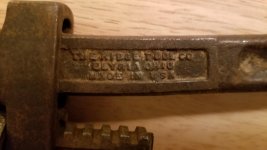
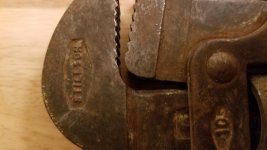
OP
Private Lugnutz
Well-known member
Holy **** I forgot all about this thread!
Jason,
I don't know anything about Ridge's STILLSON pattern pipe wrench production. This thread was concerned exclusively on dating their own patented wrenches. However, judging by some of the features that are common to both patterns (especially the fully knurled adjusting nut and the squared-off end on the moving jaw), I would say it's definitely older than WWII.
Jason,
I don't know anything about Ridge's STILLSON pattern pipe wrench production. This thread was concerned exclusively on dating their own patented wrenches. However, judging by some of the features that are common to both patterns (especially the fully knurled adjusting nut and the squared-off end on the moving jaw), I would say it's definitely older than WWII.
Holy **** I forgot all about this thread
So are you still collecting information? If you are, here's my 2 cents. I have an 8" wrench that my dad acquired in the mid 1960s. Based on your initial descriptions of various wrenches, I'm fairly certain my wrench is a post WWII version. The floating jaw is factory marked with "B 1 0". I can add a photo or two this evening if you'd like to see it. This is an interesting thread. Did you ever get to the bottom of the numbers, figure out the date codes, etc.?
Jim C.
Last edited:
OP
Private Lugnutz
Well-known member
Hi Jim,This is an interesting thread. Did you ever get to the bottom of the numbers, figure out the date codes, etc.?
Not definitively, as I recall. The format appears to be a date stamp in LETTER-MONTH-YEAR format, very similar to JP Danielson's format. No idea what the letter signifies. No way to use the date code itself to distinguish B-4-5 as April 1945 from April 1955 other than physical features pointed out in post 1, and those were derived from comparing the features with wrenches illustrated in dated advertising.
Hi Jim,
Not definitively, as I recall. The format appears to be a date stamp in LETTER-MONTH-YEAR format, very similar to JP Danielson's format. No idea what the letter signifies. No way to use the date code itself to distinguish B-4-5 as April 1945 from April 1955 other than physical features pointed out in post 1, and those were derived from comparing the features with wrenches illustrated in dated advertising.
Hi Lugz,
Let me start by saying that I really enjoy the detective work associated with date codes on old tools, cars/car parts, and machines. So this thread is of interest to me. As you probably know, old car parts were often stamped with a series of letters and/or numbers that signified dates of manufacture. Occasionally however, a letter signified a plant or location of manufacture. As a result, the letter "B" on many of the wrenches discussed above, including mine from 1960 (I think), may designate where the wrench was made. The numbers following the "B" very likely do designate month and year of manufacture. If none of the month numbers (the first number after the "B") ever exceeds 12, then it might be safe to say that's the month designation. The second number might be a little harder to distinguish. If the second number after the "B" is a number 0 to 9, then it's likely that it represents the year. Guessing the approximate decade would have to be based on the physical features of the wrench and knowing the particular wrench's history. (That could be a little harder to determine for wrenches that were found at flea markets, garage sales, auctions, etc.)
Using my 8" wrench as an example, I know FOR SURE that my dad got the wrench in the early to mid 1960s. Using the date code on the floating jaw (B 1 0), and looking at the physical features of the wrench, I also know for sure that the wrench was manufactured after 1955 based on the double banded knurling on the adjustment nut and the rounded end of the floating jaw. Now, applying the date code to the physical features, the wrench was possibly made in the "B" plant, or on the "B" assembly line, or even during the "B" work shift, in January (1), 1960 (0). Again, knowing a little background on the wrench might help pin point the decade. In the case of my wrench, since I do know its history, it's relatively safe to say it was manufactured in 1960.
Jim C.
Last edited:
twertsy
Well-known member
Not sure if you referenced this in your assumptions up front, but the interlaced DG wasn't filed for TM until July of '45, but the first use is claimed as June of 1923. Also unfortunate, it appears they filed ALL of their first trademarks for "Ridgid" (various fonts/configurations) in June/July of '45.
Here's the interlaced TM.
Here are all results for Ridgid, which I'm sure you've already browsed:
Here's the interlaced TM.
Here are all results for Ridgid, which I'm sure you've already browsed:
Sawdustmaker
Well-known member
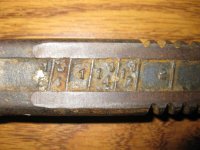
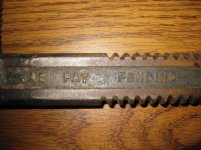
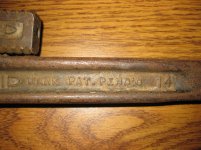
Here is my 14" Ridgid wrench. Belonged to my father. Looks to be pre-war, but has leanings to early war??? Needs cleaning to better see numbers. Jaw is Stamped with A2 PAT PENDING 14". Opposited side is stamped with a series of numbers. As best as I can read them. 15/34/1/114/112/2
Any suggestions as to date?
Any suggestions as to date?
Attachments

Last edited:
Sawdustmaker
Well-known member

OP
Private Lugnutz
Well-known member
Jim,
Thanks for talking through that. Yes, that's what I meant by LETTER-MONTH-YEAR code with no way to distinguish decades other than physical features determined by secondary sources (ads, etc).
Thanks for talking through that. Yes, that's what I meant by LETTER-MONTH-YEAR code with no way to distinguish decades other than physical features determined by secondary sources (ads, etc).
I did not reference trademarks, and only looked at patents, so thanks. I don't think it changes anything, but it's good to know.Not sure if you referenced this in your assumptions up front, but the interlaced DG wasn't filed for TM until July of '45, but the first use is claimed as June of 1923. Also unfortunate, it appears they filed ALL of their first trademarks for "Ridgid" (various fonts/configurations) in June/July of '45.
Those are jaw opening size marks: 1/2 | 3/4 | 1-1/4 | 1-1/2 | 2 |Opposited side is stamped with a series of numbers. As best as I can read them. 15/34/1/114/112/2
Sawdustmaker
Well-known member
Those are jaw opening size marks: 1/2 | 3/4 | 1-1/4 | 1-1/2 | 2 |
Thank you. Wasn't sure what they were. Have never seen anything like that before.
Slinger646
Well-known member
- Joined
- Apr 24, 2017
- Messages
- 213



disston
Well-known member
Jay,
Garage Journal is one of the easiest places to post photos because you don't have to make it a link like most places on the Web. You merely "copy" the photo you want to post by right clicking on the pic and selecting "copy". The left click the photo icon in the row above where you are typing your response and "paste" the copy you made in the line provided. After that all you do is click the OK box and your photo should appear in the dialog box.
Let me know if this helps. I'm not a computer person much myself but I have worked out a few things and really do think that GJ is one of the easiest places to post photos.
Garage Journal is one of the easiest places to post photos because you don't have to make it a link like most places on the Web. You merely "copy" the photo you want to post by right clicking on the pic and selecting "copy". The left click the photo icon in the row above where you are typing your response and "paste" the copy you made in the line provided. After that all you do is click the OK box and your photo should appear in the dialog box.
Let me know if this helps. I'm not a computer person much myself but I have worked out a few things and really do think that GJ is one of the easiest places to post photos.
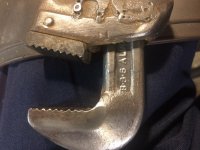
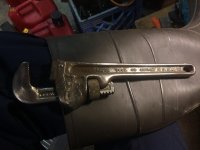
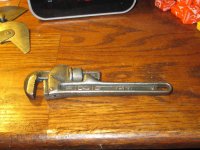
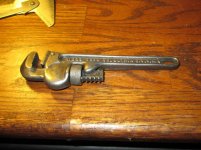
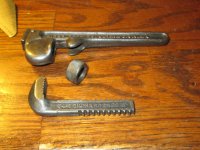
Thanks for the tip. I finally figured out I had to switch to "advanced Mode" and the pictures are now attached. I hope these are of help to somebody. Let me know if you need other pictures. I plan to use electrolysis to clean it up.
Am I correct this is a "war time" Ridgid wrench?
Am I correct this is a "war time" Ridgid wrench?
Attachments


d42jeep
Well-known member

Ole Slewfoot
Well-known member

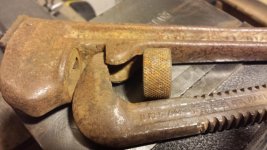
Got this one for somebody I know (though considering he did not pick it up in 2 weeks, considering to keep it)
If I got the general idea correctly, I should guess this is 1953. Please correct if I am wrong.
B-12-3
If I got the general idea correctly, I should guess this is 1953. Please correct if I am wrong.
B-12-3
Last edited:


OP
Private Lugnutz
Well-known member
Yikes I am really behind on this thread...
I will be back to post a major update.
Based on the features, yes, same style as the wrenches made during WWII. Based on the forged-in code I see on the dynamic jaw (?.12.7), probably 1947. So, technically, post-war. I need to come up with a better naming convention. It's confusing.Am I correct this is a "war time" Ridgid wrench?
Thanks for posting, Slew. That's the first pipe wrench I have seen with a number larger than 12 in the middle position, busting the idea of that possibly being a month format.Found a 10" B-13-5 in my friends shop as I fixed his boat today.
1943. In 1948 they started showing up with split knurling on the adjusting nut and a rounded end on the dynamic jaw.I should guess this is 1953. Please correct if I am wrong. B-12-3
I will be back to post a major update.
OP
Private Lugnutz
Well-known member
No problem.
All,
I have update the guide (pictures and notes) on post #1.
All,
I have update the guide (pictures and notes) on post #1.

jeffmoss26
Well-known member
Private Lugnutz, appreciate the update!!
OP
Private Lugnutz
Well-known member
It is. We don't know what the letters are, but there are wrenches that end in 6 that match the 1937 to 1948 timeframe features (and are therefore made in 1946). Yours ends in 6 but matches the 1929 to 1937 features. So, made n 1936. Which is consistent with the dating by the patents and physical features AND the theory that the last number is year of production. I have not yet encountered a wrench that busts either theory, by the way, but it's always good (statistically more relevant) to have as many examples as possible.My little 6 incher. Code is E (NOT B) 4-6. Hope it's of interest.
Thanks, buddy.Private Lugnutz, appreciate the update!!
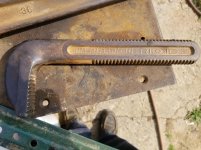
I have a 36" Rigid with the date code B-2-5. Anyone have a guess on the year? I don't know how old it is but it was my grandfather's and still works like new. For tools to survive him, they had to be well made.
Attachments



OP
Private Lugnutz
Well-known member
For tools to survive him, they had to be well made.

Based on my research and the features of the wrench (in particular the rounded end on the dynamic jaw), I would say 1955. Does that match your grandfather's life/age?
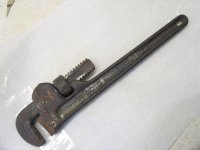
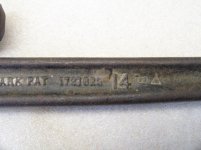
Here's a 14" I have hanging around, Lugz. Came from my Dads Tools. When I researched this over a year ago, I recall coming up with a 1937 model year because of the copyright date 1937 on the remnants of the decal on the head and other features.
Now that I see your chart, this seems to be odd, since the patent date on the handle corresponds to your diagram of the 1929 patent. According to that same chart, two other patent numbers were issued between then and 1937. So why would it have a 1929 patent number with a 1937 decal?
Also note the horizontal "8" and the triangle stamped on the handle. I seem to recall these are relevant to dating, but I'm not sure.
At least with the combination of the patent number, dated decal remnant, and stamped symbols on on handle, this particular artifact provides more information than most.
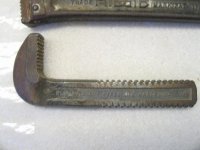
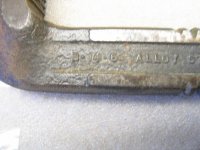
BTW, the same putty-like white smutz is on both the handle and the jaw, patina's the same, and the 'rust line' on the jaw corresponds to the section concealed in the handle, so it's been on a long time and I have little doubt the jaw is original to the handle, especially since I know the source. Some of your sampling may be corrupt if the jaw is not original to the handle.
Code on the jaw is B-14-6. Hope this helps. Can't help but agree there's a dating scheme embedded somewhere in it.
Now that I see your chart, this seems to be odd, since the patent date on the handle corresponds to your diagram of the 1929 patent. According to that same chart, two other patent numbers were issued between then and 1937. So why would it have a 1929 patent number with a 1937 decal?
Also note the horizontal "8" and the triangle stamped on the handle. I seem to recall these are relevant to dating, but I'm not sure.
At least with the combination of the patent number, dated decal remnant, and stamped symbols on on handle, this particular artifact provides more information than most.
BTW, the same putty-like white smutz is on both the handle and the jaw, patina's the same, and the 'rust line' on the jaw corresponds to the section concealed in the handle, so it's been on a long time and I have little doubt the jaw is original to the handle, especially since I know the source. Some of your sampling may be corrupt if the jaw is not original to the handle.
Code on the jaw is B-14-6. Hope this helps. Can't help but agree there's a dating scheme embedded somewhere in it.
Attachments

Last edited:
d42jeep
Well-known member
Thanks. Several questions.I've seen the sticker in wartime pictures so I would assume 1946 on your wrench. Almost all of the pipe wrenches I've run across have remnants of pipe sealing compound in the teeth of the jaws.
-Don
I'm assuming that 1946 is based on the "6" at the end. Are we sufficiently confident to determine that is the year of production?
I'm also assuming that having a 1929 patent date on a 1946 wrench is not an anomaly when, according to Lugz' chart, there are three subsequent patent numbers before 1946?
Also, I think it feasible that the decal was affixed as a final step before shipping, so theoretically a 1937 copyright label could have been placed on a 1936 production wrench still in-house?
And does anyone have a handle (so to speak) on the meaning of the horizontal "8" and the triangle symbols stamped in the handle on this wrench?
d42jeep
Well-known member
I would assume that those marks were stamped in the handle after the original purchase. I have no idea of their meaning. I think they put those stickers on the wrenches for quite a while. I've seem traces of them on several wrenches.
-Don
-Don
Last edited:
OP
Private Lugnutz
Well-known member
Not by itself, no. A production date of 1946 for your wrench (and I agree with Don on that) is based on a combination of its physical features, the patent information, and the forged-in alphanumeric code on the floating jaw. Without any forged-in code whatsoever I would date your wrench to the 1937 to 1948 timeframe based on the trademarked swash plate and the shape of the end of the floating jaw. With the code (B-14-6), and interpreting the code format as Unknown-Unknown-Year, the floating jaw can be further dated to 1946. Assuming that it is original to the handle and fixed jaw, we can apply that to the entire wrench. Their features are consistent with each other.I'm assuming that 1946 is based on the "6" at the end.
So far, no pipe wrench has busted my dating scheme based on the interpretation of the physical features in combination with the patents or my theory on the code.DadsTools said:Are we sufficiently confident to determine that is the year of production?
Did you read the notes accompanying the charts in post #1? Despite a number of patented improvements, no other patent has ever been put on a RIDGID pipe wrench as far as I know, and that one disappeared from the wrench in the late 1940's.DadsTools said:I'm also assuming that having a 1929 patent date on a 1946 wrench is not an anomaly when, according to Lugz' chart, there are three subsequent patent numbers before 1946?
The trademark for the angled swashplate was registered on March 1, 1938. It was applied for on August 5, 1937. Date of first use in the application was cited as July 10, 1937. For your wrench to have been made in 1936, it would mean Ridge was making pipe wrenches with an angled swashplate at least 6 months prior to the date they told the government they first made them.DadsTools said:Also, I think it feasible that the decal was affixed as a final step before shipping, so theoretically a 1937 copyright label could have been placed on a 1936 production wrench still in-house?
No. I agree with Don's speculation. Any time we see stampings when the original markings were forged-in, in general, across the industry, it usually means after-factory application.DadsTools said:And does anyone have a handle (so to speak) on the meaning of the horizontal "8" and the triangle symbols stamped in the handle on this wrench?
Last edited:
Thanks for the info!Not by itself, no. A production date of 1946 for your wrench (and I agree with Don on that) is based on a combination of its physical features, the patent information, and the forged-in alphanumeric code on the floating jaw. Without any forged-in code whatsoever I would date your wrench to the 1937 to 1948 timeframe based on the trademarked swash plate and the shape of the end of the floating jaw. With the code (B-14-6), and interpreting the code format as Unknown-Unknown-Year, the floating jaw can be further dated to 1946. Assuming that it is original to the handle and fixed jaw, we can apply that to the entire wrench. Their features are consistent with each other.
So far, no pipe wrench has busted my dating scheme based on the interpretation of the physical features in combination with the patents or my theory on the code.
Did you read the notes accompanying the charts in post #1? Despite a number of patented improvements, no other patent has ever been put on a RIDGID pipe wrench as far as I know, and that one disappeared from the wrench in the late 1940's.
The trademark for the angled swashplate was registered on March 1, 1938. It was applied for on August 5, 1937. Date of first use in the application was cited as July 10, 1937. For your wrench to have been made in 1936, it would mean Ridge was making pipe wrenches with an angled swashplate at least 6 months prior to the date they told the government they first made them.
No. I agree with Don's speculation. Any time we see stampings when the original markings were forged-in, in general, across the industry, it usually means after-factory application.