Private Lugnutz
Well-known member
READ ME!
THE THREAD IS WIDE OPEN AND WE ARE ALWAYS INTERESTED IN SEEING EXAMPLES - BUT THE ORIGINAL RESEARCH SURVEY HAS BEEN SOLVED!
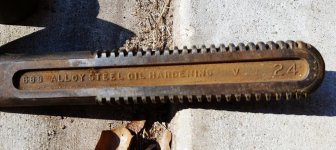
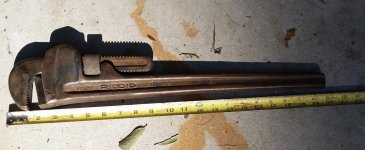
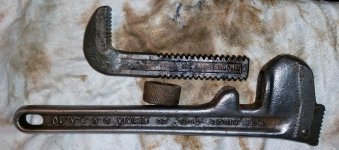
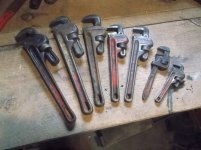
With 50+ examples, we have positively determined that the Letter-Number-Number (L-N-N) codes on dynamic jaws, which sometimes appear in LN-N or even LNN format, are indeed date codes. When they appear on the dynamic jaws of wartime pipe wrenches, they can be used to verify the wartime production, and determine the month and year.

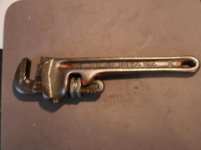
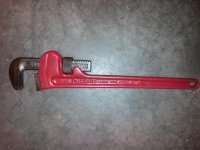
For example, the 6-incher and 10-incher above were both made in 1943.
EDIT: There was a time when we thought the middle number was month, but there are examples of wrenches with a "13" and a "16" and other two digits numbers higher than "12".
Read further if you want to know how to identify a wartime pipe wrench, distinguish pre-war pipe wrenches from wartime pipe wrenches, and distinguish wartime pipe wrenches from postwar pipe wrenches.
NOTE: While it seems plausible, it was not the objective of this survey to determine if the LNN format codes seen on the dynamic jaws of postwar pipe wrenches are also Unknown-Unknown-Year code. And if they are, this survey has not looked at how to distinguish a pipe wrench made in the 1950's from a pipe wrench made in the 1960's, 1970's or later. You will not find answers on that in this thread.
-------------------------------------------------------------------------------------------------------------------------------------------------
RESEARCH SURVEY
Calling all vintage RIDGID pipe wrench owners!
I need your help. I am part of a group of wartime collectors trying to ascertain the meaning of the forged-in codes (e.g., B-6-4, B-12-5, etc) that can be found on the floating jaw of many vintage RIDGID pipe wrenches.
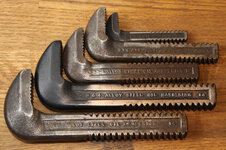
They may be date codes. If so, they would enable collectors to distinguish wartime wrenches from pre-war and post-war wrenches with similar features.
If you have a vintage RIDGID pipe wrench, please post photos of the whole wrench and the code. If that's not possible, please at least report the alphanumeric number and what category of wrench the number was found on (Pre-War, “Wartime”, or Post-War).
HOW TO DATE YOUR PIPE WRENCH (last updated 10/19/2025)
View media item 82807

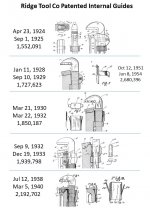
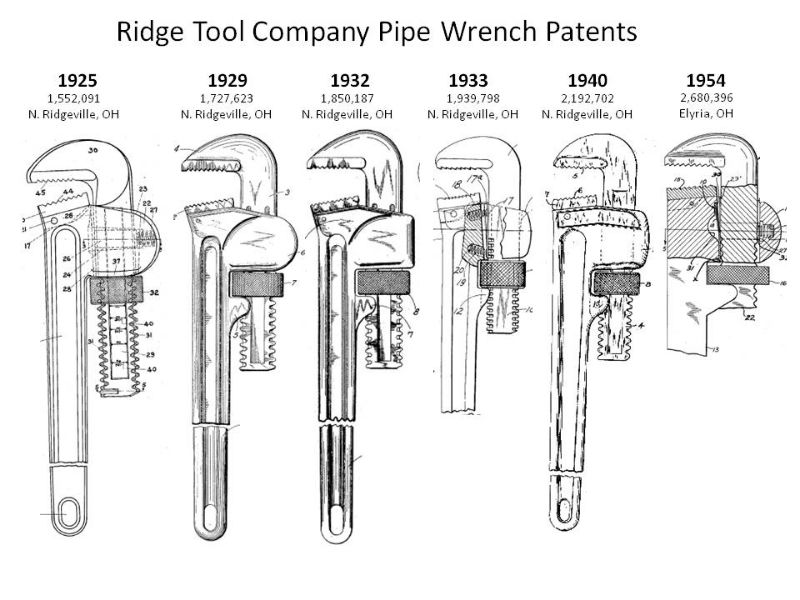
The earliest RIDGID pipe wrench has no stabilizer behind the adjusting nut (1), no trapezoidal swash plate on the housing (2), and no patent, 1,552,091, forged into the handle, which reads "PAT PEND'G" (3) instead. No RIDGID pipe wrenches have ever been found with the 1,552,091 patent. These can be dated to at least 4/23/1924, when Ridge submitted the patent application.
There is a mysterious generation of RIDGID pipe wrenches that seems to come between the 1,555,091 and 1,727,623 patents. An image of this wrench, labeled "Rigid" (no "d"), appears in Snap-on Catalog DW, which is copyrighted 1927, and looks exactly like examples, as shown here, with no trapezoidal swash plate (U1), characteristic of earliest wrenches, but a stabilizer (U2), which is a feature that was part of the 1,727,623 patent, and a "PAT PEND'G" marking (U3). What that marking refers to is not clear. It can't be 1,555,091, which was already granted. But the application for what would be patent 1,727,623 was not submitted to the USPTO until 1/11/1928. As strange as it seems, the evidence seems to suggest that Ridge was making these in 1927 and marking them "PAT PEND'G" not only before the patent was granted, but before they submitted the application.
The next definitive generation RIDGID pipe wrench has the stabilizer (4) and the trapezoidal swash plate (5), as shown in the second patent drawing, but reads "PAT PEND'G" on the handle (6). That suggests that the second patent (1,727,623) had been applied for (on January 11, 1928), but not yet granted.
RIDGID pipe wrenches with "PAT'D" in that spot (6) or the forged-in patent number "1,727,623" in that spot (7) could not have been made before the patent was granted, on 9/10/1929. If these examples have a trapezoidal swash plate, they could not have been made after 7/10/1937, which is the date that Ridge Tool Company claimed first use of their trademarked swash plate.
All RIDGID pipe wrenches with the forged-in patent number "1,727,623" (8) and a narrow angle-shaped swash plate on the housing (9) were made after 7/10/1937, when Ridge applied for a trademark for that shape plate, granted on March 1, 1938. Their USPTO application described it as an "angular bar extending across the head of the wrench," and they cited July 10, 1937 as date of first use. Link to trademark information on the Justia site can be read here. Note that this generation, and all prior generations, have a fully knurled adjusting nut (10) and a squared-off end on the dynamic jaw (11).
No RIDGID pipe wrenches have ever been found with the numbers of the patents granted in 1932, 1933, and 1940, which all deal with internal stabilizing mechanisms.
Magazine and journal ads c. 1948 show RIDGID pipe wrenches with an adjusting nut that is not completely knurled (12). Some have one recess, some have two, some even have the name with an interlocking D and G as the knurling. We're not sure of the sequence to those features, which is irrelevant to the salient point - that up until 1948 the adjusting nut was fully knurled.
Magazine and journal ads c. 1952 show RIDGID pipe wrenches with a rounded end on the threaded dynamic jaw (13).
A note on codes: I have not yet found any documentation to substantiate the three digit alphanumeric codes forged into the dynamic jaws, but the last number is almost certainly a year, and by using the other distinguishing features discussed above, you can ascertain which decade. Because the jaws are replaceable, it's not foolproof that a dynamic jaw can date your pipe wrench.
Patent 2,192,702 (1940), which purports to improve upon the internals to further stabilize the dynamic jaw, may hold the key to dating wrenches more definitively, but it's not an obvious distinction and requires removing the pin in the tongue in the static jaw to scrutinize the internals.
THANKS IN ADVANCE FOR YOUR ASSISTANCE
------------------------------------------------------------
EDIT (3/26/2019):
Recently there has been some interest in the floating jaw stabilizers inside the channel of the housing where the floating jaw moves in vintage pipe wrenches. Especially with respect to identifying OEM's for 3rd party pipe wrenches. They aren't necessary to identify the date of an early RIDGID pipe wrench, which all seemed to use the 1929 patent, but I will leave this here as a reference to direct people to it in case it's needed.
THE THREAD IS WIDE OPEN AND WE ARE ALWAYS INTERESTED IN SEEING EXAMPLES - BUT THE ORIGINAL RESEARCH SURVEY HAS BEEN SOLVED!
With 50+ examples, we have positively determined that the Letter-Number-Number (L-N-N) codes on dynamic jaws, which sometimes appear in LN-N or even LNN format, are indeed date codes. When they appear on the dynamic jaws of wartime pipe wrenches, they can be used to verify the wartime production, and determine the month and year.
For example, the 6-incher and 10-incher above were both made in 1943.
EDIT: There was a time when we thought the middle number was month, but there are examples of wrenches with a "13" and a "16" and other two digits numbers higher than "12".
Read further if you want to know how to identify a wartime pipe wrench, distinguish pre-war pipe wrenches from wartime pipe wrenches, and distinguish wartime pipe wrenches from postwar pipe wrenches.
NOTE: While it seems plausible, it was not the objective of this survey to determine if the LNN format codes seen on the dynamic jaws of postwar pipe wrenches are also Unknown-Unknown-Year code. And if they are, this survey has not looked at how to distinguish a pipe wrench made in the 1950's from a pipe wrench made in the 1960's, 1970's or later. You will not find answers on that in this thread.
-------------------------------------------------------------------------------------------------------------------------------------------------
RESEARCH SURVEY
Calling all vintage RIDGID pipe wrench owners!
I need your help. I am part of a group of wartime collectors trying to ascertain the meaning of the forged-in codes (e.g., B-6-4, B-12-5, etc) that can be found on the floating jaw of many vintage RIDGID pipe wrenches.
They may be date codes. If so, they would enable collectors to distinguish wartime wrenches from pre-war and post-war wrenches with similar features.
If you have a vintage RIDGID pipe wrench, please post photos of the whole wrench and the code. If that's not possible, please at least report the alphanumeric number and what category of wrench the number was found on (Pre-War, “Wartime”, or Post-War).
HOW TO DATE YOUR PIPE WRENCH (last updated 10/19/2025)
View media item 82807
The earliest RIDGID pipe wrench has no stabilizer behind the adjusting nut (1), no trapezoidal swash plate on the housing (2), and no patent, 1,552,091, forged into the handle, which reads "PAT PEND'G" (3) instead. No RIDGID pipe wrenches have ever been found with the 1,552,091 patent. These can be dated to at least 4/23/1924, when Ridge submitted the patent application.
There is a mysterious generation of RIDGID pipe wrenches that seems to come between the 1,555,091 and 1,727,623 patents. An image of this wrench, labeled "Rigid" (no "d"), appears in Snap-on Catalog DW, which is copyrighted 1927, and looks exactly like examples, as shown here, with no trapezoidal swash plate (U1), characteristic of earliest wrenches, but a stabilizer (U2), which is a feature that was part of the 1,727,623 patent, and a "PAT PEND'G" marking (U3). What that marking refers to is not clear. It can't be 1,555,091, which was already granted. But the application for what would be patent 1,727,623 was not submitted to the USPTO until 1/11/1928. As strange as it seems, the evidence seems to suggest that Ridge was making these in 1927 and marking them "PAT PEND'G" not only before the patent was granted, but before they submitted the application.
The next definitive generation RIDGID pipe wrench has the stabilizer (4) and the trapezoidal swash plate (5), as shown in the second patent drawing, but reads "PAT PEND'G" on the handle (6). That suggests that the second patent (1,727,623) had been applied for (on January 11, 1928), but not yet granted.
RIDGID pipe wrenches with "PAT'D" in that spot (6) or the forged-in patent number "1,727,623" in that spot (7) could not have been made before the patent was granted, on 9/10/1929. If these examples have a trapezoidal swash plate, they could not have been made after 7/10/1937, which is the date that Ridge Tool Company claimed first use of their trademarked swash plate.
All RIDGID pipe wrenches with the forged-in patent number "1,727,623" (8) and a narrow angle-shaped swash plate on the housing (9) were made after 7/10/1937, when Ridge applied for a trademark for that shape plate, granted on March 1, 1938. Their USPTO application described it as an "angular bar extending across the head of the wrench," and they cited July 10, 1937 as date of first use. Link to trademark information on the Justia site can be read here. Note that this generation, and all prior generations, have a fully knurled adjusting nut (10) and a squared-off end on the dynamic jaw (11).
No RIDGID pipe wrenches have ever been found with the numbers of the patents granted in 1932, 1933, and 1940, which all deal with internal stabilizing mechanisms.
Magazine and journal ads c. 1948 show RIDGID pipe wrenches with an adjusting nut that is not completely knurled (12). Some have one recess, some have two, some even have the name with an interlocking D and G as the knurling. We're not sure of the sequence to those features, which is irrelevant to the salient point - that up until 1948 the adjusting nut was fully knurled.
Magazine and journal ads c. 1952 show RIDGID pipe wrenches with a rounded end on the threaded dynamic jaw (13).
A note on codes: I have not yet found any documentation to substantiate the three digit alphanumeric codes forged into the dynamic jaws, but the last number is almost certainly a year, and by using the other distinguishing features discussed above, you can ascertain which decade. Because the jaws are replaceable, it's not foolproof that a dynamic jaw can date your pipe wrench.
Patent 2,192,702 (1940), which purports to improve upon the internals to further stabilize the dynamic jaw, may hold the key to dating wrenches more definitively, but it's not an obvious distinction and requires removing the pin in the tongue in the static jaw to scrutinize the internals.
THANKS IN ADVANCE FOR YOUR ASSISTANCE
------------------------------------------------------------
EDIT (3/26/2019):
Recently there has been some interest in the floating jaw stabilizers inside the channel of the housing where the floating jaw moves in vintage pipe wrenches. Especially with respect to identifying OEM's for 3rd party pipe wrenches. They aren't necessary to identify the date of an early RIDGID pipe wrench, which all seemed to use the 1929 patent, but I will leave this here as a reference to direct people to it in case it's needed.
Attachments
Last edited:











![WP_20141106_005[1].jpg](/forum/data/attachments/287/287012-2b46a47cc0b5f9add4988ca95745b2f3.jpg)
![WP_20141106_007[1].jpg](/forum/data/attachments/287/287129-b2c275fc7102a3be8e293d058882fb2b.jpg)
![WP_20141106_006[1].jpg](/forum/data/attachments/287/287080-e4d41a0d9f75606cef3d2cf7da347d4a.jpg)
![WP_20141106_004[1].jpg](/forum/data/attachments/286/286973-47e026a57e5da6efd43cfe62fb2d653b.jpg)
![WP_20141106_003[1].jpg](/forum/data/attachments/286/286934-777a1feb155c9689867d770d840d3822.jpg)
![WP_20141106_002[1].jpg](/forum/data/attachments/286/286893-271bd5a283bf1548f1660ef88bafafd3.jpg)
![WP_20141106_001[1].jpg](/forum/data/attachments/286/286857-f4f48694212794bcb25a02415f52d57d.jpg)