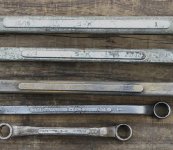
Lugz I think the confusion is you listed new britain as a craftsman supplier, and we were talking about tools supplied to sears on this thread as well.
Yup. Drives realized it in a post on the NB thread. Didn't mean to make it a 'thing' - just glad we resolved it.
That said, the Congressional investigation into steel in 1941, which catapulted an unknown senator from Missouri to national prominence and the eventual presidency, Harry Truman,
This is a very misleading statement. The Senate Special Committee to Investigate the National Defense Program, formed in 1941 to find and correct problems in US war production with waste, inefficiency, and corruption, looked at everything, from furniture to apparel to food, not just steel, exclusively, as you have implied, and not even primarily steel. Its biggest successes were in simple accounting issues.
Ricky Joe said:
exposed in testimony the fact that steel production, in the race to fulfill government contracts, was substandard, with one testimony that they could and did fool the government inspectors in front of them.
This statement is even more misleading. You are cherry picking flagrant cases and bad batches and presenting them as the norm. They were not.
Ricky Joe said:
WW2 steel was in general less robust, certain formulae being prohibited and tools considered expendable, not meant to last or be the strongest or best.
This is grossly incorrect. In fact, the direct opposite is true. "New Emergency" triple alloy steels, invented in 1941 by a consortium (AISI, academia, and industry) formed and overseen by the WPB, changed the steel industry for the better forever. Certain grades in the 8000 triple alloy series became available only to particular parts on specific aircraft and weapons with special priorities, but for the most part, aircraft, tanks, gun mounts, trucks, and other equipment, subjected to the harshest conditions imaginable, were made of the same triple alloys as tools. What the government and industry discovered in 1941 and 1942 was that the use of three alloying compounds (nickel, chromium, and molybdenum) in lesser amounts rather than one or two rare alloy compounds in richer amounts, as had been done prior to WWII, was not only much more economical, but lighter, and equally as hard, strong, and dependable as more expensive one- and two-alloy formulas in high-stress and severe service environments. And that's why triple alloy 8xxx and 9xxx series are still the core of so many industries today.
The second most ridiculous thing about your new argument (inferior wartime steel) is the overwhelming tonnage of WW2 tools that have been collected, much of which is shown right here on this forum. See any mfgr thread, DOE thread, DBE thread, etc. They were surplused and "appropriated" and saved and made their way back into circulation and professional garages and shade tree garages and used by tens of thousands of men and passed on to sons (I am one of many) and others and are still in use today, more than 70 plus years later. If the actual documented history I have summarized for you above goes as unacknowledged as my wartime history timeline did on the Bonney thread (hopefully I won't have to bury you with direct quotes here...), the empirical evidence of this forum is unavoidable.
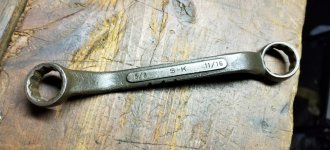
But, hypothetically speaking, the most ridiculous thing about this new argument, even if were true (again, it is not), apparently implies that this inferior steel was somehow only making its way to SK's forges. All mfgrs were using the same steel. There was no selection or preference or prerogative.