To avoid these ads, REGISTER NOW!

Vise Info Thread

To avoid these ads, REGISTER NOW!

KMScott

Well-known member
Joined
Feb 14, 2012
Messages
4,632
Location
Daufuskie Island, South Carolina
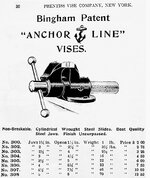
Thanks CRS, I already have the Anchor line added. I’m getting old and forgetful.

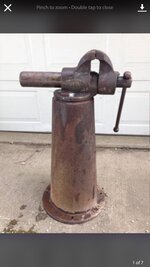
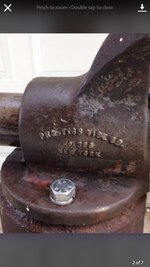
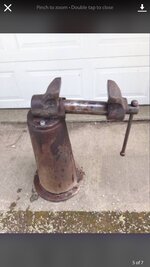
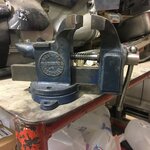
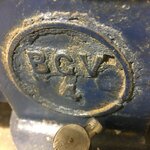
How about this one.

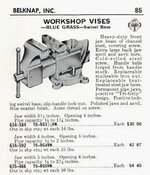
Belknap Bluegrass Vise. No spec:s
 

Attachments

  • IMG_2872.jpeg
    IMG_2872.jpeg
    802.3 KB · Views: 15
  • IMG_2873.jpeg
    IMG_2873.jpeg
    954.4 KB · Views: 15
  • IMG_2874.jpeg
    IMG_2874.jpeg
    616.8 KB · Views: 6
  • IMG_2876.jpeg
    IMG_2876.jpeg
    783.8 KB · Views: 10

four.cycle

Well-known member
Joined
Oct 19, 2015
Messages
28,458
Location
Tacoma, Washington
^ Pretty sure all Belknap / Bluegrass was outsourced, no?

Thanks for digging up the Ware information. I think from that it's reasonable to conclude he was manufacturing these in Minneapolis as well as Ontario, which is what I was wanting to establish.

(y)
 

neophyte

Well-known member
Joined
Apr 23, 2012
Messages
9,530
Location
Pennsylvannia
It would still be a PITA to get them completely parallel regardless of the cast in place method used. heck just the heat of the casting process would change things.
This was what I was thinking, although annealing and stress relieving the U-Bar after forming, and then tweaking the bar to ensure parallelism might prevent warping.
If the stationary and dynamic jaws were actually cast steel, a piece of sheet steel could probably be used to keep the open U-end parallel as the metal was poured around it.
Another trick might have been to use the castings, once cool, as a “die”, to straighten the two arms, in case of warping.
Basically, cast the two vise jaws, the push the U-bars back and forth, (using a press), thru the stationary jaw, both the remove the asbestos and to straighten the bar and match it to the holes in the stationary jaw.
 

CRSINMICH

Well-known member
Joined
Aug 15, 2015
Messages
2,393
Location
Southeastern Michigan
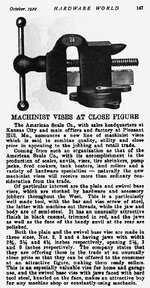
mr.reed: I don't have that information specific to American Scale #2 but I own a #3. The diameter of the main screw is 5/8" with 7 TPI. I'm not expert on thread types but it's likely Unified. I think it's fairly likely that an American Scale #2 would have the same main screw. Making two or three models using the same screw would have been a time and money saver and these vises were at the low end of the line. Let us know how you make out.

1922 American Scale Machinists Vises.jpg
 

KMScott

Well-known member
Joined
Feb 14, 2012
Messages
4,632
Location
Daufuskie Island, South Carolina
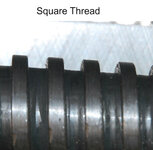
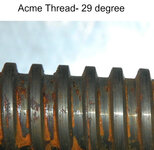
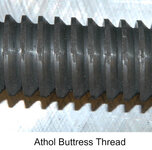
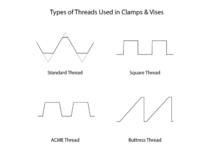
Bench Vises used three types threads. Square, Acme and Buttress threads. I’ve heard they use standard threads but I’ve never seen one used in a bench vise.
 

Attachments

  • IMG_7376.jpeg
    IMG_7376.jpeg
    779.9 KB · Views: 12
  • IMG_7375.jpeg
    IMG_7375.jpeg
    859.7 KB · Views: 5
  • IMG_7377.jpeg
    IMG_7377.jpeg
    973.6 KB · Views: 12
  • IMG_1637.png
    IMG_1637.png
    44.6 KB · Views: 13

CRSINMICH

Well-known member
Joined
Aug 15, 2015
Messages
2,393
Location
Southeastern Michigan
1Bad55: Here's a 1915 ad for Rock Island's Autovises. They seemed to be a general service vise but aimed at 'car guys'. There were a couple of other vise companies that marketed auto vises too. It seems like even back then, marketers wanted to get with the latest thing. There was even an Electric Vise and, a few years later, a Radio Vise.

1915 Rock Island Auto Vise.jpg
 

Outlawmws

Well-known member
Joined
Aug 9, 2011
Messages
39,085
Location
The Badlands
1Bad55: Here's a 1915 ad for Rock Island's Autovises. They seemed to be a general service vise but aimed at 'car guys'. There were a couple of other vise companies that marketed auto vises too. It seems like even back then, marketers wanted to get with the latest thing. There was even an Electric Vise and, a few years later, a Radio Vise.

1915 Rock Island Auto Vise.jpg

Correct! Parker, Hollands, and many others had vises setup with a more serious "anvil" on the back side aimed at early mechanics and garages. Many homeowner's vises still carried a vestige of that for many decades, and still do.
 
Joined
Jun 12, 2023
Messages
6
Location
IN
American Scale #2 2-3/4 jaws and weights 10lbs.
Hey KMScott is there any information or resources on information regarding the American scale co number 2 vise ? I have one that I’m trying to find a replacement screw for and with the wear on the internal threads of the static jaw and tight space it’s in I’m really struggling to measure the thread dimensions the threaded exit hole of the static jaw appears to be around 5/8” or 16mm however I’m having a hard time even confirming if it’s square thread/acme/buttress etc. if I had to guess I’d guess 5/8 and maybe 6 or 7tpi. Anyhow literally the only info I’ve seen was a sales marketing flyer but it didn’t have anything specific on there so I would greatly appreciate any information or resources someone could help me find.
Thanks for the time and any advice or information you may have.
Thanks
-Jeff
 
Joined
Jun 12, 2023
Messages
6
Location
IN
Heuer 75, 3" jaws, opens to 2-7/8", weighs 6 lbs. This is an early Heuer, newer ones are a little different.
Thanks for sharing👍🏻Ive always liked the heuers a lot, been wanting to get one of the heuer made and brownell branded vises…also similarly there’s a company out of turkey that makes one similar to the newer style heuers but they’re called Kanca forging and the model I’m referring to is the Kanca k2 plumbers parallel vise. Even sell the swivel base and lift or elevators which I’ve always liked
 
To avoid these ads, REGISTER NOW!

four.cycle

Well-known member
Joined
Oct 19, 2015
Messages
28,458
Location
Tacoma, Washington
^ I need to remember to READ posts before responding to them. I looked that up before I noticed your line about "Sadly, it seems it was never in production"

:rolleyes:
 

four.cycle

Well-known member
Joined
Oct 19, 2015
Messages
28,458
Location
Tacoma, Washington
^ We know for sure that all kinds of items in "Scientific American" for which there are write-ups were in fact not actually ever produced. This has become an on-going issue for the stewards at datamp.org, as some of the articles which were published allude to a given item actually having been manufactured, when in fact it was not.
Apparently "Scientific American" had people on the payroll whose business was "advertising" new inventions which had been patented, looking to make a score by selling the patent rights to somebody on an item that had not yet gone into production.

I do not know if that same issue comes up with "American Machinist" as well, but that text in the above-cited article causes me to wonder.

@RTM - your take on this one?
 

RTM

Well-known member
Joined
May 13, 2019
Messages
13,058
Location
SF Bay Area
^ We know for sure that all kinds of items in "Scientific American" for which there are write-ups were in fact not actually ever produced. This has become an on-going issue for the stewards at datamp.org, as some of the articles which were published allude to a given item actually having been manufactured, when in fact it was not.
Apparently "Scientific American" had people on the payroll whose business was "advertising" new inventions which had been patented, looking to make a score by selling the patent rights to somebody on an item that had not yet gone into production.

I do not know if that same issue comes up with "American Machinist" as well, but that text in the above-cited article causes me to wonder.

@RTM - your take on this one?

Honestly, never seen it. Usually I have a patent number on a tool, or a date. It's rare for me to be reading SA just randomly looking for stuff.

So no real opinion.
 

four.cycle

Well-known member
Joined
Oct 19, 2015
Messages
28,458
Location
Tacoma, Washington
^ I CC'd Jeff's reply to you on that one. S/A seems to be the sketchy one. The "American Machinist" organization apparently wasn't using the same practices, per Jeff.
Which begs the question: has anyone actually seen one of these in the flesh, or even a photo image of one?
 

CRSINMICH

Well-known member
Joined
Aug 15, 2015
Messages
2,393
Location
Southeastern Michigan
This time I did a search before posting

Leet Manufacturing Co. vises
Based on patents of William Northall

These Leet Manufacturing Co vise ads and journal items are all from 1884 except one from May, 1885. The vises are based on
1884 patents granted to William Northall. He was granted 4 patents for vises. Two were assigned to C.S. Leet and two were unassigned. DATAMP has the notation, "Not known to have been produced" on all of them.


Leet ads and items.jpg
It looked like another case of ads and items, which were basically press releases, leading to the question, "Were these vises ever produced?"

UNTIL ... I found this item in a book detailing the exhibits in the Fifteenth Exhibition of Massachusetts Charitable Mechanic Association held in September and October of 1884. This cut shows the "REMARKS OF THE JUDGES". Eureka!
The judges were reviewing the vise in the exhibit, ergo there is proof positive that at least one of these vises was actually produced!

1884 Exhibit item p89.jpg

And then... I found the Fourteenth Edition of the Exhibition from September and October, 1881. It has the same information about The C D Leet vise exhibit; the precise word-for-word information. In both editions, the Leet information was on the bottom of p.89 and a few lines were continued on the top of page 90. The 1881 exhibit would have been 3 years before the patents were granted.

Something is not adding up!


To paraphrase Michael Corleone, "Just when I think I can stop researching, they pull me back!"

 
Last edited:

four.cycle

Well-known member
Joined
Oct 19, 2015
Messages
28,458
Location
Tacoma, Washington
RE: (CRSINMICH):
These Leet Manufacturing Co vise ads and journal items are all from 1884 except one from May, 1885. The vises are based on
1884 patents granted to William Northall. He was granted 4 patents for vises. Two were assigned to C.S. Leet and two were unassigned. DATAMP has the notation, "Not known to have been produced" on all of them.


^ what are the patent numbers?
 

four.cycle

Well-known member
Joined
Oct 19, 2015
Messages
28,458
Location
Tacoma, Washington
^ I'm not well-versed enough on vises - or reading patent documents - to be able to figure out from the claims made in the patent documents which patents were actually used in the manufacturing of the Leet vises.

What a short trip down this rabbit hole did turn up for me, though, was that:
- C.S. Leet was apparently the son of C.D. Leet
- Charles D. Leet and one Henry A. Chapin (both of Springfield, MA) together were issued patent 208247 Sep 24 1878 for "Metallic-Cartridges" for firearms. Apparently Mr. Leet had previously been involved in the firearms (or rather ammunition) business as early as 1862.
-C.S. Leet (son of C.D. Leet) was awarded patent 250083 Nov 29 1881 for a "Call Whistle" (a whistle made in the shape of a rifle bullet.)

It looks like Mr. Leet had his fingers in more than one pie. I did not find a connection between Northall and any of the firearms/ammunition making activity.


KMScott

Well-known member
Joined
Feb 14, 2012
Messages
4,632
Location
Daufuskie Island, South Carolina
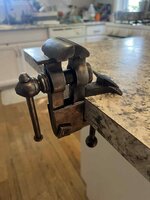
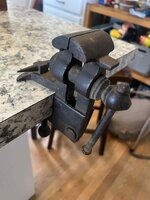
William Friedrichs. Clamp-on Jewelers vise. 2-1/8” jaws and weights 3lbs and 6 ounces.

Possibly English made?
 

Attachments

  • att.eSCwkOvavR2FvOHKBwx-gstJzxrb11H6YHGEi-xUY1M.jpeg
    att.eSCwkOvavR2FvOHKBwx-gstJzxrb11H6YHGEi-xUY1M.jpeg
    103.7 KB · Views: 17
  • att.bM6NpDFhokaZlmo1uPIfoTm47M41vgIg5DQSLu3dvwA.jpeg
    att.bM6NpDFhokaZlmo1uPIfoTm47M41vgIg5DQSLu3dvwA.jpeg
    236 KB · Views: 12
  • att.byO9oPECtD-_mZB4_btNp5u9u8O-OG6h2EyIRqAROzI.jpeg
    att.byO9oPECtD-_mZB4_btNp5u9u8O-OG6h2EyIRqAROzI.jpeg
    119.2 KB · Views: 12
  • att.jpS3bT0amkGvuXV7QEgYxH3YJyx5VoT68Op0txlySCk.jpeg
    att.jpS3bT0amkGvuXV7QEgYxH3YJyx5VoT68Op0txlySCk.jpeg
    124.7 KB · Views: 12
  • att.rtLXG8cBSs6Vg9C6lmebAiccuFYlijZS2jklZHft-Js.jpeg
    att.rtLXG8cBSs6Vg9C6lmebAiccuFYlijZS2jklZHft-Js.jpeg
    262.3 KB · Views: 14

Outlawmws

Well-known member
Joined
Aug 9, 2011
Messages
39,085
Location
The Badlands
I thought the same and asked the owner his thoughts. He came back with this pic.

Hmmm, those type of blacksmith vises are normally forged. Maybe not for the smaller clamp on's, or possibly WF imported and re-branded. Not a lot of infor there so far for a solid determination.
 

RTM

Well-known member
Joined
May 13, 2019
Messages
13,058
Location
SF Bay Area
William Friedrichs. Clamp-on Jewelers vise. 2-1/8” jaws and weights 3lbs and 6 ounces.

Possibly English made?
Here is a similar series in a German catalog.


And a different catalog


And a 3rd

More From a Hungarian source.

 
To avoid these ads, REGISTER NOW!
Top Bottom