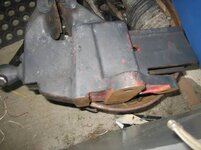
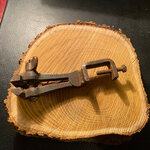
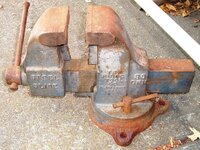
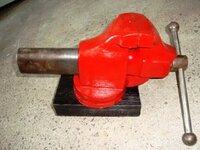
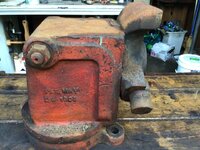
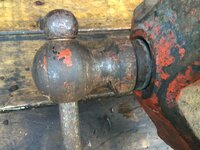
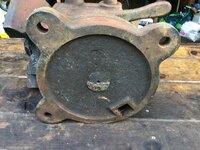
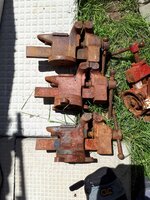
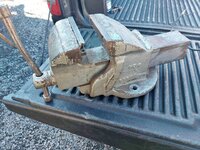
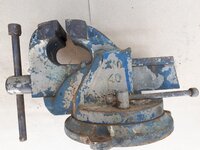
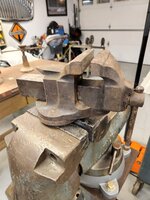
Unknown, only marking is "5" on the right side of the dynamic near the handle. 5" jaws, 8" opening. Distinctive shape to the static jaw tower, with thick leading edge. Look familiar to anyone?
I believe that is a larger Fabrex vise, made by Record. There is a 5" version on Kijiji currently. Has the raised diamond on the front jaw tower and the raised ridge running from the front of the moving jaw to the back of the fixed tower. I did not see a "5" marked on it but asked the owner its jaw width. Here are the photos from Kijiji. Pictures are not in the right format, according to GJ. Will try tomorrow.
I believe that is a larger Fabrex vise, made by Record. There is a 5" version on Kijiji currently. Has the raised diamond on the front jaw tower and the raised ridge running from the front of the moving jaw to the back of the fixed tower. I did not see a "5" marked on it but asked the owner its jaw width. Here are the photos from Kijiji. Pictures are not in the right format, according to GJ. Will try tomorrow.
KMScott...You're a very gracious host and I'm more than happy to contribute as I can.
Just a current observation about this thread as it stands today. The vise spreadsheet is approaching 4000 entries, with some being vise models never seen on GJ before. That is simply amazing to me.
Canadian vises are finally getting the love they so much deserve. I really appreciate and enjoy all of the new information coming from "North of the border" lately. A special thanks to all of those making that happen.
As so many more dated vise catalog scans continue to become available to vise collectors, I've found it interesting to see the timeline and history of the longer produced models, (e.g. Charles Parker, Prentiss...etc).
This all started for me last fall, looking for a Canadian made vise for a nephew and his wife to use at the property they bought (more about what I got another time). Doing any vise research inevitably leads to this GJ thread and the Vises of GJ. I was amazed at the number of vises and the wealth of info about them, but soon realized that Canadian made vises were not being documented as thoroughly as ones from the USA or UK. Seemed worthwhile to help fill in the gaps. Big thanks to Garage Journal for hosting this knowledge base, to @FMC1959 and @KMScott for the spreadsheet work, to @Dave600 for his deeper knowledge of Canadian vises, and to @Fierljeppen and others who seem to have an inexhaustible supply of further information and documentation. I'm enjoying the hunt!
I previously included information about the Canadian made version of this vise when responding to a post in The Vises of GJ thread, but decided to consolidate that and new material here.
Catalog pages show the vise being sold in 1901 (Caverhill) and 1903 (TS Howland & Sons).
Eaton's, a Canadian department store and catalog institution (somewhat comparable to Sears Roebuck in the USA) appears to have sold the vise in the 1907-08 Fall & Winter catalog, and given the perfectly matching description, almost certainly in the 1920-21 and 1925-26 Fall & Winter catalogs.
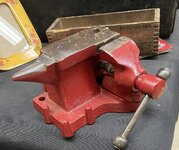
Allen's Combined Anvil and Vise
Jaw width 2"
Opening 3"
Anvil face 4 x 2-1/2"
A cold steel chisel and punch was packed with each. Red in colour (though possibly not the red shown in photos).
The Puzzling "A&W Vise"
I first saw this vise on the "Progress Is Fine" blog (the pics above):
Searching for "A&W Guelph vise" was fruitless but made me hungry. The first break came when I happened on Mark Stansbury's anvil-vise spreadsheet, with a new-to-me Guelph company, A. R. Woodyatt. After that it was following breadcrumbs, knowing what to watch for, and ultimately a suggestion from someone that didn't pan out but revealed the final clue.
I discovered the vise was made by A. R. Woodyatt & Company of Guelph, Ontario.
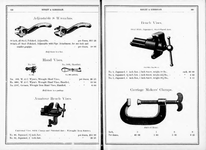
In 1902, two years after Woodyatt died at age 50, Woodyatt & Co. and Guelph Malleable Iron Works merged to create The Taylor-Forbes Company, Limited. T-F also made C-clamps among other items.
More searching showed the vise was patented by JOSEPH ALLEN, of PALMYRA, NEW YORK, US Patent 240,217, granted Apr. 19, 1881.
Although the patent is for a somewhat different design than what Woodyatt manufactured, it does describe the features that were so puzzling to readers of the "Progress is Fine" blog.
Allen manufactured the vise himself until at least 1899, according to the entry at Vintage Machinery.
The American version is described at J. ALLEN.
By July 2022 I seemed to have exhausted all resources on the web without learning anything more. The not too clear stamp in the photo above and some others, and the lack of any indication that "A&W" had real meaning, frustrated me enough that at one point this post said:
I eventually figured out that the stamp on the bottom was "A&V", presumably for "anvil and vise". [Edit March 2023 - have seen enough examples now to know the stamp is indeed "A&W", so still trying to figure out the meaning of it.]
Dave600 (GJ) and Jeff Joslin (Vintage Machinery) provided the convincingly clear photos of the "A&W" stamp. Back on the hunt then...
Nothing. More nothing. Spending too much time with no result, on the back burner it went.
Contacting Jeff about another company reminded me that he's said something about Woodyatt working with someone else and what they did together could explain the stamp. I'd discounted it at the time because I'd never come across anything to support it, but hey, lacking any other leads I should follow up properly... now where did he say that?!
Once I found Jeff's email it all fell into place quickly. The other person was JB Armstrong, also of Guelph, whose carriage works eventually morphed into an international automobile spring manufacturer. Woodyatt had assigned a patent to him, not directly vise related.
Did you catch it?! The final clue was in that article.
The company AR Woodyatt started after leaving Armstrong was not AR Woodyatt & Co. It was the predecessor company started with Charles Auld in 1887, the Guelph Enterprise Mfg. Co.
Auld & Woodyatt
A&W
The story of that partnership and more of AR Woodyatt's life is here.. Check the photos at the bottom.
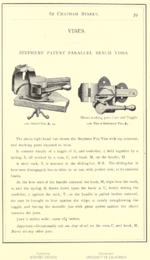
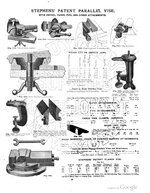
Stephens Patent Parallel Vices 2-3/4", 3-1/2", 4-1/2" with or without swivel
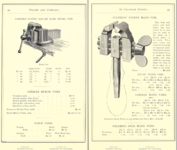
Backus Patent Parallel Vices 3", 3-1/2", 4", 4-1/2", 5" with or without seat
Note the spelling of "vice" in this 1872 Canadian catalog.
I agree. I have several Rae vises and a Clark Machine Co Vise. I want to get a Crawford as well. If Williams was a distributor, I wonder who made the vise? Rae, Clark or Crawford?
Ps. This is an edit. I noticed you say AH Williams, I am sure this is A W Williams on the tag.
@Duke74 and @Dave600 , I think it may be A. R. Williams. Only a Toronto address on this 1887 catalog, but wouldn't be surprising if they expanded to Montreal. Hard to see in the tag picture Duke but it might say "Toronto" before "Montreal".
A couple of pictures of a Trojan 705 by Parker, 4-1/2" jaws. Specs are in spreadsheet, but no pictures.
Date of manufacture and catalog page provided by @Fierljeppen here:
Bub: i've been following along and noticed that you mentioned pics of a 2 inch wide parker vise, but I didn't see any. do you have one of the little ones? Fier: always nice reading your posts and seeing what you've found!
4 page brochure showing working parts of the vise with directions for use.
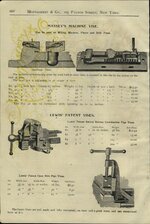
"Stephens' parallel vise: adapted to locomotive works, car builders, machinists, gun, sewing machine and carriage manufacturers, jewelers and artisans generally" New York : A.P. & M. Stephens & Co., [1870]
[Added scans & link]
1875 Frasse & Co. catalog pages with similar description, plus accessories and price list for jewelers, nickel-plated jewelers, and coach vises.
1877 catalog of W.C. Duyckinck of New York City.
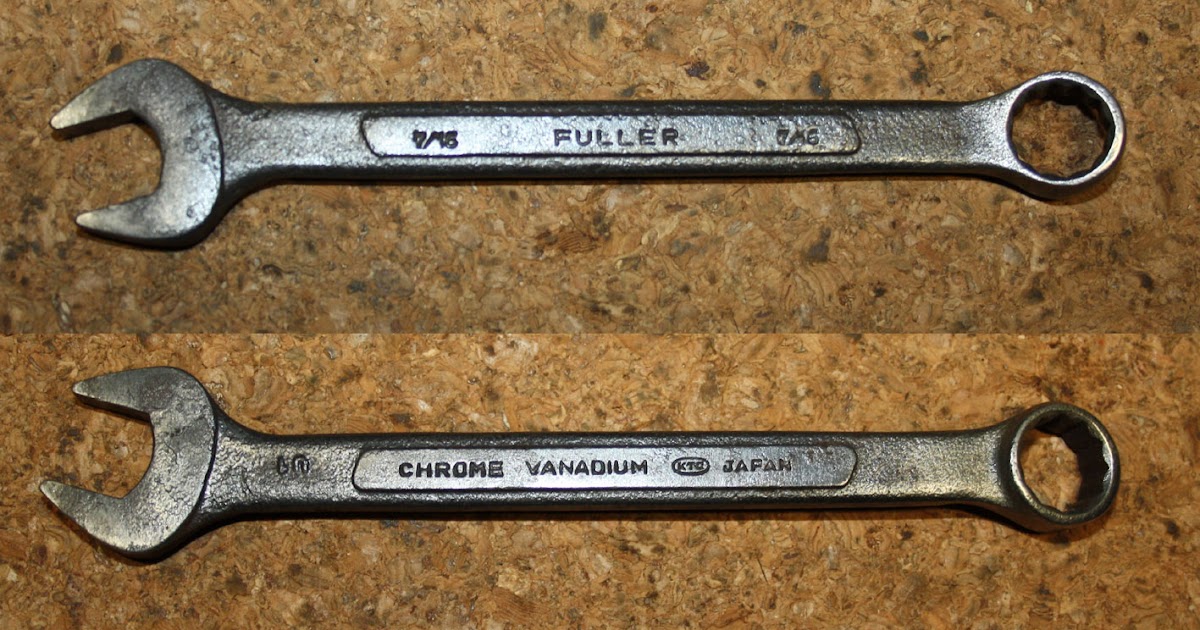
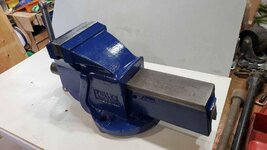
Fuller 1789. By far the heaviest and nicest Fuller branded vise I've seen. No COO. I think it looks like a Record, but don't recall seeing the little bump-out on the end of the slide before.
Jaw width 5"
Max jaw opening 6-1/4"
Overall length 17"
Edit: Looked, and that bump is present on 2 of the Henry 5 models I've seen, none of the other Henrys, and none of the Records I checked. Wonder what purpose it serves?
The way the thickened front edge of the static jaw tower curves back towards the base, and the pads both top and bottom of base where the bolt holes are, looks most similar to an ERON (made by Nabeya in Japan - thanks to @superautobacs for that lead). Also the "Oil" hole indicator on the side of the slide is just like the ERON in the last picture (from @Productbob). So COO may be Japan.
Edit 2023-12-11: Post on this blog has Fuller history, and mentions relationship between Fuller and KTC (Kyoto Tool Company) in Japan.
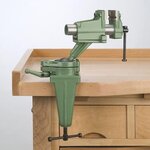
Gesswein SWIV-BALL SB-1 Toolmaker Vise. No spec:s. Made in USA.
I never had this vise when I was building Plastic Injection molds but sure used their polishing stones.
Hello everyone... After lurking about and reading the many vice threads (and even making an effort to read the huge restoration thread,) I've decided to plan my first restore project and thought that a bit of public documentation is in order. The final project is a big old Woden 190/7A that...
This has been for sale a year, maybe more . Originally was asking $200 (maybe $225) and is now down to $185. Nice vise but a bit too much; would need to be less than a $100 for me to consider it. (and not a nice paint job)
You definitely came to the right place for your vise questions.
The vise looks like a 2nd generation Yost no. 206, which was introduced around 1920. Yost was located in Meadville, PA until 1957, so the vise in question was mfg. somewhere between (1920-1957), although it's probably from the latter end of this era since it has the cylindrical screw spindle.
For the record, here's the Yost Mfg. Co. location timeline, as I understand it.
Yost Mfg. Co.
1907...Mechanicsville, PA
1908...Meadville, PA
1957...Cambridge Springs, PA
1980...Muskegon, MI
1985...Holland, MI
Finally found a catalog showing, for the first time in my experience, two lines of Canadian made vises: James Smart utility, and Canadian bench. Delighted to have some published specs and the first hard date for either.
First up, the James Smart utility line, one of many types the company made during its existence. The line was around long enough to reflect an apparent change in how the company identified itself: from "Smart" to "Smart's". The change seems to have been underway when this catalog came out in 1940: "Smart" appears on the No. 7-11 illustration and "Smart's" appears on the No. 66.
Later production no longer had the name cast, only the model number, and the name was displayed on a decal as "Smart's". The photos below illustrate the change.
1940 Caverhill, Learmont, & Co. Limited (Montreal, Toronto, Ottawa) Wholesale Hardware
Complete catalog at the Toronto Library:
I spotted this one earlier this year but was waiting to get some info on it before posting a photo. Bigger than I assumed.
Specs: Same as No. 66, with a clamp instead of swivel base.
Marking: "Smart's 44" cast on left static jaw - but only one example to go by so far.
No. 66
"Attractive red finish" according to the catalog so both 44 and 66 shown here may be with original paint.
Jaw width: 2-5/8" (Confirmed by measurement)
Jaw opening: 2-1/2" (measurement)
Weight: 8-3/4 lb. (This would be with pipe jaws; measured 8-3/8 lb. without)
Pipe jaws: Yes, loose (Have yet to see one with the pipe jaws)
Marking: "Smart's 66" cast on right static, based on numerous examples.
No. 7-11
The unusual model numbering scheme has been commented on before, but the rationale remains unknown.
Jaw width: 3-1/16"
Jaw opening: 4"
Weight: 12 lbs
Marking: Two ways the name may appear. More examples seem to exist of version 1.
Older vises have "Smart 7-11" cast on the right static; the left side is bare (photos).
Newer vises have only the model number cast on the right side: "7-11". A decal saying "Smart's" is on the left static.
No. 8-12
No. 8-12 doesn't appear in the catalog. It may be that this distributor chose not to offer it, or it may be a later model.
Jaw width: 4" (measured)
Jaw opening: 4" (measured)
Weight: 12-3/8 lb. (measured)
Marking: As with 7-11, two versions. However, more examples can be found of version 2, suggesting the 8-12 was introduced later than the 7-11.
Older vises have "Smart 8-12" cast on the right static; the left side is bare.
Newer vises have only the model number cast on the right side: "8-12". A decal saying "Smart's" is on the left static (photos).
Bonus pic: va.grouseman's SmartStack, with one to go. Great shot!
Edited 2023-04-16: corrections, new pics, formatting.
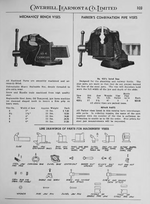
The second line of Canadian made vises in the 1940 Caverhill Learmont catalog is, umm, “Canadian”. Not very creative, and painfully generic as a search term.
This is the first document I’ve found referencing the line, so anything else known comes from observation and inference. Referred to as "Mechanics' Bench Vises" they look very much like Rae’s line of Mechanics and Heavy Duty vises, so best guess is either a Rae sub-brand, or maybe a house brand with Rae as the OEM. This catalog listing supports the Rae sub-brand idea, as it is treated like all the other manufacturers’ vises, and not highlighted in any way as a Caverhill, Learmont house brand.
Source:
1940 Caverhill, Learmont, & Co. Limited (Montreal, Toronto, Ottawa) Wholesale Hardware
Complete catalog at the Toronto Library:
Only model marked "Patented" - likely has to do with swivel as it's also the only swivel model.
Jaw width: 4”
Jaw opening: 3-5/8”
Weight: 36 lbs.
Base: Swivel. So far the only swivel base model - and never has a fixed base.
Measurements & photo: skmbabon Edited 2023-04-15 - updated information; formatting.
Edited 2023-04-17 - added photo of No. 6
You definitely came to the right place for your vise questions.
The vise looks like a 2nd generation Yost no. 206, which was introduced around 1920. Yost was located in Meadville, PA until 1957, so the vise in question was mfg. somewhere between (1920-1957), although it's probably from the latter end of this era since it has the cylindrical screw spindle.
For the record, here's the Yost Mfg. Co. location timeline, as I understand it.
Yost Mfg. Co.
1907...Mechanicsville, PA
1908...Meadville, PA
1957...Cambridge Springs, PA
1980...Muskegon, MI
1985...Holland, MI
Superior (old no. > 1940 number). Old models are not in spreadsheet, 1940 versions are.
29X > 803
39X > 803-1/2
49X > 804
59X > 804-1/2
69X > 805-1/2
229X > 823
239X > 823-1/2
249X > 824
259X > 824-1/2
269X > 825-1/2
Victor (old no. > 1940 number). Old models and 1940 versions are in spreadsheet, but 383 missing some data..
270 > 383
271 > 383-1/2
272 > 384-1/2
273 > 385
Edit: Added 2nd page with the Parker 433-1/2 as it mentions parts are interchangeable for all Parker vises in the catalog. This is all of them.
Attachments
1940 Caverhill Learmont Parker Superior Victor p102.png
770.2 KB
· Views: 25
1940 Caverhill Learmont Parkers 433.5 parts diagram p103.png
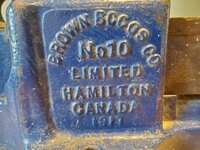
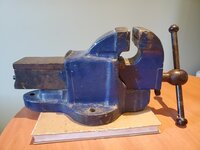
Here is a rare one. KMScott got a photo of one in Europe, #2341, 12/26/2021 in this thread. I bought this guy today. Brown Boggs Co Ltd of Hamilton, Canada. No 10. From 1917. This can have a quick release system but this one does not but still has the guide hole on the front plate for one.
Weight: 47 lbs
Jaw Width: 3-5/8"
Opening: 5-5/8"
Replaceable jaws.
No pipe jaws or anvil or swivel jaw.