To avoid these ads, REGISTER NOW!

Vise Info Thread

DCRUTT

Well-known member
Joined
Jul 28, 2012
Messages
47
Location
Rochester, NY
With regards to REED spindles and meatballs...
Which jaw sizes and/or models shared meatball sizes?
My first guess is that jaw size was the determining factor and each width regardless of model (Machinist/filers/coachmakers/combo) shared the same ones. Just a guess. If so, is the same true for shaft length and diameter? That one is a bit harder for me to guess.
I'm positive there are others in here that have many more REEDS in their collection that can clear this up for me.
Maybe someone has a CAD file of drawing the could share?
How about the same questions for the R-series hockey pucks?
Last question:
I read that the early R-series used meatball for a few years. Were they a bit longer in the neck to accommodate the split nut?
Thanks! -David
 
To avoid these ads, REGISTER NOW!

CRSINMICH

Well-known member
Joined
Aug 15, 2015
Messages
2,393
Location
Southeastern Michigan
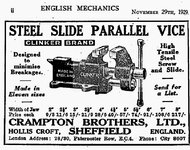
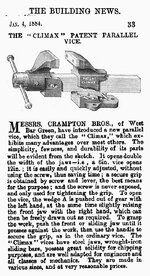
Post #94883 of the main vise thread was about a "Vyce of Extra Capacity" from Crampton Brothers Ltd. of Sheffield, England which was branded "CLIMAX".

Climax vices were introduced in January, 1884 by The Crapmpton Brothers. Notice their trademarks of Climax and Clinker in the 1919 ad.

1884 Compton Climax parallel vice.jpg
1919 Crampton ad Climax and Clincker brands.jpg

 
Last edited:

skmbabon

Well-known member
Joined
Nov 11, 2021
Messages
305
Location
Ottawa
Great eye, @twagler!
I attached the earliest evidence I have of Rae bench vises in a post just above, a 1917 catalog cut. The 1916 Canadian Trade Index (attached) does not list Rae under Bench vises, only drill press vises, and that is so far the earliest mention of the company doing any vise. Note that National Machinery & Supply is listed under "Bench Vises".
Can't rely entirely on directories though. Despite Rae bench vises appearing in the 1917 Wood, Alexander, James catalog, the 1920 Canadian Trade Index still only lists Rae under Drill Press vises.
All in all, the "16" stamp could very well be the date of production.
Rae and National clearly had some kind of relationship other than as straight-up competitors. The ghost lettering on Tom's vise adds to that assumption, and makes it a (so far) unique historical artifact. Some day, hopefully, I'll get to spend some time digging through archives in Hamilton and find some clear evidence of the nature of the relationship.
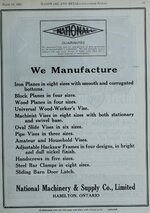
Another bit of info about National Machinery & Supply Co., Limited of Hamilton, Ontario.

This ad appeared on page 51 of the March 19, 1921 issue of Hardware and Metal. Looks like a thriving business, with over 20 vise models.
1921-03-19 Hardware and Metal p51 product line.jpg

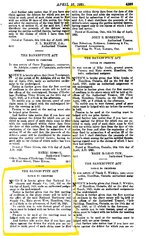
But all was not well, because less than a month later the company filed for bankruptcy.
1921-04-16 Canada Gazette Vol. LIV No42 p4389 bankruptcy.jpg

The reason is unknown as yet.

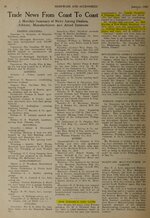
It resulted in at least two transitions. Announced in 1922, Rae Machine & Tool Works, Hamilton, took over National's vise and plane lines (and probably carpenters bar clamps as well). The Newell Manufacturing Co., Prescott, Ontario took over the hack saw frame line.
1922-01 Hardware and Accessories p28 Rae takes over Nationals vise and plane lines.jpg 1922-01 Hardware and Accessories p28 Newell takes over Nationals hack saw frames line.jpg

Using catalogues to date events can be tricky. Here are National vises appearing in two 1923 catalogues. Maybe the companies were selling stock they already had, maybe they were selling production from Rae but didn't change the art. Whatever the reason, these seem to be the closing scenes for the National Machinery and Supply Co., Limited.
1923 D Ackland_Son p134 oval slides GJ fierljeppen.jpg 1923 HS Howland Cat24 p156 National Machinists Amateur OvalSlide.jpg
 

skmbabon

Well-known member
Joined
Nov 11, 2021
Messages
305
Location
Ottawa
Way back in 2022 @va.grouseman, during a discussion about Canadian vises on the "Vises of GJ" thread, asked:

"What about Hercules, Maple Leaf, and Northern King, vises.---All Canadian.---Look like 1st and 2nd cousins to me. :dunno:"​

Since then it's been determined that Hercules was a house brand for the Canadian hardware retailer J. Pascal of Montreal. At least one vise, a utility model, is marked "Canada", however it's still not known who made it. The larger bench line was almost certainly by Bison in Poland.
Hercules vise and J. Pascal

Northern King turned out to be made by W. J. Henry's Craftools company in London, ON, as shown by the design of the base and markings underneath it. So far two, likely three models: No 0, No 2, and a 4" (would be a No 3). Note the No 0 has the typical Henry ribbed base but the only marking there is the size, neither "Craftools" or "London" appear.
My conjecture is that this line was made for Marshall-Wells stores, which used "Northern King" as a brand and operated in Western Canada where these vises are typically found.
Northern King vises

Maple Leaf remained a mystery - until now 😁 Check it out, @Mark Stansbury!
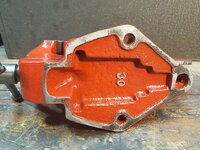
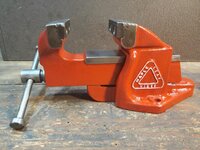
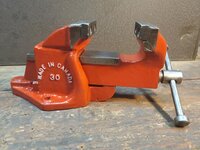
A bit of an oddball design for a Canadian made vise. @Dave600 thought it looked a bit like a Henry, but it has an angular base unlike Henrys, and no markings to tie it to Craftools. The triangular logo on the right side of the static jaw is distinctive, even when dirty or damaged, and so is the "MADE IN CANADA" arching highly over the model number on the left static. You see either of those along with the angled base, you can be confident it's a Maple Leaf vise. Here's a nice example posted by @FMC1959 in 2021.

MapleLeaf 30 GJPM Dave600 03.jpgMapleLeaf 30 GJPM Dave600 01.jpgMapleLeaf 30 GJPM Dave600 02.jpg

Easy-peasy, let's go vice hunting 🔭

I found numerous examples of Maple Leaf 5, 30, and 40 vises, but zero info.
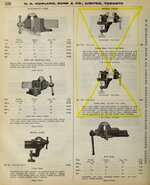
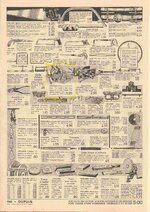
Finally a couple of years ago I found an image in a catalogue from a Montreal hardware firm, Dupuis. But still no origin info (by the way, the little woodworker's vise beside it is almost certainly a Smart's No 88).
1948 S Dupuis Freres p110 vises Bench likely ML.jpg

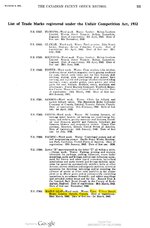
The search continued, fruitlessly, until I searched again for info about another vise, and happened to find the key, from 1943.
1943 Maple Leaf word mark registration for vises.jpg

Another vise from the prolific WJ Henry, London, Ontario 🏭

The Canadian Trade Index lists the brands used by Canadian manufacturers. The Craftools entries for 1945 and 1949 do not include Maple Leaf. I don't have other years. The Canada Gazette is so far the only place I've seen the name used. Given the vise was likely sold by Dupuis (only have the one catalogue) and they appear for sale fairly often, I'm assuming this was an OEM line for Henry, meant to avoid competition with the main Henry and Bull Dog lines, but be more affordable than store branding as seems to have been done with the Northern King brand.

Of course, tomorrow another revealing piece of information could turn up... 🛤️
 
Last edited:

Burkmerica

Member
Joined
Aug 31, 2025
Messages
6
Dunlap 5230. 3-1/2" jaws that opens to 4-1/2" Weights 17lbs. Missing the Metal Former pins and Dies.

Quote from A GJ Member. Thanks for the info.

The Dunlap 5230 vise was part of the Sears Dunlap Metal Forming Tool No. 9-05230. It was the Sears version of the Swayne Robinson Metl Former.

The MetlFormer used multiple variations of the vise. The final one had a hole in the anvil to fit a drill press attachment - total of seven holes, here and there.

The real mystery is who made the Metl Former and 5230 and Dunlap 5344 vises - Swayne Robinson or someone else?
I am looking for these types of parts for Swayne Robinson Metl-Former Vise 5230 if you come accost any please let me know. Can be with or without the vice.
 

KMScott

Well-known member
Joined
Feb 14, 2012
Messages
4,632
Location
Daufuskie Island, South Carolina
Charles Gatchels Patent 1891. This one is interesting. Owner did not provide spec:s.

Quote from the owner.

This appears to be the only known example ever made ? According to my research this tool apparently did not go into production Charles M Gatchell was in aspiring inventor in the late 1800s who came up with something completely different. There are some slight similarities in concept to the Stephan’s bench vise utilizing a cam action and also quick adjustment capabilities. Aside from that , this vise is completely different concept than anything done up to that point in time that I’m aware of . All of the hardware and parts being of custom cast iron, with the exception of 1 single piece of hard maple portion of the dynamic jaw , in this odd particular case being made out of hard maple! There is a cast rack mechanism bolted the underside of the maple dynamic providing a very smooth in and out action when you push down the locking mechanism.
Everything is Cast iron with the exception as part of the dynamic being of Maple hardwood . The only issues I am aware of is, there is a slight chip On the corner retaining mechanism shown in the pictures that does not affect its function at all . There is no Spring in the cam pawl locking mechanism , I’m not sure if that’s broken ,
 

Attachments

  • IMG_3039.jpeg
    IMG_3039.jpeg
    4.1 MB · Views: 12
  • IMG_3038.jpeg
    IMG_3038.jpeg
    4.3 MB · Views: 8
  • IMG_3037.jpeg
    IMG_3037.jpeg
    3.9 MB · Views: 8
  • IMG_3034.jpeg
    IMG_3034.jpeg
    2.6 MB · Views: 9
  • IMG_3033.jpeg
    IMG_3033.jpeg
    3.5 MB · Views: 7
  • IMG_3032.jpeg
    IMG_3032.jpeg
    2.7 MB · Views: 9
  • IMG_3031.jpeg
    IMG_3031.jpeg
    3.5 MB · Views: 9
  • IMG_3041.jpeg
    IMG_3041.jpeg
    384.7 KB · Views: 10

KMScott

Well-known member
Joined
Feb 14, 2012
Messages
4,632
Location
Daufuskie Island, South Carolina
New Britain Machine Co. 4” jaws that opens to 4-5/8 and weights 40 lbs. This one was repaired.
 

Attachments

  • IMG_3042.jpeg
    IMG_3042.jpeg
    2.1 MB · Views: 8
  • IMG_3043.jpeg
    IMG_3043.jpeg
    2.4 MB · Views: 8
  • IMG_3044.jpeg
    IMG_3044.jpeg
    1.7 MB · Views: 7
  • IMG_3045.jpeg
    IMG_3045.jpeg
    1.6 MB · Views: 9
  • IMG_3046.jpeg
    IMG_3046.jpeg
    2.4 MB · Views: 7
  • IMG_3047.jpeg
    IMG_3047.jpeg
    1.6 MB · Views: 6
Last edited:

RTM

Well-known member
Joined
May 13, 2019
Messages
13,061
Location
SF Bay Area
Charles Gatchels Patent 1891. This one is interesting. Owner did not provide spec:s.

Quote from the owner.

This appears to be the only known example ever made ? According to my research this tool apparently did not go into production Charles M Gatchell was in aspiring inventor in the late 1800s who came up with something completely different.
Well, I was guessing patent model, but the patent says no model provided

1756777318596.png


Good news is, DATAMP has some of those exact same pictures, so not a complete loss.

If the perspective isn't totally blown in the second to last picture, it looks like the jaws are 2-3/4" wide. And looking at the size of the rack on the bottom, its got quite the opening capacity. Looks like it measures about 7" from the handle to the jaw (same pic), and the overall is 23" (4th from last), so somewhere a less than 16" of travel, maybe 9 to 10", scaling the jaw to the amount of slide hanging out the rear (last pic) could give 12" (again, perspective could lie.


DATAMP" also lists the canadian patent CA35511 (approved 2/1/1890), which shows different drawings than the US ones. Google only has the name there, no pix.

Gatchell held several other patents.
 
Last edited:

PghJKB

Well-known member
Joined
Oct 13, 2012
Messages
486
Location
Industrial Heartland
Charles Gatchels Patent 1891. This one is interesting. Owner did not provide spec:s.

Quote from the owner.

This appears to be the only known example ever made ? According to my research this tool apparently did not go into production Charles M Gatchell was in aspiring inventor in the late 1800s who came up with something completely different. There are some slight similarities in concept to the Stephan’s bench vise utilizing a cam action and also quick adjustment capabilities. Aside from that , this vise is completely different concept than anything done up to that point in time that I’m aware of . All of the hardware and parts being of custom cast iron, with the exception of 1 single piece of hard maple portion of the dynamic jaw , in this odd particular case being made out of hard maple! There is a cast rack mechanism bolted the underside of the maple dynamic providing a very smooth in and out action when you push down the locking mechanism.
Everything is Cast iron with the exception as part of the dynamic being of Maple hardwood . The only issues I am aware of is, there is a slight chip On the corner retaining mechanism shown in the pictures that does not affect its function at all . There is no Spring in the cam pawl locking mechanism , I’m not sure if that’s broken ,


A real quick history of patent models:
US patent models were discontinued in 1880 when the requirement to submit them was dropped by the U.S. Patent Office, though Congress had already abolished the legal requirement in 1870. While the mandate ended in 1880, inventors continued to submit models for some time afterward.

Key Dates & Events

1790: The U.S. Patent Office began requiring inventors to submit working scale models with their patent applications.
1836 & 1877: Major fires at the Patent Office destroyed a significant portion of the collected models.
1870: Congress removed the legal requirement for submitting patent models.
1880: The U.S. Patent Office stopped requesting the submission of models.
1908-1926: The remaining models were largely disposed of by Congress, with some transferred to the Smithsonian Institution and others sold off.

My belief is that all legitimate inventors would produce at least one Proof Of Concept (POC) model to verify the legitimacy of their invention.

JKB
 

micahd1997

Well-known member
Joined
Apr 27, 2022
Messages
237
For any fellow Parker vise enthusiasts out there:

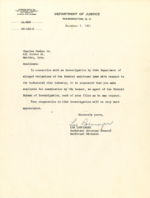
I've recently been working with the Meriden Historical Society to locate and scan any documents that they have on hand relating to the Charles Parker Company. Among those documents (all of which will eventually be publicized) is this very interesting letter written by the Department of Justice with a request for the Charles Parker Co. to cooperate with an ongoing investigation into the company regarding "alleged violations of the federal antitrust laws with respect to the industrial vise industry". There isn't any accompanying detail to explain how exactly the Charles Parker Co. had violated the antitrust laws (which deal with the illegalization of monopolies in various industries), but hopefully these details surface.
 

Attachments

  • 1756823744726.png
    1756823744726.png
    570 KB · Views: 7

skmbabon

Well-known member
Joined
Nov 11, 2021
Messages
305
Location
Ottawa
For any fellow Parker vise enthusiasts out there:

I've recently been working with the Meriden Historical Society to locate and scan any documents that they have on hand relating to the Charles Parker Company. Among those documents (all of which will eventually be publicized) is this very interesting letter written by the Department of Justice with a request for the Charles Parker Co. to cooperate with an ongoing investigation into the company regarding "alleged violations of the federal antitrust laws with respect to the industrial vise industry". There isn't any accompanying detail to explain how exactly the Charles Parker Co. had violated the antitrust laws (which deal with the illegalization of monopolies in various industries), but hopefully these details surface.
Very intriguing @micahd1997. As the number of unspotted and unidentified vise models drops through the efforts of people here and elsewhere, the remaining puzzles will be about the vise industry, the firms in it, and how they interacted. Looking forward to what you find.
 

micahd1997

Well-known member
Joined
Apr 27, 2022
Messages
237
Very intriguing @micahd1997. As the number of unspotted and unidentified vise models drops through the efforts of people here and elsewhere, the remaining puzzles will be about the vise industry, the firms in it, and how they interacted. Looking forward to what you find.
Thank you for that, SK, and I really like how you put that. Pretty amazing how many puzzles have been answered even just here on GJ since its inception. I certainly hope to continue in those same footsteps. Looking forward to sharing more!
 

CRSINMICH

Well-known member
Joined
Aug 15, 2015
Messages
2,393
Location
Southeastern Michigan
PETER BROADBOOKS' VISES
Mr. Broadbooks came to the United States from Alsace, France in 1854 as a fourteen year-old. He showed great mechanical ability and eventually became head of Batavia Iron Company. By 1920, he had over 49 U.S. patents with 7 patents in Great Britain, France and Canada. Most of his patents were for things like nippers, cutters, pliers, and farrier related items but many were for vises or were vise related. (One was for arch supports for shoes, but that's another story.)

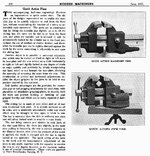
This cut from a 1907 edition of Modern Machinery shows two vises - a Quick Acting Machinists vise and a Quick Acting Pipe vise. They were based on two of his patents, #85491 and #85397, both of which were granted on April 23, 1907.

1907 Broadbooks Quick Action vises item.jpg
1907 Patents for vises in Modern Macinery item.jpg
 
Last edited:

KMScott

Well-known member
Joined
Feb 14, 2012
Messages
4,632
Location
Daufuskie Island, South Carolina
Fulton 12-1/2. 5-1/2” jaws that opens to 8-9/16 and weights 104 lbs.
 

Attachments

  • IMG_7810.jpeg
    IMG_7810.jpeg
    1.4 MB · Views: 2
  • IMG_7811.jpeg
    IMG_7811.jpeg
    1.2 MB · Views: 2
  • IMG_7812.jpeg
    IMG_7812.jpeg
    1.7 MB · Views: 2
  • IMG_7813.jpeg
    IMG_7813.jpeg
    1.1 MB · Views: 2
  • IMG_7814.jpeg
    IMG_7814.jpeg
    1.4 MB · Views: 2
  • IMG_7815.jpeg
    IMG_7815.jpeg
    1.8 MB · Views: 2
  • IMG_7816.jpeg
    IMG_7816.jpeg
    1,014.2 KB · Views: 2
  • IMG_7817.jpeg
    IMG_7817.jpeg
    1.3 MB · Views: 2
  • IMG_7818.png
    IMG_7818.png
    1.5 MB · Views: 3
Last edited:
To avoid these ads, REGISTER NOW!

micahd1997

Well-known member
Joined
Apr 27, 2022
Messages
237
Fulton 12-1/2. 5-1/2” jaws that opens to 8-9/16 and weights 104 lbs.
Boy that’s in great condition. It’s the spittin’ image of Prentiss’ Bull Dog № 55. Edwin Fulton (the vise’s namesake) worked for Bagley & Sewall in Watertown for 6 years before breaking off and starting the Fulton Machine & Vise Co only 25 miles away in Lowville around 1905. I’d love to know why he left and whether any connection remained between the two companies, but I personally suspect Fulton was one of those “unscrupulous manufacturers” that Prentiss mentions in their 1902 catalog who had been copying their vises
 

Attachments

  • 07C21946-4033-49AA-BE5C-F888C1FB89A8.jpeg
    07C21946-4033-49AA-BE5C-F888C1FB89A8.jpeg
    442.4 KB · Views: 3
  • 199FCDF1-7B7A-4A91-BF1B-A3EF0F23ED08.jpeg
    199FCDF1-7B7A-4A91-BF1B-A3EF0F23ED08.jpeg
    416.6 KB · Views: 3

KMScott

Well-known member
Joined
Feb 14, 2012
Messages
4,632
Location
Daufuskie Island, South Carolina
Micah, when do you think Prentiss started supplying their vises with replaceable jaws? I want to mention that all their jaws were the same meaning as an example one 4” vise had the same dimensions as another Prentiss model. Made it easy for me when I was producing jaws for customers. Thanks for your attachments. My mothers family was from Watertown, I buried both of my parents in Watertown in 2019.
 

micahd1997

Well-known member
Joined
Apr 27, 2022
Messages
237
Micah, when do you think Prentiss started supplying their vises with replaceable jaws? I want to mention that all their jaws were the same meaning as an example one 4” vise had the same dimensions as another Prentiss model. Made it easy for me when I was producing jaws for customers. Thanks for your attachments. My mothers family was from Watertown, I buried both of my parents in Watertown in 2019.
Thank you for that info, Kevin! I really enjoy hearing about those kinds of discoveries that can only be identified by handling a lot of the same vises. You've probably handled more than I ever will, and all as a skilled machinist with a tuned eye and appreciation for those smaller details that most people wouldn't notice. That's really neat that your mother's family was from Watertown! I'm sure with only a little bit of digging I could find a handful of mentions of them in the newspapers from that time. They're buried in a place rich with American history.

The closest timeline that I've been able to hone in on for when Prentiss actually began supplying their vises with replaceable jaws is in 1910. A few notes on that front.

1) Charles Darwin Bingham filed his patent for replaceable jaws on December 14, 1910, but it wasn't actually patented until about 6 months later on June 6, 1911 (see patent pictures attached...a very interesting read, to be honest).

2) A mutual friend and very knowledgeable group member recently shared a page from 1910 Channon Company catalog #50 with me that advertises Prentiss vises and announces that "one of the latest improvements in their manufacture is the replaceable jaw faces...". Setting aside the elephant in the room that the jaw faces depicted are Parker-style (I personally chalk this up to incorrect advertising on Channon's part given Prentiss' own advertisements in their own catalogs and because I have yet to see a Prentiss with Parker-style jaws), this seems to indicate that Prentiss' replaceable jaws were already in circulation by 1910 (even though they weren't officially patented yet).

3) It's not well-known, but Prentiss published the first version of their catalog 49 in 1906 while their headquarters were at 44 Barclay. However, upon re-locating their sales office to 106-110 Lafayette St in late 1910 and the introduction of replaceable jaws (among other various non-patented design changes to their vises), they re-issued catalog 49 in 1910. I've attached a page from the 1906 version and the 1910 version for quick comparison.

All that to say, everything I've seen tells me that Prentiss began manufacturing their vises with replaceable jaws in probably late-1910. Probably more than you bargained for, but I nerd out about those kinds of details.
 

Attachments

  • 1911-06-06 - Bingham Replaceable Jaw Patent Page 1.png
    1911-06-06 - Bingham Replaceable Jaw Patent Page 1.png
    69.6 KB · Views: 3
  • 1911-06-06 - Bingham Replaceable Jaw Patent Page 2.png
    1911-06-06 - Bingham Replaceable Jaw Patent Page 2.png
    188.1 KB · Views: 2
  • 1911-06-06 - Bingham Replaceable Jaw Patent Page 3.png
    1911-06-06 - Bingham Replaceable Jaw Patent Page 3.png
    197.3 KB · Views: 2
  • 1911-06-06 - Bingham Replaceable Jaw Patent Page 4.png
    1911-06-06 - Bingham Replaceable Jaw Patent Page 4.png
    42.8 KB · Views: 3
  • 1910-00-00 - Channon Company Catalog 50 Showing New Prentiss Replaceable Jaw Faces.png
    1910-00-00 - Channon Company Catalog 50 Showing New Prentiss Replaceable Jaw Faces.png
    322 KB · Views: 3
  • 1910-00-00 - Page from Prentiss Vise Catalog 49 - LAFAYETTE.png
    1910-00-00 - Page from Prentiss Vise Catalog 49 - LAFAYETTE.png
    615.9 KB · Views: 3
  • 1906-00-00 - Page from Prentiss Vise Catalog 49 - BARCLAY.png
    1906-00-00 - Page from Prentiss Vise Catalog 49 - BARCLAY.png
    569.5 KB · Views: 4
Last edited:

micahd1997

Well-known member
Joined
Apr 27, 2022
Messages
237

A bit more information about Prentiss' Detachable Jaw Faces
From a 1920 Prentiss catalog

1922 Prentiss Detachable Steel Jaw Faces.jpg
That’s a great excerpt, CRS, thanks for sharing! I don’t recall ever seeing any Prentiss vises with the unhardened, adapted jaws that Prentiss mentions, but I would imagine most of that adaptation would’ve been done by the buyer rather than at the factory
 

KMScott

Well-known member
Joined
Feb 14, 2012
Messages
4,632
Location
Daufuskie Island, South Carolina
I believe the jaws the article is talking about are the replaceable jaws them self. You could possibly buy soft jaws and adapt them to a specific project. The pics are misleading to me.

I have always wondered what material they made the hard jaws out of. Back then Carpenter Toolsteel was the choice used. But the oil and water quench always twisted the steel. I’m in Idaho for my grandsons wedding and don’t have my Carpenter book handy. Toolsteel we use now for jaws are air quenched with NO twisting like the water and oil quench. In 1970 Carpenter came out with air hardening Toolsteel called Vega (A6) but what they used in the early 1900’s is a good question I have.

Thanks guys for these wonderful posts.
 

KMScott

Well-known member
Joined
Feb 14, 2012
Messages
4,632
Location
Daufuskie Island, South Carolina
Massey #32. 4-1/2” jaws that opens to 5-1/2 and weights 44lbs on this stationary vise.

I’m in Chicago visiting Nick Carava, it is incredible how many quality vises for sale up here. Enjoyed my visit with the Wilton king.
 

Attachments

  • IMG_3082.jpeg
    IMG_3082.jpeg
    1.1 MB · Views: 14
  • IMG_3080.jpeg
    IMG_3080.jpeg
    1.2 MB · Views: 7
  • IMG_3081.jpeg
    IMG_3081.jpeg
    1.1 MB · Views: 9
  • IMG_3079.jpeg
    IMG_3079.jpeg
    995.8 KB · Views: 9

CRSINMICH

Well-known member
Joined
Aug 15, 2015
Messages
2,393
Location
Southeastern Michigan
MORE CURIOUS VISE FACTOIDS
Member SkyPuncher posted about his Columbian 1241/2 on the main vise thread (post #95089 and #95090). While looking for more information
about it, this chart from a 1959 Shapleigh Hardware catalog came up. (It looks like the chart itself was a reprint from 3-25-53). Columbian's Body Makers vise was 124
1/2 and so was Reed's. On closer inspection, that wasn't a fluke.

1959 Vise reference chart.jpg
 
Last edited:

BTL-A4

Well-known member
Joined
Feb 28, 2018
Messages
1,251
Location
Santa Clarita
Columbian 4500 (Columbian-Wilton 4500, per some internet searching). Not cast-in-USA as far as I can tell. I didn't see this in the spreadsheet under Columbian. It was "painted" with gray paint. I cleaned it up and put it to use. It has reversible jaws so it opens really wide. I just liked the color I painted it.
 

Attachments

  • PA030016.JPG
    PA030016.JPG
    600.7 KB · Views: 7
  • PA030017.JPG
    PA030017.JPG
    534.6 KB · Views: 8
Last edited:

KMScott

Well-known member
Joined
Feb 14, 2012
Messages
4,632
Location
Daufuskie Island, South Carolina
Columbian 4500 (Columbian-Wilton 4500, per some internet searching). Not cast-in-USA as far as I can tell. I didn't see this in the spreadsheet under Columbian. It was "painted" with gray paint. I cleaned it up and put it to use. It has reversible jaws so it opens really wide. I just liked the color I painted it.
BTL. When you get a chance can you give me the jaw width, weight and max opening. The max opening is measured by closing the vise and measuring the square slide extending out the back of the vise. Vises should not be opened where the slide end is inside the Static jaw support. Thanks for sharing your vise.

Oops, CRS beat me to it. Thank you CRS.
 

KMScott

Well-known member
Joined
Feb 14, 2012
Messages
4,632
Location
Daufuskie Island, South Carolina
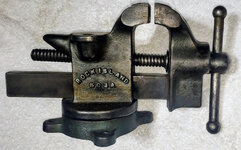
Rock Island 503A. 3” jaws that opens to 3-1/2” and weights 14lbs.
 

Attachments

  • IMG_3102.jpeg
    IMG_3102.jpeg
    610.5 KB · Views: 3
  • IMG_3103.jpeg
    IMG_3103.jpeg
    1.5 MB · Views: 4
  • IMG_3105.jpeg
    IMG_3105.jpeg
    2.3 MB · Views: 2
  • IMG_3106.jpeg
    IMG_3106.jpeg
    604.5 KB · Views: 2
  • IMG_3107.jpeg
    IMG_3107.jpeg
    1.4 MB · Views: 2

KMScott

Well-known member
Joined
Feb 14, 2012
Messages
4,632
Location
Daufuskie Island, South Carolina
Rock Island 504A. 4” jaws that weights 17lbs
 

Attachments

  • IMG_3113.jpeg
    IMG_3113.jpeg
    1.9 MB · Views: 4
  • IMG_3114.jpeg
    IMG_3114.jpeg
    2 MB · Views: 4
  • IMG_3115.jpeg
    IMG_3115.jpeg
    2 MB · Views: 2
  • IMG_3116.jpeg
    IMG_3116.jpeg
    2.5 MB · Views: 2
  • IMG_3117.jpeg
    IMG_3117.jpeg
    539 KB · Views: 2
  • IMG_3118.jpeg
    IMG_3118.jpeg
    1.4 MB · Views: 3
To avoid these ads, REGISTER NOW!
Top Bottom