I think it's very difficult to tie any of this down precisely as to a specific year. If I recall, the rationing of the metals used in consumer tools was specifically 1942-45. From what I understand, the "D-I" (Duro-Indestro) are almost certainly from that period. But that doesn't mean that existing stock/blanks/dies were not used also, perhaps finished differently. I'm sure raw materials on hand purchased prior to the rationing was not simply thrown away, and there would have been no violation of the rationing because it had already been purchased before the restrictions came into effect. Nor would the switching over to new wartime tooling be spontaneous. I suspect that 1941-42 still saw 'pre-war' production pieces--even though they are pre-war in design and materials, wouldn't they be technically considered 'wartime' production?
With the knurling, I've seen D-I examples that also have the cross-hatch knurling as well as the straight--I sold a set of 1/2" drive deepwells last year with both knurling styles that, based on the source, I know were all originally purchased together. In studying AA photos and what I've seen personally, it looks as though the straight knurling was introduced sometime in the mid-late 1930s, mostly on Indestro branded, but sometimes on Duro as well. There's even evidence that a single Duro set from that time may have had mixed cross-hatch and straight in it. Certainly the D-I deepwell set I mentioned had both.
Which brings me to what I call the schizophrenic approach at Duro in general. Heaven knows what these boys were doing at any given time! I'm still pondering an unbranded set of 3/8" & 1/2" hex drive sockets with bars, ells, and ratchet. They're identical to what AA calls the first examples of contract tools made by S-K for another company in the early 1930s, but are also identical to Duro-marked tools made during that same period, and according to the available info, neither were making contract pieces for the other. Did one counterfeit the others' work? After all, they were both in Chicago, so maybe there was contract work being done between them that no one has documented yet. Who the heck knows?

If we're talking war-time 'style' which is probably a more practical approach, the D-I marked are definitely in that category. Sockets of the previous design but with war-time finishes may also fall under that category.
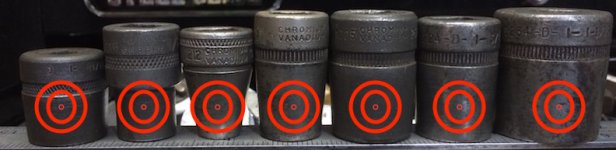
As for the photo, it's hard for me to opine with confidence without having them in person. But I lean somewhat toward twertsy's interpretation. I've not seen a true 'black-oxide' finish on a D-I socket, but I've seen plain steel dark enough to think that. Some of this WW2 stuff had micro-thin cadmium finishes that wore off just by looking at them. The last two look like they might have chrome on them, but again, I can't be sure just on the photo. Based on what I can see:
--first two cross-hatch are early wartime 1942ish, perhaps existing stock that hadn't been branded yet
--3rd definitely falls under "one of these things doesn't go with the others"
--4th and 5th having C-V marks but with straight knurling,and can't see the maker-s mark on them--either 1941-42 or earlier, particularly if that's chrome on #4....OR....for a period of time, Duro used their old marking tooling during early rationing and didn't care if they really weren't C-V. Wouldn't put it past this company.
--6th & 7th, definitely wartime style, but if that's traces of chrome on them, probably immediate post-war still using 1942-45 tooling.
Best
practical conclusion for me going on style alone: mixed set that were not purchased together at one time, but pieced together
-- #1 #2 #6 #7=1942-45 wartime.
--#3=pre-war
--#4 #5=late 1930s to 1941

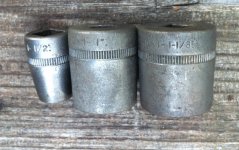


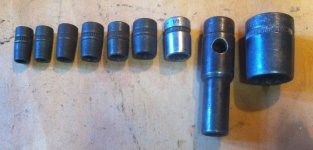
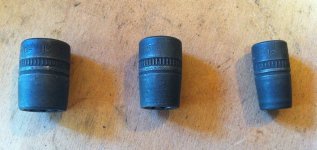


 I'm happy just to get a close thumbnail with those boys.