To avoid these ads, REGISTER NOW!

Want To Take A Crack At Identifying Another Socket? Stumped.

Jp267

Well-known member
Joined
Aug 6, 2017
Messages
427
Location
New England
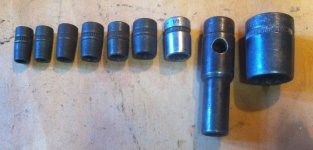
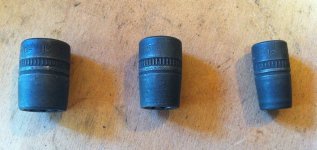
So after finding a couple of SR sockets in a box of sockets I bought from someone. I ran into another one off that has me stumped. The making almost looks like a B or D with a line though it and two II. Never saw one before. No country of origin and it's quite worn sorry I tried to capture it in a pic as best as possible.

Maybe someone knows what it is. I have no idea. There was only a single 5/8.

Thanks again everyone!

View media item 73946
View media item 73947
 
To avoid these ads, REGISTER NOW!

d42jeep

Well-known member
Joined
Oct 22, 2014
Messages
16,554
Location
Northern California
How about D-I? Is it a 3/8" drive socket? Duro made D-I sockets during WW2. Here are some 1/2" drive examples.
-Don
 

Attachments

  • IMG_5268.jpg
    IMG_5268.jpg
    148.4 KB · Views: 27
  • IMG_2873.jpg
    IMG_2873.jpg
    149 KB · Views: 34
Last edited:
OP
J

Jp267

Well-known member
Joined
Aug 6, 2017
Messages
427
Location
New England
How about D-I? Is it a 3/8" drive socket? Duro made D-I sockets during WW2. Here are some 1/2" drive examples.
-Don
Yes that's it! 3/8 drive indeed. Thank you thank you thank you![emoji2]

Sent from my XT1635-02 using Tapatalk
 

d42jeep

Well-known member
Joined
Oct 22, 2014
Messages
16,554
Location
Northern California
You are very welcome. Those of us who collect WW2 tools are very familiar with the brand as they are verified to have been originally supplied in WW2 toolsets. Here are some more 3/8" drive examples and my complete 1/2" drive set.
-Don
 

Attachments

  • IMG_5309.JPG
    IMG_5309.JPG
    80.8 KB · Views: 30
  • IMG_5315.JPG
    IMG_5315.JPG
    64.2 KB · Views: 29
OP
J

Jp267

Well-known member
Joined
Aug 6, 2017
Messages
427
Location
New England
You are very welcome. Those of us who collect WW2 tools are very familiar with the brand as they are verified to have been originally supplied in WW2 toolsets. Here are some more 3/8" drive examples and my complete 1/2" drive set.
-Don
Very cool, Don! Learning so much here! I had never seen that brand before. I was completely stumped and the logo was so worn it was tough to Google. Thanks again!

Sent from my XT1635-02 using Tapatalk
 

twertsy

Well-known member
Joined
Jan 5, 2014
Messages
6,726
Location
Reedville, VA
You are very welcome. Those of us who collect WW2 tools are very familiar with the brand as they are verified to have been originally supplied in WW2 toolsets. Here are some more 3/8" drive examples and my complete 1/2" drive set.
-Don

Curious about the cross-hatch knurled example.........thought they were pre-war.
 

Username already in use

Well-known member
Joined
Sep 4, 2015
Messages
2,177
Location
Ohio
Curious about the cross-hatch knurled example.........thought they were pre-war.

I think they're hold-over/transition pieces. They're out there...
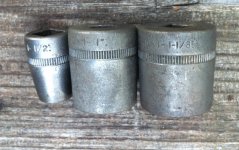
Far left example is a 3/8" D-I socket. The rest are 1/2"

attachment.php
 

Attachments

  • D-I examples.jpg
    D-I examples.jpg
    44.1 KB · Views: 217

twertsy

Well-known member
Joined
Jan 5, 2014
Messages
6,726
Location
Reedville, VA
I think they're hold-over/transition pieces. They're out there...
Far left example is a 3/8" D-I socket. The rest are 1/2"

attachment.php

Were I dating the ones in your picture, I'd say that the first 2 (left to right) are earlier, the third is post war, and the rest are correct.

Edit: 4 and 5 are also questionable and likely post-war.
 

Username already in use

Well-known member
Joined
Sep 4, 2015
Messages
2,177
Location
Ohio
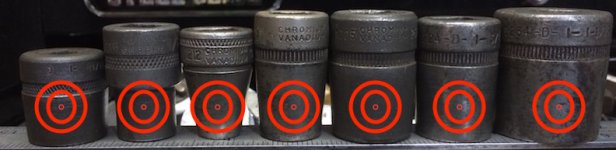
Hmmm. That's not how I look at them. Of course, who really knows, but 1,2,5 are all black oxide, and so, likely wartime.
1 and 2 are probably early wartime based on the socket knurling style.
3 is the pre-war style and chrome, so probably pre-war.
4 is the post war style and chrome... so... post war.
6 and 7 are plain finish, or the finish has worn off and are wartime.
 
To avoid these ads, REGISTER NOW!

DadsTools

Well-known member
Joined
Jul 27, 2017
Messages
1,852
I think it's very difficult to tie any of this down precisely as to a specific year. If I recall, the rationing of the metals used in consumer tools was specifically 1942-45. From what I understand, the "D-I" (Duro-Indestro) are almost certainly from that period. But that doesn't mean that existing stock/blanks/dies were not used also, perhaps finished differently. I'm sure raw materials on hand purchased prior to the rationing was not simply thrown away, and there would have been no violation of the rationing because it had already been purchased before the restrictions came into effect. Nor would the switching over to new wartime tooling be spontaneous. I suspect that 1941-42 still saw 'pre-war' production pieces--even though they are pre-war in design and materials, wouldn't they be technically considered 'wartime' production?

With the knurling, I've seen D-I examples that also have the cross-hatch knurling as well as the straight--I sold a set of 1/2" drive deepwells last year with both knurling styles that, based on the source, I know were all originally purchased together. In studying AA photos and what I've seen personally, it looks as though the straight knurling was introduced sometime in the mid-late 1930s, mostly on Indestro branded, but sometimes on Duro as well. There's even evidence that a single Duro set from that time may have had mixed cross-hatch and straight in it. Certainly the D-I deepwell set I mentioned had both.

Which brings me to what I call the schizophrenic approach at Duro in general. Heaven knows what these boys were doing at any given time! I'm still pondering an unbranded set of 3/8" & 1/2" hex drive sockets with bars, ells, and ratchet. They're identical to what AA calls the first examples of contract tools made by S-K for another company in the early 1930s, but are also identical to Duro-marked tools made during that same period, and according to the available info, neither were making contract pieces for the other. Did one counterfeit the others' work? After all, they were both in Chicago, so maybe there was contract work being done between them that no one has documented yet. Who the heck knows?:dunno:

If we're talking war-time 'style' which is probably a more practical approach, the D-I marked are definitely in that category. Sockets of the previous design but with war-time finishes may also fall under that category.

As for the photo, it's hard for me to opine with confidence without having them in person. But I lean somewhat toward twertsy's interpretation. I've not seen a true 'black-oxide' finish on a D-I socket, but I've seen plain steel dark enough to think that. Some of this WW2 stuff had micro-thin cadmium finishes that wore off just by looking at them. The last two look like they might have chrome on them, but again, I can't be sure just on the photo. Based on what I can see:

--first two cross-hatch are early wartime 1942ish, perhaps existing stock that hadn't been branded yet
--3rd definitely falls under "one of these things doesn't go with the others"
--4th and 5th having C-V marks but with straight knurling,and can't see the maker-s mark on them--either 1941-42 or earlier, particularly if that's chrome on #4....OR....for a period of time, Duro used their old marking tooling during early rationing and didn't care if they really weren't C-V. Wouldn't put it past this company.
--6th & 7th, definitely wartime style, but if that's traces of chrome on them, probably immediate post-war still using 1942-45 tooling.

Best practical conclusion for me going on style alone: mixed set that were not purchased together at one time, but pieced together
-- #1 #2 #6 #7=1942-45 wartime.
--#3=pre-war
--#4 #5=late 1930s to 1941
 

Username already in use

Well-known member
Joined
Sep 4, 2015
Messages
2,177
Location
Ohio
Best practical conclusion for me going on style alone: mixed set that were not purchased together at one time, but pieced together
-- #1 #2 #6 #7=1942-45 wartime.
--#3=pre-war
--#4 #5=late 1930s to 1941

Sorry if I wasn't clear when I posted the image. These are not a 'set' that was acquired together, but collected examples that I grouped to show the variation of production differences across the Duro - Indestro lines of the times.

I can assure you that the last 2 examples in the image (6 and 7) are a plain finish, or the layer of cadmium plating has been lost over the years. Though, I do have some chrome plated examples in my collection as well, which certainly date to after the restrictions of alloys were lifted very late in the war.

It's my understanding that the change from the *** to the ||| knurling was made during the early 40's (wartime) and so, mixed [knurled] sets may have shown up during that time, no doubt. Post war, Duro and Indestro were only making the ||| knurled sockets.

As an aside, I've collected more wartime D-I sockets than I care to admit... and so, I would re-iterate my own opinion..
:beer2:

1,2,5 are all black oxide, and so, likely wartime.
1 and 2 are probably early wartime based on the socket knurling style.
3 is the pre-war style and chrome, so probably pre-war.
4 is the post war style and chrome... so... post war.
6 and 7 are plain finish, or the finish has worn off and are wartime.
 

twertsy

Well-known member
Joined
Jan 5, 2014
Messages
6,726
Location
Reedville, VA
Sorry if I wasn't clear when I posted the image. These are not a 'set' that was acquired together, but collected examples that I grouped to show the variation of production differences across the Duro - Indestro lines of the times.

I can assure you that the last 2 examples in the image (6 and 7) are a plain finish, or the layer of cadmium plating has been lost over the years. Though, I do have some chrome plated examples in my collection as well, which certainly date to after the restrictions of alloys were lifted very late in the war.

It's my understanding that the change from the *** to the ||| knurling was made during the early 40's (wartime) and so, mixed [knurled] sets may have shown up during that time, no doubt. Post war, Duro and Indestro were only making the ||| knurled sockets.

As an aside, I've collected more wartime D-I sockets than I care to admit... and so, I would re-iterate my own opinion..
:beer2:

So we all pretty much agree, except for #5....I'd only hesitate on that one.
 

Username already in use

Well-known member
Joined
Sep 4, 2015
Messages
2,177
Location
Ohio
So we all pretty much agree, except for #5....I'd only hesitate on that one.

Pretty much, yes, #5 is definitely an oddball.

The last two look like they might have chrome on them, but again, I can't be sure just on the photo.
Actually, I think you're right. Good eyes! This was an old pic that I dug up for this discussion, but yes, going back to look at the actual sockets in the pic, I believe the last 2 (6,7) do have a thin chrome plating to them. So, late war/post alloy restriction, or left over contract production makes the most sense.
:beer:
 

d42jeep

Well-known member
Joined
Oct 22, 2014
Messages
16,554
Location
Northern California
It's barely possible that I have collected even more D-I sockets than Username and have many examples of dark finish sockets as well as very strange chrome plated ones. I guess that D-I branding must have started before the metal restrictions were fully in place.
-Don
 

Attachments

  • IMG_5316.JPG
    IMG_5316.JPG
    22 KB · Views: 11
  • IMG_5317.JPG
    IMG_5317.JPG
    118.5 KB · Views: 12
  • IMG_5318.jpg
    IMG_5318.jpg
    142.2 KB · Views: 15
  • IMG_5323.JPG
    IMG_5323.JPG
    80.5 KB · Views: 13
  • IMG_5324.JPG
    IMG_5324.JPG
    90.4 KB · Views: 11
  • IMG_5326.JPG
    IMG_5326.JPG
    114.9 KB · Views: 1
  • IMG_5332.jpg
    IMG_5332.jpg
    129 KB · Views: 1
Last edited:

DadsTools

Well-known member
Joined
Jul 27, 2017
Messages
1,852
From everything I've seen, right down to the odd relationship between the two companies, Duro-Indestro was a schizophrenic entity from its very beginnings. :eyecrazy: I'm happy just to get a close thumbnail with those boys.
 

Private Lugnutz

Well-known member
Joined
Mar 30, 2012
Messages
30,605
Location
The Authentic Jersey Shore
Oh boy! What fun! It's a shooting gallery! :lol:

FWIW, I agree with the collective analysis, just a few notes to add...

- Black oxide was actually invented in 1942 by a consortium of government, industry, academia, and AISI/SAE in response to restrictions on nickel- and chrome-plating and the R&D quest for alternatives (source: April 1942 STEEL Magazine)

- One possible explanation for the post-war CV socket with black oxide finish is commercial market economy line. Many collectors associate cadmium finishes exclusively with the war, but several Mfgrs were using it as an economy line finish in the 1930's, and continued using it on economy line tools after the war. Perhaps Duro did the same thing for awhile with black oxide. Another explanation is an old CV die inadvertently used instead of a -D-I- die during the war for a run or two before they caught it.
 

Private Lugnutz

Well-known member
Joined
Mar 30, 2012
Messages
30,605
Location
The Authentic Jersey Shore
If I recall, the rationing of the metals used in consumer tools was specifically 1942-45...[ ]...I suspect that 1941-42 still saw 'pre-war' production pieces
Your recollection and suspicions are sound. If you want to read further on this subject, a colleague in the UK (Roger Milam) and I have done a little research. Some threads from another board:

Wartime Alloy Restrictions

General Preference Order E-6 12th June 1942

Limitation order L-216 May 29th 1943

DadsTools said:
...even though they are pre-war in design and materials, wouldn't they be technically considered 'wartime' production?
The definition of "wartime" depends on context. WWII started in September 1939 for the Brits among us, of course, just to name one obvious case. And if one gives proper consideration to FDR-directed U.S. activities during the Emergency Period (Lend Lease, US Navy operations to protect Atlantic shipping channels, massive build-up and creation of pre-war agencies and departments, etc) prior to December 1941, when we actually declared war, you could make a case for 1939 for the US as well. And I have War Production Board records that define wartime, by name, as July 1940 to September 1945. But most American collectors consider it to be December 1941, mainly because so many things changed, and not just composition and plating. Many specifications were updated from the interwar sets to the early war sets. Those tapered-wall sockets, for an example relevant to the thread, went to straight wall. It can be fun and interesting to collect pre-war tools, and guys have done that to match a 1938 specification that we have. Also, guys with late 1941 and early 1942 Date of Delivery jeeps and an exacting sense of historical accuracy will intentionally look for "transition" (pre-war to wartime) era tools for their on-board toolkits.
 
To avoid these ads, REGISTER NOW!
Top Bottom