To avoid these ads, REGISTER NOW!

Warning to wood workers

shelteredV

Well-known member
Joined
Sep 3, 2015
Messages
532
Location
The Rock
Have a collet shatter on a 12 HP shaper with a door panel bit in it, now you're talking some carnage...
 
To avoid these ads, REGISTER NOW!

rlitman

Well-known member
Joined
Oct 18, 2010
Messages
24,657
Location
Long Island
Snickers, I bet that hurt for awhile. What happened on mine was that I was ripping a piece of 24" ply down to 22". The ply was 1/2". I guess it flexed. I saw it moving away from the fence towards the end of the cut and tried to correct it. That is when I got the kickback. I should have stopped and shut the saw down...

Before I made my first cuts on my saw, the first thing I made sure of was that I could shut it down without having to take my eyes off the workpiece. If you think the piece wants to get away from you, the last thing you want to do is have to look away (and heaven forbid move your head into the firing line) to get it shut down.

.. riving knife is really only for when you aren't using good technique feeding stock through the saw...but I guess it can help.

BS. A riving knife will prevent a cut piece with internal tension from closing onto the blade. No feeding technique can do that.

...The fence should NOT be parallel to the blade. Fence should be farther at the rear of the blade than the front, just slightly.

No. If you have the tools to set it up right, then the fence should be as parallel as possible to both the slot and the blade. But I'll agree in so far as that any error should be in the direction stated. However, we're talking thousandth's of an inch here.

Remember that the kerf of the blade's teeth is wider than the saw plate. So long as you're not forcing wood into the plate, and the teeth keep removing stock, you shouldn't have a problem.
 

ctb

Well-known member
Joined
May 8, 2011
Messages
1,121
Location
Central Europe
Blade first has to be parallel to the slots, then set the fence to be parallel to the blade.

It looks from the picture that he's using a Delta Contactors saw. Those saws are difficult to set up precisely. When I bought mine I had to enlarge the trunnion bolt holes to get the blade to line up properly and this was with a Delta tech providing expertise beside me.

The fence was set so the front of the blade had about 1/64th more clearance than at the back.
 

bob15

Well-known member
Joined
Dec 8, 2011
Messages
6,863
Location
Northeasten, CT
Please elaborate.

I believe he is referring to the post before his which is the one below in red:

Removed my table saw gaurd the day I got it. If your going to be ripping a piece like that you should not be using the fence. You should mark your 22” and use the angle guide in the slide set at 90. This way there is no fence to bind against. The issue is improper use of the tool imo. We are all guilty of it. You. None of the job site saws that I encountered had the guards on them either. They can be a danger in their own right. Also the panel saws at school never had if I remember correctly.
 

850xpeps

Well-known member
Joined
Aug 6, 2017
Messages
1,365
I believe he is referring to the post before his which is the one below in red:


I don’t see what was wrong with my post. You don’t cross cut plywood against a fence. It will bind.

You can use a mark on the plywood and use the angle guide to keep the plywood square. No binding can happen because there is nothing to bind to.

I’m curious to what he has a problem with. Not sure why he had the time to write the comment he did but not say why.
 

850xpeps

Well-known member
Joined
Aug 6, 2017
Messages
1,365
"fence system that has been squared up to the miter slot within that same tolerance as the blade"

I try not to comment on every kickback thread we have.

But this is probably 75% of the problem with kickback accidents. (the other 50% is operators truly are not focused on what they are doing.)

The fence should NOT be parallel to the blade. Fence should be farther at the rear of the blade than the front, just slightly.


I agree with fence being a touch wider at the rear.
 

M_George

Well-known member
Joined
Sep 25, 2016
Messages
966
Location
Eastern Pa.
Clamp a wedged scrap of wood against the fence then shove a scrap piece into the wedge. You got yourself a table saw cannon, be amazed how far it will throw it.

Sounds crazy, but you'll never chance being on the receiving end of that!!
 

Alchymist

Well-known member
Joined
Mar 1, 2009
Messages
4,423
Location
Central PA
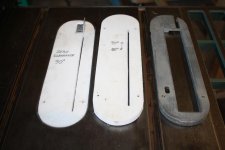
Just refurbed an old Grizzly saw, which came with only a dado insert. Made a new zero clearance insert for ripping, and added a splitter, as I had no riving knife or other guard. I also made one for 90 to 45 angle cuts, which remains zero clearance regardless of angle, but doesn't allow a splitter to be added. Since I use it mostly for ripping, a splitter in the one is a plus, and do most of my 45 cutting as edge work on the router table. Several push sticks on hand at all times. looking into original parts to see if I can come up with a riving knife setup.
 

Attachments

  • IMG_6561.jpg
    IMG_6561.jpg
    106.8 KB · Views: 26

turbowoodworker

Well-known member
Joined
Mar 18, 2012
Messages
3,548
Location
Apex NC
For jons and 850, I apologize. I think I misread your original post that started out about removing the guard and not using a fence. I went back to reread again all that was said and I agree with not cross cutting with a fence in place.

I will say that of all the threads about kickback here, they all start out with " I had removed the guards...". Not real common for this to happen when all safety devices are functional.

Sorry for my hasty post.
 

Git

Well-known member
Joined
May 18, 2008
Messages
6,894
Location
S Cal
A little off the subject, but I was reading the "Custom picnic table $500-600 really?" thread and it had a video of a guy cutting parts for the table on his miter saw. What got my attention is he broke one of my cardinal rules - never cross your hands while making a cut. One of the things I like about my Bosch Glide is it can easily be operated with either hand

https://www.garagejournal.com/forum/forumdisplay.php?f=7

attachment.php
 

Attachments

  • SNAG-1060.jpg
    SNAG-1060.jpg
    100.4 KB · Views: 143
To avoid these ads, REGISTER NOW!

WWheeler

Well-known member
Joined
Jun 23, 2015
Messages
4,105
Location
Middleofnowhere USA
I don’t see what was wrong with my post. You don’t cross cut plywood against a fence. It will bind.

You can use a mark on the plywood and use the angle guide to keep the plywood square. No binding can happen because there is nothing to bind to.

I’m curious to what he has a problem with. Not sure why he had the time to write the comment he did but not say why.

I have never, and I would never, cut anything but really small pieces of sheet goods on a crosscut sled and never with a miter gauge (I'm not sure which or what you're referring to). I cut full sheets, half sheets, etc, of plywood against the fence for more than 30 years without issue. A little bit of wood shop class is really helpful to make sure your saw is set up correctly, where to stand when you cut, when and how to use a push stick, etc.

That said the best thing ever for boards or sheets on a table saw is Board Buddies. With the Board Buddies unless your fence is out of alignment you can cut sheet goods (short side or long side) on the saw against the fence all day every day, and even if your fence is whack you'll know it when it starts screaming, and the Board Buddies will prevent it from being kicked back until you turn off the damn saw and rethink what you were trying to do. Of course on all through cuts one should have a riving knife in place, though there wasn't one on any of the table saws I used for the first 15-20 yrs I used them.
 
Last edited:

Git

Well-known member
Joined
May 18, 2008
Messages
6,894
Location
S Cal
Thanks for the tips guys...I had no idea it was supposed to be wider at the rear. It makes sense and I will make the adjustment to the Biesemeyer fence.

That is a matter of personal opinion.

I am a firm believer that the saw blade should be parallel to the miter slot and the fence should also be parallel to the miter slot/blade

just google it and you will see a variety of opinions on the subject
 

bob15

Well-known member
Joined
Dec 8, 2011
Messages
6,863
Location
Northeasten, CT

My Old Tools

Well-known member
Joined
Jun 4, 2014
Messages
5,446
Location
Hamrick Lake, TX
Sheet goods on a light weight saw are asking for trouble. When the material being cut is high and heavy enough to move the saw, you need to rethink what you are doing. There is a reason real cabinet saws weigh 500+ pounds.
 

850xpeps

Well-known member
Joined
Aug 6, 2017
Messages
1,365

jonshonda

Well-known member
Joined
Jul 17, 2017
Messages
4,749
Location
Wisconsin
Yes it will.
We all have our ways we’ve used for years. A bigger thing in mind is being comfortable with what your doing. If your not then you need to stop. Because that’s when bad stuff happens.

To be honest, I worked at a stereo shop/helped frame/fixture a stereo shop in high school and processed more 4x8 sheets of material then most people ever will on GJ. In a room that was not large enough to be safe, on a CM saw that had a **** fence and not much for outfeed tables. Yes we made due, yes it wasn't the safest. But we made it work. I am pretty sure 18 years later I could still blow my nose really hard and there would be MDF dust on the tissue. :wtf:

I am putting 100x more thought and care into my CM table saw then we ever did at that stereo shop, so I am confident that if an accident happens, it wasn't for a lack of planning and awareness. But I honestly do appreciate the tips, and will practice safe cutting as much as I can!
 

PCustoms

Well-known member
Joined
Jul 23, 2011
Messages
23,429
Location
VT
There's a lot of information here, some good, most bad.

When you've responded to multiple amputations and severe trauma via table saw and replaced two dozen saws with sawstop in a production environment at threat of insurance being dropped you learn a few things.

I respect my saw, like you wouldn't believe. It's tuned in about as tight as you can get a saw and as long as I use it within its capabilities I am safe. No guard, no riving knife. At some point I'll install an overam dust collection.

I've made parts and tooling off my saw that others thought impossibl, just by understanding my tools and having respect for them.

Maybe later on a full computer I'll elaborate
 
Last edited:

rlitman

Well-known member
Joined
Oct 18, 2010
Messages
24,657
Location
Long Island
If you make the fence to the blade wider on one end of the fence, it won't make/cut a parallel piece.


Actually, so long as the piece moves parallel to the fence, the cut sides will be parallel, no matter the blade orientation.

The safety issue here, as I said above has to do with kerf. It is important that only the blade teeth contact the wood. With the back of the fence closer to the blade by more than the amount a tooth sticks out from the side of the saw plate, the wood can be trapped between the two and be forced into the spinning disc. This is how you guarantee a kickback.

With the fence intentionally misaligned away from the blade in the rear, the wood will not be trapped by the fence. However, if the fence is sufficiently misaligned, and the wood is sufficiently long for it to contact the disc before the cut is completed, it can still lead to a kickback.

The ONLY safe way to make this adjustment is to have the blade and fence parallel. When parallel, the teeth will cut a kerf path that guarantees a safe clearance, so long as the operator controls the wood, and feeds it straight.
 

WWheeler

Well-known member
Joined
Jun 23, 2015
Messages
4,105
Location
Middleofnowhere USA
If you make the fence to the blade wider on one end of the fence, it won't make/cut a parallel piece.

For safety, read here:
https://www.woodcraft.com/blog_entries/preventingtablesaw-kickback-it-s-not-an-acceptable-risk

I've always as meticulously as I could possibly get set the blade exactly parallel to the slot with a woodpeckers dial indicator jig and then set the fence to the slot (and just for good measure checked the fence to the blade), and that has always worked perfectly well for me but even your link says ...

To align the fence, mark one tooth, rotate it to the fore, and measure its distance from the fence (Photo A). Next, rotate the tooth aft, and perform the same measurement. (Using the same tooth as a reference removes any blade warp from the equation.) Adjust the fence until the measurements match. If you’re unsure of perfect parallelism, angling the fence outward 1⁄64" or so at the rear of the blade is a safe bet.
Despite reading that I would never set a fence 0.015" out. I'd shoot for a tolerance of less than half that. Then again, after some use when periodically checking I have found my fence to be about that far out before. Even a perfect setup doesn't stay that way forever.
 
Last edited:
To avoid these ads, REGISTER NOW!
Top Bottom
