So back with another water heater question.. woke up this morning to find some water on the floor. Dripping from the relief valve/pipe. Planning on replacing the water heater as soon as we're done with some projects early summer... but is this common for them to leak? Just replace the valve and try that first? Need this thing to Last just another 2 or 3 months lol


You are using an out of date browser. It may not display this or other websites correctly.
You should upgrade or use an alternative browser.
You should upgrade or use an alternative browser.
Water heater woes again
- Thread starter Sh40674
- Start date
Check your incoming water pressure first. I've had two houses now that had the pressure reducing valve fail. The last house sat around 110 psi coming into the house and this current house was pushing past 140 at times.
Verify your house PSI is limited to where it should be prior to throwing parts at a symptom.
Verify your house PSI is limited to where it should be prior to throwing parts at a symptom.
Jack_Toepfer
Well-known member
Valve/pipe makes me think it’s your blow off (bypass) valve? Not the drain valve?
Drain valve may just need the screw on top of it tightened.
Drain valve may just need the screw on top of it tightened.
Check your incoming water pressure first. I've had two houses now that had the pressure reducing valve fail. The last house sat around 110 psi coming into the house and this current house was pushing past 140 at times.
Verify your house PSI is limited to where it should be prior to throwing parts at a symptom.
^^^^ Good Advice
Our house has a pressure regulator that was set to around 70 psi - but one day I noticed the pressure was actually about 120 psi (there is a guage near the water heater but it is not very easy to see). If I opened a faucet, the gauge would drop to around 70 psi, but once the faucet was closed, the pressure would creep back up to 120 - which is street pressure. What happened was the regulator needed a rebuild kit (cheaper than a new one) and it's been working great ever since.
So ya, start with your water pressure
ddawg16
Well-known member
Check your incoming water pressure first. I've had two houses now that had the pressure reducing valve fail. The last house sat around 110 psi coming into the house and this current house was pushing past 140 at times.
Verify your house PSI is limited to where it should be prior to throwing parts at a symptom.
Yea....worth taking a look at.
Also look for a check valve. If you have an anti-siphon valve on your incoming cold water, it could prevent the pressure from being relieved on your hot water heater as the water expands from being heated up. In fact, I think there is something in the code about that. Expansion tank?
But TP valves do go bad. I've replaced mine on my 15 year old water heater. It's still working fine otherwise.....but I know a new one is in the cards for the future. If I get a couple more years out of it, I'll be quite happy.
Richard Cranium
Well-known member
pressure and temp. relief valve, Either can cause it to leak, or it could simply be old and the spring got weak.
The other thing is some systems need an expansion tank near the water heater. Some new homes it’s now code in some locations or regions.
My experience replaced a 25 year water Heater.......never had a pressure problem wit(the old system. New water heater needed the expansion tank or the relief valve released pressure.
https://plumblineservices.com/help-guides/does-my-water-heater-need-an-expansion-tank
https://goo.gl/images/MFZuOe
My experience replaced a 25 year water Heater.......never had a pressure problem wit(the old system. New water heater needed the expansion tank or the relief valve released pressure.
https://plumblineservices.com/help-guides/does-my-water-heater-need-an-expansion-tank
https://goo.gl/images/MFZuOe
sberry
Banned
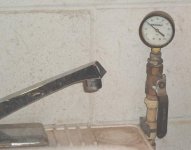
If there is a check valve a tank is needed. I am on a well but have a gauge plumbed on to a work faucet so I can follow it. I use it a lot during irrigation and tank filling. I have troubleshot a couple problems as the well is in a remote pit, a gauge is ok there but even better i can see it every day, hour.
A gauge on city water wouldn't see the use mine does but would find a port and stick one on. Replacing a relief valve is a good idea if there is any doubt of its function, especially a stuck one.
A gauge on city water wouldn't see the use mine does but would find a port and stick one on. Replacing a relief valve is a good idea if there is any doubt of its function, especially a stuck one.
Attachments
Last edited:
nehog
Well-known member
So back with another water heater question.. woke up this morning to find some water on the floor. Dripping from the relief valve/pipe. Planning on replacing the water heater as soon as we're done with some projects early summer... but is this common for them to leak? Just replace the valve and try that first? Need this thing to Last just another 2 or 3 months lol
1. Dripping from the TP relief valve is rarely the fault of the water heater. Check and make sure the TP valve is good, and also (important!) that there is a expansion air tank on the inlet side of the water heater. You can get the tank at HD or Lowes.
2. If you do have an expansion tank, make sure it is still good! They do fail from time to time. Also make sure the air pressure is correct in that tank.
We bought our house last fall and I was giving the WH a once over. I tested the valve and it never stopped dripping after that. So I replaced it. It's amazing to see how much **** was built up on it.
Now I need to buy a big impact to get my anode rod out of there.
Now I need to buy a big impact to get my anode rod out of there.
woodturner9
Well-known member
We bought our house last fall and I was giving the WH a once over. I tested the valve and it never stopped dripping after that. So I replaced it.
In theory they should be tested monthly, but my guess is that few people do that. If you operate the valve periodically, it will remove the buildup that has started and prolong the useful life of the valve, as well as verify it will work when needed.
redmondjp
Well-known member
In theory they should be tested monthly, but my guess is that few people do that. If you operate the valve periodically, it will remove the buildup that has started and prolong the useful life of the valve, as well as verify it will work when needed.
But the flip side is also true - if you do operate the valve periodically, you can also cause that very same buildup to deposit upon the sealing surface inside the valve, causing the valve to leak afterwards.
This happened at the apartment complex that I lived in during college, and it drove the maintenance technician crazy. The relief valve discharge line was shared between two heaters in separate apartments on each floor, and he had to change out one valve, wait for a week to see if the leak stopped and if not, then had to go into the second apartment and change out that relief valve.
All because somebody else said that you had to regularly test those valves.