Ststephen7
Well-known member
Hey guys, I need some guidance here...
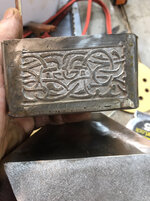
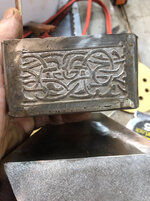
I make and sell Mjolnir. I use electro etching, and in the past I have successfully used 2 batteries left over from my old bass boat.
I etch 4 1/8" pieces of SS at a time, and I etch pretty deep, like 1/64 to 1/32". I used both batteries, both positives to the part being etched, and both negatives to the cathode(?).
This set up put out a LOT of power. I had to use 1/8 or larger steel rod to attach to my parts, otherwise the rods (usually welding rod) would actually get red hot and start to melt!
It would take about 30/40 minutes to etch all 4 parts to a nice depth. The longer the parts are in the solution (and etching) the better the chance of the decals coming loose and ruining the etching, so quicker is better.
Now, my batteries are failing (for whatever reason, I've topped off the water) and I can't afford more batteries. So.... I picked up a vintage battery charger. It works great for rust removal, which is a plus.
I tried it for etching and if failed miserably! I let it go for about 90 minutes and it barely etched at all. That ruined 2 almost completed hammers, and cost me quite a bit of time.
Now to my question(s)...
I have a Miller Econotig A/C D/C welder... can I use it on D/C for etching? And if yes, how do I know what settings to use?
I have a multimeter, and really only know the most basic uses.
How do I hook up the multimeter to the leads to know how many amps/volts the welder is putting out (and what settings on the meter)? I have a stinger (for arc welding) so for leads I would use the ground and the stinger (and without the foot pedal).
I hope I have covered all of the information you might need to help me out.
The Econotig does not have a great interface... it only states output as a % of max, and that changes depending on the process. So that's why I feel the need to use the meter to know how much amperage (if I'm using the correct terms here) to kind of match up with the 2 batteries I was using (one starting battery and one deep cycle battery, hooked up pos to pos and neg to neg).
Please let me know if you need more info in order to give me some guidance.
Thank you so much!
Steve
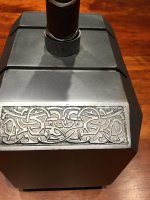
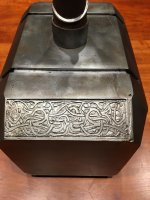
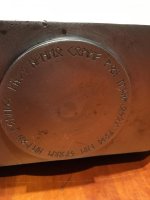
I make and sell Mjolnir. I use electro etching, and in the past I have successfully used 2 batteries left over from my old bass boat.
I etch 4 1/8" pieces of SS at a time, and I etch pretty deep, like 1/64 to 1/32". I used both batteries, both positives to the part being etched, and both negatives to the cathode(?).
This set up put out a LOT of power. I had to use 1/8 or larger steel rod to attach to my parts, otherwise the rods (usually welding rod) would actually get red hot and start to melt!
It would take about 30/40 minutes to etch all 4 parts to a nice depth. The longer the parts are in the solution (and etching) the better the chance of the decals coming loose and ruining the etching, so quicker is better.
Now, my batteries are failing (for whatever reason, I've topped off the water) and I can't afford more batteries. So.... I picked up a vintage battery charger. It works great for rust removal, which is a plus.
I tried it for etching and if failed miserably! I let it go for about 90 minutes and it barely etched at all. That ruined 2 almost completed hammers, and cost me quite a bit of time.
Now to my question(s)...
I have a Miller Econotig A/C D/C welder... can I use it on D/C for etching? And if yes, how do I know what settings to use?
I have a multimeter, and really only know the most basic uses.
How do I hook up the multimeter to the leads to know how many amps/volts the welder is putting out (and what settings on the meter)? I have a stinger (for arc welding) so for leads I would use the ground and the stinger (and without the foot pedal).
I hope I have covered all of the information you might need to help me out.
The Econotig does not have a great interface... it only states output as a % of max, and that changes depending on the process. So that's why I feel the need to use the meter to know how much amperage (if I'm using the correct terms here) to kind of match up with the 2 batteries I was using (one starting battery and one deep cycle battery, hooked up pos to pos and neg to neg).
Please let me know if you need more info in order to give me some guidance.
Thank you so much!
Steve