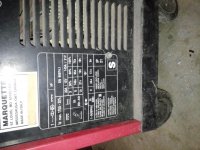
In no particular order:
The machine nameplate lists 170A output at a 20% duty cycle as the 'max'.
"I" is current. I2 is the output current, I1 is the input current.
"U" is the voltage (why the dang nameplates use "U" instead of "V" is beyond me). U2 is output voltage, U1 is input voltage (doesn't vary, shouldn't vary). That machine says to use 220V input power, 240V input power is just fine.
slight diversion/explanation: Once upon a time, USA household voltages from the power lines were 110V and 220V, over time and with things being more and more 'power hungry' those voltage levels have crept up to 115V and 230V and nowadays mostly 120V and 240V. For the most part in practical terms those voltages are the 'same' (110=115=120V and 220=230=240V).
"X" is the duty cycle. For welders, duty cycle is how many minutes out of 10 minutes you can 'safely' run the machine at that power output level without overheating the machine. For a 100% duty cycle, the machine should be fine to run at that power output level continuously. For a 60% duty cycle, the machine is only supposed to be run at that power output level for 6 minutes and then a 4 minute 'cool off' (for the 10 minute duty cycle time period). For a 30% duty cycle, the machine is only supposed to be run for 3 minutes and then a 7 minutes cool off period. Etc, etc, etc.
So, reading the nameplate, that welder has the following electrical characteristics:
220V input voltage (use 'standard' 220-240V USA input voltage)
Max output current of 170A at a 20% duty cycle.
At an output power level of 75A and 18V, the machine is rated as 100% duty cycle and will draw 9A input current from the 220-240V AC circuit.
At an output power level of 95A and 19V, the machine has a duty cycle of 60% and will draw 13A from the 220-240V AC circuit.
At an output power level of 140A and 21V, the machine has a duty cycle of 30% and will draw 24A from the 220-240V AC circuit.
So, you don't 'need' a 60A 240V circuit to feed that welder, but I probably wouldn't bother changing it. The machine probably only 'needs' a 30A 240V circuit.
Remember, in general the purpose of the circuit breaker is to
protect the circuit wiring in the 'wall'. The circuit breaker is not there to protect the device's power cord. That's why plugging in a lamp with a skinny 18ga cord into a 15A or 20A 115V (110-120V, all pretty much the 'same') wall output circuit is just fine. Plugging in a machine (welder, compressor, saw, plasma, whatever) that has a cord only 'good' for the 30A the machine uses into a 30A or 50A or 60A circuit is similarly just fine.
In the USA, most 'small' 220-240A welders use a '50A' plug. If you don't want to swap out your existing NEMA 14-50 wall outlet (that is on a 60A circuit breaker with 6AWG wires in the 'wall'), I wouldn't worry about that at all.
Put some 12 AWG or 10 AWG cord onto the welder and put a NEMA14-50P plug on the end and plug it into your existing NEMA14-50R outlet.
I'd pull the cover(s) off and run the new cord back to the terminals or connection points and wouldn't leave or connect to the 'stub' of the old cord remnant.
As to the thickness of metal that could be welded, general welding rule-of-thumb is to use 1A of welding current for every 0.001" of steel thickness being welded. So, to weld 1/8" thick steel (in a single pass) you would use ~125A of welding current. The amperage and voltage change somewhat depending on exactly what welding process is being used, but that's the general rule-of-thumb.
So, for a max output current of 170A, I'd say that machine should be able to weld 3/16" steel in a single pass with GMAW. Maybe a bit thicker if using plain CO2 as the shielding gas instead of C25. And a bit thicker still if using FCAW (FCAW generally runs a bit 'hotter' than GMAW), so maybe 1/4" or 5/16" single pass with FCAW-S.
No, that machine is most likely
not going to be able to run any sort of dual-shield (FCAW-G). That type of wire generally has a different voltage-amperage output level needed than most 'small' wire feed machines can produce ('small' being most machines smaller than the 250-class of machines).
And be aware of and watch out for "cold lap" (aka lack of penetration, aka lack of fusion) with wire-feed machines. It's not like a SMAW process where you can pretty much just keep welding and running more passes for thicker workpieces.
With wire feed, especially GMAW in the short-circuit transfer mode (as opposed to spray mode transfer, but that 170-190 class of machine can most likely
not do spray mode transfer GMAW), the wire electrode will (almost always) melt but you may not have enough total weld power to actually melt
into thicker workpieces. Even with multiple passes. So, no, you are not going to be welding any 1/2" thick plate with that machine.