To avoid these ads, REGISTER NOW!

Welder Wiring Q's

MikesTTGt

Well-known member
Joined
Feb 17, 2010
Messages
98
Location
Missouri
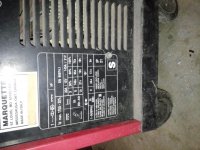
Hey I have an old marquette mig welder that was tossed by a company because the wire feed motor wasn't working, anyhow I fixed the motor but the cord was cutoff when the welder was thrown out, it looks like from what is left it was 14-3 I want to put a 15-20ft cord on it but I'm not positive on the size to replace it with? The only info I have is whats on the front of the welder in the pic, my outlet in the garage is a 14-50 style with 6 awg run from the panel in the basement and its protected by a 60a breaker, basically wondering what size cord and breaker to use and some explanation on the specs listed on the welder would be great! Thanks
 

Attachments

  • 20150204_094440.jpg
    20150204_094440.jpg
    143.6 KB · Views: 46
Last edited:
To avoid these ads, REGISTER NOW!

Falcon67

Well-known member
Joined
Jun 11, 2009
Messages
18,371
Location
Merkel, TX
A Hobart 190 needs a 240V 30A circuit so I would use the same for a 170A unit. That may be overkill for the cord - my 140A 120V unit uses a 16 gauge power cord and even though Hobard rates it at 20A full load, it's never popped a 20A breaker on a 20A 12 gauge wired circuit.

From the Hobart 190 spec page:

Amps Input at Rated Load, 60 Hz 230 V 20.5A
 
Last edited:

zkling

Well-known member
Joined
Jan 23, 2007
Messages
16,939
Put it on a 40amp breaker. I'd put at least a 12/3 cord on it.

The chart reads vertical columns.
Duty cycle at:
Output amps
Voltage

Input amperage at 220v input.

Example: At 140amp output setting it has a 30% duty cycle an arc voltage of 24V and an input amperage of 24amps at 220v input.

It is a 170A max output welder. The input is 24amps at 140amps output, so you will be into the 30's when the machine is maxed out.
 
Last edited:

Electric_Light

Well-known member
Joined
Jan 3, 2015
Messages
74
If you were an OEM, you'd find every possible way to save every penny, but in your case, I would use 10/3 SJOOW or simply match the existing wires. If you pull it apart, strip the outer jacket, you should be able to figure out the gauge of the existing wires.

The only reason to step down to 12/3 from 10/3 is if you can't get 10/3 to fit through the hole provided that the original is not 10/3... never use something smaller than original.
 
OP
M

MikesTTGt

Well-known member
Joined
Feb 17, 2010
Messages
98
Location
Missouri
Thanks everyone for the replies, I suppose ill switch out my breaker get some cord and give it a try, as it seems parts and info are pretty much obselete for this machine but if it still works why not fix it, anyone know about how thick you can weld with 170a? My 110v 140a lincoln honestly barely penetrates 1/8" also would 12 or 14 ga wire catch fire before a 60a breaker would trip?
 
Last edited:
To avoid these ads, REGISTER NOW!

sberry

Banned
Joined
Jun 18, 2005
Messages
35,747
Location
Brethren, Michigan
Welders that come factory with cord and end are designed to run on a 50 and not a 60. I am not familiar with the Marquette models but it would have needed a 12 cord or better if it came with a 50 end. It needs a 10 to go to a 60.
 

sberry

Banned
Joined
Jun 18, 2005
Messages
35,747
Location
Brethren, Michigan
BTW,,, a 140 comes with 14 and the next class comes with a 12 to allow it to be used on a 50A. The cord on them is actually heavier than the demands of the machine and there just for that reason.
 

MoonRise

Well-known member
Joined
Nov 5, 2010
Messages
4,028
Location
NJ
In no particular order:

The machine nameplate lists 170A output at a 20% duty cycle as the 'max'.

"I" is current. I2 is the output current, I1 is the input current.

"U" is the voltage (why the dang nameplates use "U" instead of "V" is beyond me). U2 is output voltage, U1 is input voltage (doesn't vary, shouldn't vary). That machine says to use 220V input power, 240V input power is just fine.

slight diversion/explanation: Once upon a time, USA household voltages from the power lines were 110V and 220V, over time and with things being more and more 'power hungry' those voltage levels have crept up to 115V and 230V and nowadays mostly 120V and 240V. For the most part in practical terms those voltages are the 'same' (110=115=120V and 220=230=240V).

"X" is the duty cycle. For welders, duty cycle is how many minutes out of 10 minutes you can 'safely' run the machine at that power output level without overheating the machine. For a 100% duty cycle, the machine should be fine to run at that power output level continuously. For a 60% duty cycle, the machine is only supposed to be run at that power output level for 6 minutes and then a 4 minute 'cool off' (for the 10 minute duty cycle time period). For a 30% duty cycle, the machine is only supposed to be run for 3 minutes and then a 7 minutes cool off period. Etc, etc, etc.

So, reading the nameplate, that welder has the following electrical characteristics:

220V input voltage (use 'standard' 220-240V USA input voltage)

Max output current of 170A at a 20% duty cycle.

At an output power level of 75A and 18V, the machine is rated as 100% duty cycle and will draw 9A input current from the 220-240V AC circuit.

At an output power level of 95A and 19V, the machine has a duty cycle of 60% and will draw 13A from the 220-240V AC circuit.

At an output power level of 140A and 21V, the machine has a duty cycle of 30% and will draw 24A from the 220-240V AC circuit.

So, you don't 'need' a 60A 240V circuit to feed that welder, but I probably wouldn't bother changing it. The machine probably only 'needs' a 30A 240V circuit.

Remember, in general the purpose of the circuit breaker is to protect the circuit wiring in the 'wall'. The circuit breaker is not there to protect the device's power cord. That's why plugging in a lamp with a skinny 18ga cord into a 15A or 20A 115V (110-120V, all pretty much the 'same') wall output circuit is just fine. Plugging in a machine (welder, compressor, saw, plasma, whatever) that has a cord only 'good' for the 30A the machine uses into a 30A or 50A or 60A circuit is similarly just fine.

In the USA, most 'small' 220-240A welders use a '50A' plug. If you don't want to swap out your existing NEMA 14-50 wall outlet (that is on a 60A circuit breaker with 6AWG wires in the 'wall'), I wouldn't worry about that at all.

Put some 12 AWG or 10 AWG cord onto the welder and put a NEMA14-50P plug on the end and plug it into your existing NEMA14-50R outlet.

I'd pull the cover(s) off and run the new cord back to the terminals or connection points and wouldn't leave or connect to the 'stub' of the old cord remnant.

As to the thickness of metal that could be welded, general welding rule-of-thumb is to use 1A of welding current for every 0.001" of steel thickness being welded. So, to weld 1/8" thick steel (in a single pass) you would use ~125A of welding current. The amperage and voltage change somewhat depending on exactly what welding process is being used, but that's the general rule-of-thumb.

So, for a max output current of 170A, I'd say that machine should be able to weld 3/16" steel in a single pass with GMAW. Maybe a bit thicker if using plain CO2 as the shielding gas instead of C25. And a bit thicker still if using FCAW (FCAW generally runs a bit 'hotter' than GMAW), so maybe 1/4" or 5/16" single pass with FCAW-S.

No, that machine is most likely not going to be able to run any sort of dual-shield (FCAW-G). That type of wire generally has a different voltage-amperage output level needed than most 'small' wire feed machines can produce ('small' being most machines smaller than the 250-class of machines).

And be aware of and watch out for "cold lap" (aka lack of penetration, aka lack of fusion) with wire-feed machines. It's not like a SMAW process where you can pretty much just keep welding and running more passes for thicker workpieces.

With wire feed, especially GMAW in the short-circuit transfer mode (as opposed to spray mode transfer, but that 170-190 class of machine can most likely not do spray mode transfer GMAW), the wire electrode will (almost always) melt but you may not have enough total weld power to actually melt into thicker workpieces. Even with multiple passes. So, no, you are not going to be welding any 1/2" thick plate with that machine. :D
 

sberry

Banned
Joined
Jun 18, 2005
Messages
35,747
Location
Brethren, Michigan
Remember, in general the purpose of the circuit breaker is to protect the circuit wiring in the 'wall'.
Actually it is to protect against short circuit interruption. Most circuits where it actually protects the building wire are general use 15 and 20 where there are multiple outlets available to the operator.
A 6 wire can handle a lot more than 50A, in the case of some welders 125.
In the case of the OP the switch on the machine is a disconnect for both legs and following it is thermal protection for the finer internals. A buzz box does not have tis, again the internal wiring based on its max duty and output but within 50A short circuit limits.
A 60 while not super dangerous is not for supplied cord machines. Many 50A machines,,,, in fact most of them come with 12 cord, we can only breaker this to 250% of its amps, which means 50 not 60. In some sense the OP could use a 10 if he wanted to fit the 60 but not all machines are like that, the little wire feeders are though.
The bottom line is a 12 or better and change the outlet to a 6-50-R like its sposed to be for welders along with a 50 or smaller breaker. .
 

sberry

Banned
Joined
Jun 18, 2005
Messages
35,747
Location
Brethren, Michigan
(welder, compressor, saw, plasma, whatever) that has a cord only 'good' for the 30A the machine uses into a 30A or 50A or 60A circuit is similarly just fine
Maybe it doesn't seem important here but there is a difference in the math,, 30 is different from 50 and 60 is not the same as 50. You can supply the OP's machine with a 14 but it needs to be limited to a 30A breaker if you do.
 
OP
M

MikesTTGt

Well-known member
Joined
Feb 17, 2010
Messages
98
Location
Missouri
Thanks moonrise and sberry for the breakdown and info, these questions definatly can cause alot of debate in the end I just want to be sure i am being safe and not running the risk of starting a fire. I honestly dont no the differnce in outlets but for the sake of easyness id like to keep the existing 14-50 outlet thats already installed and there when i bought the house currently I run my air compressor from it as well.
 

zkling

Well-known member
Joined
Jan 23, 2007
Messages
16,939
Nema 6-50 is the standard for welders and other high amp 220v single phase shop equipment. IIRC 14-50 is used for RV's and boat to shore connections and has a neutral giving an option 120v where as the 6-50 is only 220v and a ground. Since you have the 14-50Rs existing it would be fine to go with the matching 14-50 plugs, just make sure you have the wires correct.
 
To avoid these ads, REGISTER NOW!
Top Bottom