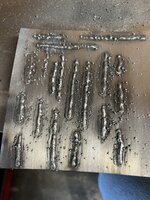
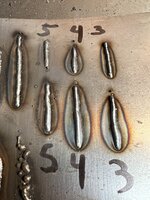
It
looks as if you are just moving the gun along. You need to learn to watch the puddle and control how deeply it penetrates, that is washes out on the sides instead of sitting on top and all that good stuff. Are you pushing the puddle or pulling? When it comes to thin sheet, most of the time it works better to push the puddle so the arc stays on the more massive bead. As thickness goes up (relative to wire size and welding amperage) you transition to pulling the bead so the arc is blasting through a good root. When you get your **** welds just right, you will have a tiny bit of bead on the backside (suspect you have a crack still there now by beads sitting on top. Practice, practice, practice.
As far as distortion goes, it doesn't matter so much how you cool it, as that just allows a more even bead than one that is accumulating temperature as it goes along. On thin sheet, as mentioned, you need to start with a LOT of little tacks and learn to join short stitches together (often alternating in location to keep more even heat. The ONLY way to prevent distortion is not to weld it. When you lay ANY bead down, it logically starts at melting temp, and as it solidifies it is still relatively hot compared to the substrate/base metal part. As that bead continues to cool it will develop progressively more strength as it continues to shrink/shorten leaving a LOT of stress in the weld that will relieve itself by straining (distorting) the welded part. The longer and more continuous the weld, the greater the distortion (thus why the alternating stitches after tacking). Another thing to do to minimize distortion is pre-heat the part, but in doing so you have to reduce your welding heat input (amperage).
Again: follow these three steps: 1. Practice, 2 practice and 3 practice. Study as much as you can before each session