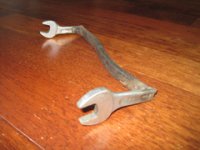
That's why they use steel in springs! Of course, other metals are alloyed in to get specific qualities, but steel is the perfect material for springs.
Actually, steel is a poor material for springs, unless it is tempered/hardened. Steel is used for springs because it's cheaper that alternatives such as composites which actually make a better spring. Tempering/hardening reduces steel's plastic range to make it inelastic within the load range designed for. If it still had plastic properties, the spring would bend and not rebound. That's also why you cannot weld broken springs, because the heat from welding anneals the metal, and it will break next to the weld after a few cycles.
Getting back on topic, I've welded a couple wrenches, but have had mixed results. They weld okay, (I used 6013 rod on one, MIG welded the other), but one broke again next to the weld at lower load than the original break. The other is still going, but I haven't really loaded it too much. Most quality tools are forgings. The forging process aligns the grain in the steel and reduces porosity in the metal. Welding will once again anneal the steel, making it softer. Heat treating is a possibility, but you will never make it as strong as the original forging.
Dale