To avoid these ads, REGISTER NOW!

Welding air cylinder - must be crazy, right?

malbojah

Well-known member
Joined
Feb 26, 2014
Messages
162
Location
Cape Cod, MA
So I have this old Coats RC-20 tire machine I bought to change my motorcycle tires with

xy0b.jpg

(yes, I've already changed out the PVC air lines that worked fine for a decade with copper. This is an old pic)

I've gone through and replaced everything that leaked air (rotary coupling, turntable cylinder, hoses in general) but I'm stuck with the bead breaking cylinder. I've replaced the seals, but there are a pair of pin hole leaks on the mounting ears

3vyJ0a.jpg


I have choices here:

1) leave it be and live with the air leak,
2) 2-part epoxy it and hope it holds
3) weld it (it is a steel cylinder, not aluminium)
4) maybe find a used cylinder on ebay

As much as I would love to weld it (I do have a mig welder), I'm also aware of the dangers of fvcking with air cylinders and changing the steel temperament.

Something tells me it will either be option 1 or 2
 
To avoid these ads, REGISTER NOW!

jimbbski

Well-known member
Joined
Feb 5, 2009
Messages
67
Location
Chicago Area
I do have to ask the question here: Does anyone know if these air tanks are heat treated after any welding is done on them by the MFG? I don't think so, so why the concern of having a sudden failure after you do a repair weld on such a tank?

I've welded on a Craftsman 30 gal compressor to adapt a different compressor motor to the used tank. I've run 130 psi through it all the time.
 

Thumper68

Well-known member
Joined
May 16, 2013
Messages
5,134
Location
Duluth MN
The main issue with welding on a compressed air cylinder is the the heat effected zone can flex at a different rate from the rest of the tank and crack.
 

larry_g

Well-known member
Joined
Apr 28, 2007
Messages
16,899
Location
oregon
Is that a cylinder or a storage tank? Seeing the flange and bolt heads on the bottom of the picture I'm assuming a cylinder. If a cylinder then you could epoxy from the inside. Otherwise weld it up. Part of the danger of welding on a pressure vessel is the size of the tank and the amount of stored energy it can contain. When a pressure vessel lets go it is a lot of stored energy released quickly. Being a cylinder it is a small volume and not likely to blow apart. Welding is common on cylinders.

lg
no neat sig line
 

zebrabeefj40

Member
Joined
Aug 18, 2011
Messages
23
Location
Pepperell MA
I have roughly the same machine (mine is an RC15 but the bead breaker cylinder is made the same). I bought it from my uncle... IIRC the first cylinder was cracked worse than that. My uncle had it welded and it worked for a while but ultimately cracked again (like Thumper 68 describes). He ended up getting a used cylinder for the machine from a Coats dealer that had parts machines. BUT if you have just pinhole leaks I'd weld it and use it. And be on the lookout for another to replace it.

As a side note my machine had cracks on the bead breaker arms too. There were a couple sharp corners in the stampings that the cracks started from. I've since welded those too.

Those are nice machines. Good luck with yours.

Nick
 

gearhead1

Well-known member
Joined
Oct 14, 2013
Messages
1,935
Location
NC
I'd try welding it myself. If it cracks every year, then instead of buying the same air cylinder to replace it, have a custom shop make an air cylinder heavier duty.
 
OP
M

malbojah

Well-known member
Joined
Feb 26, 2014
Messages
162
Location
Cape Cod, MA
.119 is under 1/8"

.187 is 3/16

Must consult conversion chart I have laminated on tool box. Would not surprise me after the long day it was.

Good thing is I only use the tire machine a couple of times a year so I'm not in a rush.

I'll probably weld it next week and set the welder to a low amperage. After I pull the piston back out to take a peak were the leaks would be on the inside.
 

PugetDude

ALLIANCE MEMBER
Joined
Mar 13, 2013
Messages
22,481
Location
Superstition Mountains, AZ
I have choices here:

1) leave it be and live with the air leak,
2) 2-part epoxy it and hope it holds
3) weld it (it is a steel cylinder, not aluminium)
4) maybe find a used cylinder on ebay

As much as I would love to weld it (I do have a mig welder), I'm also aware of the dangers of fvcking with air cylinders and changing the steel temperament.

Something tells me it will either be option 1 or 2

Clean it up and weld it up. If you're not comfortable doing it with your MIG, have a friend or a local shop with a TIG do the root pass.

A before and after dye penetrant test is easy to perform and will tell you exactly where the leaks are and whether you eliminated them.

Good luck.
 
To avoid these ads, REGISTER NOW!

rsanter

Well-known member
Joined
Dec 22, 2007
Messages
18,524
Location
visalia ca
Weld,it,or the other option is to silver solder it. All you are really doing is sealing a leak

Bob
 

laser3kw

Well-known member
Joined
Nov 17, 2012
Messages
7,276
Location
northen IL
weld it - done :thumbup:
just spot weld it like they do on body panels - spot - cool - spot- cool etc.
Do not run a continues bead
 

trackwelder

Well-known member
Joined
Jun 22, 2005
Messages
2,608
Location
n.y
weld it - done :thumbup:
just spot weld it like they do on body panels - spot - cool - spot- cool etc.
Do not run a continues bead

I would not recommend doing this. Spot welding like that can easily have defects. Run a continuous pass
 

laser3kw

Well-known member
Joined
Nov 17, 2012
Messages
7,276
Location
northen IL
Where you learn this?
I learned it from watching you......;)

but there are a pair of pin hole leaks on the mounting ears

pin hole , not crack.
if it is a "pin hole" leak, I would "spot weld" it. Locate the "hole", clean, position gun, pull trigger and count "1, 2, 3, 4" stop.
if it is a crack, then prep area, and weld away
 

laydoubtFab

Member
Joined
Dec 30, 2015
Messages
10
Just bevel it out a bit with a twist drill and blast it with the mig. Don't get carried away, could be thin around the hole too.
 

zmotorsports

ALLIANCE MEMBER
Joined
Oct 20, 2009
Messages
21,477
Location
Northern Utah
I have welded a couple of smaller air cylinders but they were aluminum, however, I have welded probably 60+ steel hydraulic cylinders in my career. The only thing to make sure of is to remove the ram with the packing so they aren't damaged by the heat. Once the cylinder is disassembled "V" out the crack or pinhole and weld it up. This is providing you are a competent weldor, otherwise you may want to pursue one of your other options.

With the thicker hydraulic cylinders, .25" and up side wall, I would usually preheat with a rose bud tip after V-ing out the crack and cleaning everything thoroughly with acetone.

Mike.
 

sberry

Banned
Joined
Jun 18, 2005
Messages
35,747
Location
Brethren, Michigan
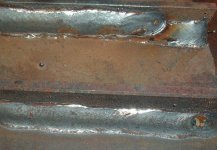
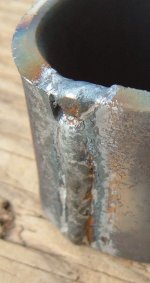
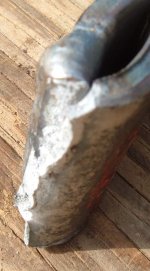
I left a little spot so a guy can see the fit before welding. The front and the back, this is welded from one side. Also couldn't have busted it if I welded it any better. It was for a bust demo anyway.
 

Attachments

  • wire feed ****.JPG
    wire feed ****.JPG
    97.4 KB · Views: 79
  • wire feed **** back.JPG
    wire feed **** back.JPG
    101.2 KB · Views: 75
  • wire feed **** bend.JPG
    wire feed **** bend.JPG
    56.6 KB · Views: 74
  • wire feed **** break.JPG
    wire feed **** break.JPG
    75.6 KB · Views: 80

why worry

Well-known member
Joined
Oct 3, 2014
Messages
301
As long as your comfortable with your welding ability"weld er up"! If you want the proper fix for pressure vessels then I would drill out the hole and then plug weld it. If it is a crack it should be drilled at each end of the crack then welded.
Dave
 

kerrynzl

Well-known member
Joined
Nov 8, 2013
Messages
5,054
Location
Tauranga, New Zealand
weld it - done :thumbup:
just spot weld it like they do on body panels - spot - cool - spot- cool etc.
Do not run a continues bead

He'd be better hammer welding it.

A pin-hole can be "rosette"[plug] welded into a small raised circle.
When the weld cools and starts to shrink, you hammer down the weld to stress relieve it.

As for welding confidence, it ain't going to blow apart if you don't get it right! All it will do is still leak [as before]
 
Last edited:

Hondafreak08

Member
Joined
Feb 6, 2014
Messages
18
Weld it, worst case scenario , it will crack..

Just an idea, we weld .312 SS tube .020" wall.... It gets hydro tested at 4k psi

Our .750x.035" alum tube gets air tested at 240 psi....

It's not going to explode
 

dbabicky

Well-known member
Joined
Dec 30, 2012
Messages
874
Location
NE Wisconsin
Just weld it and don't let some of these folks scare you. I worked in a foundry and welded this stuff and other pressure cylinders and vessels every day. If it would have been a problem OSHA and our hard assed Safety dude would have never allowed it.
Worst thing that's gonna happen......................................it'll still leak.
 
OP
M

malbojah

Well-known member
Joined
Feb 26, 2014
Messages
162
Location
Cape Cod, MA
Follow up: my welding skills aren't acceptable due to lack of use. I didn't have the amperage high enough to start so the puddle would just sit on top of the metal and not bond properly. Air was still escaping under the weld, so I would go back with an angle grinder and take the weld down, pressure test with soapy water, dry, weld, pressure test again. I would say the leak is down about 85% compared to when I started which for me is acceptable. I have more air escaping around the shaft seal that the tiny pinholes on the cylinder mounts.
 

bsaint

Well-known member
Joined
Apr 26, 2010
Messages
5,109
Location
Manchester, CT
The main issue with welding on a compressed air cylinder is the the heat effected zone can flex at a different rate from the rest of the tank and crack.

So how do they tackle this in tank manufacturing? Do you think they heat stress reliefl the whole tank!? Yea right.

Just weld it. You'll be fine. It won't explode. Itll just fail where the seam is if itll fail at all.
 

bsaint

Well-known member
Joined
Apr 26, 2010
Messages
5,109
Location
Manchester, CT
Follow up: my welding skills aren't acceptable due to lack of use. I didn't have the amperage high enough to start so the puddle would just sit on top of the metal and not bond properly. Air was still escaping under the weld, so I would go back with an angle grinder and take the weld down, pressure test with soapy water, dry, weld, pressure test again. I would say the leak is down about 85% compared to when I started which for me is acceptable. I have more air escaping around the shaft seal that the tiny pinholes on the cylinder mounts.

You can weld a patch panel over it too.
 

zmotorsports

ALLIANCE MEMBER
Joined
Oct 20, 2009
Messages
21,477
Location
Northern Utah
You can weld a patch panel over it too.

You could, but then you would be welding in an area that wasn't designed for weld and could possible change the shape of the cylinder slightly if the patch extended up past the mounting tab area. Generally the cylinder itself is thinner than the end cap and definitely compared to the mounting tabs.

In all of the ones I have welded, I merely grind out the weld that failed or where the leak is, and reweld it. Don't overthink it too much, just repair it. I also have found that tapering the "V" that you are prepping to weld and then when you start welding start slightly off to the side of the existing weld and bring the molten puddle directly onto the old weld at the taper and continue along the "V" that you created (hope that makes sense). When ending the weld I do the same, slightly go off to the side of the existing weld.

Mike.
 
To avoid these ads, REGISTER NOW!
Top Bottom