To avoid these ads, REGISTER NOW!

Welding in patch panels

To avoid these ads, REGISTER NOW!

MP&C

Well-known member
Joined
Oct 21, 2009
Messages
4,396
Location
Leonardtown, MD
Robert,

I just ordered a Martin 1024 surfacing spoon, which I'm hoping will be a good "*******"?

I have their Light Dinging spoon. I've never understood the "light dinging spoon" - where you hit the spoon with a hammer. How does one hit the spoon and hold a dolly behind at the same time. Are there a situations where you use the hammer-on-spoon in your work with no dolly support? I guess that "light" spoon can also be used as a *******?

Gus
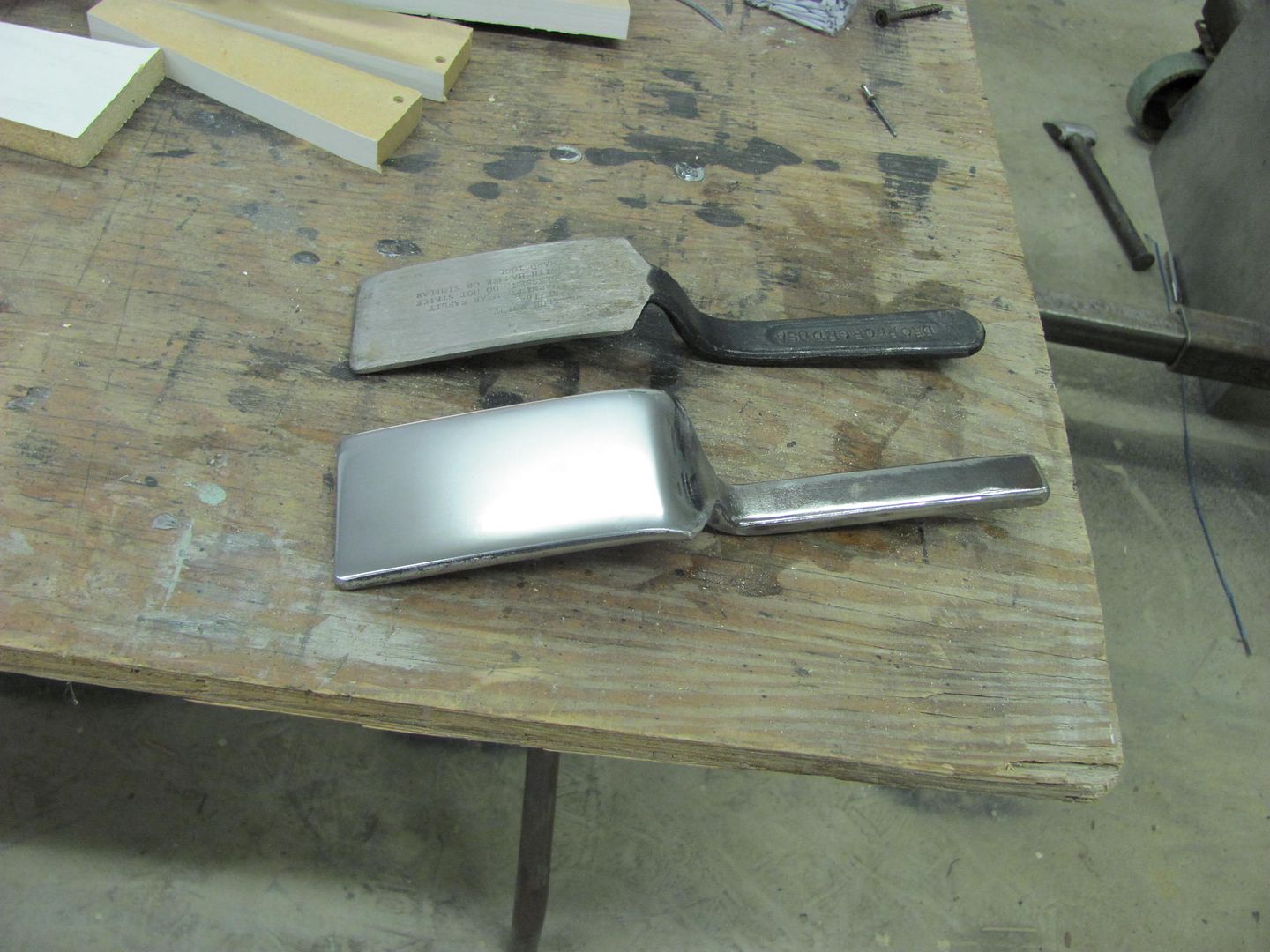


A lot of it depends on the material (steel vs aluminum, for example). A heavier ******* would perhaps do more damage to aluminum where your light dinging spoon would be more appropriate. Another consideration may be the extent of the damage. A light ding would be easier to remove, where a more pronounced dent, even if the same size in diameter but deeper, will require a bit more force to manipulate the metal. Here is my Snap on dinging spoon, likely the same as the Martin 1036, next to one I made from an old leaf spring. The home made is noticeably heavier. (the pic below links to the build thread for the *******)


....and just like your hammers and dollies, not all are made for all circumstances. A ******* about twice as long as the one shown above would come in handy to span creases like shown on the lower fender in my previous post.
 
Last edited:

gelierb

Well-known member
Joined
Nov 16, 2010
Messages
52
Location
Redwood City, CA
....and just like your hammers and dollies, not all are made for all circumstances. A ******* about twice as long as the one shown above would come in handy to span creases like shown on the lower fender in my previous post.

Very nice job on the heavy spoon. The Snap-on (although styled like the light Martin) looks quite a bit heavier than my spoon.

On the subject of heavy, how much of the hidden back side of the patch welds do you grind away? I've always tried to leave as much as possible because it seems like a stronger join/**** to me, but no doubt harder to work with H/D. Probably not stronger so much because of the extra filler material but mainly I don't like the idea of grinding sheet metal away where it won't be seen anyway?

I've patched a few long quarter panel areas - flat (low crown?) panels that have factory lap joints where the inside wheel cover's flanges are spot welded to the outside flat (replaced with plug welds - trying to stay stock). Hammer and dolly work around those double-layered seams has been a challenge for me :) and sometimes a bit more force seems to be called for.
 
Last edited:

MP&C

Well-known member
Joined
Oct 21, 2009
Messages
4,396
Location
Leonardtown, MD
As a matter of personal preference I try to locate any such welds where they are accessible for planishing, so by default they are also accessible for dressing the welds. I try to clean the welds up, inside and out, so the panel appears as original. Not all panel installation circumstances work out that way, but at least it's something to strive for...
 

gelierb

Well-known member
Joined
Nov 16, 2010
Messages
52
Location
Redwood City, CA
Got the Martin 1024 in the garage. A brute of a ******* spoon with lots of weight to swing – should be easier to really screw something up :bounce:. More crown on the surface of the spoon than the lighter version. Shown next to the Martin1036 light dinging spoon. They should probably be cleaned up to personal preference, but all the Martin tools I've seen have a nice finish to them.
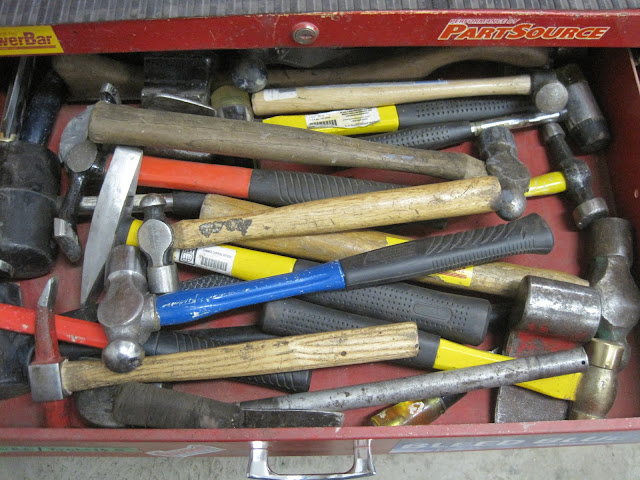

http://www.fj40toolbox.com/sites/all/themes/fjbird/images/*******.jpg
 
Last edited:

e-tek

Well-known member
Joined
Dec 19, 2007
Messages
10,690
Location
Saskatoon, SK
Gee gelierb, ya got some nice body tools there - wish mine where that nice!!

IMG_3387.JPG
 

moose knuckle

Well-known member
Joined
Jul 28, 2009
Messages
58
thanks guys, i just bought a lincon 140 mig & im learning to weld. i think i just got the best lessen on welding. i have one question, a 59 f100 cab is 18 ga. wire thickness .035 or .030 flux core. whats best?

Inside your machine should be the recomended settings for the wire/material being welded. I personally hate welding w/ flux, messy and dirty.
 

59f100

Member
Joined
Nov 12, 2009
Messages
18
Location
long island
With sheet metal the gap is not necessary, I try to have little to no gap when doing patches. The clamps work great when you need them but that is pretty rare. The trick is to do tacks, alternate around the panel and give plenty of time to cool, let them air cool and NEVER accelerate the process with water, damp rag, compressed air. Accelerating the cooling process will create brittle and weak welds that can crack later in time. As shown above you should occasionally grind down your tacks to see where you are at. Make sure the metal is clean, no paint, oils, etc., this will keep the weld clean. One thing that I will point out is in the pictures above the metal has epoxy primer on it, this will be debated but this is generally a bad idea. If it is absolutely necessary then make sure it is ground off about 1" away from the weld area, not only will it dirty the weld but it ends up needing to be ground off later anyways. As for wire size, .023 is pretty much standard, .035 can be used on the thicker metal but not all cars have 18ga. sheet metal. Clecos are a bad idea, this is not their intended use and flanged patches are a huge no no, they will retain moisture in the flange and fail in short order due to corrosion.
thanks rusty kustoms & mp&c. i just bought a lincon 140 mig. im learning to weld. i think i just got the best welding lesson yet. i have a question, 59 f100 cab is 18 ga. wire size .035 or .030 flux core, whats best for me to use?
 

creativecars

Well-known member
Joined
Nov 15, 2010
Messages
4,300
Location
Indiana- where horse and buggies still roam
The problem with flux core is the smallest you can easily get is .030, which takes more heat to melt than .023. More heat, more chance to warp, more chance to burn through. That said, you should look for E70S6 wire and use 75/25 Argon/CO2 mix gas for the easiest welding.
 

e-tek

Well-known member
Joined
Dec 19, 2007
Messages
10,690
Location
Saskatoon, SK
Don't feel bad - at least you probably know how to use yours. I'm still trying to figure out which end of that ******* to hold on to :bounce:.

While I'd never claim to be a know-it-all (especially in this company!) I did grow up watching and learning from many "metal-masters" in my Dad's shop.:thumbup: That being said, I was just reading through the various posts and it struck me that one of the simplest ways of "shrinking" hasn't been discussed yet - that of using a cross-hatch hammer, dolly and/or a slap-file. While a lot of guys don't know why some body hammers have the "tenderizing" ridges on them, once you find out and use them appropriately, you'll be amazed at what they can do!

The ridges grab and pull the metal together thereby shrinking it in. You'll run into areas that need to be shrunk more often than not, due to the stretching caused by any distorting damage, as well as by any bumping you're doing to straighten any distortions (damage) out. I often find that repairing damage to metal occurs in three oft-repeated steps: returning the major damage to the basic shape before the distortion occured, hammer and dolly or planishing work to flatten out the area, shrinking the now stretched area back to a normal contour, finishing with a combination of shrinking, stretching and filing, plus filling areas's that are best left low.

Of course really badly stetched metal (often acting - and thus referred to - as oil-canned) will need to be shrunk with heat (either with a planishing disc or a torch), but many distortions can be brought back into shape with these key additions to your metal bumping tool box.

Slapfile.jpg
 

e-tek

Well-known member
Joined
Dec 19, 2007
Messages
10,690
Location
Saskatoon, SK
The problem with flux core is the smallest you can easily get is .030, which takes more heat to melt than .023. More heat, more chance to warp, more chance to burn through. That said, you should look for E70S6 wire and use 75/25 Argon/CO2 mix gas for the easiest welding.

X2!
Once you go gas - you'll never go back! Also, for the money, the softer E70 023 or 025 makes working metal after welding a whole new ball-game!!:thumbup:
 

gelierb

Well-known member
Joined
Nov 16, 2010
Messages
52
Location
Redwood City, CA
... I was just reading through the various posts and it struck me that one of the simplest ways of "shrinking" hasn't been discussed yet - that of using a cross-hatch hammer, dolly and/or a slap-file. While a lot of guys don't know why some body hammers have the "tenderizing" ridges on them, once you find out and use them appropriately, you'll be amazed at what they can do!

My experience (self taught :)) is very limited, but I've had success, even with small amounts of heat, shrinking and removing oil-canning, etc. I've never had anything good come about using a shrinking hammer/dolly - do those things really work? I have one shrinking hammer and no plans to buy more. All I've managed to do is destroy the finish on sheet metal with no shrinking in the process. :(
 

gelierb

Well-known member
Joined
Nov 16, 2010
Messages
52
Location
Redwood City, CA
As a matter of personal preference I try to locate any such welds where they are accessible for planishing, so by default they are also accessible for dressing the welds. I try to clean the welds up, inside and out, so the panel appears as original. Not all panel installation circumstances work out that way, but at least it's something to strive for...
Robert - I can see your "personal preference" comment is going to create a lot of extra work for me. It's not easy trying to live/measure up to your level of skill and attention to detail :) - Gus
 

MP&C

Well-known member
Joined
Oct 21, 2009
Messages
4,396
Location
Leonardtown, MD
I've never had anything good come about using a shrinking hammer/dolly - do those things really work? I have one shrinking hammer and no plans to buy more. All I've managed to do is destroy the finish on sheet metal with no shrinking in the process. :(


Gus, When you say shrinking hammer, are you referring to the waffle faced hammer? They are very finicky in that there is a very fine line between shrinking and you should have stopped 5 minutes ago and now it's stretched worse than when you started. I have tried them, but refuse to use them. To me there are other preferred methods of shrinking, from low crown body hammers using off-dolly technique, shrinking discs, up to using localized heat, that won't distort the flatness of the metal where the use of filler is a requirement and not just a choice.


Robert - I can see your "personal preference" comment is going to create a lot of extra work for me. It's not easy trying to live/measure up to your level of skill and attention to detail :) - Gus


Your vehicle, your choice of how far to take the finish level or methods to get to that point. I will say that once someone gets proficient at metal finishing, it is faster than applying and finishing body filler. I have yet to get to that level of detail myself, right now I'm about at the high build primer and/or a slight bit of evercoat 416 to get things real smooth. But we all need something to shoot for. The more you strive to refine your skills, the better your finish level will become.
 

gelierb

Well-known member
Joined
Nov 16, 2010
Messages
52
Location
Redwood City, CA
Gus, When you say shrinking hammer, are you referring to the waffle faced hammer? They are very finicky in that there is a very fine line between shrinking and you should have stopped 5 minutes ago and now it's stretched worse than when you started. I have tried them, but refuse to use ...

Yes - like the guy here in the middle. This is the only one I have, came with my little Martin "starter set". I've seen the toe dolly versions too and have always been suspect after my experiences with the hammer.

waffle_hammer.jpg
 

SM Racing

Well-known member
Joined
May 3, 2006
Messages
856
Location
Huntsville, AL
Can someone explain how a shrinking disk works. To me it just looks like a smooth steel disk. Do you use heat from a torch or just this thing? Do you just warm the metal up and the quench it with a wet rag?
 

joeswamp

Well-known member
Joined
Jul 25, 2007
Messages
2,418
Location
Massachusetts
I believe a shrinking disk works by heating the metal with friction rather than a torch. I've never used one but it's supposed to give way more control.
 

SM Racing

Well-known member
Joined
May 3, 2006
Messages
856
Location
Huntsville, AL
Do you quench it like you do when you use a torch?

Yes I am currently too lazy to look this up on the web. Plus it seems relevant to the discussion.
 

e-tek

Well-known member
Joined
Dec 19, 2007
Messages
10,690
Location
Saskatoon, SK
I believe a shrinking disk works by heating the metal with friction rather than a torch. I've never used one but it's supposed to give way more control.

Yes sir!

Do you quench it like you do when you use a torch?

Yes Sir!

Yes I am currently too lazy to look this up on the web. Plus it seems relevant to the discussion.

It's relevent. It's the heat from the dic that does it. The benefit is that the heat is concentrated on the high spots that the disc touches, which can then be quenched and shrunk, sometimes several at a time. Run it until the high spots barely turn color, then quench. After some practice, you can heat even less, so long as the high spots are hot enough to steam water on a rag. Intersperse using the dic with more bumping up of low spots, maybe hammer and dolly work, then more shrinkage ;)
 
Last edited:
To avoid these ads, REGISTER NOW!

e-tek

Well-known member
Joined
Dec 19, 2007
Messages
10,690
Location
Saskatoon, SK
Gus, When you say shrinking hammer, are you referring to the waffle faced hammer? They are very finicky in that there is a very fine line between shrinking and you should have stopped 5 minutes ago and now it's stretched worse than when you started. I have tried them, but refuse to use them. To me there are other preferred methods of shrinking, from low crown body hammers using off-dolly technique, shrinking discs, up to using localized heat, that won't distort the flatness of the metal where the use of filler is a requirement and not just a choice.

While I agree with your sentiment of being careful with the shrinking hammer/dolly or spal file, it's like anything: taught by the right people and practiced a lot, it can become a favourite method. I use mine for mid-way finishing: after hammer/dolly and stretching the metal back to shape, I then use my shrinking tools to bring it all lwoer and clsoer to shape, then I shrink with a disc/torch depending on level of shrinkage (I love that term!) nedded.

Your vehicle, your choice of how far to take the finish level or methods to get to that point. I will say that once someone gets proficient at metal finishing, it CAN BE faster than applying and finishing body filler. I have yet to get to that level of detail myself, right now I'm about at the high build primer and/or a slight bit of evercoat 416 to get things real smooth. But we all need something to shoot for. The more you strive to refine your skills, the better your finish level will become.

Truer words where never said!
 

SM Racing

Well-known member
Joined
May 3, 2006
Messages
856
Location
Huntsville, AL
I assume the shrinking disk puts less heat into the panel than a torch, thus keeping the metal softer than heating with a torch and then quenching with a rag. I always wondered about the hardening of the panel when shrinking with a torch.
 

MP&C

Well-known member
Joined
Oct 21, 2009
Messages
4,396
Location
Leonardtown, MD
The biggest advantage of the disc is that it only heats the high spots, so that is where the shrinking gets concentrated. Not always the case when using a torch.
 

gelierb

Well-known member
Joined
Nov 16, 2010
Messages
52
Location
Redwood City, CA
The biggest advantage of the disc is that it only heats the high spots, so that is where the shrinking gets concentrated. Not always the case when using a torch.

When it comes to "heat" shrinking in general, I've never been able to find a consensus on cooling the steel. I never cool welds (or steel that gets hot from torch, etc.) with water, air or anything else. To me that's always seemed like heat-treating the steel in the process - something one would do to harden/temper. If a slow cool "softens" things a bit - you would think planishing with a hammer would in turn work-harden the steel some after the fact?

Does the cooling process actually effect the amount of final shrinking that results - verses just letting things cool slowly at room temps?

The strange thing about shrinking discs (IMO/no experience) - no one seems to manufacture/market them. I've seen a few plans for "make-your-own" and a few websites that sell a limited run, custom made kind of thing. In general, they don't seem to be anything you would find in a typical tool supply catalog? And safety issues, like a spinning circular saw with no teeth? I wouldn't like the idea of buying something like a home-made cut-off wheel with no speed rating spec, etc. Seems like they would also tear up the finish to some degree - steel on steel, all that friction? I know lots of people swear by them ...
 
Last edited:

dragginbalz

Well-known member
Joined
Sep 19, 2005
Messages
197
Location
Illinois
Jeez, this is a good thread! Awesome work and advice! I can't believe I haven't checked it out until tonight!

I did not read every post, so if someone else mentioned these things, I apologize.

Working for an automotive paint supplier, I wanted to mention two items available that may be beneficial to you. If you are familiar with them already, I apologize.

1. For grinding the welds, 3M makes a 3/16" thick 3" grinding wheel for a bit more surface area. It is part # 01991. It would definitely help from gouging the metal, have less side flex and last longer than a 1/16" wheel.

http://products3.3m.com/catalog/us/en001/home_leisure/-/node_GS4LCC8J27gs/root_GS2MT8MCQBgv/vroot_BWFLZ648DFge/bgel_6FSFRVQKQGbl/gvel_V81136SWNHgl/theme_us_chimpartnersupport_3_0/command_AbcPageHandler/output_html


2. USC imports (Germany) some 2K epoxies in spray cans, that would help for small areas, rather then use a brush or dirty your gun, as mentioned above. They are pretty cool and have a bit longer pot life due to the fact that they are in a sealed can (a few days as opposed to a few hours) so you don't have to use it all at once. I believe the epoxy you have 4 days at 68 degrees.

http://www.uschem.com/index.cfm?page=productDetail&id=140&pid=2

Once again, Awesome thread!
 

dragginbalz

Well-known member
Joined
Sep 19, 2005
Messages
197
Location
Illinois
...
The strange thing about shrinking discs (IMO/no experience) - no one seems to manufacture/market them. I've seen a few plans for "make-your-own" and a few websites that sell a limited run, custom made kind of thing. In general, they don't seem to be anything you would find in a typical tool supply catalog? ... ...

Isn't Sunchaser tools still making them? I believe they were the originators... could be mistaken though.

As you mentioned, I also know a guy who purchased one and loves it. I did not get to see it in action though.
 

MP&C

Well-known member
Joined
Oct 21, 2009
Messages
4,396
Location
Leonardtown, MD
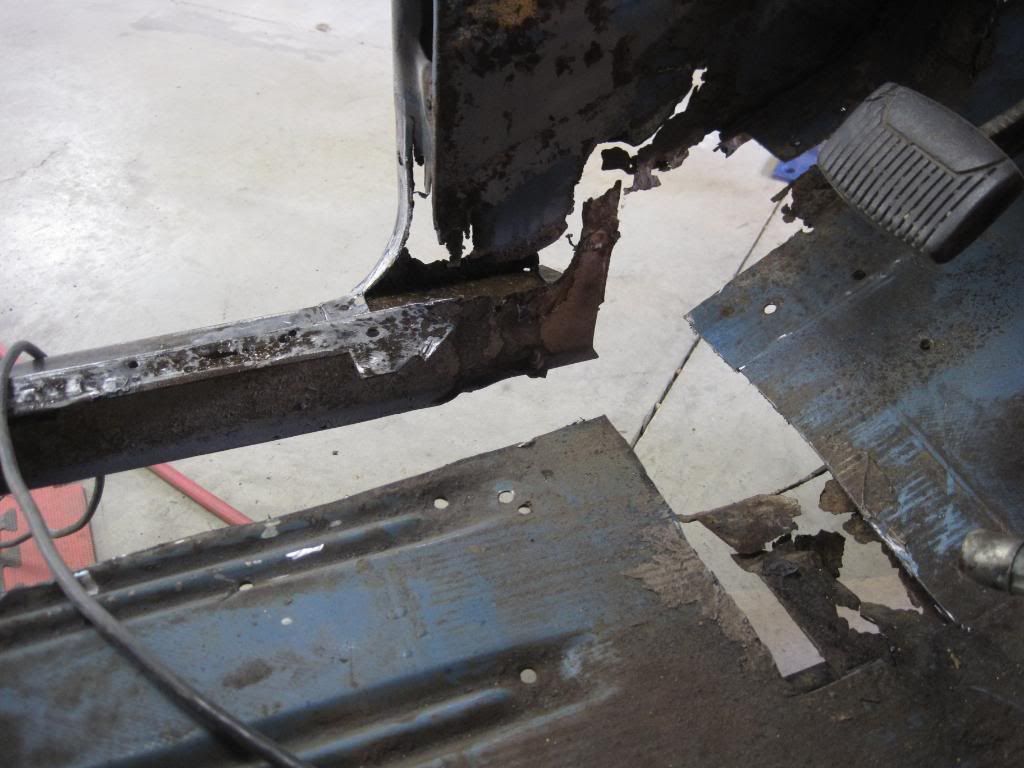
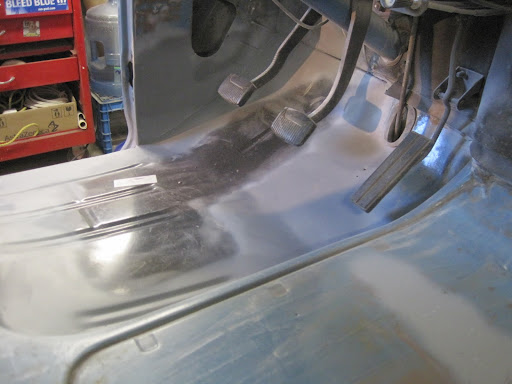
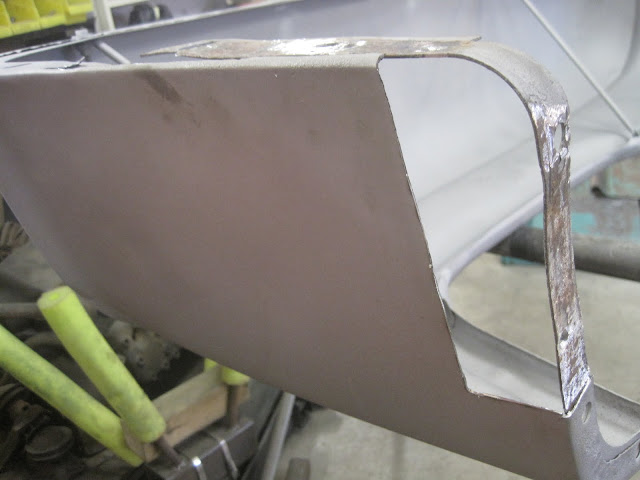
I have a nephew who helps me in the shop when he has free time, and today he started to disassemble an early 90's extended cab Chevy PU for rust repairs, while I was busy bending some brackets for a 55 chevy. We have some lower cab repair panels to install on the PU just behind the doors. How hard can this be, right? As my luck normally runs, there was more damage than meets the eye, and the rear of the passenger rocker also needed repair.
Picture037-1.jpg


Picture038-1.jpg


Picture039-1.jpg


Even though this would get covered up by our repair panel, any moisture/water that would get channeled through would exit the rust hole (instead of draining out the bottom) and settle inside our new panel, starting the rust process in a hurry. So I grabbed a piece of 19ga, and using the offset dies in the bead roller, some shrinking here and there, a few rolls through the english wheel to contour......


Picture040-1.jpg


Quite a bit of hammering using makeshift anvils..........


Picture041-1.jpg


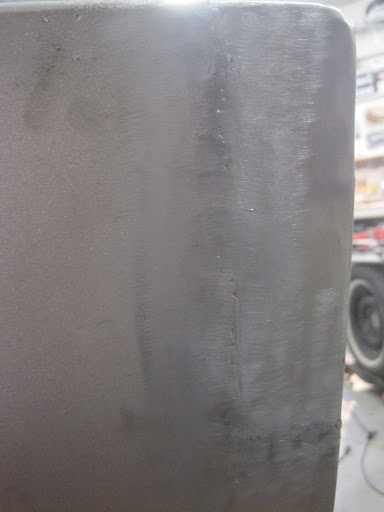
I tried to make it all in one piece, but couldn't seem to get enough shrink on the rear flanged taper. Had to cheat, cut a sliver and welded up the seam. Turned out pretty nice.....and won't see most of it. :lol_hitti


Picture043-1.jpg


Picture044-1.jpg
 

e-tek

Well-known member
Joined
Dec 19, 2007
Messages
10,690
Location
Saskatoon, SK
As my luck normally runs, there was more damage than meets the eye, and the rear of the passenger rocker also needed repair.
I know you meant it "tongue-in-cheek" Rob, but when was the last time you had "good luck" and there was LESS damage than meets the eye!! LOL!! Rust never sleeps. always creeps....and all that! As usual, very nice work - I'm sure your nephew will always look back with fondness over what you taught him.

Remember this "little" rust job I posted last year? It just kept coming and coming!!

Crozon66Ford012-1.jpg


In the end I can only hope I got most of it!!

IMG_1856.JPG


Here's the link if anyone's interested: http://www.garagejournal.com/forum/showthread.php?t=50692

In the end I can only hope I got most of it!!

Luckily, this years project is in MUCH better shape!!

IMG_3600.JPG


IMG_3633.JPG


Again: link: http://www.garagejournal.com/forum/showthread.php?t=74725

Some restorers feel like cancer surgeons (Not to make light of "real" cancer of course - just a crude analogy). Cutting a little more than you think to make sure "you got it all".... Grafting in clean tissue...Hoping the patient doesn't have to come back....

"NURSE! I need suction!!!!" :lol_hitti:lol_hitti
 

e-tek

Well-known member
Joined
Dec 19, 2007
Messages
10,690
Location
Saskatoon, SK
Isn't Sunchaser tools still making them? I believe they were the originators... could be mistaken though.

As you mentioned, I also know a guy who purchased one and loves it. I did not get to see it in action though.

Yes they are. As well, my fave web-based AB supply store (www.autobodystore.com) has them: http://autobodystore.net/Merchant2/merchant.mvc?Screen=PROD&Product_Code=DAGSD1&Category_Code=MWH

I think the reason you don't see many are that they aren't used in production shops, as most panels are just replaced now and guys will use the torch first if they have to shrink. As well, it's a bit of a "backwards" process, 'cause you have to have the metal "high" before using it, even if that means you have to "bump it up" in order to then shrink it down... Guys that like to metal-finish are not the mainstream auotbody techs (and as Robert often shows, they are the craftsmen!). As well, can you imagine how long a SS disc would last? They aren't selling them in boxes!:bounce:
 

gelierb

Well-known member
Joined
Nov 16, 2010
Messages
52
Location
Redwood City, CA
“Had to cheat, cut a sliver and welded up the seam. Turned out pretty nice.....”

For me, in the garage (with hacksaw/file/vise), cheating is a way of life. I scratched my head for a long time trying to decide if I should buy after market quarters, etc. to get this curved piece with the lip. The after market stuff didn't look that great. Thought about trying a hammer form but realized it would even be even trickier for me to try and make the wood form. I bent this piece around a plastic bucket, did the 90 degree folds with hammer/vise, and actually cut the old “lip” off the original panel (mostly toast but the lip area was good) and welded it to the new. So far, I think it looks pretty good, considering. :)

cheat1.jpg


cheat2.jpg
 
Last edited:

gelierb

Well-known member
Joined
Nov 16, 2010
Messages
52
Location
Redwood City, CA
1. For grinding the welds, 3M makes a 3/16" thick 3" grinding wheel for a bit more surface area. It is part # 01991. It would definitely help from gouging the metal, have less side flex and last longer than a 1/16" wheel.
These look great.


...some 2K epoxies in spray cans, that would help for small areas, rather then use a brush or dirty your gun, as mentioned...
Would this be a good (or acceptable) foundation whatever primer/base layers come along later? Anyone have experience with these rattle cans?
 

e-tek

Well-known member
Joined
Dec 19, 2007
Messages
10,690
Location
Saskatoon, SK
gelierb your patch looks great - as does your welding!

As for the Epoxy in a can, I have used it a couple times over the years, plus I've shot per-hardened paint from a can (mixed up at a store and purchased by a neighbour). They work "OK" (taking into account spray patterns of a can tip) and although it would likely be "generally" compatible, there's always something that "could" go wrong when mixing manufacturers (Improbable Incompatibilty!). The advantage (I guess) is convenience, but the draw-backs would be usage-time (before it hardens in the can) and what I described above, re: compatibilty.

Although I spray Etch primer from acan quite often for smaller parts and areas, it doesn't have a hardener. For hardened stuff I mix it and use the gun.
 

gelierb

Well-known member
Joined
Nov 16, 2010
Messages
52
Location
Redwood City, CA
Home made plug welding – welder helper tool:
In this small, in process patched area on a door – this thing is down inside the door, holding a small ¼” 18 GA disc behind the 1/8” hole on the right - ready for weld.

hole_in_process.jpg


Also made up a copper attachment (below). More “long-winded” details if you want them at:
http://www.fj40toolbox.com/tools.php

copper_action_6.jpg
 

gelierb

Well-known member
Joined
Nov 16, 2010
Messages
52
Location
Redwood City, CA
House of Kolor used to have Chromate in their KP epoxy, and it stuck well to anything. With the introduction of regualtioins and restrictions, they have removed the chromates, hence the CF (chromate free) in the ...

What's a really good epoxy primer currently available - that would also be for sale in California? I realize something like PPG's DP-series is out of the question these days? Maybe something from House of Kolor?

Thanks,
Gus
 

MP&C

Well-known member
Joined
Oct 21, 2009
Messages
4,396
Location
Leonardtown, MD
I started using House of Kolor epoxy primer about 15 years ago, painting some Harley tanks. Got them primed and guide coated, and forgot the owner wanted the tanks sealed (creamed). First part of the sealing process is the cleaning process, where you place a section of sash chain inside the tank, along with their cleaning solution, MEK. The chain is to knock any loose material (weld slag, etc) off, and works via agitation. (yes, shake it up) Yours truly thought I could do this without a cap in place, and soon I had MEK running down the side of the tank, guide coat running off with it. Stopped what I was doing, wiped down the tank, and the only thing the MEK touched was the guide coat. EP never budged, didn't wipe off, nothing on the rag.

All that said, it is not without it's issues. I've been using it ever since on restorations and motorcycle work, and the only problem I've ever encountered with the H/K EP was after spraying over an owner's application of Ospho on his Model A street rod. And just like most compatibility issues, the problem doesn't show up until a few months later after it's been sitting in the sun. A call to H/K tech line confirmed, their EP did not play well with rust conversion type products. I was told to abrade the metal to get rid of any rust, fix anything that wouldn't turn shiny (replace rust with new metal), and paint directly over the bare metal. I haven't had any issue since with the H/K EP. I don't really use the rust conversion products; I don't care for POR products except in some inaccessibility circumstances; but I am a firm believer in replacing what looks like crappy rusty metal with new shiny stuff. That new shiny stuff tends to hold paint for a good while longer than something with "converted" rust ....any day of the week.

Now I'm not telling you to rush out and buy H/K, this wasn't to plug their product. But it should show that you need to look at your complete paint job and insure compatibility throughout to eliminate problems like the one I described above. Some brands of EP will have reaction issues when sprayed over etch primer, in much the same way as my issue with Ospho, so some reasearch is in order before rushing out to buy a rust conversion product or getting some etch primer because that's what your neighbor from the body shop uses. Another consideration would be close proximity of a paint jobber to your area. If it's easier to drive somewhere and pick up another quart if you think you'll run low, it may make one brand more appealing if that's what they carry. I think all are comparable, and all likely have their little quirps. I would be curious to ask why you say PPG DP is no good. Not that I'm using it or defending it, but trying to learn something. I've heard some people say they can wipe it with laquer thinner and the paint comes off on the rag, and yet others say that once fully cured, nothing touches it. ????

Which kinda brings this to another point, why was someone using laquer thinner on the epoxy? If it was to test the paint, that's one thing. If it was to use as a preclean, that would be another issue:

A wax and grease remover is typically a slow evaporating solvent, which allows it to "float" the impurities to the surface where a final wipe will remove them. If you've ever used W&G remover, you'd have seen how it leaves a film upon first application. Most manuf. recommend using one cloth to apply, and a second to wipe. Some people choose to use Laquer thinner without fully understanding this principle. Lacquer thinner dries too fast to perform as effectively as W&G remover. Once you have wasted time, money, and material from having fisheye show up in your paint, any extra expense for purchasing the right product for the job will be well worth it.

On the primers, my personal thoughts are the Epoxy will give you a better, more stable base. For the enthusiast or restoration shop, it may make more sense than it would to a production shop, who expects to have your car out the door in three days. In that time frame most EP's would not fully cure. But for the quick turnaround the production shops are looking for, perhaps the etch primer gives a better bite where something didn't get prepped as meticulously as it could have, and the 2K gets things done more quickly than the EP. Safe to say these are products that are really designed for the collision industry, and not restorations. So use caution if you look to your local paint supplier for their recommendation, they will likely steer you toward buying what they sell the most of, and their largest customer base is the collision industry.

Other brands that have epoxies include Dupont, PPG, SPI, Sherman Williams, and many others. (Yes, Sherman Williams does make industrial coatings) Most of these will also have a value line product, (i.e: H/K is Valspar, Dupont is Nason, etc.) Like I said earlier, most are comparable products, slight differences here or there. Some are direct to metal primers, some need an etch first, others may not be compatible with etch primers. So there, I've probably given you more questions than answers, but it should help you a bit more in what to look for in your research.
 
Last edited:

e-tek

Well-known member
Joined
Dec 19, 2007
Messages
10,690
Location
Saskatoon, SK
Or you could ask rlocal AB supply store - they are a wealth of knowledge and (should) understand the compatibilty issues of their products.
 

gelierb

Well-known member
Joined
Nov 16, 2010
Messages
52
Location
Redwood City, CA
I would be curious to ask why you say PPG DP is no good. Not that I'm using it or defending it, but trying to learn something. I've heard some people say they can wipe it with laquer thinner and the paint comes off on the rag, and yet others say that once fully cured, nothing touches it. ????
When I said out "of the question these days" I just meant I can't buy it :(. A local paint supplier told me it's unavailable (at least in California anyway)? I had always heard it was the best and wanted to use it.

As usual, thank you for the incredible feedback. I notice I usually need to read your posts a minimum of three times to make sure I glean all the information they provide. :thumbup:
 

MP&C

Well-known member
Joined
Oct 21, 2009
Messages
4,396
Location
Leonardtown, MD
when i said out "of the question these days" i just meant i can't buy it :(. A local paint supplier told me it's unavailable (at least in california anyway)?

If you asked for DP90, that is the old formulation, and is indeed unavailable. The new stuff is DPLF, which means they took the "good" stuff out to satisfy EPA folks (like the H/K KP-2CF with chromates removed). So if he was referring to DPLF as being unavailable, then that is likely a CA thing and you'll have to try someone/something else...
 
To avoid these ads, REGISTER NOW!
Top Bottom