To avoid these ads, REGISTER NOW!

Welding in patch panels

MP&C

Well-known member
Joined
Oct 21, 2009
Messages
4,396
Location
Leonardtown, MD
Notice the oil can is not as tight as it was. With the oil can up you still see a pronounced bulge. With it pushed down you see and up-down-up-down as a sinusoidal wave. This is indicative of too much metal and its pushing up and down to have someplace to go.. This is all part of reading the panel as you go to see what the metal is telling you. Keep shrinking..
 
To avoid these ads, REGISTER NOW!

mopar4don

Well-known member
Joined
Mar 9, 2013
Messages
103
I know that I need to shrink the highs, but in the above video examples do I push the bulge down and shrink the highs?
 

MP&C

Well-known member
Joined
Oct 21, 2009
Messages
4,396
Location
Leonardtown, MD
you may to shrink outward a bit from center. The wave up and down shows stretch, so you have some outside of center as well.
 

MP&C

Well-known member
Joined
Oct 21, 2009
Messages
4,396
Location
Leonardtown, MD
It is just now starting to loosen up. Keep shrinking. You don’t want it in the down position, that is still metal pushing the extra where it doesn’t belong. Try hitting slightly harder and when you get the oil can where it EASILY flops back and forth, you will be getting close.

for your clearance issue underneath, cut the dolly in half. Plastic is easier to cut than drill out spot welds, so try the easy first.
 

mopar4don

Well-known member
Joined
Mar 9, 2013
Messages
103
The oil can is now gone. Now I need to get the metal closer to the templates. The metal in the valley is to low. I don't expect to match the templates perfectly but am using them as a reference.
I am using my hand feeling for highs and lows and referencing back to the templates and the flexable and straight edge.
So because the metal is a bit low, I am off dollying from the back. Trying to move it back into position.

I started from the hood edge and moved it back slightly. This is close to my template. Anyway I got it pretty good but noticed an area beginning to oil can. It's about 2 inches from the 1st oil can.

So my question is since the valley is to low, how do I move the metal back up? Do I donut dolly?20220402_105348.jpg
 
Last edited:

MP&C

Well-known member
Joined
Oct 21, 2009
Messages
4,396
Location
Leonardtown, MD
If you have metal too low in the valley, flip the fender over and use the hammer from the inside of the fender into the donut dolly on the outside. Should bring the low up a bit more controlled than using off dolly
 

mopar4don

Well-known member
Joined
Mar 9, 2013
Messages
103
And when I get the metal close and I have slight highs and lows, do I use the normal dolly? Or the donut dolly?
 

MP&C

Well-known member
Joined
Oct 21, 2009
Messages
4,396
Location
Leonardtown, MD
I’d keep using donut dolly or small shot bag. Hard dolly is more apt to planish/stretch. As long as you still need to shrink, stay away from hard steel dolly as much as possible.
 

mopar4don

Well-known member
Joined
Mar 9, 2013
Messages
103
Maybe I should get the metal low and fill it with filler.
I have been messing with this for at least 6 hours and I don't feel like I am getting anywhere! :brickwall:

I feel like I am back where I started.


MP&C

Well-known member
Joined
Oct 21, 2009
Messages
4,396
Location
Leonardtown, MD
Whether it is pushed up or down matters not, you still have excessive metal. Pushing it down and smearing it with filler is just asking for it to pop up one day out of the blue. The fender is apart, you have the tools, make it happen. Part of the length of time here is due to the light taps. Go ahead and hit it harder but not hard enough to leave a dent the other way.

Quit worrying about what it looks like when you force it down, that is not its natural state and I don’t recommend keeping it that way. Leave it pushed upward and Shrink the high spots.

keep checking it with the ruler laid over at a angle to get a true reading of the highs and lows, and also use you templates. Find where the high spots are and shrink those. Oh yeah, quit popping it down and reading that with a ruler, it’s not where it belongs and its helping to confuse the issue. Shrink the high spots. Shrink the high spots. Shrink the high spots.
 
Last edited:

mopar4don

Well-known member
Joined
Mar 9, 2013
Messages
103
But when i work around the high spot (approx 4 inch bulge) it suddenly reverses and becomes a large low area. So I put the donut on top and hammer from underneath. Then it reverses again. I am hitting it hard and don't know what I am doing wrong.

I really appreciate the time your taking to help me.

I have also tried a high crown hammer. Same results.
 

no704

Well-known member
Joined
Apr 27, 2016
Messages
5,205
I’m definitely not versed in this field, but if it’s been stretched that much? Would it be a bad idea to slice it with an .045 dremmel death wheel and re weld?
 
To avoid these ads, REGISTER NOW!

mopar4don

Well-known member
Joined
Mar 9, 2013
Messages
103
Ok here is where I am at. The metal is to low. So the donut dolly should be on top and I am hitting from below, right?

1st pic shows flexable straight edge 2 inches in from the valley
20220407_183132.jpg

2nd pic shows the valley

20220407_183145.jpg

3rd pic shows 2inches out from the valley
20220407_183158.jpg
 

mopar4don

Well-known member
Joined
Mar 9, 2013
Messages
103
I’m definitely not versed in this field, but if it’s been stretched that much? Would it be a bad idea to slice it with an .045 dremmel death wheel and re weld?
I don't think that is a good idea.
 

PugetDude

ALLIANCE MEMBER
Joined
Mar 13, 2013
Messages
22,263
Location
Superstition Mountains, AZ
I’m definitely not versed in this field, but if it’s been stretched that much? Would it be a bad idea to slice it with an .045 dremmel death wheel and re weld?
I'd probably be trying heat-shrinking by now. Oil canning is the toughest thing to fix, IMO. But that's why I'm not a bodyman.
 

MP&C

Well-known member
Joined
Oct 21, 2009
Messages
4,396
Location
Leonardtown, MD
Ok here is where I am at. The metal is to low. So the donut dolly should be on top and I am hitting from below, right?

1st pic shows flexable straight edge 2 inches in from the valley
20220407_183132.jpg

2nd pic shows the valley

20220407_183145.jpg

3rd pic shows 2inches out from the valley
20220407_183158.jpg

Can you push the low up from the bottom as you did before? It didn’t just “become” a low, it was high in the last video. So will it push upward and stay there?
 

mopar4don

Well-known member
Joined
Mar 9, 2013
Messages
103
Ok here is the last video of the day.
I am TIRED. At least 4 hours of hammering.
What am I doing wrong?


MP&C

Well-known member
Joined
Oct 21, 2009
Messages
4,396
Location
Leonardtown, MD
Don, this is a repeat from earlier in this thread, but I'll add it again here so you can find it easily...


One of the guys over on the metal shaping web sites has a neat tool he sells called a donut dolly. It works more proficiently in off-dolly shrinking a crowned panel because it supports the bottom side in more than one spot (around the perimeter) as the panel is bumped from the top in the center of the donut dolly. This would seem to be useful in body repair, especially to address high spots found after blocking primer where heat would not be as feasible.

A few days ago, someone on another forum asked for advice in removing an outward roof dent. I suggested a low-buck alternative to the donut dolly, simply using a PVC pipe fitting. Where it may not work as aggressively as the donut dolly which has more mass, sometimes slower is better, especially when trying something new. I just today got around to trying this process in the shop, and rather than use the roof of something sitting here, we will use a piece of 18 ga CRS to simulate a roof.

Grid layout for the Wheeling Machine, and completed "sample" roof...


Picture112.jpg


Picture113.jpg


The first order of business should be to make some profile templates. In the case of an actual dented roof, use the opposite, undamaged side. This will allow you to check your progress as you go, and easily find the remaining high spots.


Picture114.jpg


Picture115.jpg


Using a crowned body hammer, a "dent" will be added from the back side, crossing both of our template areas.


Picture118.jpg


With the dent added:


Picture119.jpg


Picture120.jpg


Picture121.jpg


I chose to use a PVC elbow, it had two different sized ends for two tools in one. As with any body tool, they should be free of any burrs that may mar the metal surface. I also added a slight radius to the edges...


Picture123.jpg


Picture124-1.jpg


Holding the dolly against the bottom of the panel, you can see that due to the dents it only touches the panel at the red arrows. Based on off-dolly principle, the shrink would occur more prominently in the direction of the red arrows. If we needed to shrink in the direction of the green arrows, we would need to relieve two sides of the dolly to allow a contact pattern in the direction of the green arrows. This makes it especially important to check your progress with the templates, not only to find the high spots but more importantly to see which direction requires shrinking to insure the contact pattern will provide the neccessary shrink.


Picture142-1.jpg


Here are the tools we will use today:


Picture140-1.jpg


After some off-dolly bumping:


Picture133-1.jpg


Check with the templates


Picture130-1.jpg


Picture131-1.jpg


Progress....these are light taps only with the hammer. We just want to bring down the high spots, not create craters.


Picture136-1.jpg


Picture137-1.jpg


Here's where I finished up...


Picture134-1.jpg


Picture135-1.jpg


I have a little over an hour in making the panel, denting, and removing the dent. Where I still could have gone a bit more, it was about to a point where high build primer should have masked any remaining imperfections. This dent removal could also have been accomplished with heat shrinking using an O/A torch, etc, but for those times where you may not wish to use heat and want another option, this seems to work well. I think with using the donut dolly and it's heftier mass, one could shave some additional time off the repair.
 

MP&C

Well-known member
Joined
Oct 21, 2009
Messages
4,396
Location
Leonardtown, MD
Next, to further explain the benefit of the donut dolly, lets compare to typical off-dolly..
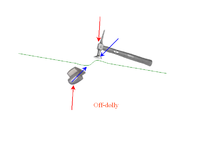

OffDolly.png

....where a dolly is placed behind a low spot, a hammer strikes the high spot on the opposite side. This brings the metal closer to flat, but does minimal shrinking. For an area that is stretched, you will still see the stretch in the form of a bulge, such as you see on top of your fender... Next, some basics....

Where most hammers will have its face parallel with the handle, when hammering you want to keep the handle parallel to the panel surface at the point the hammer face impacts the metal.. This is to prevent any coining marks that may occur from one edge hitting first..
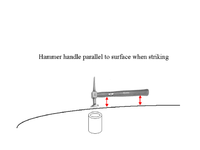
hammertechnique.png


Next, the donut dolly does so much better at shrinking than the off-dolly depicted above because the panel is supported around the perimeter of the dolly and the hammer hits the high spot into the hollow of the dolly, trapping the metal.


Next, lets talk about the theory behind the dent forming. Typically any dent is going to have direct and indirect damage. the "striking blow", or whatever caused the damage, is going to push inward on the panel surface. Where this direct force overcomes the support of the crown in the panel it will stretch the metal as well as pull some along for the ride, creating a dent. There is also a certain amount of spring-back that occurs, as this stretched area is pushing outward as the metal now has more surface area. The spring-back will show up as a slightly raised area that surrounds the dent/damage. In dent removal you would want to ignore this indirect "side effect" and shrink the area that stretched, the direct damage. Once the stretch is removed and not pushing outward, the indirect damage will relax to it's normal state.


Now with this spring-back theory in mind, a donut dolly works in a similar fashion. In the ideal setting, your hammer strike would push the metal into the hollow of the donut as the perimeter is providing support, and the spring-back would bring the metal surface back to flat.. Too much hammer action (either hit too hard or hammer too much crown) and you will leave a dent. Too light of a hammer swing and you don't push far enough into the hollow to capture the stretch. So it's a fine line that has to be learned, just as someone does with planishing welds to find that correct amount.


Now that we know more of how the donut dolly works, here are some limiting factors.. If you have a flat hammer and a flat panel, the metal does not push into the hollow enough to shrink. Here you would want to use a crowned hammer, but proceed with caution that your hammer swing does not add dents... you want enough force to push the panel inward but not enough to leave a dent. So although you have a slight bit of crown in that stretched out bulge, it would be more responsive to the donut dolly by using a slightly crowned hammer..


Lastly, some constructive criticism. Take it with a grain of salt, not picking on YOU, just your methods.. :ROFLMAO: Besides, it's a good learning tool for everyone else.. In your hammering videos, some of the effort seems to be a bit haphazard and lacks purpose. Meaning the dolly should support the metal and our hammer taps should push metal into the hollow of the dolly. Nothing more. When your hammer strike drives the panel inward and carries the dolly with it, this is not going to be an effective shrink. You're doing nothing more than pop the panel back and forth as you did by hand, only now a hammer is pushing it, so likely this action added stretch back in the panel.. Your hammer strikes need to be accurate and with purpose. Now knowing better how the donut dolly works, I think if you can used a crowned hammer without adding dents in your strikes, or without pushing past the dolly, it should work well for you.. the last item for possible improvement is a slightly larger target, ie: larger TEE fitting. Just be aware the larger the void, the more prone to inward dents. So adjust hammer swing accordingly. You started with a very tight oil can that was difficult to cycle back and forth... The next step in showing progress toward your goal is an oil can not so tight, then an oil can that is loose. All while verifying what the panel is doing through use of the laid over ruler for front-back crown, and your profile templates for side to side. Keep shrinking the highs.. but do them with purpose, don't just hit around haphazardly. Check using your profile tools to see where the highest part is, always go after the highest first..
 

mopar4don

Well-known member
Joined
Mar 9, 2013
Messages
103
I really appreciate your help! Your write up explaining the principles is absolutely amazing and makes sense.

However in my case (because of inexperience) I think my biggest problem is reading the metal, or knowing what to do and what not to do.
I agree with your assessment of my hap-hazarrd hammer strikes. And since those videos I mounted my donut dolly to a scrap piece of 2x2 that extends to the floor.

20220409_122004.jpg


I also am now making sure that I align the donut dolly to hammer strike. So I am much more accurate now.
I will admit I have hit the metal to hard and put dents in the metal. Which I worked out in a circular motion which in the end the bulge popped down and stayed in that "hard" oil can. Which is where I started.

I have also done the process with hammer strikes that produced slight, and I mean slight dents. Again working around hitting the highs in a circular motion. But still ended up with the metal wanting to pop downward staying in that tight oil can.

SO It sounds like I need to try again with out any visible dents.... I will let you know how it turns out.
 
Last edited:

MP&C

Well-known member
Joined
Oct 21, 2009
Messages
4,396
Location
Leonardtown, MD
Looking at video 1, you can see it working as you are hitting. You see flats appear as you hit. As far as the loose area, that is what you are looking for to show that the shrinking is working. When it becomes loose, leave it alone. Find the next high spot. shrink. start checking with your ruler and profile templates more often in between, so you can MAKE SURE the high spot is where you think it is.. Find the next high spot. shrink. find the next high spot. shrink. Find the next high spot. shrink.. before you know it the high spot is gone.
 

mopar4don

Well-known member
Joined
Mar 9, 2013
Messages
103
Is it normal for those loose areas to tighten up as I shrink some highs?
When it happens it feels like I just lost the ground I gained.
 

MP&C

Well-known member
Joined
Oct 21, 2009
Messages
4,396
Location
Leonardtown, MD
Any stretched area will have a tendency to pull/push on adjacent areas, so yes it is possible. Go to the next high spot..
 

jmdirk

Well-known member
Joined
May 4, 2015
Messages
695
Don, this is a repeat from earlier in this thread, but I'll add it again here so you can find it easily...


Holding the dolly against the bottom of the panel, you can see that due to the dents it only touches the panel at the red arrows. Based on off-dolly principle, the shrink would occur more prominently in the direction of the red arrows. If we needed to shrink in the direction of the green arrows, we would need to relieve two sides of the dolly to allow a contact pattern in the direction of the green arrows. This makes it especially important to check your progress with the templates, not only to find the high spots but more importantly to see which direction requires shrinking to insure the contact pattern will provide the neccessary shrink.


Picture142-1.jpg

You've provided fantastic explanation on the mechanics which I think helps a lot in understanding 'why' and gives the background necessary to apply the techniques in various situations. Rather than just saying 'Do this' instead you tell us why.

The above quoted does confuse me a bit. You said that in order to create more shrink in the direction of the green arrows, you've have to relieve the dolly a bit so you get contact there. Given that it appears the dent was more oblong, to me it feels like that is exactly what you would want to do, at least in the middle part of the dent and shrink in the direction of the red arrows more at the 'tips' of the oblong shape. You never did state whether you did actually relieve the dolly or left it flat. Based on your description of the technique, it seems like it would make sense to have maybe to versions, one flat to do work on small circular dents where you'd want to shrink in all directions simultaneously, and a relieved version that you could use a rotate depending on which direction you want to shrink.

Or am misunderstanding the technique and principle here?
 

mopar4don

Well-known member
Joined
Mar 9, 2013
Messages
103
Would a weld dot right in the center of the bulge be causing me any problems? I also noticed that it has a crack along the edge.
I'm sure it happened because of all the hammer hits it received.
I should probably re-weld it now before I get the metal moved into position?


Last edited:

MP&C

Well-known member
Joined
Oct 21, 2009
Messages
4,396
Location
Leonardtown, MD
You've provided fantastic explanation on the mechanics which I think helps a lot in understanding 'why' and gives the background necessary to apply the techniques in various situations. Rather than just saying 'Do this' instead you tell us why.

The above quoted does confuse me a bit. You said that in order to create more shrink in the direction of the green arrows, you've have to relieve the dolly a bit so you get contact there. Given that it appears the dent was more oblong, to me it feels like that is exactly what you would want to do, at least in the middle part of the dent and shrink in the direction of the red arrows more at the 'tips' of the oblong shape. You never did state whether you did actually relieve the dolly or left it flat. Based on your description of the technique, it seems like it would make sense to have maybe to versions, one flat to do work on small circular dents where you'd want to shrink in all directions simultaneously, and a relieved version that you could use a rotate depending on which direction you want to shrink.

Or am misunderstanding the technique and principle here?


Theoretically, I think it still holds true. Realistically, I think you can just use a flat donut dolly and it would shrink between the contact points to the panel, and eventually everything would catch up once things start to flatten out. If we kept reshaping the tool it wouldn't be around long :ROFLMAO:

Would a weld dot right in the center of the bulge be causing me any problems? I also noticed that it has a crack along the edge.
I'm sure it happened because of all the hammer hits it received.
I should probably re-weld it now before I get the metal moved into position?


Don, was this a MIG weld? If so, a TIG or gas weld would be better to offer similar properties that the parent metal shows. With all the popping back and forth you were doing it may have caused a fracture, normally happens adjacent to a weld.
 
To avoid these ads, REGISTER NOW!
Top Bottom