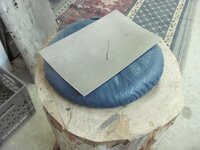
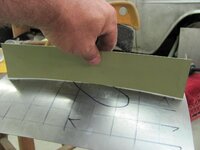
Next, to further explain the benefit of the donut dolly, lets compare to typical off-dolly..
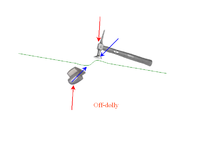
....where a dolly is placed behind a low spot, a hammer strikes the high spot on the opposite side. This brings the metal closer to flat, but does minimal shrinking. For an area that is stretched, you will still see the stretch in the form of a bulge, such as you see on top of your fender... Next, some basics....
Where most hammers will have its face parallel with the handle, when hammering you want to keep the handle parallel to the panel surface at the point the hammer face impacts the metal.. This is to prevent any coining marks that may occur from one edge hitting first..
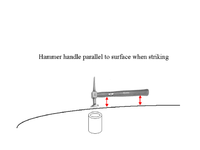
Next, the donut dolly does so much better at shrinking than the off-dolly depicted above because the panel is supported around the perimeter of the dolly and the hammer hits the high spot into the hollow of the dolly, trapping the metal.
Next, lets talk about the theory behind the dent forming. Typically any dent is going to have direct and indirect damage. the "striking blow", or whatever caused the damage, is going to push inward on the panel surface. Where this direct force overcomes the support of the crown in the panel it will stretch the metal as well as pull some along for the ride, creating a dent. There is also a certain amount of spring-back that occurs, as this stretched area is pushing outward as the metal now has more surface area. The spring-back will show up as a slightly raised area that surrounds the dent/damage. In dent removal you would want to ignore this indirect "side effect" and shrink the area that stretched, the direct damage. Once the stretch is removed and not pushing outward, the indirect damage will relax to it's normal state.
Now with this spring-back theory in mind, a donut dolly works in a similar fashion. In the ideal setting, your hammer strike would push the metal into the hollow of the donut as the perimeter is providing support, and the spring-back would bring the metal surface back to flat.. Too much hammer action (either hit too hard or hammer too much crown) and you will leave a dent. Too light of a hammer swing and you don't push far enough into the hollow to capture the stretch. So it's a fine line that has to be learned, just as someone does with planishing welds to find that correct amount.
Now that we know more of how the donut dolly works, here are some limiting factors.. If you have a flat hammer and a flat panel, the metal does not push into the hollow enough to shrink. Here you would want to use a crowned hammer, but proceed with caution that your hammer swing does not add dents... you want enough force to push the panel inward but not enough to leave a dent. So although you have a slight bit of crown in that stretched out bulge, it would be more responsive to the donut dolly by using a slightly crowned hammer..
Lastly, some constructive criticism. Take it with a grain of salt, not picking on YOU, just your methods..

Besides, it's a good learning tool for everyone else.. In your hammering videos, some of the effort seems to be a bit haphazard and lacks purpose. Meaning the dolly should support the metal and our hammer taps should push metal into the hollow of the dolly. Nothing more. When your hammer strike drives the panel inward and carries the dolly with it, this is not going to be an effective shrink. You're doing nothing more than pop the panel back and forth as you did by hand, only now a hammer is pushing it, so likely this action added stretch back in the panel.. Your hammer strikes need to be accurate and with purpose. Now knowing better how the donut dolly works, I think if you can used a crowned hammer without adding dents in your strikes, or without pushing past the dolly, it should work well for you.. the last item for possible improvement is a slightly larger target, ie: larger TEE fitting. Just be aware the larger the void, the more prone to inward dents. So adjust hammer swing accordingly. You started with a very tight oil can that was difficult to cycle back and forth... The next step in showing progress toward your goal is an oil can not so tight, then an oil can that is loose. All while verifying what the panel is doing through use of the laid over ruler for front-back crown, and your profile templates for side to side. Keep shrinking the highs.. but do them with purpose, don't just hit around haphazardly. Check using your profile tools to see where the highest part is, always go after the highest first..