To avoid these ads, REGISTER NOW!

Welding on an air compressor

To avoid these ads, REGISTER NOW!

1320stang

Well-known member
Joined
Dec 28, 2006
Messages
4,565
Location
Edmond, OK
Reznunt,

Here's your solution. Take a piece of steel and form it to the tank so that it lines up with the leg. If you want, make two, one for each side of the leg. Drill holes thru the leg and bracket(s) so the formed piece(s) will sit against the tank. Trace the bracket location(s) and remove the paint down to bare metal. Prep the bracket(s) face that touches the tank and get some epoxy to bond it to the tank. I'd suggest Dexter Hysol, but something that is thinner than the kneeding type, but thicker than JB Weld. You could probably take it to a body shop once it's ready and have them use a gun that they use to glue door hinges to A pillars.

After it dries, touch up the paint and go.
 

MoonRise

Well-known member
Joined
Nov 5, 2010
Messages
4,028
Location
NJ
Hey, I am generally a DIY guy.

Will I weld an air compressor tank or a fitting to the same or bracket to the same? Nope.

Liability. Even if it turns out it had nothing to do with my hypothetical weld, as soon as -I- welded it, my **** is on the line.

If you weld it, then YOU are on the hook if it -ever- fails. The legal and financial liability is waaaay more $$$ than just replacing the air tank. Even if it turns out that your 'repair' had nothing to do with a failure down the line, the costs to prove/show that would be much-much-much more than just replacing the tank completely.

Can you meet all the required ASME Boiler and Pressure Vessel code requirements?

Can you meet any other locality-based Code requirements relating to welding and repair of a pressure vessel?

You don't even -know- what alloy the steel on the tank is. You don't -know- the metallurgy. You don't -know- if the factory/OEM weld 'damaged' the tank metal itself. You don't -know- the metallurgy of the crappy factory/OEM weld filler.

Too many unknowns there.

Does it matter? Yup.

http://www.hghouston.com/pvessel.html

http://www.nationalboard.org/Index.aspx?pageID=164&ID=189

http://www.nationalboard.org/Index.aspx?pageID=164&ID=187

Short excerpt from the above:

Good fabrication generally means attention to detail, and it, too, is essential for failure avoidance. As a minimum, this requires understanding of and adherence to the relevant codes. They represent the corporate experience of many segments of the industry and should not be taken lightly. Code requirements for welding documentation and control such as preheat, postheat, care of consumables, and operator skill levels need to be observed. The author has sometimes found codes and specifications treated as if they were desirable goals and not minimum performance standards. From the failure avoidance viewpoint, they are the starting point, not the end point, of control.

...

One of the special problems in fabrication is repair welding or, in an extreme case, retrofitting, of a finished product. Repair welding of a structure, such as a pressure vessel, is usually more difficult than initial welding, and requires more, rather than less, care. The vessel is more highly constrained, is more difficult to access, is harder to preheat and postheat than before, and sometimes is also harder to inspect.


http://www.twi.co.uk/content/oilgas_casedown26.html

http://www.twi.co.uk/content/ksih001.html

http://www.twi.co.uk/content/spjsjan2005.html

http://www.twi.co.uk/content/oilgas_casedown27.html

http://www.twi.co.uk/content/oilgas_caseup31.html

http://www.twi.co.uk/content/oilgas_casedown28.html

http://www.twi.co.uk/content/oilgas_casedown30.html

http://www.thefabricator.com/articl...should-know-about-welding-codes-and-standards

http://www.thefabricator.com/articl...ws-welding-codes-similarities-and-differences

http://www.thefabricator.com/article/trainingretention/but-anybody-can-weld-rightr

http://www.practicalmachinist.com/vb/cnc-laser-waterjet-plasma-welding-fab/patching-air-tank-146850/

http://www.smokstak.com/forum/showthread.php?t=32559

How about the DOE/NRC doing some experimental weld repairs to thick-walled (6inch thick) pressure vessels? They found that the welding-induced residual stresses in the surrounding base metal generally reached the yield-stress level.

http://www.osti.gov/bridge/servlets/purl/6703769-oj7oiJ/6703769.pdf

How about failure of an aluminum pressure vessel (water tank pressurized by air to push the water out) that was originally negligent in design and materials and workmanship, resulting in the fatality of a welder who tried to repair some 'cracks'? Tank failed at less than the tank's nameplate pressure rating of 60 psi, failed in a part of the tank that he had not even worked on, and basically cut him in half. The original design, materials, and workmanship all failed to meet ASME pressure vessel codes.

http://www.cna.com/vcm_content/CNA/...oncreteMixerWashoutTankAccidentReport_CNA.pdf

I strongly suspect that in that lawsuit the original manufacturer of the tank paid. Dearly. The welder lost his life, he couldn't pay any more and the failure wasn't even his direct or even indirect fault. Although he probably could/should have done the pressure testing in a safer manner (hydrostatic pressure test and not an air-pressure test).

Oh, also add in that state and Federal OSHA or other regional/provincial often have safety Codes and regulations regarding the operation and especially the repair of pressure vessels and it -IS- a BigDeal.

Do NOT weld on a pressure vessel unless you KNOW what you are doing.

That's MNSHO.

Fix the leg/bracket without welding? Sure. Weld up your replacement leg/bracket/support. Then epoxy it to the original tank. Wait, use some JB-Weld, then you can say you 'welded' it. :lol:
 
Last edited:

rwhite692

Well-known member
Joined
Mar 4, 2008
Messages
1,850
Location
Central Valley, CA
But.... if he epoxies the leg back on, what if the epoxy fails, right at the precise moment when a visiting neighbor's child is crawling next to the tank?

Tank topples over and squashes the poor little foundling waif, like a grape...

....he's just as liable.

I swear, this is one of the most entertaining and ridiculous threads I've seen on GJ in quite some time.
 

csp

Well-known member
Joined
Mar 23, 2010
Messages
5,719
Location
Franktown, CO
Oh, also add in that state and Federal OSHA or other regional/provincial often have safety Codes and regulations regarding the operation and especially the repair of pressure vessels and it -IS- a BigDeal.

OSHA also says that an extension cord has to be thrown away if it is cut in any way, yet in my home there's nothing that says I can't install a new end on it and use it.

Way to blow the "rules and regs" out of proportion relative to to the use and location of the compressor guys! :thumbup:

Fawking ridiculous.
 

1320stang

Well-known member
Joined
Dec 28, 2006
Messages
4,565
Location
Edmond, OK
But.... if he epoxies the leg back on, what if the epoxy fails, right at the precise moment when a visiting neighbor's child is crawling next to the tank?

Tank topples over and squashes the poor little foundling waif, like a grape...

....he's just as liable.

I swear, this is one of the most entertaining and ridiculous threads I've seen on GJ in quite some time.

If he uses the Dexter Hysol 9432NA (I guess it's a Loctite product now) it has a 3000 psi shear strength on abraded steel. 7350 psi tensile strength, 680,000 modulus, we used to use this stuff to attach cell tower antennas to water towers. The steel bracket would tear and the tank distort before the epoxy gave out. It wasn't until it got about 300F that the shear strength dropped significantly.
 

rwhite692

Well-known member
Joined
Mar 4, 2008
Messages
1,850
Location
Central Valley, CA
If he uses the Dexter Hysol 9432NA (I guess it's a Loctite product now) it has a 3000 psi shear strength on abraded steel.

Yes, But what specific surface finish RA will he have to achieve, on that abraded steel?

And what if he wants to operate his compressor on a remote geological expedition, conducted atop a lava flow?
 

1320stang

Well-known member
Joined
Dec 28, 2006
Messages
4,565
Location
Edmond, OK
Well Hell, if you'll sign off on him welding his tank is okay and have it notarized and your attorney mail it to him, by all means do so.

Even if he just strips the paint off with a razor blade and doesn't clean any of the steel (assuming it's a new piece of hot rolled steel) it'll still hold. It's a helluva lot less dangerous than welding on it.

I'm offering up a genuine SAFER solution and all you're offering is smart *** remarks.
 

e-tek

Well-known member
Joined
Dec 19, 2007
Messages
10,690
Location
Saskatoon, SK
Go ahead weld it!Get some advice from that other guy who welds on propane tanks.:thumbup::thumbup::thumbup:
Glad your not my neighbor!:lol_hitti **** DOES happen.

I could find you several pictures of ANYTHING your imagination desires here on the InterWeb!! Including........nevermind:wtf::wtf::bounce:
 

NASTYZEN

Well-known member
Joined
Jun 11, 2010
Messages
2,823
Location
St-Colomban,Que. Canada
Well all I can say is....:eek::monkey_poand:moon::yikes:
Make sure you setup a tripod camera far from the tank and then put your head near the flux core weld mend when you pressure test it.:thumbup:Please have someone post it on you tube so we can all enjoy it!:beer:
 

nismomans13

Well-known member
Joined
May 1, 2008
Messages
438
Location
Pittsburgh, PA
Well i haven't exactly read every post here because most of them are just off the wall stupid, but seeing as i'm probably the one only certified pressurized vessel welders on this board, and have welded countless tubes that see excess of 5-6000psi. I can honestly say, certification or not, I'd weld that leg on in a heart beat.

Are there risks? sure, theres risks driving to the store, theres risks using a grinder without wearing a respirator, hell theres also numerous risks in welding with out wearing a proper osha approved respirator and filters but I would venture to guess than 99% of the people on this board don't put on a mask EVERY time they strike an arc.

Just weld the leg on man and let the rest of these guys enjoy mamby pamby land with their "OMG DON"T DO IT" posts. worst case scenario is the tank would fail at the weld point and it would just crack and let all the pressure out, this thing isn't going to explode and take out the neighbors shed.
 

Skin

Well-known member
Joined
Feb 24, 2010
Messages
11,713
Location
Boston
The bottom of the tanks are usually quite thick, i'm sure you wont get penetration with one of those HF units anyway. Weld away. If you're really paranoid do it on a medium setting, tack it, and just run a beed along the crack on both sides. Its piss poor welding for sure but will hold just fine. Hell of a lot better than any epoxy.
 
Last edited:

rwhite692

Well-known member
Joined
Mar 4, 2008
Messages
1,850
Location
Central Valley, CA
Well i haven't exactly read every post here because most of them are just off the wall stupid, but seeing as i'm probably the one only certified pressurized vessel welders on this board, and have welded countless tubes that see excess of 5-6000psi. I can honestly say, certification or not, I'd weld that leg on in a heart beat.

Are there risks? sure, theres risks driving to the store, theres risks using a grinder without wearing a respirator, hell theres also numerous risks in welding with out wearing a proper osha approved respirator and filters but I would venture to guess than 99% of the people on this board don't put on a mask EVERY time they strike an arc.

Just weld the leg on man and let the rest of these guys enjoy mamby pamby land with their "OMG DON"T DO IT" posts. worst case scenario is the tank would fail at the weld point and it would just crack and let all the pressure out, this thing isn't going to explode and take out the neighbors shed.


There you have it...

Thanks Nismo for injecting a little sanity...
 

bdkruger1

Banned
Joined
Sep 14, 2010
Messages
349
Location
Constant Disbelief
Well i haven't exactly read every post here because most of them are just off the wall stupid, but seeing as i'm probably the one only certified pressurized vessel welders on this board, and have welded countless tubes that see excess of 5-6000psi. I can honestly say, certification or not, I'd weld that leg on in a heart beat.

Are there risks? sure, theres risks driving to the store, theres risks using a grinder without wearing a respirator, hell theres also numerous risks in welding with out wearing a proper osha approved respirator and filters but I would venture to guess than 99% of the people on this board don't put on a mask EVERY time they strike an arc.

Just weld the leg on man and let the rest of these guys enjoy mamby pamby land with their "OMG DON"T DO IT" posts. worst case scenario is the tank would fail at the weld point and it would just crack and let all the pressure out, this thing isn't going to explode and take out the neighbors shed.


AMEN. And I'm probably the only person on here who is Certified by the American Welding Society to certify welders and inspect their work ( CWI ). I've worked in DOE facilities, ASME "N" stamp shops, and of course passed NQA-1 testing to inspect nuclear stuff. I've inspected vessels that were 4 stories tall and made of alloys most on here have never even heard of.


Anyway, just follow my instructions above and weld the *****. Have a nice day.
 
To avoid these ads, REGISTER NOW!

nehog

Well-known member
Joined
Jan 2, 2010
Messages
7,935
Location
Jaffrey, NH
Wow, I've seen enough dumb comments in this thread to last a month...

Were someone (foolishly) weld a tank and it blew up, injuring or hurting someone, then criminal liability would be the result almost certainly. And it would be virtually impossible to prove that the welding done improperly was not the cause of the accident. And should you escape criminal liability, civil liability would certainly ruin the rest of your life, taking all your assets, all your future earnings excluding a pittance to live on, and generally resulting in you wishing you'd been the person killed (or injured).

But say you did weld it (and say you are a reasonably good welder, though I don't get that impression regarding the OP...) at a minimum you would (MUST) get the tank re-certified by a properly re-certifying place (there are companies who will pressure test tanks in most big cities). In the hydrostatic re-certification process the tank is filled with water, and pressurized to about three times the rated (certified) pressure. If it survives they put a sticker on it, if it fails, they hand you a pile of scrap metal worth a dollar if you are lucky. And as a side benefit that hydrostatic re-certification will give you a lot of peace of mind, you can be comfortable using that tank without worrying that some day it will blow. (re-certification isn't that expensive, either...)

One should NEVER ever simply modify a tank and pressurize it with gas, the amount of energy in the gas is amazing, and can easily cause massive damage even if no one is near by to get hit by shrapnel and other flying debris.

MoonRise's posts are absolutely the best in this thread!
 

hh76

Well-known member
Joined
Nov 9, 2010
Messages
3,441
Location
NE Wisconsin
Everyone keeps talking about all the liability when someone gets hurt in a commpressor explosion. Isn't it the same when one of the modifications on your hot rod fails and you plow into a bunch of pedestrians, or when your self installed garage heater lights the building spreads to the neigbors house. Everything in this lawyer friendly world can have consequences.

Like any project, take a close look at your skill level, do some research into what issues may arise if you fail, decide if you are going to do it yourself.

Personally, I'd probably end up tacking it on with a light weld (assuming the tank is in good shape). I've seen some portable compressors on jobsites that have seen far worse.
 
Last edited:

MBfreak

MEMBER EMERITUS
Joined
Dec 10, 2010
Messages
2,301
Location
Linkoping , Sweden
Here is my take.
We used to do it at a process industry where I worked, that contained numerous back up air supply tanks for process instrumentation

Do all normal weld preps. Then fill the tank with water so that the weld spot will be cooled from the inside. Make sure that there are several openings in the tank.
Go ahead and weld.
Fill the tank as ull as you can with water. Attach all fittings and pressurize the tank. Leave for an hour or two.
IF anything at all will break, all that will happen is a small poff and the water will leak out.
Empty the tank and dry it out as best you can.

Or, since its broken leg. Remove also the other leg. Make a strap that goes around the tank that is clamped on by two tensioning bolts. Weld the legs on to the strap, attach over tank and tighten up.

Ola
 

z28snksknr

Well-known member
Joined
Jul 8, 2009
Messages
1,827
Location
Turnersville, NJ
this thread certainly displays the differences between people that have the in-depth knowledge regarding the subject material and those that do not. The ones that identify the consequences of the actions are the only ones thinking clearly. Since when is risking the lives of you or others justified vs. a few ******** "man points" earned by saying "I welded that leg"

And just to "credential drop", I specify ASME vessels for design and fabrication as well as the pressure relief valves that protect them from blowing up, so I'm extremely qualified at saying ASME pressure vessels are not home-hobbyist fabricatable (if I can invent a word) and that their fabrication requires extensive procedures, inspections, and certifications and then they STILL put a 2.5x factor on the vessel's design "just in case".

Just think about it - the people recognized by the entire country and beyond as the foremost experts on pressure vessel fabrication (the ASME board members) still puts a big safety factor on WELL AFTER A HOME WELDER WOULD HAVE SAID "..should be good enough". What makes you so smart to say that doesn't matter?
 

NASTYZEN

Well-known member
Joined
Jun 11, 2010
Messages
2,823
Location
St-Colomban,Que. Canada
AMEN. And I'm probably the only person on here who is Certified by the American Welding Society to certify welders and inspect their work ( CWI ). I've worked in DOE facilities, ASME "N" stamp shops, and of course passed NQA-1 testing to inspect nuclear stuff. I've inspected vessels that were 4 stories tall and made of alloys most on here have never even heard of.


Anyway, just follow my instructions above and weld the *****. Have a nice day.

Yes of course Three mile island and Chernobyl only hurt a handful of people:bounce:

Cut the tank in two on its length,fill with enriched soil and plant some flowers in them.

Go buy a new one made on this continent and you should never have a problem again.If you can,find one that was properly designed in the first place with a supporting ring that has the legs welded to it instead of directly to the tank.Stop buying **** from the chinks and support your own industry.
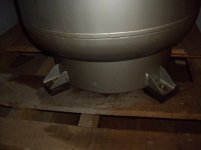
Looking at the failed weld you can see it is very ****** for having cracked in the middle rather than next to it.It also is rusty on part of it.It is called a cyclic failure,meaning it cracked little by little each time the compressor ran thru it's pumping cycle until it finally fell off.Makes you wonder about the integrity of the rest of it's construction no?
I mounted mine on rubber to keep the noise down and vibration to a minimum.If it ever cracks I think Sunflowers will be my choice of plant.:spit:
 

Attachments

  • IMGP5210.jpg
    IMGP5210.jpg
    67.5 KB · Views: 50

MoonRise

Well-known member
Joined
Nov 5, 2010
Messages
4,028
Location
NJ
re: the amount of energy in the compressed gas in even a 'small' relatively low-pressure tank is HUGE.

Think about it. Let's say the compressor has a 'little' 1 HP (real, not 'peak' or other BS HP, so it would probably be 'rated' at somewhere from 2-3 HP while Sears might rate it as 5 'peak' HP) electric motor. To fill the tank to the pressure cut-off may take a minute or two or so. Let's use an example time here of two minutes.

So that's 1 hp for two minutes. That's 550 ft-lb/sec for two minutes. That's 66,000 ft-lb of energy. 66,000 lbs raised 1 ft up and then dropped. The same amount of (rough) energy as 6-10 large caliber 'elephant' guns all at the same time. The same (rough) energy as a 3000 lb car going 25 mph crashing into something.

Release that pressurized gas in a sudden and catastrophic manner and it is waaaay more than capable of killing. See my previous documented example of the 'lowly' less than 60 psi of air in the (completely inadequately designed and manufactured) aluminum air tank CUTTING A MAN COMPLETELY IN HALF.

And to the CWI, all I can say is WTF? As a CWI how can you think that an uncertified welder with unknown/undocumented weld parameters on material of unknown alloy and condition with a fluxcore weld filler of unknown/uncertified CVN properties is somehow 'OK"? Where is the qualified WPS? Where is the welder qualification? Where is the material cert for the filler? Preheat? Post-heat? Hydrostatic test on the pressure vessel after weld repair as REQUIRED by any and all Codes such as ASME?

Pressure vessels are NOT a DIY item. They are not an item where you GUESS or say/think 'should be OK' or 'looks good enough'.

See all those previously posted examples of failures of pressure vessels, done by pros? If or when a pressure vessel failure occurs, the results can be devastating. Destructive and FATAL.
 

ishiboo

Well-known member
Joined
Oct 27, 2010
Messages
9,481
Location
Oshkosh, WI
Here is my take.
We used to do it at a process industry where I worked, that contained numerous back up air supply tanks for process instrumentation

Do all normal weld preps. Then fill the tank with water so that the weld spot will be cooled from the inside. Make sure that there are several openings in the tank.
Go ahead and weld.
Fill the tank as ull as you can with water. Attach all fittings and pressurize the tank. Leave for an hour or two.
IF anything at all will break, all that will happen is a small poff and the water will leak out.
Empty the tank and dry it out as best you can.

Or, since its broken leg. Remove also the other leg. Make a strap that goes around the tank that is clamped on by two tensioning bolts. Weld the legs on to the strap, attach over tank and tighten up.

Ola

I think with water, it should be much safer.

I would NEVER attempt this myself, air compressors are just too cheap to risk my life over, but my concern would not be initial failure. If the weld penetrates far into the tank, the weld is substantially harder then the metal around it. Given the vibrations and repeated pressurizations/etc, a failure at the weld in the future would be my concern.

I think people who err on the side of safety are right here, this is one of those things which you can do a 100 times and not have any issues, but the 101st time something bad happens. It's not worth the risk to me.
 

djd99

Well-known member
Joined
May 4, 2009
Messages
1,006
Location
Owosso,Michigan
re: the amount of energy in the compressed gas in even a 'small' relatively low-pressure tank is HUGE.

Think about it. Let's say the compressor has a 'little' 1 HP (real, not 'peak' or other BS HP, so it would probably be 'rated' at somewhere from 2-3 HP while Sears might rate it as 5 'peak' HP) electric motor. To fill the tank to the pressure cut-off may take a minute or two or so. Let's use an example time here of two minutes.

So that's 1 hp for two minutes. That's 550 ft-lb/sec for two minutes. That's 66,000 ft-lb of energy. 66,000 lbs raised 1 ft up and then dropped. The same amount of (rough) energy as 6-10 large caliber 'elephant' guns all at the same time. The same (rough) energy as a 3000 lb car going 25 mph crashing into something.

Release that pressurized gas in a sudden and catastrophic manner and it is waaaay more than capable of killing. See my previous documented example of the 'lowly' less than 60 psi of air in the (completely inadequately designed and manufactured) aluminum air tank CUTTING A MAN COMPLETELY IN HALF.

And to the CWI, all I can say is WTF? As a CWI how can you think that an uncertified welder with unknown/undocumented weld parameters on material of unknown alloy and condition with a fluxcore weld filler of unknown/uncertified CVN properties is somehow 'OK"? Where is the qualified WPS? Where is the welder qualification? Where is the material cert for the filler? Preheat? Post-heat? Hydrostatic test on the pressure vessel after weld repair as REQUIRED by any and all Codes such as ASME?

Pressure vessels are NOT a DIY item. They are not an item where you GUESS or say/think 'should be OK' or 'looks good enough'.

See all those previously posted examples of failures of pressure vessels, done by pros? If or when a pressure vessel failure occurs, the results can be devastating. Destructive and FATAL.

Talking about a mountain out of a molehill, were only talking a inch of weld. You guys are way too serious I guess I should be dead I made my sandblasting pot witch is pressurized to 150 well over a couple thousand times with no pressure release valve. If your tank is up to par a inch of weld IS NOT going to kill anybody. Get real

Once again throw away society throw it away so I can pick it up for next to nothing at the scarp yard, I'll fix it and won't lose any sleep over it.
 
Last edited:

Steevo

Well-known member
Joined
Aug 18, 2009
Messages
8,738
Location
43.49600, -112.04300
I sure learn a lot here on this forum.
If I hadn't read this thread, I wouldn't know that all of those truck bumpers that I built of 6" black pipe and welded caps and fittings onto and filled with compressed air were bombs just waiting to go off. I wouldn't know that both of my compressors are going to kill me . . . eventually . . . because I welded brackets or motor mounts to them . . . . . over fifteen years ago.
I'll never be able to sleep again :)
 

ForceFed70

Well-known member
Joined
Apr 27, 2010
Messages
3,441
Location
BC, Canada
Funny how the certified welders are saying "go for it". It's the folks who arn't qualified who are actually against it.

I think we'll all agree that there is very little chance that the OP welding the leg back on is going to cause the tank to fail in a catastrophic/dangerous mannor.

Most of the argument seems to be around liability. For some reason people focus on pressure vessels but there is liability involved with any welding job. We don't see people screaming about liability when we see posts regarding automotive welding. People can weld frames for cars and nobody seems to care about the liability, yet weld on an air tank and we've got chicken little.

Perhaps we should all stick to welding curtain rods... no it could fall and take out an eye. Railings... no.. ummm, brackets? Probably not. Sheetmetal on cars is now considered structural..can't weld in a patch panel. Is there anything that is safe to weld?
 

bdkruger1

Banned
Joined
Sep 14, 2010
Messages
349
Location
Constant Disbelief
"And to the CWI, all I can say is WTF? As a CWI how can you think that an uncertified welder with unknown/undocumented weld parameters on material of unknown alloy and condition with a fluxcore weld filler of unknown/uncertified CVN properties is somehow 'OK"? Where is the qualified WPS? Where is the welder qualification? Where is the material cert for the filler? Preheat? Post-heat? Hydrostatic test on the pressure vessel after weld repair as REQUIRED by any and all Codes such as ASME?"

Are you kidding me dude? Really? Not only do I have all of the quals above, plus a couple of ASNT LVII certs I didnt mention, I also have an AAS in Welding Technology, AND I spent 17 years as a welder!!!!!!!!!!!!!!

That F*CKING tank is mild steel. It was MIG welded with regular old run of the mill mild steel bare wire. LOOK AT THE F*CKING SPATTER ON IT!!!!!!!!!!!!!!!!!!!!! Every piece of spatter is a stress riser that could potentially be a failure point! If you read my instructions, you would understand that hes going to weld the bracket to the existing weld that remains on the tank where it broke!!!! that tank isnt even going to get hot to the touch!!!!!!!!!!!!!! And he said hes using LINCOLN WIRE!!!!!!! it has charpy values. PRE-HEAT and POST-HEAT on what, MAYBE 12ga. at best?

MY guess is that your an engineer of some sort. You know the terms, but I highly doubt you know what they mean, or where and how they are employed in reality.


ANY MORE QUESTIONS GENIUS?????????????????????????????
 

NASTYZEN

Well-known member
Joined
Jun 11, 2010
Messages
2,823
Location
St-Colomban,Que. Canada
Ok,ok I know,sell it to bdkruger1. Then go buy a new one.He's more than qualified to fix it.:bounce:
But seriously,at least get a welder buddy over to weld it for you.You could have drinks while it builds up pressure again.It's only two years old,set it up on rubber and chances are it'l last a lifetime. But
It is a liability issue more than anything else and if your not that familiar with welding it could be a safety issue also.It's also law but laws are meant for breaking.hehe
Just trying to let you see both sides of it that's all.Like I tell my customers it's your *** not mine.
And Hey everyone.Lighten up it's Christmas!Have a safe holiday all!:beer:xmas
 

djjsr

Well-known member
Joined
Sep 4, 2006
Messages
4,796
Location
In the cornfields
To the original poster ............

Ok, Reznunt, you've heard from the experts, the guys that think they're experts, the guys that want everybody else to think they're experts, the qualified, the unqualified, the guessers, and the BSers, so ..........

What are you going to do?
 

csp

Well-known member
Joined
Mar 23, 2010
Messages
5,719
Location
Franktown, CO
Sorry, I agree with your post for the most part but you lost me with this comment. What law would be broken?

Exactly. ASME specs or OSHA requirements aren't "laws" that an individual is subject to.

Sure are a lot of people who forget what the word "perspective" means in relation to the subject.
 

koditten

Well-known member
Joined
Apr 10, 2008
Messages
5,528
Location
Midland, Michigan
I couldn't agree more. That weld is a low quality mig weld from the start. Just attach you new weld to the existing old weld. You are not even going to touch the base metal.

Additionally, if you are really paranoid, just hydro test the can at 1.5 time the operating pressure. I figure if you take the pressure up to 200-225 psi you will know for sure. I sappose you want to know how to hydro a tank, too. I use my pressure washer, you have to a bit of creative plumbing, but it works.

Me, I'm just gonna weld the fucker! I'm pissed at myself for opening this thread. I knew it was gonna go exactly like this! I got sucked in and I knew I was going to regret it.

I'm not going to go into details on hydro testing with a pressure washer. that would be using a tool for something it was never intended to be used for. We would be right back were we started. Christ, you never used a crescent wrench for a hammer? I'm done with this thread. Flame me for being an ***, I aint gonna hear about it unless it in another thread.

Rant over


"And to the CWI, all I can say is WTF? As a CWI how can you think that an uncertified welder with unknown/undocumented weld parameters on material of unknown alloy and condition with a fluxcore weld filler of unknown/uncertified CVN properties is somehow 'OK"? Where is the qualified WPS? Where is the welder qualification? Where is the material cert for the filler? Preheat? Post-heat? Hydrostatic test on the pressure vessel after weld repair as REQUIRED by any and all Codes such as ASME?"

Are you kidding me dude? Really? Not only do I have all of the quals above, plus a couple of ASNT LVII certs I didnt mention, I also have an AAS in Welding Technology, AND I spent 17 years as a welder!!!!!!!!!!!!!!

That F*CKING tank is mild steel. It was MIG welded with regular old run of the mill mild steel bare wire. LOOK AT THE F*CKING SPATTER ON IT!!!!!!!!!!!!!!!!!!!!! Every piece of spatter is a stress riser that could potentially be a failure point! If you read my instructions, you would understand that hes going to weld the bracket to the existing weld that remains on the tank where it broke!!!! that tank isnt even going to get hot to the touch!!!!!!!!!!!!!! And he said hes using LINCOLN WIRE!!!!!!! it has charpy values. PRE-HEAT and POST-HEAT on what, MAYBE 12ga. at best?

MY guess is that your an engineer of some sort. You know the terms, but I highly doubt you know what they mean, or where and how they are employed in reality.


ANY MORE QUESTIONS GENIUS?????????????????????????????
 

NASTYZEN

Well-known member
Joined
Jun 11, 2010
Messages
2,823
Location
St-Colomban,Que. Canada
Me, I'm just gonna weld the fucker! I'm pissed at myself for opening this thread. I knew it was gonna go exactly like this! I got sucked in and I knew I was going to regret it.


Rant over[/QUOTE]

LOL,Must admit this thread has been entertaining,no?:thumbup:

Now that we've heard from all of us smart asses garage experts know it all's, it would be interesting to hear from an insurance broker smart *** to see his take about all this?
My worry would be this.Say a leg fell off my shop compressor,I think after 28 years of welding I should be confident enough by now to make the weld mend that was required to do the job half adequately and not loose sleep over it and with a little paint nobody would know.
But say because of it's ****** Chinese workmanship(mine was built in Ontario)the leg on the other side breaks off during the night but this time on the tank side a there is catastrophic rupture and the thing flies off and lands on my $50000.00 cnc lathe after causing lots of $$$ to the building.Am I gonna get some insurance expert guy come over and inspect the damage and say .Hey!Wait a minute here! someone tampered with this!Your loss pal ,shouldn't of messed with it.:headscrat
 

nehog

Well-known member
Joined
Jan 2, 2010
Messages
7,935
Location
Jaffrey, NH
... thing flies off and lands on my $50000.00 cnc lathe after causing lots of $$$ to the building.Am I gonna get some insurance expert guy come over and inspect the damage and say .Hey!Wait a minute here! someone tampered with this!Your loss pal ,shouldn't of messed with it.:headscrat

I'll put money on that they say just that... Your only valid defense would be to have the tank re-certified. Insurance companies look first for a way to NOT pay for a loss, then for a way to minimize what they have to pay... :bounce:

Again if the OP (or anyone else) wants to weld on a pressure tank, just have the blasted thing re-certified--it is not that expensive to do... Then if it blows the certifying company is the one on the hook! :beer:
 
To avoid these ads, REGISTER NOW!
Top Bottom