rickycobra
Well-known member
- Joined
- Sep 9, 2010
- Messages
- 292
Do it right take to a certified welder.


Oh, also add in that state and Federal OSHA or other regional/provincial often have safety Codes and regulations regarding the operation and especially the repair of pressure vessels and it -IS- a BigDeal.

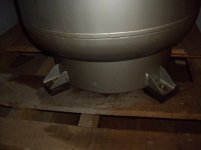
But.... if he epoxies the leg back on, what if the epoxy fails, right at the precise moment when a visiting neighbor's child is crawling next to the tank?
Tank topples over and squashes the poor little foundling waif, like a grape...
....he's just as liable.
I swear, this is one of the most entertaining and ridiculous threads I've seen on GJ in quite some time.
If he uses the Dexter Hysol 9432NA (I guess it's a Loctite product now) it has a 3000 psi shear strength on abraded steel.
Go ahead weld it!Get some advice from that other guy who welds on propane tanks.
Glad your not my neighbor!**** DOES happen.


 and
and
 Please have someone post it on you tube so we can all enjoy it!
Do it right take to a certified welder.
Well i haven't exactly read every post here because most of them are just off the wall stupid, but seeing as i'm probably the one only certified pressurized vessel welders on this board, and have welded countless tubes that see excess of 5-6000psi. I can honestly say, certification or not, I'd weld that leg on in a heart beat.
Are there risks? sure, theres risks driving to the store, theres risks using a grinder without wearing a respirator, hell theres also numerous risks in welding with out wearing a proper osha approved respirator and filters but I would venture to guess than 99% of the people on this board don't put on a mask EVERY time they strike an arc.
Just weld the leg on man and let the rest of these guys enjoy mamby pamby land with their "OMG DON"T DO IT" posts. worst case scenario is the tank would fail at the weld point and it would just crack and let all the pressure out, this thing isn't going to explode and take out the neighbors shed.
Well i haven't exactly read every post here because most of them are just off the wall stupid, but seeing as i'm probably the one only certified pressurized vessel welders on this board, and have welded countless tubes that see excess of 5-6000psi. I can honestly say, certification or not, I'd weld that leg on in a heart beat.
Are there risks? sure, theres risks driving to the store, theres risks using a grinder without wearing a respirator, hell theres also numerous risks in welding with out wearing a proper osha approved respirator and filters but I would venture to guess than 99% of the people on this board don't put on a mask EVERY time they strike an arc.
Just weld the leg on man and let the rest of these guys enjoy mamby pamby land with their "OMG DON"T DO IT" posts. worst case scenario is the tank would fail at the weld point and it would just crack and let all the pressure out, this thing isn't going to explode and take out the neighbors shed.
AMEN. And I'm probably the only person on here who is Certified by the American Welding Society to certify welders and inspect their work ( CWI ). I've worked in DOE facilities, ASME "N" stamp shops, and of course passed NQA-1 testing to inspect nuclear stuff. I've inspected vessels that were 4 stories tall and made of alloys most on here have never even heard of.
Anyway, just follow my instructions above and weld the *****. Have a nice day.

Here is my take.
We used to do it at a process industry where I worked, that contained numerous back up air supply tanks for process instrumentation
Do all normal weld preps. Then fill the tank with water so that the weld spot will be cooled from the inside. Make sure that there are several openings in the tank.
Go ahead and weld.
Fill the tank as ull as you can with water. Attach all fittings and pressurize the tank. Leave for an hour or two.
IF anything at all will break, all that will happen is a small poff and the water will leak out.
Empty the tank and dry it out as best you can.
Or, since its broken leg. Remove also the other leg. Make a strap that goes around the tank that is clamped on by two tensioning bolts. Weld the legs on to the strap, attach over tank and tighten up.
Ola
re: the amount of energy in the compressed gas in even a 'small' relatively low-pressure tank is HUGE.
Think about it. Let's say the compressor has a 'little' 1 HP (real, not 'peak' or other BS HP, so it would probably be 'rated' at somewhere from 2-3 HP while Sears might rate it as 5 'peak' HP) electric motor. To fill the tank to the pressure cut-off may take a minute or two or so. Let's use an example time here of two minutes.
So that's 1 hp for two minutes. That's 550 ft-lb/sec for two minutes. That's 66,000 ft-lb of energy. 66,000 lbs raised 1 ft up and then dropped. The same amount of (rough) energy as 6-10 large caliber 'elephant' guns all at the same time. The same (rough) energy as a 3000 lb car going 25 mph crashing into something.
Release that pressurized gas in a sudden and catastrophic manner and it is waaaay more than capable of killing. See my previous documented example of the 'lowly' less than 60 psi of air in the (completely inadequately designed and manufactured) aluminum air tank CUTTING A MAN COMPLETELY IN HALF.
And to the CWI, all I can say is WTF? As a CWI how can you think that an uncertified welder with unknown/undocumented weld parameters on material of unknown alloy and condition with a fluxcore weld filler of unknown/uncertified CVN properties is somehow 'OK"? Where is the qualified WPS? Where is the welder qualification? Where is the material cert for the filler? Preheat? Post-heat? Hydrostatic test on the pressure vessel after weld repair as REQUIRED by any and all Codes such as ASME?
Pressure vessels are NOT a DIY item. They are not an item where you GUESS or say/think 'should be OK' or 'looks good enough'.
See all those previously posted examples of failures of pressure vessels, done by pros? If or when a pressure vessel failure occurs, the results can be devastating. Destructive and FATAL.

.It's also law but laws are meant for breaking.hehe
Sorry, I agree with your post for the most part but you lost me with this comment. What law would be broken?
"And to the CWI, all I can say is WTF? As a CWI how can you think that an uncertified welder with unknown/undocumented weld parameters on material of unknown alloy and condition with a fluxcore weld filler of unknown/uncertified CVN properties is somehow 'OK"? Where is the qualified WPS? Where is the welder qualification? Where is the material cert for the filler? Preheat? Post-heat? Hydrostatic test on the pressure vessel after weld repair as REQUIRED by any and all Codes such as ASME?"
Are you kidding me dude? Really? Not only do I have all of the quals above, plus a couple of ASNT LVII certs I didnt mention, I also have an AAS in Welding Technology, AND I spent 17 years as a welder!!!!!!!!!!!!!!
That F*CKING tank is mild steel. It was MIG welded with regular old run of the mill mild steel bare wire. LOOK AT THE F*CKING SPATTER ON IT!!!!!!!!!!!!!!!!!!!!! Every piece of spatter is a stress riser that could potentially be a failure point! If you read my instructions, you would understand that hes going to weld the bracket to the existing weld that remains on the tank where it broke!!!! that tank isnt even going to get hot to the touch!!!!!!!!!!!!!! And he said hes using LINCOLN WIRE!!!!!!! it has charpy values. PRE-HEAT and POST-HEAT on what, MAYBE 12ga. at best?
MY guess is that your an engineer of some sort. You know the terms, but I highly doubt you know what they mean, or where and how they are employed in reality.
ANY MORE QUESTIONS GENIUS?????????????????????????????

... thing flies off and lands on my $50000.00 cnc lathe after causing lots of $$$ to the building.Am I gonna get some insurance expert guy come over and inspect the damage and say .Hey!Wait a minute here! someone tampered with this!Your loss pal ,shouldn't of messed with it.