To avoid these ads, REGISTER NOW!

Welding question....

ratdoggy

Well-known member
Joined
Mar 27, 2009
Messages
11,971
Location
Akron-Canton area OH
I have an AC/DC Lincoln tombstone. When should I use the DC +/-?
I know DC does prettier welds and I know to use DC sticks. So any quick way to figure it out. I've watched some videos and I'm more confused:headscrat
 
To avoid these ads, REGISTER NOW!

dr_clyde

Well-known member
Joined
Jan 7, 2009
Messages
6,432
Location
Holland, MI
Each electrode will have a polarity which it works best at. Most stick electrodes are designed to run on DC +, called "reverse polarity". Some are designed to run on DC - or "straight polarity".

Most common rods, 7018 and 6010 are reverse polairity. 6013 is the only one that comes to mind that runs on straight polarity.
 

ilovevocs

Well-known member
Joined
Jun 26, 2009
Messages
1,966
Location
Toledo, Ohio
This is quoted from Brainfarth on welding web but is something you learn in an intro to smaw welding class. This information was only available in books or microfiche when i took my first welding class.


Welding rod usually goes E(Electrode), PSI(X1000), Position, Current and Coating, Chemical Composition, H and then R.

Rod

PSI 60,70,80,90,100,110

Position

0: the classification is not used
1: all positions
2: flat and horizontal positions only
3: flat position only
4: vertical down position only

Current and Coating

10: DC+ .................................................. . Cellulose Sodium
11 : DC+ .............................................. Cellulose Potassium
12 : AC or DC+ DC- .................................... Rutile Sodium
13 : AC or DC- ........................................... Rutile Potasium
x4 : AC or DC+ DC- ............................ Rutile Iron Powder
x5 : DC+ ......................................... Low Hydrogen Sodium
x6 : AC or DC+ .......................... Low Hydrogen Potassium
x8 : AC DC+ ............................. Low Hydrogen Potassium*
28: AC or DC+........................Low Hydrogen Iron Powder
20: AC or DC+ DC-...............................Iron Oxide Sodium
27: AC or DC+ DC- ......................Iron Oxide Iron Powder
 

dr_clyde

Well-known member
Joined
Jan 7, 2009
Messages
6,432
Location
Holland, MI
This is quoted from Brainfarth on welding web but is something you learn in an intro to stick welding class. This information was only available in books or microfiche when i took my first welding class.


Welding rod usually goes E(Electrode), PSI(X1000), Position, Current and Coating, Chemical Composition, H and then R.

Rod

PSI 60,70,80,90,100,110

Position

0: the classification is not used
1: all positions
2: flat and horizontal positions only
3: flat position only
4: vertical down position only

Current and Coating

10: DC+ .................................................. . Cellulose Sodium
11 : DC+ .............................................. Cellulose Potassium
12 : AC or DC+ DC- .................................... Rutile Sodium
13 : AC or DC- ........................................... Rutile Potasium
x4 : AC or DC+ DC- ............................ Rutile Iron Powder
x5 : DC+ ......................................... Low Hydrogen Sodium
x6 : AC or DC+ .......................... Low Hydrogen Potassium
x8 : AC DC+ ............................. Low Hydrogen Potassium*
28: AC or DC+........................Low Hydrogen Iron Powder
20: AC or DC+ DC-...............................Iron Oxide Sodium
27: AC or DC+ DC- ......................Iron Oxide Iron Powder

Haha I was looking in my old welding school textbook for this info. Yes. The electrode code will determine all the settings for you.
 

sberry

Banned
Joined
Jun 18, 2005
Messages
35,747
Location
Brethren, Michigan
They will work on those listed, if you only have AC then you are limited to that but if you have DC+ set it there and bust the knobs off so you are not tempted to fool with it.
 

matt_i

Well-known member
Joined
Mar 14, 2008
Messages
10,725
Location
SE Michigan
For some reason I have memorized the DCEP "DC electrode positive" and DCEN acronyms.

With the Sync 250 its DCEN for Tig (otherwise it melts down the tungsten right quick!) and DCEP for 7018s which is 99.999% of what I do.

I think the Mig also runs DCEP.
 

Lelandwelds

Well-known member
Joined
Sep 6, 2017
Messages
2,443
Location
Central Texas
They will work on those listed, if you only have AC then you are limited to that but if you have DC+ set it there and bust the knobs off so you are not tempted to fool with it.

Ditto. I never move it. I use AC only for magnetized metal.

Some weird, rare cast iron and hard face electrodes like straight.
 

BD1

Well-known member
Joined
Mar 18, 2007
Messages
4,602
Location
north side
DC is a smoother arc. 6010 5 P and 7018 Lo Hi are the most common. If you use 6010 1/8" that same heat setting is pretty close for 3/32 Lo hi.
 

Muggzy

Well-known member
Joined
Jun 29, 2013
Messages
583
Location
Orange Co., NY
This is quoted from Brainfarth on welding web but is something you learn in an intro to smaw welding class. This information was only available in books or microfiche when i took my first welding class.


Welding rod usually goes E(Electrode), PSI(X1000), Position, Current and Coating, Chemical Composition, H and then R.

Rod

PSI 60,70,80,90,100,110

Position

0: the classification is not used
1: all positions
2: flat and horizontal positions only
3: flat position only
4: vertical down position only

Current and Coating

10: DC+ .................................................. . Cellulose Sodium
11 : DC+ .............................................. Cellulose Potassium
12 : AC or DC+ DC- .................................... Rutile Sodium
13 : AC or DC- ........................................... Rutile Potasium
x4 : AC or DC+ DC- ............................ Rutile Iron Powder
x5 : DC+ ......................................... Low Hydrogen Sodium
x6 : AC or DC+ .......................... Low Hydrogen Potassium
x8 : AC DC+ ............................. Low Hydrogen Potassium*
28: AC or DC+........................Low Hydrogen Iron Powder
20: AC or DC+ DC-...............................Iron Oxide Sodium
27: AC or DC+ DC- ......................Iron Oxide Iron Powder
I'm having a hard time trying to apply this info to let's say a 7018 rod. Can someone break this down so I can understand the code. Looks very useful for me being completely self taught. Tia!

Sent from my Pixel XL using Tapatalk
 

alexb2000

Well-known member
Joined
Feb 7, 2010
Messages
664
Location
Fort Worth, TX
I'm having a hard time trying to apply this info to let's say a 7018 rod. Can someone break this down so I can understand the code. Looks very useful for me being completely self taught. Tia!

Sent from my Pixel XL using Tapatalk

70-1-8

70= 70,000psi minimum 1= all position welding 8= low hydrogen
 

sberry

Banned
Joined
Jun 18, 2005
Messages
35,747
Location
Brethren, Michigan
At home I use 11 anymore over 6010. I like it a little better where there are a lot of restarts and went to it when I got a little Maxstar. I don't fool with every rod they ever made,,, it was a bit different when a guy had AC but there is not much point with DC.
 

BD1

Well-known member
Joined
Mar 18, 2007
Messages
4,602
Location
north side
Some of those smaller inverters have issues with 6010. The 6011 rod can be ran on AC or DC. Many inverters can run 6011 better than 6010.
The Miller CST 280 inverters run 6010 fine.
 

sberry

Banned
Joined
Jun 18, 2005
Messages
35,747
Location
Brethren, Michigan
I think some small inverters have worked around it, not sure which ones though. The Max has a saftey feature of super low ocv and it was a problem with long whips. With the 11 it flew just like every other machine. These machines are touted as some kind of super arc, they the same to me and I actually give my granny the edge a little in the restart dept. It's so minor though that only a critical operator would notice the difference.
I understand a bit of difference for the downhill piping gang but for the rest of the common work really never noticed difference in machines and I ran a lot of them on highly critical work. Put them where they couldn't be seen and not as many guys could tell them apart as think they could.
 

king nero

Well-known member
Joined
Dec 27, 2010
Messages
1,469
Location
Belgium
all welding positions: in most cases this excludes vertical down, especially with 7018 rods.
 

alexb2000

Well-known member
Joined
Feb 7, 2010
Messages
664
Location
Fort Worth, TX
If you guys haven't tried 7018 downhill, try it. The main issue and the reason it isn't rated for downhill is the flux runs down and gets in your weld puddle. If your heat is just right and the weld length is fairly short you can lay down a beautiful bead and finish before the melted flux contaminates the weld. Generally 4" long welds or less are pretty easy downhill.
 
To avoid these ads, REGISTER NOW!

joe49

Well-known member
Joined
Sep 25, 2009
Messages
1,883
Location
Tonica, Il
I don't, but I position the rod up at a greater angle to hold the flux and puddle.
Just to mention I run on the high side of the amp range all the time.
 

Mgdoug3

Well-known member
Joined
Mar 2, 2018
Messages
1,391
Location
KY
Ok, thanks. I have a Thermal Arc 161 but it runs hotter than what the dial says. If I try to weld uphill with text book settings, I just burn through the metal. Made it hard to learn until i figured it out. When I use a 6011 downhill, my rod angle is steep.
 

joe49

Well-known member
Joined
Sep 25, 2009
Messages
1,883
Location
Tonica, Il
When learning vertical up well prepped thicker sections are easier to learn on.
Amps run a little hot, and the arc length will allow some control of the weld pool heat.
Watch the pool, not the pretty arc.
Watch your joint filling out from the pool.
Gauge your weld width by the filling out from the rod.
Use 7018 to learn, it's not as busy, then go to 5P once you got it.
 

alexb2000

Well-known member
Joined
Feb 7, 2010
Messages
664
Location
Fort Worth, TX
Everybody who welds ends up figuring out what works for them. I tune the welder/rod to run an overhead weld. If you can do that well then any other position works out fine. Yes, there are always little nuances like rod angle, whip vs. stringers, etc. that depend on what you are trying to accomplish.

One thing I like to do when tuning is to look at the backside of a piece I have welded. I am looking for a consistent heat signature approximately equal the length and width of the bead I just ran. It's a good way to judge proper penetration without putting too much heat into the weld either.
 

Mgdoug3

Well-known member
Joined
Mar 2, 2018
Messages
1,391
Location
KY
When I first started practicing I was using 1/4" metal and burning through. Then I jumped up to 1/2 and was melting it. Finally decided to lower my amps below the recommended amps and then I started to actually get better. I should have used my voltage meter and see what it actually is. I also learned a 3/32 rod was much easier to control and learn with.

For the most part I use a 1/8" 6011 first then a 3/32" 7018. I don't have to change any settings that way.
 

Muggzy

Well-known member
Joined
Jun 29, 2013
Messages
583
Location
Orange Co., NY
Can anyone tell me what the "AWS" and the "E" mean on the welding rod AWS E7014? I got a package of 1/16 in. rods to play with because I mostly weld smaller gauge metals and I've been laying down the cleanest welds I've ever done.

Edit: woah! Very sorry guys somehow there is a chunk of text missing:
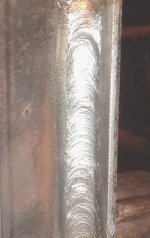
[Due to my ability, current selector limits of my old Lincoln tombstone (only DC choices I have for the 1/16" rods is 30 or 45 amps), and the thinness of the material, I got some 3/32" 7014 rods. This helped me figured out that much of the trouble I've had is the result of the 10-15 year old rods I've been working with :-/ So the result of my hard - learned education is the weld below. ]

The second pic is the end view so you can see how thin the metal is that I'm working with... IMG_20180629_190737.jpegIMG_20180629_193158.jpg

Sent from my Pixel XL using Tapatalk
 
Last edited:

JimDon

Well-known member
Joined
Jan 23, 2007
Messages
602
AWS = American Welding Society, It is the industry standard.
Muggzy, from what I can see in the pix, the welds look pretty decent. Real test is to look at the HAZ though. That is the Heat Affected Zone, on the underside of the weld. If it is a solid weld, you should see a continuous outline where the heat penetrated. It'll be a darker line or outline. When you see it, you'll know what I'm talking about. If no or little HAZ, the weld is (generally) crappy. Good HAZ, and it is usually solid. only experience will tell for sure though, or destructive testing on a couple of your welds.
Cheers, Jim Don
 

sberry

Banned
Joined
Jun 18, 2005
Messages
35,747
Location
Brethren, Michigan
I have some small rods, never use them. 1/8 6011 and 3/32 7018. I bought some smaller ones, will never use them. Figured I would tune up and be a whiz but fell back to what I used for last 30 yrs.
The arc length is so fussy with small, a bit easier if a guy is a daily driver but larger wire fill wider gaps. While some others, 13 and 14 are listed milder penetration they take a lot more current and do not freeze as fast.
 
Last edited:

Muggzy

Well-known member
Joined
Jun 29, 2013
Messages
583
Location
Orange Co., NY
AWS = American Welding Society, It is the industry standard.
Muggzy, from what I can see in the pix, the welds look pretty decent. Real test is to look at the HAZ though. That is the Heat Affected Zone, on the underside of the weld. If it is a solid weld, you should see a continuous outline where the heat penetrated. It'll be a darker line or outline. When you see it, you'll know what I'm talking about. If no or little HAZ, the weld is (generally) crappy. Good HAZ, and it is usually solid. only experience will tell for sure though, or destructive testing on a couple of your welds.
Cheers, Jim Don

Sberry, thank you :-/.

Jimdon, here's a picture of the back side of the weld for the HAZ for this weld with 3/32" 7014 but not sure of what "good" looks like. From what you said, it may be alright, but I'm going to want to weld both sides so I don't have an open seam like this to hold water. I'll be adding gussets to an ATV frame, hence the tubing and flat plate I'm practicing with.

And thank you too for your feedback. [emoji482]

Muggzy
24431efc415d121846648655792ef9a1.jpg


Sent from my Pixel XL using Tapatalk
 
Last edited:

bad_idea

Well-known member
Joined
Jun 11, 2011
Messages
4,332
Location
Pasquotank, NC
I work in ship repair, mostly Navy ships. We just about exclusively use 7018M (M stands for Military, it just means the tolerances are a little tighter - basically high quality 7018). Because of that I am accustomed to 7018 and that is what I use at home. I set the machine to whatever it is that you need for 7018 and left it there. Use 3/32 rod for 1/8" to 3/8" thick or so, 1/8 rod for everything else.

I have some rod for stainless, but I use it so seldom I forget what the number is. IF you weld any stainless, make sure you wear a respirator while welding as the smoke has Chrome 6 in it (google it). Wicked stuff, will make you twitchy when you get older.
 

Muggzy

Well-known member
Joined
Jun 29, 2013
Messages
583
Location
Orange Co., NY
Can someone give me an idea of what the effect of the different coatings are on the rods? The last two digits of the rod number define the position of the weld and the type of shield gas they generate (based on the table shared above) but I read on a post somewhere recently that the last digit (gas) affects the penetration of the weld - low numbers like '13 & '14 give lower penetration than let's say '18. Can anyone confirm this for me? Can't seem to find it.
The pkg info is misleading b/c they all claim to be able to do everything [emoji849]

Thanks
Muggzy

Sent from my Pixel XL using Tapatalk
 

bad_idea

Well-known member
Joined
Jun 11, 2011
Messages
4,332
Location
Pasquotank, NC
I have no idea what the different numbers are for. BUT I do know that the military uses 7018 on all mild steel. It runs good and penetrates good. Why would you want to run a different rod? Takes one more variable out of the equation.
 

Lelandwelds

Well-known member
Joined
Sep 6, 2017
Messages
2,443
Location
Central Texas
Can someone give me an idea of what the effect of the different coatings are on the rods? The last two digits of the rod number define the position of the weld and the type of shield gas they generate (based on the table shared above) but I read on a post somewhere recently that the last digit (gas) affects the penetration of the weld - low numbers like '13 & '14 give lower penetration than let's say '18. Can anyone confirm this for me? Can't seem to find it.
The pkg info is misleading b/c they all claim to be able to do everything [emoji849]

Thanks
Muggzy

Sent from my Pixel XL using Tapatalk

Lincoln or Hobart or some other electrode manufacturer will spell that out somewhere. All rods generate a CO2 atmosphere from burning cellulose flour. The classification numbers where made buy a committee years and years ago. The biggest difference in the classes is the percentage of iron powder in the flux (to freeze puddle and deposit faster) and whether the flux is rutile or basic. (Chemistry thing)

There is enough wiggle room in the specs for each mfg to differentiate themselves in the market place. Some take extra care in the core wire. Some add an additional optional deoxidizers or fluxing agent. Some keep tighter carbon content. Some will add the alloys to the flux instead of the core wire.

Most of the effort and technology goes into the fluxes. The competing factories are very different. Some have one old guy with a shovel and a scoop who follows a recipe. Some are high tech and meter a premixed "additive package" or "sweetener " with auto scales. Some have auto mated scales to spool wire. Some have dozens of little ladies with a stick with a notch cut in the end who step on a footpedal and eyeball it.

So, some welders prefer Lincoln 5P or Murex E6013 or Esab E7018.
 
Last edited:

Muggzy

Well-known member
Joined
Jun 29, 2013
Messages
583
Location
Orange Co., NY
Leland, thank you.

For the most part, I'm comparing apples to apples here. Most of the rods are Hobart brand obtained from Tractor Supply. But the standards were created to standardize the behavior of the rods to *some* degree. Sure some manufacturers have their secrets and some will do some things better than others.

What I'm trying to understand is what the performance differences are *supposed* to be among the last digit of the rod numbers?
Reading the packages on the Hobart rods there's very little difference in the description of purpose. And they *all* claim to be for AC*

What I seem to have determined (for me anyway) with my simple Lincoln AC/DC tombstone with limited steps on the current selector is that the 7014 rods of any size are easier to control;
1) they start much easier and
2) the arc is clean and steady on DCEP*
3) I can run a straight stringer bead to get appropriate penetration on steal as thin as 0.065" or a circular pattern on thicker (up to 0.120") material to get deeper penetration without blowing holes. 1/16" rods for the thinner mtrl and 3/32" for the 0.085" and up mtrl.

* On AC, the arc was difficult to start without raising the current. And erratic and rough once started (like current too high), making it hard to see the puddle clearly.

I'm aware that steal this thin should probably be done with another process like TIG, but I've only got this stick welder and I'm confident now that I can do what I need to with it.

So back to my original question, What I'm trying to understand is what the performance differences are *supposed* to be among the last digit of the rod numbers?348dabe8522a547933de69de8a627793.jpg

Sent from my Pixel XL using Tapatalk
 

Attachments

  • 348dabe8522a547933de69de8a627793.jpg
    348dabe8522a547933de69de8a627793.jpg
    112.6 KB · Views: 0
Last edited:

dr_clyde

Well-known member
Joined
Jan 7, 2009
Messages
6,432
Location
Holland, MI
You must not have read what Leland wrote very well.

The last digit is used to describe the flux, and the flux is everything.

Take 7014 vs 7018. Both are 70 ksi tensile, all position rods. But the flux is different. The 7014 rod is designed for high deposition rate. Build up work and the like. The extra iron in the flux powder aids in high deposition. The 7018 is low hydrogen. The low-hy is what is specified for code work, as it removes hydrogen that leads to hydrogen embrittlement, and therefore cracks.

They may not appear to weld different, but their effect on the weld deposit may be very different metallurgically.
 

Muggzy

Well-known member
Joined
Jun 29, 2013
Messages
583
Location
Orange Co., NY
The last digit is used to describe the flux, and the flux is everything.
Got that.


This is exactly the detail I've been looking for THANK YOU:
The 7014 rod is designed for high deposition rate. Build up work and the like. The extra iron in the flux powder aids in high deposition. The 7018 is low hydrogen. The low-hy is what is specified for code work, as it removes hydrogen that leads to hydrogen embrittlement, and therefore cracks.
Since my application is adding gussets to an ATV frame that will flex under use/stress, this tells me that the 7018 is the right choice for the application. If my lack of experience prevented me from seeing this in previous posts, then please accept my apologies. Your information has been VERY helpful.

Muggzy


Sent from my Pixel XL using Tapatalk
 
Last edited:

dr_clyde

Well-known member
Joined
Jan 7, 2009
Messages
6,432
Location
Holland, MI
I wasn't trying to pick on your inexperience, there is a lot to learn and know in the welding world. I went to college for it, and I'm still learning. The amount of knowledge my mentors and profs have is scary sometimes.

Glad I could be of some help.
 
To avoid these ads, REGISTER NOW!
Top Bottom