To avoid these ads, REGISTER NOW!

Welding question....

alexb2000

Well-known member
Joined
Feb 7, 2010
Messages
664
Location
Fort Worth, TX
Got that.


This is exactly the detail I've been looking for THANK YOU:
Since my application is adding gussets to an ATV frame that will flex under use/stress, this tells me that the 7018 is the right choice for the application. If my lack of experience prevented me from seeing this in previous posts, then please accept my apologies. Your information has been VERY helpful.

Muggzy


Sent from my Pixel XL using Tapatalk

I would expect that the ATV frame is chrome-moly and probably thin wall <.100". No offense, but I would consider having the gussets TIG welded on if you don't TIG weld. Especially since the cost of screwing up the frame would be considerable. Chrome-moly is sensitive to overheating that can cause stress cracking, that is the reason for my concern.
 
To avoid these ads, REGISTER NOW!

dr_clyde

Well-known member
Joined
Jan 7, 2009
Messages
6,429
Location
Holland, MI
I doubt a common atv frame is anything but mild steel.

4130 is expensive, and unless you are flying or have a racing application, there is no reason for the extra material strength to weight savings. An OEM wouldn't use it unless they had to.

Source, I worked on UTVs and designed aftermarket performance parts like suspension and roll cages. The only time we used 4130 was on trophy trucks and builds where the weight vs strength was critical.

Polaris and Can-am just use mild steel frames.
 

alexb2000

Well-known member
Joined
Feb 7, 2010
Messages
664
Location
Fort Worth, TX
I doubt a common atv frame is anything but mild steel.

4130 is expensive, and unless you are flying or have a racing application, there is no reason for the extra material strength to weight savings. An OEM wouldn't use it unless they had to.

Source, I worked on UTVs and designed aftermarket performance parts like suspension and roll cages. The only time we used 4130 was on trophy trucks and builds where the weight vs strength was critical.

Polaris and Can-am just use mild steel frames.

OK, good enough, disregard the above.
 

Muggzy

Well-known member
Joined
Jun 29, 2013
Messages
583
Location
Orange Co., NY
I wasn't trying to pick on your inexperience, there is a lot to learn and know in the welding world. I went to college for it, and I'm still learning. The amount of knowledge my mentors and profs have is scary sometimes.

Glad I could be of some help.
No worries at all. My problem with getting the answers that I needed were that people who are trying to be helpful keep answering questions that I wasn't asking. I've learned a lot, but I'm not a welder and this makes it hard to ask the questions properly.


Sent from my Pixel XL using Tapatalk
 

Muggzy

Well-known member
Joined
Jun 29, 2013
Messages
583
Location
Orange Co., NY
I doubt a common atv frame is anything but mild steel.

4130 is expensive, and unless you are flying or have a racing application, there is no reason for the extra material strength to weight savings. An OEM wouldn't use it unless they had to.

Source, I worked on UTVs and designed aftermarket performance parts like suspension and roll cages. The only time we used 4130 was on trophy trucks and builds where the weight vs strength was critical.

Polaris and Can-am just use mild steel frames.
This is reassuring to hear. I tweeked the mounting tabs for the front left a-arm on my Kawi 750 Brute Force. Maybe even a hairline crack on the factory weld, but since cleaning the finish off don't see a crack. Thought gussets would be a good idea to be on the safe side.

Sent from my Pixel XL using Tapatalk
 
Last edited:

sberry

Banned
Joined
Jun 18, 2005
Messages
35,747
Location
Brethren, Michigan
There is a lot of fuss about moly and as much mis info as good. I never worried about it. Not saying it was technically correct but,,,, factory stuff broke, repair held. I cant imagine it is a big critical deal on minor alloy and thin sections, stick, especuially 7018 is pretty good and pretty forgiving.
When we were kids welded it with torches and 6011 too.
 

Muggzy

Well-known member
Joined
Jun 29, 2013
Messages
583
Location
Orange Co., NY
There is a lot of fuss about moly and as much mis info as good. I never worried about it. Not saying it was technically correct but,,,, factory stuff broke, repair held. I cant imagine it is a big critical deal on minor alloy and thin sections, stick, especuially 7018 is pretty good and pretty forgiving.
When we were kids welded it with torches and 6011 too.
I've welded a few frames myself on much less costly 4-whlrs. Didn't come out too pretty - poked a few holes and did a lot of filing and grinding. Clean-up afterwards isn't in the cards this time due to the sensitive and somewhat complicated location. So it's got to be clean the first time.
Until very recently, all I ever welded with were very old 6013's. I'm learning a lot this time around. Largely due to the help I've been getting here [emoji482]

Sent from my Pixel XL using Tapatalk
 
Last edited:

Muggzy

Well-known member
Joined
Jun 29, 2013
Messages
583
Location
Orange Co., NY
So I got good at laying a clean bead in a tight spot on material similar to (thinner) than the frame I need to fix with the 7014 rods. Boy, they were easy to strike the arc with.

Then, thanks to @dr_clyde , I went back to practicing with the 7018 rods and I can lay down a clean looking bead pretty reliably. My only problem is that I'm also (reliably :-/ ) getting these little pinholes at the start of my welds (rt side of pic below). Some are worse. I've tried to strike the arc ahead of the direction I'm heading and backing up before proceeding - didn't really work. Also, when I was practicing a bunch of starts and stops in hopes that I could improve, the restarts with the hot rod/surface were clean every time. But new, cold starts still have pinholes. Anybody got any suggestions to help me improve my striking an arc?
Tia! 048725815b66ee8ee64e40724b460065.jpg

Sent from my Pixel XL using Tapatalk
 

Attachments

  • 048725815b66ee8ee64e40724b460065.jpg
    048725815b66ee8ee64e40724b460065.jpg
    77.2 KB · Views: 0
Last edited:

dr_clyde

Well-known member
Joined
Jan 7, 2009
Messages
6,429
Location
Holland, MI
Porosity is always caused by lack of shielding. Pinholes are easy to get at the beginning of the weld with stick welding especially with beginners.

Here's my suggestions.

Light up with a fresh rod, or make sure your rod has flux all the way to the end. If it has flaked off or is missing chunks, it can affect your shielding cloud at the beginning of the weld.

Don't move while long arcing. It is common practice to long arc for a second or two until the arc is established and the rod is burning right. During this time, you don't have shielding. Wait a second or two tor the arc to stabilize, then get your arc nice and tight to get your puddle going. Don't move until you have a tight arc.

What settings are you running? If that was me, I'd be running a 3/32" rod at about 90 amps to start, then adjust from there.
 

Muggzy

Well-known member
Joined
Jun 29, 2013
Messages
583
Location
Orange Co., NY
Hey Doc! Thanks for the reply.
Porosity is always caused by lack of shielding. Pinholes are easy to get at the beginning of the weld with stick welding especially with beginners.

Here's my suggestions.

Light up with a fresh rod, or make sure your rod has flux all the way to the end. If it has flaked off or is missing chunks, it can affect your shielding cloud at the beginning of the weld.
Good to know. Thx

Don't move while long arcing. It is common practice to long arc for a second or two until the arc is established and the rod is burning right. During this time, you don't have shielding. Wait a second or two tor the arc to stabilize, then get your arc nice and tight to get your puddle going. Don't move until you have a tight arc.
Ok, I'll practice this for a while. Due to the thin material and small pieces, I've been afraid to hold still. Been starting the arc and move.

What settings are you running? If that was me, I'd be running a 3/32" rod at about 90 amps to start, then adjust from there.
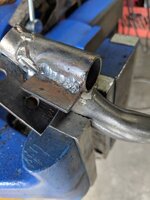
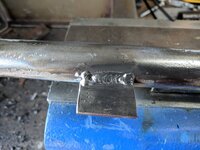
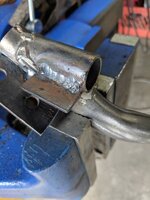
Yeah, I'm using 3/32 7018 at 75 amps. The thin material that I'm welding melts through really fast at 90a, but I'll burn a few sticks at 85 amps to see if I can control that. Don't have too many choices on the selector switch (see below). You also probably noticed that I'm welding pretty short tabs to the tubing that I'm practicing on. That's b/c it's similar to the little gussets I'll be welding to this frame. I've basically got to strike the arc and get moving. The welds will only be 1 - 1 1/2" long each and with pieces that small, I feel like I won't have much time before things overheat.

Oh yeah, I included some picks of the "cold" start-stops I was practicing. (waiting 10 sec or so between each stop and the next start. If I do these with a 1-2 sec delay, only the first start has the porosity

Best Regards,
Muggzy
fc003889a2770f2e7c6ab33814c28b84.jpg
004dca191d2c79bc7d9c874fd3b32ce6.jpg
095b2b8588fdb72d97090466a1bd4374.jpg


Sent from my Pixel XL using Tapatalk
 
Last edited:

GaryM909

Well-known member
Joined
Apr 11, 2016
Messages
1,517
Location
Calgary, Alberta, Canada
You could try warming up the electrodes a bit. 7018 absorb moisture when stored with the sleeve open. 130 - 140 F for an hour or two might help with the porosity. You probably don't have a rod oven so a toaster oven or regular oven would work.
 

Muggzy

Well-known member
Joined
Jun 29, 2013
Messages
583
Location
Orange Co., NY
You could try warming up the electrodes a bit. 7018 absorb moisture when stored with the sleeve open. 130 - 140 F for an hour or two might help with the porosity. You probably don't have a rod oven so a toaster oven or regular oven would work.
The sleeves are new and closed each time I remove a rod. But I do have a large toaster oven that I've used for powder coating. I could give this a try easily enough.

Sent from my Pixel XL using Tapatalk
 
Last edited:

Mgdoug3

Well-known member
Joined
Mar 2, 2018
Messages
1,391
Location
KY
I don't heat my 7018 up but I do keep them in an air tight seal container. The boxes they come in aren't air tight. Two things I do to help restart a 7018 is whip it when I'm done with a bead and also keep a file with me. Don't whip it if anyone is around you though, you could throw a hot ball of slag at them. The file gets rid of the excess flux but doesn't chip it like you would when you tap the rod.
 

Lelandwelds

Well-known member
Joined
Sep 6, 2017
Messages
2,443
Location
Central Texas
Run a grinder over your steel first. Metallurgically bright metals have less pinholes when welded.

I would'nt worry about electrodes too much. Focus on quality work. Tack with E6013 or E6011 or whatever because of easy strikes. Weld up with E7018 cause it just looks like a weld.

I wouldn't worry about alloys too much either. First, you are not going to bump into any. Probably. If you double the strength of your steel, you can reduce wall thickness by 25% for roughly the same strength. If you weld 4130 with ER 70S-6, for example, your weld deposit dilutes with the base metal about 25%. If it didnt, your weld would fall off. The deposit strength is somewhere in between.

The mixing can take some off some of the need to pre heat correctly. Torch work has built in pre heat btw.
 

Muggzy

Well-known member
Joined
Jun 29, 2013
Messages
583
Location
Orange Co., NY
Hello All, been out of town visiting family and finally got back to my "edjumacation" [emoji851]. OK to close the loop on what I've learned so far and the advice I've received here... (Remember, all of the following is using 3/32" rods at 75 amps);
1) Heating the 7018's had no impact.
2) long arcing at the start made the porosity worse.
3) stepping away for a week and coming back seems to have improved the quality of my starts, a lot.
4) since I was nearly out of Hobart 7018's, I got my hands on some Bohler 7018's and here's what my experience with the two rods has been side-by-side;
a. the Hobart 7018s are easier to start but continue to give me pinholes at the start of my welds
b. The Bohler 7018's are a PIA to start once used and are very difficult to restart without filing and tend to stick on me A LOT at the start. Really bad at 65 amps.

I'm going to try whipping the Bohler rods at the end of a weld to see if this makes them easier to restart.

Picture below is Hobart rods on the left and Bohler rods on the right. The first two starts for each were pretty ok (Bohler actually had a single pinhole). The third start on each was a small amt of long arching to try and make the pin holes come back - only the Hobarts got ugly. The last two on the Bohler (right) were extreme long arcs to try and force the porosity prob. but couldn't make it show up with those rods [emoji4].
b516fd6c74d6ac3b68e550f51d76d07b.jpg


Edit: when I originally posted this, I thought the new rods were Lincoln but we're actually Bohler. The label is pictured in post #66 below.

Sent from my Pixel XL using Tapatalk
 
Last edited:

Muggzy

Well-known member
Joined
Jun 29, 2013
Messages
583
Location
Orange Co., NY
Jody, welding tricks & tips, youtube, recently posted some arc welding videos...


uphill techniques...

might watch them those videos...

Charl
Xman_charl, thanks! I've seen most of Jodie's smaw videos, but nothing dealing with stick welding thin metal. Also read a lot of material (some a little over my head). But there's no substitute for doing.

So I've been going back and forth between working on what I've gotten out of the videos and asking questions like here on GJ. What I really need is for someone to look over my shoulder and tell me what I'm doing wrong with striking an arc, puddle control, rod angle, etc. I'll likely take an adult Ed course in the near future, but at the moment I've got a repair that's above my comfort level.

I know enough to recognize that I could weaken the frame of the ATV I'm going to repair. For instance; after practicing some more today with 3/32" rods and feeling really confident on 1/8" angle, I moved to trying small tabs on a piece of tubing very similar to the ATV frame. With the lowest current for the rods (65 A), I was getting undercutting at the toe of the weld, thus thinning (weekening) the tubing. So I switched to practicing with 1/16" rods (result in pic).

The ends were tacked with 7014 and the fillet with 7018. Clearly, I've got to work on the restart, but a little more practice tomorrow and I'll have it. Problem is those skinny little rods are so flexible. d69829e26492652d64ae23888cd359df.jpg

Sent from my Pixel XL using Tapatalk
 

Attachments

  • d69829e26492652d64ae23888cd359df.jpg
    d69829e26492652d64ae23888cd359df.jpg
    95.8 KB · Views: 0
Last edited:
To avoid these ads, REGISTER NOW!

joe49

Well-known member
Joined
Sep 25, 2009
Messages
1,883
Location
Tonica, Il
You need to read all of this thread over now, and then try applying some of what you re-read.
 

dr_clyde

Well-known member
Joined
Jan 7, 2009
Messages
6,429
Location
Holland, MI
Ok, I decided to run one to see what it did for me. I haven't stick welded metal this thin in a long time.

I had a small piece of 14ga wall square tube, and a scrap of 14ga CRS sheet.

Tacks were a little rough, but they're acceptable. 75 amps DC reverse with 3/32" 7018" Lincoln Excalibur rod.

42652621824_69b8e84df0_b.jpg


Ran one at 75 amps. A bit too hot. I had to hustle. Almost got away from me there at the end, I snapped out a bit early and didn't consume my tack all the way. Not my best work.

42652621714_233f8c8fe5_b.jpg


Tried to stick with the settings available on the lincoln stick welder OP has. So I ran one at 65 amps. I had let the metal cool, so this was on the backside of the first weld.

This one was done with a restarted rod. It ran a touch colder than I was expecting, and the flux fought me on getting adequate toes on the tube. I think had I started with a fresh rod I would have had a better shot.

28499995177_53267eee5d_b.jpg

This isn't an ideal weld for stick, but very do-able. I didn't have any porosity anywhere. If I had to do it a few more times I think I could get it pretty dialed. 70 amps is probably the sweet spot.
 
Last edited:

dr_clyde

Well-known member
Joined
Jan 7, 2009
Messages
6,429
Location
Holland, MI
Inside of the tube. Managed to not get any melt through.

28499994597_8bf83f0d46_b.jpg


Not weldporn by any means, but an adequate weld.
 

bczygan

Well-known member
Joined
Nov 4, 2009
Messages
22,002
Location
DETROIT! Arsenal of Scrappers
I LOVE this thread!

The step by step teaching you guys are doing has me excited to use my AC/DC tombstone!

I'll be taking a welding course at the local community college this fall. For people 60 and over the courses are free. Just have to pay for books.

Bill
 

Muggzy

Well-known member
Joined
Jun 29, 2013
Messages
583
Location
Orange Co., NY
Ok, I decided to run one to see what it did for me. I haven't stick welded metal this thin in a long time.

I had a small piece of 14ga wall square tube, and a scrap of 14ga CRS sheet.

Tacks were a little rough, but they're acceptable. 75 amps DC reverse with 3/32" 7018" Lincoln Excalibur rod.

42652621824_69b8e84df0_b.jpg


Ran one at 75 amps. A bit too hot. I had to hustle. Almost got away from me there at the end, I snapped out a bit early and didn't consume my tack all the way. Not my best work.

42652621714_233f8c8fe5_b.jpg


Tried to stick with the settings available on the lincoln stick welder OP has. So I ran one at 65 amps. I had let the metal cool, so this was on the backside of the first weld.

This one was done with a restarted rod. It ran a touch colder than I was expecting, and the flux fought me on getting adequate toes on the tube. I think had I started with a fresh rod I would have had a better shot.

28499995177_53267eee5d_b.jpg

This isn't an ideal weld for stick, but very do-able. I didn't have any porosity anywhere. If I had to do it a few more times I think I could get it pretty dialed. 70 amps is probably the sweet spot.
Dr_clyde, Wow! After seeing your test, my lack of experience and training became really obvious. Most importantly, what I want to do with what I've got available is doable. Thank you for taking the time!
I thought really carefully about my results and all the variables involved in getting to where I am (not far, but a reasonable start) and went back to this video I found just about a week ago:
From what I can get out of the video and your examples, my stick angle is likely too high and this is probably causing the under cutting that only recently showed up. So tmrw, I'll go back to practicing with the 3/32" 7018 Lincoln (but not excalibur) rods I've got and keep working on my technique. [emoji482]

Thanks Again

Edit: sorry my rods aren't Lincoln after all but are Bohler. Shouldn't matter though, I clearly need to work on my technique. [emoji106]

Sent from my Pixel XL using Tapatalk
 
Last edited:

dr_clyde

Well-known member
Joined
Jan 7, 2009
Messages
6,429
Location
Holland, MI
Not saying the rod is your issue, but I try to buy good welding consumables. Lincoln and Hobart filler metals are usually a very safe bet.

Lincoln Excalibur is probably the best 7018 rod that is commonly available.
 

sberry

Banned
Joined
Jun 18, 2005
Messages
35,747
Location
Brethren, Michigan
The dials on the machines are not always accurate. My dc buzzer is way off, it's out is way above the settings. I am using 92 for a perfect setting, reads 85 and on 105 and 115 off even more. I turn down 5 at the most for thin work. Thin takes a steadier hand, change in speed and is way fussier about arc length.
I don't have file pics of much stick sheet. This is overhead, wobbly but smooth. It would have helped to clean plate and get into position. But no undercut . Hobart rod, 3/32 7018. 92A
 

Attachments

  • OH 7018.JPG
    OH 7018.JPG
    52 KB · Views: 20

Muggzy

Well-known member
Joined
Jun 29, 2013
Messages
583
Location
Orange Co., NY
Not saying the rod is your issue, but I try to buy good welding consumables. Lincoln and Hobart filler metals are usually a very safe bet.

Lincoln Excalibur is probably the best 7018 rod that is commonly available.
The Bohlers were given to me to try. I'm not looking to blame the rods either. But the practicing I did with them today, unlike the Hobart rods, I got zero pinholes.

As I tried to demonstrate with the side by side, I can easily make the Hobart rods give me a porous weld. Not so easily with the Bohlers. Yet the Bohlers were *much* more difficult for me to hold an arc without sticking at 65 amps. Likewise, they were harder to strike an arc without sticking.

Didn't have much practice time today, but got to where I can run a bead at 65a with the Bohlers if I can get them get to start without sticking.


Sent from my Pixel XL using Tapatalk
 

Muggzy

Well-known member
Joined
Jun 29, 2013
Messages
583
Location
Orange Co., NY
The dials on the machines are not always accurate. My dc buzzer is way off, it's out is way above the settings. I am using 92 for a perfect setting, reads 85 and on 105 and 115 off even more. I turn down 5 at the most for thin work. Thin takes a steadier hand, change in speed and is way fussier about arc length.
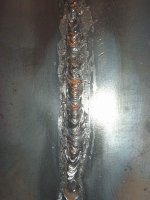
I don't have file pics of much stick sheet. This is overhead, wobbly but smooth. It would have helped to clean plate and get into position. But no undercut . Hobart rod, 3/32 7018. 92A
Sberry, this is something I understand well. It's especially true of a tapped transformer based welder like my Lincoln AC/DC tombstone like mine. Unlike modern inverter type welders, these welders are also susceptible to line fluctuations. Since I'm trying to use the rods at the bottom limit of their rating, and the machine only has stepped selection of the current, it's certainly got the potential to be the source of some of my troubles. But because the current selection is limited, I can't adjust it up a little.

With all the variables inherent in the stick welding process, this is one I'd like to have :). As it is, I'm trying to be methodical and work to improve on the others one at a time.
 
Last edited:

sberry

Banned
Joined
Jun 18, 2005
Messages
35,747
Location
Brethren, Michigan
For general work most of the time the steps worked but the Miller Tbolt was a bit better for critical work with small electrodes. When I was a daily driver and doing critical work could tell the difference in a couple amps. The arc is as good as the Maxstar but the dial is better on the blue.
On some stuff make up for a little with technique if it's not super fussy. Even light sheet can be done hot, makes for fast clean starts. Some of those light joints it can help to tack in marginal areas then come back and run a bead both ways.
 
Last edited:

Muggzy

Well-known member
Joined
Jun 29, 2013
Messages
583
Location
Orange Co., NY
On some stuff make up for a little with technique if it's not super fussy. Even light sheet can be done hot, makes for fast clean starts.

Thanks, this is exactly what I'm going for. Though since I've noticed (learned) how different the rods can behave from brand to brand, I found a welding supply house near me and went and splurged on 10lbs of Lincoln Excalibur 3/32" 7018. I'll probably never use them all, but to my knowledge, they don't come in smaller quantities.

So I'm about to go out and practice some more with them and compare them to the Hobart and Bohlers. I'll let you know what my inexperienced hand discovers [emoji16]


Sent from my Pixel XL using Tapatalk
 
Last edited:

sberry

Banned
Joined
Jun 18, 2005
Messages
35,747
Location
Brethren, Michigan
10# of 3/32 goes a long ways. It is really nice for light work, the smaller rod gives it good control especially out of position and on lighter plate. If you use it enough to get really comfortable the 7018 (lo hy) even in that small you can get good with the arc length, this makes for a good finish.
If its hot enough its really hard to miss making decent welds with it. The stuff is brutally strong, even if its not neat it works so well.
With all the variables inherent in the stick welding process, this is one I'd like to have :). As it is, I'm trying to be methodical and work to improve on the others one at a time.
There is a lot of truth to this. Much of the real work in small shops has went the way of wire but good stick skills cant be faked, its really obvious when a guy really knows.
Most failures I see are not directly due to lacking welding skill but often design,,, they go together a bit but every once in a while I run across something that would have worked had they been a better welder. A lot of the time its somewhat difficult out of position work where they just cant do it.
 
Last edited:

sberry

Banned
Joined
Jun 18, 2005
Messages
35,747
Location
Brethren, Michigan
I had a small plow truck come in a while back. The owner had a ride over but I suggested he wait, so he commented that I had taken the time to work a grinder up in and outright removed the goobers of the last repair. It wasn't all bent etc and I ground out what looked like the remains of a 6013 buzzer job, about 20 or 30A too cold, all overhead tucked up in the frame.
He commented when I jack it back in place and burn the first rod on it. Says it just sounded different and so consistent till the end of the rod.
I am willing to sacrifice a bit of perfection and play catch up for great fusion and fast starts. Smaller faster beads from tighter arc length.
 

sberry

Banned
Joined
Jun 18, 2005
Messages
35,747
Location
Brethren, Michigan
Crack or gap. With a little practice could put a little more on the face and a little less on the back but the point was a demo I think about welding thru the plate from one side in a pass. First 2 pics.
As for the different brands of rods. I havnt tried them all in direct comparison other than some Radnor a while back following some Hobart. I have used lotso Lincs back in the day and do not recall the different flavors and some Chemtron Atom Arc. I like the Hobarts well enough in both flavors, 6011 and 7018. The Lincolns are fine too. I am not a daily driver changing brands all the time, I use what I got and the rod is better than my skill level today.
 

Attachments

  • 6011 obnb.JPG
    6011 obnb.JPG
    60.3 KB · Views: 18
  • 6011 ob vert.JPG
    6011 ob vert.JPG
    67.3 KB · Views: 17
  • 6011 sheet 16 ga.jpg
    6011 sheet 16 ga.jpg
    25 KB · Views: 88
Last edited:

Muggzy

Well-known member
Joined
Jun 29, 2013
Messages
583
Location
Orange Co., NY
Sberry, thanks for all of the input and your examples.
I'm going to show the practice I've been doing first and then explain:
919882be47c750fbafd037581af424bd.jpg
This is about 20 inches of hot rolled 1 1/4" angle that was cleaned off with a wire knot brush in an angle grinder prior to practicing and again right before taking these pics. It's about 4-6+ layers of welds all using 65 amps dcp on my Lincoln AC/DC tombstone. Rods are 7018 3/32" Lincoln Excalibur, Bohler, and 1 Hobart (expl. below).
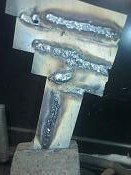
a10ed8376c0f3d93785290404b80b0ae.jpg The purpose of the practice (and the direction of the welds) is to improve my ability to strike and maintain a tight arc w/out the rods sticking. Hence the starts and stops in the short direction. I'm affraid my age may be a big factor as my reflexes aren't what they used to be. I can run a tight bead once started with no trouble (if anyone wants to give me feedback on what you can see of my short runs, I'll happily welcome your comments) but I've gotten to the point where I can start an arc and only stick once about half the time at this low-end current for the 3/32" rods (I'm continuing the practice :). I've also gotten to the point where the Lincoln and Bohler rods are *almost* indistinguishable. Though the Bohlers *seem* to stick a little more and the Lincolns have a *slightly* smoother arc. I saved the last Hobart rod I had until I had some level of confidence/repeatability (that's what the soapstone marks are about) ...
3fa1efe75172e183bfebc114ed1f1f73.jpg
OK, as far as starting the arc (both new and restarting) the Hobart rod was astounding and didn't stick on me at all! BUT, the porosity is back. I haven't seen more than a pinhole or two with the other rods in several days. The soapstone marks are the last welds I did with the Hobart rod I had left and all but the very last one had pinholes at the start of the weld. Someone just told me that is because I'm starting off too fast. Which is entirely true and may be because they start so easily?

If I can get these pinholes under control, I'll be a Hobart desciple.

Sent from my Pixel XL using Tapatalk
 

Attachments

  • a10ed8376c0f3d93785290404b80b0ae.jpg
    a10ed8376c0f3d93785290404b80b0ae.jpg
    77.6 KB · Views: 0
  • 3fa1efe75172e183bfebc114ed1f1f73.jpg
    3fa1efe75172e183bfebc114ed1f1f73.jpg
    74.1 KB · Views: 0
Last edited:

sberry

Banned
Joined
Jun 18, 2005
Messages
35,747
Location
Brethren, Michigan
That machine should be on 85 for 3/32 lo hy. When I do welder training I usually only fool with flat a little and try to get to vertical as fast as I can.
 

Attachments

  • 7018 vert 2p.JPG
    7018 vert 2p.JPG
    26.6 KB · Views: 13
Last edited:

Muggzy

Well-known member
Joined
Jun 29, 2013
Messages
583
Location
Orange Co., NY
That machine should be on 85 for 3/32 lo hy. When I do welder training I usually only fool with flat a little and try to get to vertical as fast as I can.
I'm aware. The reason for practicing at the bottom of the rod's rating is so I can get good enough with tight arc control to weld gussets onto the relatively thin wall of an ATV frame without blowing holes in it. This was the reason for Dr_Clyde's example above (https://www.garagejournal.com/forum/showthread.php?p=7309594), to show it can be done with a stick welder rather than mig or tig.
I don't have the years of experience that Dr_Clyde has, so I'm practicing with the settings I'll need to do the job. Soon I'll go back to practicing on material similar to the frame and gussets. I'm trying to improve my skills one variable at a time, in the direction I need to go; four short horizontal fillets on 0.090" tube and 0.100" sheet.

Sent from my Pixel XL using Tapatalk
 
Last edited:

sberry

Banned
Joined
Jun 18, 2005
Messages
35,747
Location
Brethren, Michigan
I only turn down about 5 for light material. I get way more disciplined on technique. Arc length and speed. Get a narrow tight bead. If it's cold it starts too slow and we get back to a big ole fat bead.
Near the end of the bead on the one you did at 75 is better. You should have to hurry. The big bead at 65 really took as much heat cause it was slow, but the edges are not well fused.
 
Last edited:

Heididayne

Member
Joined
Jul 18, 2018
Messages
7
Location
n/a
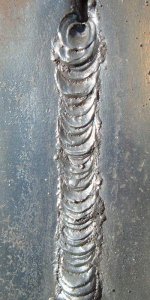
is there lots of techniques in welding? manual welding but looks precise or came from factory?
 
To avoid these ads, REGISTER NOW!
Top Bottom