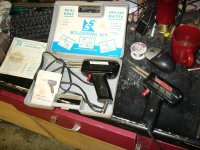
I've long held the idea that many tools made in the golden eras of our country were made better and, in many cases, were more functional than the tools we have available t...
To read the rest of this blog entry from The Garage Journal, click here.



I have three of the Weller "guns", all from that era, and all still as reliable as ever.
Of course, there are no more electronics stores around where you can walk in and buy tips, bulbs and solder, but it is all still available online.
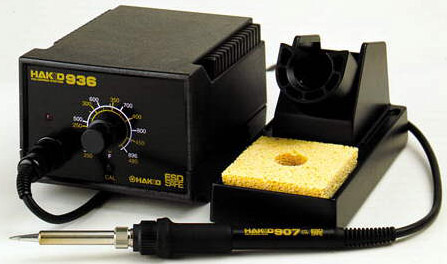
I have to disagree...

My dad had one of those and used it constantly. He worked for IBM in the ear of big iron and would bring home discarded PCBs to strip for project parts. He was also a Ham and built his own transmitter and antennas. I have a more modern late 80s model Weller station but it needs a new stick. The old one was cool with the little incandescent lights that came on with the trigger. I'd love to have one.

I bought one of the newer mexican made Weller 100/140W last semester. I used it only once or twice during school. After semester ended I went to use it again and it wouldnt get hot :' (((
It says 7 year warranty tho?
Disagree to what? Talk to me in 50 years, we'll see if it still works.
A 50 year old soldering gun cannot hold a candle to a proper soldering iron when it comes to working with delicate SMD components.
You are comparing apples and oranges, two tools for completely different purposes. There are things that Hakko cannot do that the Weller can; and the point was where will your station be in 50 years? probably a landfill regardless of how good it is now, if only because the maker will obsolete the tips...
I don't understand what you mean by different purposes. I agree, it's more complex and uses a ceramic heater that is fragile. But what I'm getting at is while the Weller gun is a tank it isn't as good as a temperature controlled station for soldering electronics.
In the past, absolutely. Now, not so much.Weller generally makes some of the best soldering irons available.

Did you or your dad use it daily?Disagree to what? Talk to me in 50 years, we'll see if it still works.
I can only think of one person that hasn't sworn by these after they tried one.It's not just the Mexican made models either.I bought one of the newer mexican made Weller 100/140W last semester. I used it only once or twice during school. After semester ended I went to use it again and it wouldnt get hot :' (((
It says 7 year warranty tho?
But 7 years? Doesn't sound right IMHO, as Weller tends to only offer a year.Good stuff.So was kester solder a weller product? I have a partial roll of rosin core. I use it all the time.
Depends on the electronics. I can work on a point-to-point wired tube guitar amp all day long with a soldering gun. On an iPhone, not so much. Different applications.
You cannot work on an iPhone with a soldering iron, it takes crazy expensive hot air re-flow stations to work on those PCBs, usually that stuff isn't even worth working on.
That said, I'd rather have a JBC any day.
You also cannot solder the older larger wired stuff with a soldering iron either.
Steve
example?
You cannot work on an iPhone with a soldering iron, it takes crazy expensive hot air re-flow stations to work on those PCBs, usually that stuff isn't even worth working on.
<snip>
My original 8200N (IIR..) that I bought when I was making slot cars in the 6th grade or so....
</snip>
The only thing that can't be done with an iron, the right materials, and skills, are BGA packages.You cannot work on an iPhone with a soldering iron, it takes crazy expensive hot air re-flow stations to work on those PCBs, usually that stuff isn't even worth working on.
It's possible to heat heavy gauge wire sufficiently with an iron.You also cannot solder the older larger wired stuff with a soldering iron either. Think watts.
If you try, it'll take forever and you risk cold solder joints.
936/7 models were built like tanks, and well priced, thus generating a well deserved reputation IMHO.Haha I just used hakko as my example because that is what I have the most experience with and it's affordable. I have no doubt that there is much better to be had out there.
.. . . It's possible to heat heavy gauge wire sufficiently with an iron.
And it's not the watts, but if the iron can deliver enough heat to the joint (larger irons are typically used, but it comes down to the efficiency of the heating system, tip geometry & mass, and regulation). . . .
Easy? No. But not entirely impossible (could pull the passives with an iron, and even easier with hot tweezers; damn BGA's would be another matter though).There is nothing there I want to even think about touching with an iron