This is a good question for @Private Lugnutz !
I appreciate your faith in me, pancho!

My compadres
@3baygarage and
@four.cycle, and
@Stelzer, who I have never met, have acquitted themselves very well on this topic, if overthinking a tad, methinks.
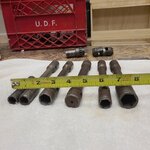
Anyone know what they are/were used for or what you would call them?
Socket wrenches. As opposed to open end wrenches or box wrenches.
Seriously. If you troll through old catalogs before, oh, say, 1902, and more commonly, even before 1919, before the sockets on the ends of "socket wrenches" were detached, forged with a hex or square drive opening, and inserted into drive tools, you'll see that they were indeed called "socket wrenches".
Yes, the larger sizes of the straight shank double-enders were commonly used for truck lug nuts, as 3bay alluded to and Stelzer elaborated on. But they were not confined, as a type, to that use case, and I think yours are too small and present too wide of a variety. I suspect they're just socket wrenches for general purposes. Railroad perhaps, or a large machine shop, as kay suggested. Often, they were made by the yard shop or the tool shop. If they didn't have a cross-drilled hole for a crossbar, they often had a hex or square shaped shank for turning with another wrench.
I have some straight double-enders, but they are less commonly found in the wild in my experience than offsets.

That's a Williams and a Budd in the back, for trucks. The tubular pressed steel offset socket wrenches on the left are Vlchek and Braunsdorf-Mueller, and they come closest to the
cles a pipes (literally, "pipe wrenches"
) that 4.c referred to. If you follow his link you will find a whole wonderful discussion on how they are still quite popular with mechanics in Europe. Amazing that something considered passe and obsolete here in the US, where they were very likely invented, are offered in a 2023 FACOM catalog. The oldest examples on the table are probably the Gruber Wagon Works socket wrenches in the middle. Those square shank jobbies at the center bottom, under the Gruber wrenches, are not branded. Note on the bottom right that even when sockets started becoming detached, the earliest approaches still weren't drive tools, just a more economical use of the same shank. (There is a little detent ball on the end.)
The variety was endless, though. Single end. Triple end. Offset. Tee-handle. Even Speeders, believe it or not, one for every size opening!
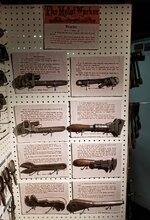
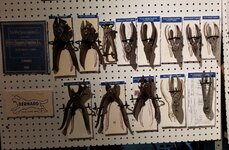
Here is a fin de siecle Mossberg board full of all kinds of socket wrenches and if you look to the right, an entire range of Mossberg Tee-handle socket wrenches sitting on top of a wood box on a green cabinet. And some early Walden. All "socket wrenches" before they were detachable.