To avoid these ads, REGISTER NOW!

What are these called?

RegeSullivan

Well-known member
Joined
Mar 30, 2014
Messages
695
Location
Canonsburg Pennsylvania (South of Pittsburgh)
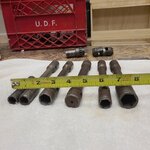
Been searching under "socket" and "vintage socket" but can't find anything remotely close. Both ends fit a nut except the one on the right. That one is closed off on the end you cant see..

Anyone know what they are/were used for or what you would call them?

Thanks in advance for your help and my apologies to those who feel I didnt searched hard enough.
 

Attachments

  • 1696969119163424192558643668913.jpg
    1696969119163424192558643668913.jpg
    1.1 MB · Views: 278
  • 16969732693137279523827639388535.jpg
    16969732693137279523827639388535.jpg
    741.7 KB · Views: 245
To avoid these ads, REGISTER NOW!

BusterofKnuckles

Active member
Joined
Mar 31, 2023
Messages
31
They look like sliding t-bar sockets. Double-ended is neat. Don't recall ever seeing any like that before. You said both ends fit a nut...Are they 6-point? What are the stamps not shown?
 
Last edited:

kaymccampbell

Well-known member
Joined
Feb 27, 2015
Messages
29,438
Location
Upstate New York
I've seen things like that be little low speed, wobble and slight misalignment tolerant drive shafts in old engines and old machine tools. I've seen longer ones be torsion bars of a sort. There was an engine that used pushrods similar to those.

Are there numbers or letters stamped into the surface?
 
OP
R

RegeSullivan

Well-known member
Joined
Mar 30, 2014
Messages
695
Location
Canonsburg Pennsylvania (South of Pittsburgh)
I've seen things like that be little low speed, wobble and slight misalignment tolerant drive shafts in old engines and old machine tools. I've seen longer ones be torsion bars of a sort. There was an engine that used pushrods similar to those.

Are there numbers or letters stamped into the surface?
No markings anywhere on them. The hex openings are different sizes on all but 2 of them. One of the 2 is closed at one end and a hex opening on the other. None seem to have worn enough to be a drive shaft unless it was a control or adjustment in a machine of some sort. They belonged to a tool and die maker so they could be parts from a lathe or some other machine shop tool I suppose.
 

kaymccampbell

Well-known member
Joined
Feb 27, 2015
Messages
29,438
Location
Upstate New York
No markings anywhere on them. The hex openings are different sizes on all but 2 of them. One of the 2 is closed at one end and a hex opening on the other. None seem to have worn enough to be a drive shaft unless it was a control or adjustment in a machine of some sort. They belonged to a tool and die maker so they could be parts from a lathe or some other machine shop tool I suppose.
Can we see a shot of the ends?
 

four.cycle

Well-known member
Joined
Oct 19, 2015
Messages
28,585
Location
Tacoma, Washington
possibly something along this line?


but your size openings are wildly off if they're supposed to be SAE, and no closer if they're supposed to be metric:

0.52" = 13/250 13.208 mm

0.57" = 57/1000 14.478 mm

0.58" = 29/500 14.732 mm

0.62" = 31/500 15.748 mm

0.65" = 13/200 16.51 mm
 

Stelzer

Well-known member
Joined
Mar 14, 2022
Messages
445
Location
Portland, OR
Double ended truck wrench used for removing lug nuts & budd nuts off heavy trucks, tractors, etc. A bar was placed in the holes, perpendicular to the shaft, for increased leverage. I have some old Herbrands I inherited. Ken-Tool still offers them.
 
To avoid these ads, REGISTER NOW!

Private Lugnutz

Well-known member
Joined
Mar 30, 2012
Messages
30,477
Location
The Authentic Jersey Shore
This is a good question for @Private Lugnutz !
I appreciate your faith in me, pancho! :)

My compadres @3baygarage and @four.cycle, and @Stelzer, who I have never met, have acquitted themselves very well on this topic, if overthinking a tad, methinks.
Anyone know what they are/were used for or what you would call them?
Socket wrenches. As opposed to open end wrenches or box wrenches.

Seriously. If you troll through old catalogs before, oh, say, 1902, and more commonly, even before 1919, before the sockets on the ends of "socket wrenches" were detached, forged with a hex or square drive opening, and inserted into drive tools, you'll see that they were indeed called "socket wrenches".

Yes, the larger sizes of the straight shank double-enders were commonly used for truck lug nuts, as 3bay alluded to and Stelzer elaborated on. But they were not confined, as a type, to that use case, and I think yours are too small and present too wide of a variety. I suspect they're just socket wrenches for general purposes. Railroad perhaps, or a large machine shop, as kay suggested. Often, they were made by the yard shop or the tool shop. If they didn't have a cross-drilled hole for a crossbar, they often had a hex or square shaped shank for turning with another wrench.

I have some straight double-enders, but they are less commonly found in the wild in my experience than offsets.

20231010_211315.jpg

That's a Williams and a Budd in the back, for trucks. The tubular pressed steel offset socket wrenches on the left are Vlchek and Braunsdorf-Mueller, and they come closest to the cles a pipes (literally, "pipe wrenches") that 4.c referred to. If you follow his link you will find a whole wonderful discussion on how they are still quite popular with mechanics in Europe. Amazing that something considered passe and obsolete here in the US, where they were very likely invented, are offered in a 2023 FACOM catalog. The oldest examples on the table are probably the Gruber Wagon Works socket wrenches in the middle. Those square shank jobbies at the center bottom, under the Gruber wrenches, are not branded. Note on the bottom right that even when sockets started becoming detached, the earliest approaches still weren't drive tools, just a more economical use of the same shank. (There is a little detent ball on the end.)

The variety was endless, though. Single end. Triple end. Offset. Tee-handle. Even Speeders, believe it or not, one for every size opening!

Here is a fin de siecle Mossberg board full of all kinds of socket wrenches and if you look to the right, an entire range of Mossberg Tee-handle socket wrenches sitting on top of a wood box on a green cabinet. And some early Walden. All "socket wrenches" before they were detachable.

6.1 Mossberg.jpg21.1 Walden 2.jpg
 
OP
R

RegeSullivan

Well-known member
Joined
Mar 30, 2014
Messages
695
Location
Canonsburg Pennsylvania (South of Pittsburgh)
Thank you Private Lugnutz! Great information and really appreciate those pictures. I have examples of many of the sockets with both square and hex angled handles and a few (no full sets) of the tee-handle sockets. All belonged to my grandfather or great grandfather. The pictures you provided gave me some ideas for ways to display some of these tools from the past.
 

whateg01

Well-known member
Joined
Mar 13, 2006
Messages
11,211
Location
doo dah, kansas, usa
I attached another photo in my original post. In order Left to right measured from flat to flat = 0.46", 0.52", 0.65", closed end, 0.52", 0.77". The other end left to right as seen in the picture, 0.52", 0.57", 0.58", 0.62", 0.58", 0.65".

Double ended truck wrench used for removing lug nuts & budd nuts off heavy trucks, tractors, etc.

That's a tiny heavy truck!
 

four.cycle

Well-known member
Joined
Oct 19, 2015
Messages
28,585
Location
Tacoma, Washington
^ thanks Private Lugnutz - I kind of wish you'd seen the thread before I had. The opening sizes on them had me seriously puzzled, but in an era where "standard" wasn't "standard" by today's terms, those sizes make more sense.
 

Private Lugnutz

Well-known member
Joined
Mar 30, 2012
Messages
30,477
Location
The Authentic Jersey Shore
I kind of wish you'd seen the thread before I had.
I didn't see it. A pajarito told me! :) (My GJ reading consists almost entirely of 'Watched List' threads only, and all of those are down on the Vintage Tools Discussion board except for one, and that's the annual Garage Sale thread on the General Tools Discussion board. The only boards I scan for new threads are Vintage and Free Parking.) But seriously, I thought your cles a pipes ref was spot on. They did come straight, too.
The opening sizes on them had me seriously puzzled, but in an era where "standard" wasn't "standard" by today's terms, those sizes make more sense.
'Zackly. It was a very "tolerant" era, not only for wrenches, but fasteners. Eyeballing Sully's openings, it looks like that little range covered ~7/16" to ~3/4" with some skips.
I have examples of many of the sockets with both square and hex angled handles and a few (no full sets) of the tee-handle sockets. All belonged to my grandfather or great grandfather. The pictures you provided gave me some ideas for ways to display some of these tools from the past.
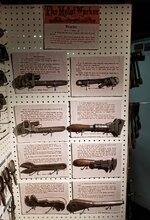
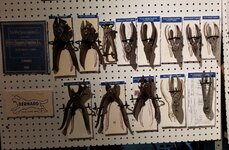
Just keeping them is an honor to their memory and the way of life they gave us. If you mean the "placards," I had some fun turning a section of the basement of my house, built in 1893, into a museum of sorts. :) If you want to take the whole virtual tour, there's a link in my signature block. Below are a few more...
 

Attachments

  • 19.5 Metal Worker All.jpg
    19.5 Metal Worker All.jpg
    681.8 KB · Views: 126
  • 19.4 Bernard.jpg
    19.4 Bernard.jpg
    599.1 KB · Views: 74
  • 19.2 Champion DeArment.jpg
    19.2 Champion DeArment.jpg
    784.3 KB · Views: 127
OP
R

RegeSullivan

Well-known member
Joined
Mar 30, 2014
Messages
695
Location
Canonsburg Pennsylvania (South of Pittsburgh)
Just keeping them is an honor to their memory and the way of life they gave us. If you mean the "placards," I had some fun turning a section of the basement of my house, built in 1893, into a museum of sorts. :) If you want to take the whole virtual tour, there's a link in my signature block. Below are a few more...
[/QUOTE]

Love those plier displays... I tried to look at the link in your signature but just get " Oops! We ran into some problems.
This member limits who may view their full profile." I'm not very techie on a smart phone or tablet so maybe it's me.
 

2oolhound

Well-known member
Joined
Dec 18, 2010
Messages
5,918
Location
BC Canada
These tools remind me of my Hazet Tube Spanners.

DSC_3287 copy.JPG

When I came across these I "had" to have the 19mm to adjust my clutch tension on my Norton mc.
You can remove a plug in the chaincase, insert a 19mm socket on the lock nut and turn the adjustment screw with a screw driver through the centre of the tube. You can lock the lock nut using a wrench on the outer hex profile of the tube socket (much better than using a rod through the hole in the body of the tube which interferes with the screw driver alignment on the adjustment screw). Of coarse when I ran into the set I also "had" to have all these other sizes as well.

The Facom Socket Wrenches would be another solution for this adjustment IF the short bent end with the pass through socket was a bit longer.

FacomSocketWrench1.png

As it is you would need to remove the outer chaincase to reach the lock nut. Still, I like the idea of these but haven't sprung for a purchase and they'd need to be cheap.

75.JE16.jpg

146220921.jpg
 

ConductorChris

Well-known member
Joined
Mar 21, 2017
Messages
160
I posted something similar in this post - my post is #20

 
To avoid these ads, REGISTER NOW!
Top Bottom