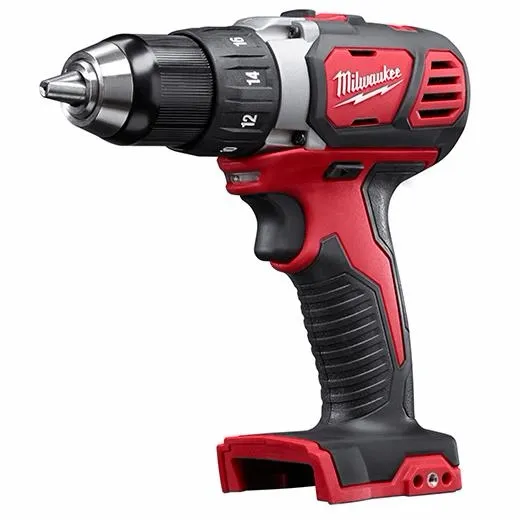
Ok, so what driving a screw, I will keep it on a low number, and see how far the screw goes in. If it stops too early, I need to increase the torque.
I now also see there is a selector from drill to drive mode.
I'm not even sure what mine was on.
What is a hammer drill ?
A Hammer drill is for drilling into masonry. Brick, concrete, ect.. the function can be turned on or off with small handheld drills that offer this feature. This is an additional feature that a more expensive or a higher tier drill will offer. it applies a percussion force downward towards the hole to help chip and break up what you are drilling into for faster drilling. (Think ‘hitting a chisel with a hammer’) Masonry drill bits are a speciality bit with a chisel on the tip. You wouldnt use that function to drill into on anything else that wasnt masonry. The hammer function offers no benefit for driving screws either. It will just make noise. Even though they may sound similar, a hammer drill and impact driver are completely different tools.
For clarity - a hammer drill is also a “drill/driver”. It just has one more feature (the hammering option).
The difference between a hammer drill and impact driver is the direction the “hammering” force it applied. Hammer drills “hammer” downward towards (into) the hole you are drilling. Impact drivers are just like impact wrenches used to work on cars. They “hammer” in the direction the tool is rotating. Clockwise or counter clockwise only, never down like a hammer drill. Their hammering is meant to apply force to drive or remove a fastener like a screw or nut. The hammering of an impact driver will also not twist your wrist, while a hammer drill can easily twist the hell out of your wrist if the bit suddenly binds up.
There are THOUSANDS of videos on YouTube that can help you learn about tools, and its sometimes much easier to understand with someone actually giving a demo with an explanation.
For the record - you dont ‘NEED’ to use the clutch on the drill to drive screws. You can easily just leave the drill in ‘drill’ mode, and just use the variable speed trigger and your eyes instead.
The real benefit of the clutch is for driving small screws, to protect a powerful drill from stripping the head on a delicate small screw. Or - if you were trying to drive multiple screws (or say a bolt with the use of an adapter) - the clutch setting will keep the drill from twisting the hell out of your wrist when the fastener hits a dead stop. (Picture a nut bottoming out on a bolt). Say also - you were driving multiple fasteners across one surface, and you had a need for every fastener to be about as tight as each other - you ‘could’ use the clutch as a simple way to keep one fastener from being much more tight than all the others. In other words, every screw or nut would be about as tight as each other if you were to use the same clutch setting on all of them.
A drill would not be the ideal tool to use for this - but say you had to install a gasket between two pieces of metal (a rear diff cover say) - and there were 10 bolts holding the cover on, with a gasket underneath it - you ‘could’ run down every bolt with the drill using the clutch - and they would all be ‘ABOUT’ as tight as each other - preventing one bolt from being way too tight that might encourage a leak from the gasket. Again - a drill is not the best tool to use - but you ‘could’ do it..
The clutch setting on a drill is really to protect one of two things - either your wrist from being twisted, or a small screw from being stripped. You’d only really use it when installing a fastener, not removing. It allows you to choose how much maximum force the drill can physically apply at any given time.