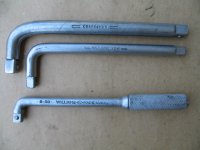
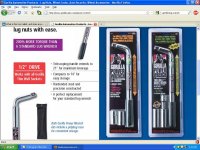
That's perfect except for the length (only 12"), though a deep-well socket on the end would add 3". I'd like to find one that is at least 18" to begin with though.
i can honestly say i'd use a breaker bar. the idea is good, but with the different offsets of wheels that may not have enough reach of depth to be really useful.
I'd have a socket extension on hand anyway, even if using a breaker bar, because I prefer wrenching with the tool at a 90 degree angle whenever possible.
I'd have to say a breaker bar is likely superior in most every way. Speed, ease of use, ect ect. With that L tool or a tire iron, you may have to remove the tool every so often to reposition. It takes up more space with it's fixed end. You have to switch ends to "speed off" where as you just straighten the breaker bar and it becomes a speeder w/o removing it. Not to mention adjustable angles can be convenient on some wheel combos w/o resorting to an extension.
This is one reason many people keep a breaker bar in their car/truck even though they never intend on using it on any other lug/bolt size.
That answers none of your questions, but it is because I had the question of why? The "moving" parts of a breaker bar don't typically wear out, especially if only infrequently used as a lug wrench. Of course that is with the addition of blue locktite on the threads.
If I had something like a Snap-on breaker bar, that would be one thing, but I wouldn't want to spend a lot of money for a lug wrench, and I would suspect that the hinge/pin area of cheap breaker bars would be the most likely area to fail.
I've used breaker bars as lug wrenches before and they don't work good as speeders by straightening out the handle until the nuts are loose enough to turn by hand (and in some cases, the nuts never get loose enough to turn by hand). One advantage that they have over a solid L-wrench though is that you can swing the handle ~180 degrees to make another turn without removing the socket from the nut, though that isn't really a speedy process with a long breaker bar, probably little-to-no faster than removing the socket from the nut and repositioning it.
With an L-wrench, once you flip to the other socket, you still have some available leverage; about 6" or 8" worth (because of the 3" length of a deep-well socket plus the length of the short end of the wrench), which is as much leverage as you can get from a typical 3/8" drive ratchet handle. This allows you to start "speeding off" sooner than if using a breaker bar, and allows you to speed off when you have nuts that never turn easily at all due to rust, grime, or whatever.
In any event, either one would work. It mostly comes down to the fact that I just like the rugged simplicity of a single piece of steel and I also like the idea of having a socket on both ends. Another advantage of that is that you can lengthen the handle for more leverage by adding a socket extension, which seems like a nicer solution than using a cheater pipe (assuming the joint between the extension and L-wrench could handle the job).