To avoid these ads, REGISTER NOW!

What Makes A Good Bench Vise?

To avoid these ads, REGISTER NOW!

noid

Well-known member
Joined
Jul 15, 2010
Messages
1,341
Both. Where space is at a premium, the smaller forged vise is better. If space and bench height allows, the larger/more massive vise is better.

1. The Yost is from Taiwan, not mainland China.

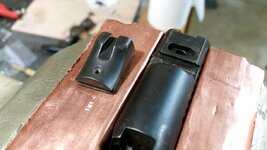
2. The Starrett is far superior for fine percussive work where mass is an asset. When drifting the sights off an older Kimber 1911 pistol to replace with fresh tritium night sights, the owner of the pistol could not get the damn things to budge on his small Home Depot sourced vise, as the entire fixture along with his bench kept rattling around and shifting with each hammer blow against the pin, resulting in the sight block not moving. He even tried a purpose-built sight drifting tool which broke during the attempt to move these particularly stubborn sights.

Clamping it up into my Starrett, which is bolted to a ~400lb bench which itself is bolted to a load bearing wall behind it, I was able to easily drift the sights out with just a few light taps of an 8oz ball peen hammer and brass punch. The sheer mass and rigidity of the entire fixture, particularly the inertia of the vise, turned what was an impossible task into an easy 5 minute job.
20161011223436-ff2af538-xl.jpg

3. Sheer clamping force and grip. Particularly stubborn pieces that I'm trying to remove stripped/corroded fasteners from, I have found can slip in the jaws of the Yost while the Starrett bites down harder and holds them fast. This is due to a confluence of factors including the better grip of the custom jaws that @KMScott made for the Starrett, along with the longer handle and thicker/beefier mainscrew of the Starrett compared to the Yost. As I try not to abuse my vises, I don't use cheater bars on the handles to tighten them further than I can get em just from putting my body weight on the handle itself.

If I had an ~80 lb forged steel vise, it would likely accomplish those same tasks just fine. Not saying it's impossible to do with forged steel, just that existing mass-produced forged steel vises tend not to be available in such size and mass.


You're right, the F60 at ~56 lbs is much closer in size and weight to my Starrett (which weighs about 79 lbs). If I didn't have the Starrett, it would probably be a suitable equivalent for most purposes, with the exception of non-replaceable jaw faces.
Do we agree the 63lb F60 would destroy the starrett in all forms of torture testing and day to day use?

FWIW, clip on jaws are available for the F60, and the Heuer is available with replaceable jaws.
 

General Geoff

Well-known member
Joined
Jan 12, 2013
Messages
3,878
Location
Allentown, Pennsylvania
Do we agree the 63lb F60 would destroy the starrett in all forms of torture testing and day to day use?
No.

The F60 still doesn't open as wide as my Starrett, which I do use on occasion to hold things up to ~8" wide. It also doesn't have the depth of throat of my Starrett, nor does it have the larger pipe jaws of the Starrett which I do use from time to time.

For actual yield strength? Maybe!
 
Last edited:

paulsomlo

Well-known member
Joined
Jul 16, 2013
Messages
3,903
Location
Northern Colorado
4-5", not over 60lbs., swivel base, soft, smooth jaws that are easily replaced/fabricated - plain rectangular with two counterbored clearance holes, like Wilton mechanics. Material of no consequence as long as it's strong. Important that the jaws close evenly.
 

noid

Well-known member
Joined
Jul 15, 2010
Messages
1,341
No.

The F60 still doesn't open as wide as my Starrett, which I do use on occasion to hold things up to ~8" wide. It also doesn't have the depth of throat of my Starrett, nor does it have the larger pipe jaws of the Starrett which I do use from time to time.

For actual yield strength? Maybe!
It's not really a matter of maybe; material science tells us that you could take the f60, strap it to a handle and sledgehammer the starret into pieces.

I think you'll be happy to know the Heuer has just under a 9 inch jaw opening, replaceable jaws, swivel, nearly no slop.
 

shawhite

Well-known member
Joined
May 28, 2014
Messages
1,519
Do we agree the 63lb F60 would destroy the starrett in all forms of torture testing and day to day use?

FWIW, clip on jaws are available for the F60, and the Heuer is available with replaceable jaws.
In Jason’s torture test video the forged Heurer started to deform ie making is unusable about the same point the cast vises failed.
 
To avoid these ads, REGISTER NOW!

noid

Well-known member
Joined
Jul 15, 2010
Messages
1,341
In Jason’s torture test video the forged Heurer started to deform ie making is unusable about the same point the cast vises failed.
You're missing one very key point here. His test unit was the 120 Heuer which is.... 20lb.

It goes 100>120>140>160>180. The difference between a 120 and 140? 20>35lb. The difference between a 120 and a 180? 20>63lb.
 

tarbellb

Well-known member
Joined
Apr 17, 2011
Messages
5,765
Location
Oregon
What i would like to see in a new vise design:

Modular (easily) replaceable jaws for more diverse clamping shapes and materials

Rotating base w/ QUICK release (cam lock or similar?)

Deeper throat, possible Asymmetrical jaw?

Concealed screw

Quick smooth action of handle/ or ratchet style?
 

F-22

Well-known member
Joined
Jan 23, 2022
Messages
1,830
If space and bench height allows, the larger/more massive vise is better.
Depends on your needs too. I think the sweet thing about a Heuer is how much space it leaves around what you're clamping. Classic old cast iron vises don't leave much room underneath due to the massive slide. The Heuer is a lot more vertical.

With no swivel and 4 screws to clamp it down to a massive table, a Heuer is not going to flex, especially 140mm or larger versions...

In Jason’s torture test video the forged Heurer started to deform ie making is unusable about the same point the cast vises failed.
When it started to deform, it would still spring back to original shape if untightened. But the failure torque is pretty meaningless, the vise is typically only clamped to as much as the handle can take until it bends. Difference is you can hammer on the heuer, and you really shouldn't do that on a cast iron vise.


Cast steel would be awesome, I hope OP goes through with it!

7C75D365-6DF5-4C75-8571-4EBEDA660C62.jpeg

Record 518 chipping cast steel vise, probably the biggest steel vise ever mass produced. Would be cool to see how this compared on Jasons torture tests (well, I guess we don't need to see - the spindle would snap, cause nothing else really can...). One thing that would improve this design would be an enclosed slide at the rear with a nut in the middle instead of it on the bottom, but since it's cast steel and crazy large it's probably meaningless too...
 
Last edited:

noid

Well-known member
Joined
Jul 15, 2010
Messages
1,341
Depends on your needs too. I think the sweet thing about a Heuer is how much space it leaves around what you're clamping. Classic old cast iron vises don't leave much room underneath due to the massive slide. The Heuer is a lot more vertical.

With no swivel and 4 screws to clamp it down to a massive table, a Heuer is not going to flex, especially 140mm or larger versions...
Heuer has swivels available:1674340159458.png
 

F-22

Well-known member
Joined
Jan 23, 2022
Messages
1,830
Heuer has swivels available:1674340159458.png
Yes but that's basically just a generic swivel table, you could screw anything down on the top plate. It's not part of the vise design - because German vises practically never have them (its competition were Schlegel EMF, Leinen, Gressel...).
 
OP
D

dr_clyde

Well-known member
Joined
Jan 7, 2009
Messages
6,461
Location
Holland, MI
There’s a lot to love about a forged steel vise but the reality is there’s also a lot to love about cast vises as well.

They’re two different designs for two different applications.

Cast iron has unique features to like vs forged steel such inherent vibration dampening and just sheer mass. Sometimes size matters. You can cast shapes and sizes that would be impossible or expensive in a forging.

I think it is wrong to say that a forged vise is strictly superior. I think it’s correct to say that forged has advantages in certain areas but it’s also correct to say that castings also have advantages.

Can a forged vise handle more hammering abuse? Probably. But I would argue that’s a rare thing to just ask a vise to take a sledgehammer pounding on it all day. And frankly, a cast STEEL vise should be able to handle the same amount of abuse a forged vise can.

The reality is I cannot justify the expense and extra engineering involved in making a forged vise and whatever benefits a forging provides are not enough to justify the cost difference at low volume.

If I make a vise it’ll be a cast vise of either ductile iron or steel.
 
OP
D

dr_clyde

Well-known member
Joined
Jan 7, 2009
Messages
6,461
Location
Holland, MI

Do you perceive this as low class?
I absolutely do. It looks homemade because it is homemade.

Notice Jason isn’t making weldments as his finished product.

I’m not knocking the craftsmanship or the intent. If a guy wants to fabricate a vise for himself I’m sure it’ll be very functional and could be very nice.

But a weldment will always appear cheap compared to a casting and a forging because it’s such a lower barrier to entry and because it is cheaper.

A casting or a forging carries some gravitas and weight behind it purely because a guy usually can’t make one in their garage at home. It just looks more professional because it takes so much more work to make a casting or a forging.

If I’m going to put my name on a product I want it to be something that took some real effort to design and engineer properly and a weldment just doesn’t do it for me.
 
To avoid these ads, REGISTER NOW!
Top Bottom