

You are using an out of date browser. It may not display this or other websites correctly.
You should upgrade or use an alternative browser.
You should upgrade or use an alternative browser.
What makes a Good Vise?
- Thread starter Ralf11
- Start date
ssdave
Banned
....
Last edited:
isb cornbinder
Well-known member
Watch the Fireball tools channel on You Tube. The owner is making a vise
aggie113
Well-known member
I'd say how useful it is to you (a bit of a philosophical answer maybe). Get what you can afford with the features you need. It doesn't have to last the next 30 years for you to get your money's worth out of it.
Don't forget to mount it to a solid surface as well. A nice heavy stand or table
Don't forget to mount it to a solid surface as well. A nice heavy stand or table
matt_i
Well-known member
In my book a good vise is made the day the owner chucks the original serrated hard jaws into a drawer and installs some new soft jaws (copper, brass, AL). About 1% of what I put into it I find acceptable to leave with the "bite marks". Usually thats a rough casting thats already full of oil grease or crust and I don't run across them often.
dr_clyde
Well-known member
In my book a good vise is made the day the owner chucks the original serrated hard jaws into a drawer and installs some new soft jaws (copper, brass, AL). About 1% of what I put into it I find acceptable to leave with the "bite marks". Usually thats a rough casting thats already full of oil grease or crust and I don't run across them often.
Yep. Copper jaws go in all my bench vises.
Customers don't like their parts knurled unless the print calls for it.
Slednut
Well-known member
In my book a good vise is made the day the owner chucks the original serrated hard jaws into a drawer and installs some new soft jaws (copper, brass, AL). About 1% of what I put into it I find acceptable to leave with the "bite marks". Usually thats a rough casting thats already full of oil grease or crust and I don't run across them often.
This is why I like having two vises on the bench. If I had to change out the jaws every time I had the need it would drive me crazy.
The thing to remember is to not abuse your vise, even though they have what's called an anvil it's not a good idea to pound on your vise. I found out the hard way, the one I have outside I broke trying to straighten out a piece of steel.
Attachments


Jeff Ivers
Well-known member
Takes a beating and keeps on clamping!
A good vise is the one suited for the job that you are doing. You have black smiths post vises, machinists machine vises, bench vises, plumbers pipe vises, pin vises, jewelers vises, hand vises, and probably a lot more that I don't know about yet. Within each category there are many forms that meet the criteria. So your question has hundreds of correct answers depending on the use the responder has for his vise.
So be a bit more specific what you intend to do with this vise. If your response is to be "general garage use." then I would suggest a red one.
lg
no neat sig line
So be a bit more specific what you intend to do with this vise. If your response is to be "general garage use." then I would suggest a red one.
lg
no neat sig line
dkroth
Well-known member
A good vise is one that helps you get the job done without causing you difficulty; and provides years of reliable service.
Beyond that it's just antlers.
.
Beyond that it's just antlers.
.
I am asking about the mechanical design, tolerances, etc. that make a good shop vise.
What does one look for to buy a good vise....
so far, the only real answers I see are
1. heavy
2. things related to the screw thread and its guideways
What does one look for to buy a good vise....
so far, the only real answers I see are
1. heavy
2. things related to the screw thread and its guideways
I am asking about the mechanical design, tolerances, etc. that make a good shop vise.
And as I said above there are many kinda of vises. What kind of a shop is the vise going in? What do YOU expect it to do?
lg
no neat sig line
dr_clyde
Well-known member
The primary thing I look for is the name “Wilton” and “Made in USA” cast into the side.
I like Wiltons because they are well made, smooth operating, hold strong, are US made (the machinist vises are), have enclosed slides and have minimal lash in the screw. I have used most vise brands commonly available and keep coming back to Wilton as the best for me.
This is my personal preference.
I like Wiltons because they are well made, smooth operating, hold strong, are US made (the machinist vises are), have enclosed slides and have minimal lash in the screw. I have used most vise brands commonly available and keep coming back to Wilton as the best for me.
This is my personal preference.
And as I said above there are many kinda of vises. What kind of a shop is the vise going in? What do YOU expect it to do?
lg
no neat sig line
mostly automotive; home handy stuff
SweetD
Well-known member
I'd much rather own a vintage USA-Made vise than anything else. Of any size.
Goto the vise thread, https://www.garagejournal.com/forum/showthread.php?t=44782&page=4042 and scroll down to post 80823. This to me is what makes up a good vise. Notice the base has the lower guide for the slide extended out giving the slide support wen open. On the sliding jaw look at the mass of the neck behind the jaw, not likely to bend or break. The same mass is backing up the fixed jaw. The slide with its large box section is going to guide well, slide well, and keep the jaws in alignment. It will work as well as a Wilton without the Wilton name price differential. A good Reed or similar vise of that style can a lot of times be had for under a hundred bucks and work just fine in the home garage.
I have vises from 2" to 6" for bench vises, The most used are the 3" Wilton and the 4" Reed. Both easy to operate and cover most of the jobs I do. The big 6" Wilton is just to big to hold a 12mm bolt while you want to rethread it. It has its place when bigger jobs come in but that is usually not automotive.
Spend a bit of time wandering through the vise thread and you will learn a lot.
Good luck on your adventure.
lg
no neat sig line
I have vises from 2" to 6" for bench vises, The most used are the 3" Wilton and the 4" Reed. Both easy to operate and cover most of the jobs I do. The big 6" Wilton is just to big to hold a 12mm bolt while you want to rethread it. It has its place when bigger jobs come in but that is usually not automotive.
Spend a bit of time wandering through the vise thread and you will learn a lot.
Good luck on your adventure.
lg
no neat sig line
csp
Well-known member
In my book a good vise is made the day the owner chucks the original serrated hard jaws into a drawer and installs some new soft jaws (copper, brass, AL). About 1% of what I put into it I find acceptable to leave with the "bite marks". Usually thats a rough casting thats already full of oil grease or crust and I don't run across them often.
+1
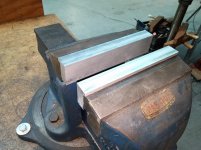
I prefer those magnetic jaw covers, typically aluminum, that are quickly removable if I need some bite. For example, if cutting down bolts I don't mind scarring the section that's getting tossed and I don't like getting my soft jaws chewed up with bolt threads. You can buy them pretty cheap, though I milled my own with neo magnets for my big Paramo and Ridgid forged.
Attachments
Goto the vise thread, https://www.garagejournal.com/forum/showthread.php?t=44782&page=4042 and scroll down to post 80823. This to me is what makes up a good vise. Notice the base has the lower guide for the slide extended out giving the slide support wen open. On the sliding jaw look at the mass of the neck behind the jaw, not likely to bend or break. The same mass is backing up the fixed jaw. The slide with its large box section is going to guide well, slide well, and keep the jaws in alignment. It will work as well as a Wilton without the Wilton name price differential. A good Reed or similar vise of that style can a lot of times be had for under a hundred bucks and work just fine in the home garage.
I have vises from 2" to 6" for bench vises, The most used are the 3" Wilton and the 4" Reed. Both easy to operate and cover most of the jobs I do. The big 6" Wilton is just to big to hold a 12mm bolt while you want to rethread it. It has its place when bigger jobs come in but that is usually not automotive.
Spend a bit of time wandering through the vise thread and you will learn a lot.
Good luck on your adventure.
lg
no neat sig line
Thx
Base with lower guide for the slide extended out giving the slide support when open
Jaws should have mass on the neck behind the jaw, not likely to bend or break. The same mass is backing up the fixed jaw.
Slide should have a large box section to guide well, slide well, and keep the jaws in alignment
- I have an old Craftsman which I've had for decades without thinking much about it - trying to figure out how good it is
Thx also for that video - Wilton didn't do so well...
Last edited:
Leaflessshadetree
Well-known member
For my most used vice I want one that holds securely. Having the jaw faces parallel is key. Pipe jaws are a bonus. I do have rubber and copper pieces that slip on when I need them.
Yes I regularly use cheater bars, hammers and even a torch on thinks clamped in the vice. I'm not afraid of getting metal chips or grinding dust on it either. I use the "anvil" it is handy. My chinese vise does just fine.
If I'm working on something delicate I don't often need a vise to hold it.
I have a woodworing vice that gets used as a clamp for glue ups more than any other use.
Yes I regularly use cheater bars, hammers and even a torch on thinks clamped in the vice. I'm not afraid of getting metal chips or grinding dust on it either. I use the "anvil" it is handy. My chinese vise does just fine.
If I'm working on something delicate I don't often need a vise to hold it.
I have a woodworing vice that gets used as a clamp for glue ups more than any other use.