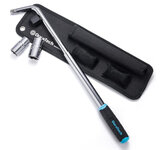
Find the cheapest and longest breaker you can find, probably at least 24" long and 1/2" drive .
Amazing deals on this 1/2In Dr 25In Breaker Bar at Harbor Freight. Quality tools & low prices.

www.harborfreight.com
Menard's has a 30" version but I doubt there are any in your area.
Then something similar to these, just make sure to get a set with the appropriate sized socket for your car.
www.harborfreight.com/12-in-drive-impact-flip-socket-set-3-piece-62491.html
+1
I do all my own car work, and my recommendation would be just a long breaker bar and proper socket.
-Make sure the socket is all the way on the lug nut
-Position the breaker bar such that it is about 6” off the ground as if you were to loosen the lug nut. (You may have to remove the socket, rotate it, and put back on the breaker bar to get the position to work out.)
-Put one hand on the car for balance, and stand on the end of the breaker bar.
I‘m happy to take a pic if you need it.
I have had to do this for lug nuts that were rusted. A friend in the snow belt purchased a truck and went to remove the wheel, and couldn’t do it. So both of us were side by side with a hand on the hood and a foot on the breaker bar using the method described above. The breaker bar had quite a bow to it (was a good quality one) and some lug nuts broke loose and the stud broke on others.
Said all that to say this: leverage is your key to being independent on this task. You can do it, you just didn’t know how.
Most guys are actually happy to help, but if nobody is around it’s good to know how to do it.
The math / physics may help in understanding why the aforementioned works.
Most car lug nut torque these days with aluminum rims is around 90 ft lbs and let’s assume there is no rust issue. Let’s round it up to 100 ft - lbs to make it easy. That is the target torque you’re trying to achieve. So in order to create 100 ft - lbs of torque. You could have a 100 ft lever and 1 lb of force. Of course it is not practical to have a 100 ft lever handy, this is just for aid in understanding the concept. 100 ft x 1 lb = 100 ft-lbs of torque.
So let’s look at the trend:
If you had a 100 foot lever, you would need only 1 pound: 100 ft x 1 lb = 100 ft - lbs of torque.
If you had a 50 foot lever, you would need only 2 pounds: 50 ft x 2 lbs = 100 ft - lbs of torque.
If you had a 10 foot lever, you would need 10 pounds: 10 ft x 10 lbs = 100 ft - lbs of torque.
If you had a 5 foot lever, you would 20 pounds: 5 ft x 20 lbs = 100 ft - lbs of torque.
If you had a 2 foot lever, you would need 50 lbs: 2 ft x 50 lbs = 100 ft - lbs of torque.
If you had a 2 foot lever, and 140 lbs: 2 feet x 140 pounds = 280 ft - lbs of torque. In this scenario, since the torque of 280 ft - lbs is far beyond the 100 ft - lbs, the lug nut should loosen (of course this assumes there is no rust, and it was not over tightened etc).