To avoid these ads, REGISTER NOW!

What tool is this, does anyone know?

Figsy

New member
Joined
May 15, 2020
Messages
2
Location
Chicago
Hello Everyone,

I am new to the forum, but have read many of your threads over the years to find very useful information, thank you. I was wondering is anyone knows what the tools are in the pictures I attached. I pulled these out of my grandfathers toolbox when he passed away in the early 90's. I have used them to remove trim and windpw stop in the past. You can make out on the smaller one that these are made of molybdneum and the larger one has a maker's mark of MHS, made in USA. Any input is greatly appreciated.
 

Attachments

  • 20200515_104823[1].jpg
    20200515_104823[1].jpg
    130.7 KB · Views: 314
  • 20200515_104840[1].jpg
    20200515_104840[1].jpg
    120.1 KB · Views: 254
  • 20200515_104953[1].jpg
    20200515_104953[1].jpg
    130.6 KB · Views: 226
  • 20200515_105012[1].jpg
    20200515_105012[1].jpg
    91.1 KB · Views: 193
  • 20200515_105101[1].jpg
    20200515_105101[1].jpg
    87.2 KB · Views: 266
  • 20200515_105112[1].jpg
    20200515_105112[1].jpg
    84.4 KB · Views: 175
  • 20200515_105121[1].jpg
    20200515_105121[1].jpg
    85.7 KB · Views: 155
To avoid these ads, REGISTER NOW!

didit

Well-known member
Joined
Feb 11, 2020
Messages
892
Location
S.W. Ontario
I was thinking a pry tool for roofing or flashing of copper or aluminum. I have one very similar but it has a small 'V' cut into it for lifting nails as well.
 

jask

Well-known member
Joined
Jul 4, 2009
Messages
314
Location
Gods Country, B.C.
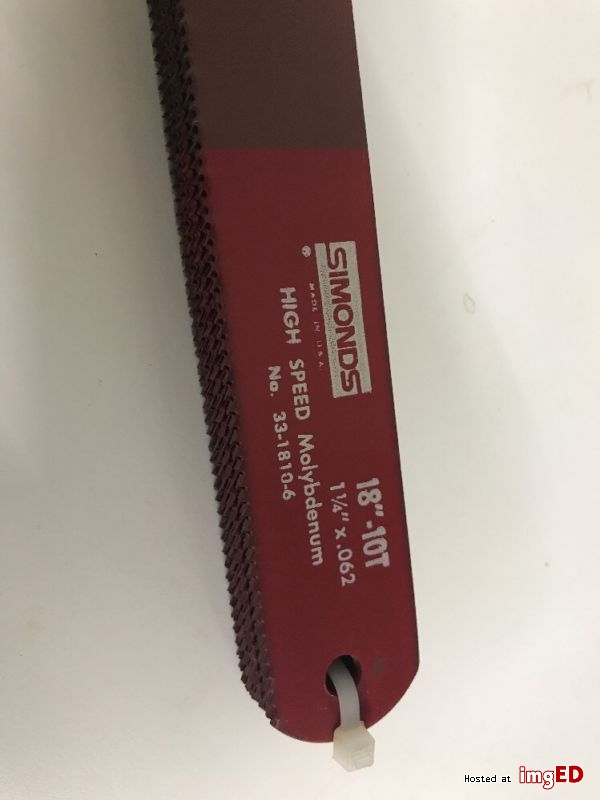
they look like homemade tools.. probably from old power hacksaw blades. any chance he was a bee keeper? that looks like it would work as a hive tool.
 

JR 42

Well-known member
Joined
Nov 2, 2013
Messages
966
Location
Sunny Seattle
I was going to say they look like they're made out of old power hacksaw blades (high speed steel has molybdenum in it to achieve high hardness and resist heat), but no idea for what purpose.
 

Millwrong

Well-known member
Joined
Feb 4, 2018
Messages
369
Location
Canada
I think the guys are on to something here. look at these old blades from Simonds. Looks awfully similar lol!


10-new-simonds-18-10t-power-hacksaw-blades-no-33-1810-6.jpg
 

JR 42

Well-known member
Joined
Nov 2, 2013
Messages
966
Location
Sunny Seattle
Good eye! I can't find any info on the other one, my weak googlefu just gets me a bunch of high schools and random distributors and stuff.
 
To avoid these ads, REGISTER NOW!

RTM

Well-known member
Joined
May 13, 2019
Messages
13,082
Location
SF Bay Area
They are wonderful tool blanks. People make knives, pry tools etc. yours look like some one needed really thin pry bars. Buddy had his Craftsman bungalow trim redone, and they supposedly came in with a handful of super skinny pry Bars to minimize the damage to the 75 yr old moldings. Started with a knife to cut the paint layers, and worked up to progressively thicker and thicker putty knife shaped pry bars.

i-J8TFjqc-5K.jpg
 
Last edited:
OP
F

Figsy

New member
Joined
May 15, 2020
Messages
2
Location
Chicago
Interesting ideas everyone, maybe they are homeade. My grandfather worked as a foreman in the heat treat part of a forge for 40+ years, right next to the machine shop part of of the forge. If they are homeade, I am thinking maybe they were made there.
 

Flat Thunder Channel

Well-known member
Joined
May 4, 2020
Messages
402
Location
Ohio
They look like old fashion hand scrapers to me. They are beat up pretty good. I am referring to scrapers used to fine tune metal surfaces. Not a scraper in the traditional sense.
 

neophyte

Well-known member
Joined
Apr 23, 2012
Messages
9,568
Location
Pennsylvannia
The angled end is not dissimilar to the 45 degree end of the Bantam Bar/Scraper made by Vaughan.
These types of Scrapers are sometimes used as scrapers and sometimes used as pry bars, and could be used for anything from scaping paint or grease, to gently prying forms apart when you don’t want to damage them.
If made from a high speed steel jumbo hacksaw blade, the idea simply might have been to use a more abrasion resistant steel than would be used in a commercial bar which might only be carbon spring steel.
 

jask

Well-known member
Joined
Jul 4, 2009
Messages
314
Location
Gods Country, B.C.
the reason I knew they were power hacksaw blades is because I have a few myself :) they make excellent knives for leatherwork, particularly what is known as a skiving knife- whick is used to cut wide bevel or taper on the edge of a piece of leather. I have several that I have used for over 20 years and as most of the modern power hacksaw blades only have the tooth edge induction hardened they are no good to use as knife blanks.
 

neophyte

Well-known member
Joined
Apr 23, 2012
Messages
9,568
Location
Pennsylvannia
the reason I knew they were power hacksaw blades is because I have a few myself :) they make excellent knives for leatherwork, particularly what is known as a skiving knife- whick is used to cut wide bevel or taper on the edge of a piece of leather. I have several that I have used for over 20 years and as most of the modern power hacksaw blades only have the tooth edge induction hardened they are no good to use as knife blanks.

Most higher end hacksaw blades have a thin strip of a harder steel alloy welded to a more flexible steel body, to prevent blade breakage, while still having ultra hard teeth.
Older, as well as less expensive blades tend to have the hacksaw body and teeth made from a single steel alloy, with just the teeth hardened using a process like induction hardening, which still alloys for a flexible blade body, and harder teeth.
Starrett I believe still manufactures fully hardened hacksaw blades, at least in smaller sizes, for more accurate cutting.
I’m not sure about larger industrial hacksaw blades, but I presume harder teeth welded to a more flexible, less breakable alloy would be more common nowadays, since welding or brazing harder teeth on a flexible backing can both save manufacturing costs for raw materials, as well as provide a safer saw blade, and the tooth welding technology is at the point were multiple manufacturers are making carbide toothed blades for reciprocating saws, that can cost less than $10 per blade retail.
 
To avoid these ads, REGISTER NOW!
Top Bottom