
To avoid these ads, REGISTER NOW!

When to discard aircompressor tank.

Raisedonadeere

Well-known member
Joined
Jul 31, 2017
Messages
436
Location
Central KY
I have a two cylinder single stage Sears 125psi air compressor I have had since 1968. It has stayed in constant use, I changed the oil a time or two and replaced the regulator and fittings once. It has stayed in constant service all that time, usually full of air. It has done some roofing jobs but otherwise just blowing our air filters, running impact wrench, pumping tires to keep my 3 or 4 car/truck family going and an occasional sanding job. What is amazing about this compressor is that it still has the same drive belt that came on it. How can that be unless someone sneaked in my garage and changed it while I was away or sleeping?

I am well aware of the potential energy in a tank of compressed air. One friend lost a finger when a bicycle tire blew while airing it up. and a neighbor showed me a hole in a concrete block wall that his compressor blew out. The welds broke on that one. It was a fairly new compressor.


Mine does not leak, and other wise I am not knowledgeable on how one checks these things for safety.

I am wondering if because of age I should do away with it or if it is a matter of some sort of check for the condition of the bottom of the tank where water collects.
 
To avoid these ads, REGISTER NOW!

ddawg16

Well-known member
Joined
Jul 11, 2008
Messages
21,005
Location
S. California
Assuming you have drained the water out of them on a regular basis and there is no obvious signs of damage on the outside, they should be good. There are places you can get them tested....a diving shop comes to mind for something like that.

Typically, tanks like that are tested to 1.5x the rated max pressure. But most likely it's good for at least 2x the rated pressure.

I'd be more concerned the pressure switch works correctly.

But....if you are concerned.....scrap it.
 

Packard V8

Well-known member
Joined
Mar 16, 2009
Messages
7,380
Location
Spokane, WA
Yes, there are the extremely rare instances where air compressor tanks explode. But then so do home water heaters (do a search) and few worry much about those. One is in infinitely greater danger driving to the grocery store; 5,419,000 crashes, killing 33,000 and injuring 2,250,000.

No, JMHO, but I don't worry about air compressor tank rust. When there is a rust problem, it's usually manifest as a small leak. Exactly to your question, I just picked up a similar vintage Craftsman because the tank had developed a pinhole rust leak in the bottom of the tank. The owner wouldn't even keep it in his garage, for fear it might spontaneously combust. I brought it home and plugged it in. With that tiny leak, it would still pump up to 120 PSI and shut off; never exploded ;>)

I drilled the hole to 1/2" so I could get a look at the surrounding metal with an inspection camera. I scratched around with a hooked rod; the adjacent area of the inside bottom of the tank looked solid, sounded solid when pounded on. I bent and welded a 3"x 3" patch over the hole and put it back into service.

Assuming you have drained the water out of them on a regular basis
Excellent advice, however the Craftsman unit mentioned above inexplicably has the drain valve in the end of the tank, not at the lowest point, where it rusted.

Your opinions and results may vary. The above is not recommended as advice or best practice, just sharing one instance and experience.

jack vines
 
Last edited:

Danglerb

Well-known member
Joined
Sep 6, 2007
Messages
9,736
Location
SoCal
Look up some failure modes, off the cuff I am thinking most failures will start small and be easily noticed.
 

bob15

Well-known member
Joined
Dec 8, 2011
Messages
6,863
Location
Northeasten, CT
If the water has been drained once in a while and the outside of the tank isn't solid rust, i wouldn't be too concerned with it. Try looking inside with one of the plugs removed if your really, really concerned. I think you would hear a small leak well before anything would fail.

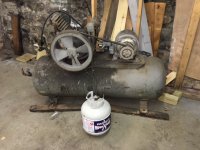
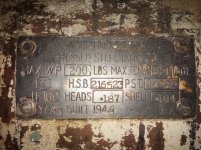
My compressor has a 1944 tank and it still going strong.....
 

Attachments

  • image1.JPG
    image1.JPG
    130.9 KB · Views: 93
  • tank tag.jpg
    tank tag.jpg
    68.7 KB · Views: 89

Citation

Well-known member
Joined
Jan 20, 2016
Messages
3,223
Location
Indy
These tanks by design are meant to rust through as pin holes before the tank would ever burst. So basically if it starts to leak that's the end of the tank. If it isn't leaking (and hasn't been repaired) then enjoy using it.
 

Packard V8

Well-known member
Joined
Mar 16, 2009
Messages
7,380
Location
Spokane, WA
These tanks by design are meant to rust through as pin holes before the tank would ever burst. So basically if it starts to leak that's the end of the tank. If it isn't leaking (and hasn't been repaired) then enjoy using it.

Interesting factoid which I'd never seen before. I believe you, as that's been my experience, but do you have a reference we could site for those who doubt our saying same?

jack vines
 

Handyfarmer

Well-known member
Joined
Dec 20, 2014
Messages
316
Location
in the high plains of Colorado
hot water heater blow because of superheated water turning to steam,
excellent video on super heated water

and I really think that a lot of the air compressors that blow in extreme ways are not just air pressure, if all the safeties are working, one that blew up a utility room in a school was determined that the oil was getting int the air stream and was ignited like a diesel is ignited in the cylinder, blowing it up with an explosive force,
this is not the incedent that I was refering to, but the same thing happened,, https://www.cdc.gov/niosh/face/stateface/ca/05ca010.html

another one, http://metroforensics.blogspot.com/2016/10/industrial-air-compressor-overheats-and.html
 
Last edited:
OP
R

Raisedonadeere

Well-known member
Joined
Jul 31, 2017
Messages
436
Location
Central KY
Thanks all. I have been assuming a small leak would develop as a warning but then after hearing some war stories I thought maybe I better be asking around. Looked at it admiringly the other day and realized it was one of the oldest tools in my shop and when it hit me it was over 50 years old I said perhaps I had been taking things for granted too long.

I am going to remove the plug in the end and use my newly acquired endoscope just to give it a once over, and if good change the oil and sentence it to a few more years back in the corner to be ignored for another few years except for a water drain occasionally.
 

Bellaireroad

Well-known member
Joined
Mar 22, 2013
Messages
636
Location
Fort Worth
I have a two cylinder single stage Sears 125psi air compressor I have had since 1968. It has stayed in constant use, I changed the oil a time or two and replaced the regulator and fittings once. It has stayed in constant service all that time, usually full of air. It has done some roofing jobs but otherwise just blowing our air filters, running impact wrench, pumping tires to keep my 3 or 4 car/truck family going and an occasional sanding job. What is amazing about this compressor is that it still has the same drive belt that came on it. How can that be unless someone sneaked in my garage and changed it while I was away or sleeping?


I am well aware of the potential energy in a tank of compressed air. One friend lost a finger when a bicycle tire blew while airing it up. and a neighbor showed me a hole in a concrete block wall that his compressor blew out. The welds broke on that one. It was a fairly new compressor.


Mine does not leak, and other wise I am not knowledgeable on how one checks these things for safety.


I am wondering if because of age I should do away with it or if it is a matter of some sort of check for the condition of the bottom of the tank where water collects.


Isn't it amazing what good stuff sears used to sell?


Sent from my iPad using Tapatalk Pro
 
To avoid these ads, REGISTER NOW!

MoonRise

Well-known member
Joined
Nov 5, 2010
Messages
4,031
Location
NJ
Air compressor tanks are supposed to fail 'gracefully'. Meaning not catastrophically.

Usually, they do.

But not always. And when they fail in a catastrophic manner, there can be damage, injury, and death. No joke.

Know of someone who had a 'small' portable type air compressor. Horizontal tank, maybe 20 gallon size or so. The tank failed suddenly and catastrophically and 'unzipped' it self. While he was nearby. It broke his femur and several bones in his hand as well. Knocked over things in the garage and punched things through the wall 20 feet away.

That said, if an air compressor tank is drained regularly and doesn't have the tank weakened from rust, the tank can last decades.

Inspect the inside of the tank visually. Fancy way would be to inspect the tank wall thickness with something like an ultrasonic thickness tester. And to do a hydrostatic pressure test on a small home air compressor tank is usually cost prohibitive.

If in doubt, throw it out (turn it into a grill or BBQ or yard art or something else that is not a pressurized vessel). After 40+ years of service, the tank doesn't 'owe' you anything.

And unless you absolutely KNOW exactly what you are doing (meaning you know the exact steel allow used in the original tank and have a complete and documented and 'certified' welding procedure done by a certified welder and do the required post-weld NDT and pressure testing and have an ASME "R" stamp to certify all of that),

You

Do

NOT

Weld

On

A

Pressure Vessel

EVER.
 
OP
R

Raisedonadeere

Well-known member
Joined
Jul 31, 2017
Messages
436
Location
Central KY
Air compressor tanks are supposed to fail 'gracefully'. Meaning not catastrophically.

Usually, they do.

But not always. And when they fail in a catastrophic manner, there can be damage, injury, and death. No joke.

Know of someone who had a 'small' portable type air compressor. Horizontal tank, maybe 20 gallon size or so. The tank failed suddenly and catastrophically and 'unzipped' it self. While he was nearby. It broke his femur and several bones in his hand as well. Knocked over things in the garage and punched things through the wall 20 feet away.

That said, if an air compressor tank is drained regularly and doesn't have the tank weakened from rust, the tank can last decades.

Inspect the inside of the tank visually. Fancy way would be to inspect the tank wall thickness with something like an ultrasonic thickness tester. And to do a hydrostatic pressure test on a small home air compressor tank is usually cost prohibitive.

If in doubt, throw it out (turn it into a grill or BBQ or yard art or something else that is not a pressurized vessel). After 40+ years of service, the tank doesn't 'owe' you anything.

And unless you absolutely KNOW exactly what you are doing (meaning you know the exact steel allow used in the original tank and have a complete and documented and 'certified' welding procedure done by a certified welder and do the required post-weld NDT and pressure testing and have an ASME "R" stamp to certify all of that),

You

Do

NOT

Weld

On

A

Pressure Vessel

EVER.

Taking all that to heart, and thanks for putting all that info out there.

I would can it in a heart beat if I knew where to get a known good replacement tank.

I really like this compressor compared to most of the newer stuff. Don't want to spend a fortune for a suitable/comparable upgrade since I wont be around for another 50 years. Also don't need any major fabrication projects.
 

md21722

Well-known member
Joined
Nov 30, 2015
Messages
1,840
Location
Mt Juliet, TN
If you were that concerned you could get one of those lighted inspection cameras and put it in the outlet port and look around. Tanks both new and old can be fine, just depends on maintenance. If the pump is worn and putting oil into the tank, that could be a dangerous condition if the wrong oil is used. Older tanks tend to be thicker and will take longer to rust through.
 

lakeroadster

Well-known member
Joined
Jan 19, 2015
Messages
5,166
Location
Central Colorado
These tanks by design are meant to rust through as pin holes before the tank would ever burst. So basically if it starts to leak that's the end of the tank. If it isn't leaking (and hasn't been repaired) then enjoy using it.

What you are eluding to is known as "Tell Tale Drilling". Lets say, just for discussion, that the thickness of your tank is 1/4" and it had a 3/16" thickness required for pressure. That's a 1/16" corrosion allowance.

The manufacturer "could" drill a hole from the outside of the tank, 3/16" deep during manufacturing. If they did, it would be stated as such on the vessels ASME Data report.

Then when the inside of the tank had 1/6" corrosion in the area of the hole... the hole would become open and the vessel would "tell you" it was corroded, by air blowing out of the tell tale hole.

The practice of drilling Tell Tale holes pretty much disappeared when Ultrasonic Thickness Testing became readily available / affordable. That was in the 1960's.

Very unlikely any manufacturer of air tanks has used the practice of Tell Tale Drilling on any tanks built in the last 45 years. The company I used to work for used tell tale holes on large vessels that had an internal abrasion allowance, but never on air tanks. Large vessels... these were 10 foot in diameter and 30 foot long steam jacketed vessels.

We also performed ASME Section VIII Division 1 pressure vessel evaluations. We used Visual and Ultrasonic Thickness Testing. Basically borescopes or the naked eye to look for corrosion, then UTT to check the thickness in those areas. Compared the actual thickness to the minimum required thickness.

Age of the tank means nothing. It's use, care and maintenance does.
 
Last edited:

Aberdale

Well-known member
Joined
Mar 13, 2009
Messages
1,380
Location
Ohio
My Craftsman air compressor tank developed pinholes and started leaking after 25 years. That was when it was time to discard the tank. When I was younger, I was negligent on draining the water out of the tank. I'm surprised it lasted as long as it did.
 

EOC_Jason

Well-known member
Joined
Jun 25, 2012
Messages
11,388
Location
Bentonville, AR
One thing you can also do is check (and possibly replace) the safety pressure pop-off valve... It's always good to give it a little tug now & and to make sure it hasn't corroded shut.
 

Showkey

"MEMBER EMERITUS"
Joined
Aug 9, 2014
Messages
8,638
Location
Wausau WI
My Craftsman air compressor tank developed pinholes and started leaking after 25 years. That was when it was time to discard the tank. When I was younger, I was negligent on draining the water out of the tank. I'm surprised it lasted as long as it did.


+2 those were well known for pin hole leaks in the bottom .......when they get thin gentle tapping on empty tank........they sound very different on the bottom.
 

Citation

Well-known member
Joined
Jan 20, 2016
Messages
3,223
Location
Indy
Interesting factoid which I'd never seen before. I believe you, as that's been my experience, but do you have a reference we could site for those who doubt our saying same?

jack vines

What you are eluding to is known as "Tell Tale Drilling". Lets say, just for discussion, that the thickness of your tank is 1/4" and it had a 3/16" thickness required for pressure. That's a 1/16" corrosion allowance.

The manufacturer "could" drill a hole from the outside of the tank, 3/16" deep during manufacturing. If they did, it would be stated as such on the vessels ASME Data report.

Then when the inside of the tank had 1/6" corrosion in the area of the hole... the hole would become open and the vessel would "tell you" it was corroded, by air blowing out of the tell tale hole.

The practice of drilling Tell Tale holes pretty much disappeared when Ultrasonic Thickness Testing became readily available / affordable. That was in the 1960's.

Very unlikely any manufacturer of air tanks has used the practice of Tell Tale Drilling on any tanks built in the last 45 years. The company I used to work for used tell tale holes on large vessels that had an internal abrasion allowance, but never on air tanks. Large vessels... these were 10 foot in diameter and 30 foot long steam jacketed vessels.

We also performed ASME Section VIII Division 1 pressure vessel evaluations. We used Visual and Ultrasonic Thickness Testing. Basically borescopes or the naked eye to look for corrosion, then UTT to check the thickness in those areas. Compared the actual thickness to the minimum required thickness.

Age of the tank means nothing. It's use, care and maintenance does.

What you are talking about sounds like the burst joints I've seen in a number of products. In this case I'm actually thinking about the choice of materials and the structural design. The term is "burst before leak". In short the idea is the material is such that you get a local failure that drops the pressure before you get the catastrophic failure.
http://metal2012.tanger.cz/files/proceedings/metal_02/papers/92.pdf
 

MoonRise

Well-known member
Joined
Nov 5, 2010
Messages
4,031
Location
NJ

redmondjp

Well-known member
Joined
Nov 25, 2014
Messages
2,318
Location
Redmond, WA
Every one of these that I have ever seen fail has first developed pinhole leaks on the bottom of the tank. And most of these older compressors shut off at a pretty low pressure as well: 80 - 100 psi in many cases.

Me, personally, I wouldn't worry about it. My dad still has one in his garage and we keep it full of air with the outlet ball valve shut, and it's at least 45 years old. I've parted out two others from family members when the pinhole leaks appeared on the underside.
 
OP
R

Raisedonadeere

Well-known member
Joined
Jul 31, 2017
Messages
436
Location
Central KY
Interesting that tank costs about what I paid in 1968 for the whole unit. I haven’t shopped compressors lately so I don’t know what would be cost of equivalent to my old sears. I bet the price will make me gladly just get the tank.
 
OP
R

Raisedonadeere

Well-known member
Joined
Jul 31, 2017
Messages
436
Location
Central KY
Actually the one I have was priced much higher, 4 or 5 hundred, but it had been returned and "reconditioned" and was sitting in a store room/shop at sears and one day when I was picking up an air conditioner receiving some warranty attention I saw it sitting there with a tag on it that said something to the effect it was to be scrapped. It was just a write off of some sort I suppose, but I asked about it and somehow I offered some money and out the door I went with it, some paint sprayers and other accessories, complete with warranty papers and all. I had no idea at the time why I was buying it. Only pumping up tires for the kids bicycle for a couple of years until I finally got going on diy projects and from then on it was a workhorse in my shop running sanders, impact wrenches, air blow gun etc.
 
To avoid these ads, REGISTER NOW!
Top Bottom