To avoid these ads, REGISTER NOW!

Which Heavy Duty Come-Along?

To avoid these ads, REGISTER NOW!

kctyphoon

Banned
Joined
Jun 9, 2014
Messages
9,102
Location
Jersey/Staten Island
KC, the first post says $50.

I am going to flat out say that you must not know how to use a cable come along or any type of cable winch. The only time that they are hurt by abrasion is if the cable is going side to side over something sharp for a long time. We run all cable come alongs and have very few issues that were not caused by user error. I run winches with thousands of feet of cable and that cable will cut through steel when it is moving and it does not damage the wire rope. The biggest cause of damage it when people do not put the cable away under at least minimum tension (as you noted the lug alls do have a spring loaded guard that helps), then they just use it under full load the next time and the cable crushes itself. I agree that chain is the most robust, but not the only option, besides try dragging a 15 foot long chain hoist around all day and see how productive you are.

well, you have your opinion - i have 15 years working as a lineman for Verizon pulling just about every size cables that have been made, indoors and out, ariel and undergroud, with every size/type winch they have in their lineup, from steel to synthetic.. most every type of telco method is based off of ours.. hoists and winches are part of my everyday tool - like a rathet is to a mechanic... SO - i can say from experience - wire rope winches can cut through some pretty tough items - but not without splintering and makeing them almost impossible to handle both with and without gloves on - if they are exposed to abbrasion - which is WHY rollers/sheaves are used to deflect them.. it protects the expensive winch, and whatever is underneath it.. they are not these "indestructible" things you think they are. id also be happy to run out the line on my wire rope lugall and take a picture of the line laying on the ground in coils while there is no tension on it..
also - your comparing expensive winch lines, and aircracft grade cables to cheap wire ropes on a $20 -$50 HF or Tekton grade puller. they are NOT the same things..

lastly - here is the manual for a Lugall wire rope hoist - http://www.lug-all.com/warning/index.html i invite you to read pages 8 and 9 - warning against abrasions and pulling the line over rough surfaces - which can result in splinters, and broken lines.
 

Strouty

Well-known member
Joined
Mar 21, 2010
Messages
38,224
Location
Southern Maine
KC I was talking about winches running over steel, as far as come alongs running the cable over a sharp edge is user error AFAIAC.

I was never suggesting suing a cheap Chinese one, I know that the lug all is one of the best, but also out of the OP's budget. The Tuf Tug is a decent choice, especially over the HF ****.

If you have a come along that when uncoiled tends to ball up like that, the cable should be replaced because it was damaged. I have been building towers with wire rope come alongs and wire rope winches for 25 years and we pull tensions of 8000 plus without issues, you just can't get the chain units to fit where a wire rope unit will fit. As I stated before, I have only seen one fail in all that time and it was due to a repair that failed. I personally own nine 3/4 ton (used for antennas and light towers), nine 2 ton, and nine 3 ton cable come alongs. They vary in age from 5 years to 30 years old. I also have three 4 ton tirfor (griphoists) that are close to ten years old. How many come alongs do you own and maintain?
 

kctyphoon

Banned
Joined
Jun 9, 2014
Messages
9,102
Location
Jersey/Staten Island
KC I was talking about winches running over steel, as far as come alongs running the cable over a sharp edge is user error AFAIAC.

I was never suggesting suing a cheap Chinese one, I know that the lug all is one of the best, but also out of the OP's budget. The Tuf Tug is a decent choice, especially over the HF ****.

If you have a come along that when uncoiled tends to ball up like that, the cable should be replaced because it was damaged. I have been building towers with wire rope come alongs and wire rope winches for 25 years and we pull tensions of 8000 plus without issues, you just can't get the chain units to fit where a wire rope unit will fit. As I stated before, I have only seen one fail in all that time and it was due to a repair that failed. I personally own nine 3/4 ton (used for antennas and light towers), nine 2 ton, and nine 3 ton cable come alongs. They vary in age from 5 years to 30 years old. I also have three 4 ton tirfor (griphoists) that are close to ten years old. How many come alongs do you own and maintain?

i probably have about 12 of varying styles and ratings spread across the 2 utlilty trucks im assigned. they include wire rope, nylon strap, roller chain, and regular chain.. the regular chains see almost all the use since they are impervious to damage from abrasion on anything including bolts and broken poles, but are still flexible enough to get deflected in any direction, (unlike roller chains), and not cut into anything (wire ropes) causing damage to the hoist's line and whatever its cutting into.. i don't need 9 of the same hoists for what i do, honestly 2 or 3 is enough for one person. because i know how to use them w/o breaking them or overloading them i still have some of the first i was given.

the main advantage of wire rope hoists is their weight and ability to pay out 20 feet of line in a compact unit while storing the un-used line on a drum, opposed to having 15 feet of chain hanging around all the time. the dis-advantage is they can damage easily, tangle, and CAN break under load if they find a sharp edge (which is not impossible). they can easily get caught in sheaves/pulleys between the roller and the frames, and have a tendency to get a little "wild" if there is no weight on them. also - the line coiling around itself has NOTHING to do with damage. its the memory of the cable being wound on the drum under tension. the strand you use for guys will do the same exact thing when it comes off the reel. also - having the metal edge of a bucket truck, or the blade of a chainsaw, or ANY tool near a thin wire rope under load is just asking for disaster. we have very different working environments. i dont even use wire rope slings to place or remove poles anymore.. they offer no advantage to a chain sling - and the chain does not splinter anc cut though people's gloves.. everyone hates using them, and after they see how much better the chains are when they work with me - often leave wanting to switch over to a chain instead..

there are chain hoists around that are small/light enough to fit in tight places, you just need to know what brand and model to look for. many of them are big and bulky but a Ratcliff style (now made by Reliable tools) or a Harrington are the smallest and lightest that offer real capacity.

this is THE BEST chain hoist on the maket. originally made by Ratcliff (now out of business), thier design has finally been aquired by Relaible Tools and is being sold again.. you WILL NOT find anything that is smaller and lighter in a 1.5 or 3 ton unit.
http://www.reliable-equip.com/pg105rel.html
i know this because when Ratcliff when out of business, i went to grainger - and under a corperate account, had them order almost every other brand in a 1.5 ton, (if it was in their catalog or not) and compared them all.. the only one that comes close is the Harrington, but the Ratcliff stlye is still better.

now getting back to the OP - if you have a $50 budget id get the Tekton as a "budget" choice.. it has a double pawl lock, (that doesnt appear to be a bunch of stamped plates bolted togethet) and gives you a convertibe feature with the single and double line option, using the include pully/****** block.. just know that its actually a 2 ton hoist - but doubling the line with the pulley affords you twice the force when giving up half the distance.. id suggest investing in a couple of HF slings to attach your puller to the anchor point and whatever you are pulling.. this way you protect your hoist and the line. better and safer to damage a $15 sling than your $50 hoist..
 
Last edited:

bushmechanic

Well-known member
Joined
Mar 17, 2014
Messages
4,820
KC, the first post says $50.

I am going to flat out say that you must not know how to use a cable come along or any type of cable winch. The only time that they are hurt by abrasion is if the cable is going side to side over something sharp for a long time. We run all cable come alongs and have very few issues that were not caused by user error. I run winches with thousands of feet of cable and that cable will cut through steel when it is moving and it does not damage the wire rope. The biggest cause of damage it when people do not put the cable away under at least minimum tension (as you noted the lug alls do have a spring loaded guard that helps), then they just use it under full load the next time and the cable crushes itself. I agree that chain is the most robust, but not the only option, besides try dragging a 15 foot long chain hoist around all day and see how productive you are.

These cable comments are accurate.

It's how you wind it on the drum that matters. It needs to be right, which is why any good mounted winch allows visual confirmation of the wrap in use.

If you don't get it right, the cable can fray or kink. When that happens, you've got a problem. If it frays, some winding procedures can severely cut you, even through the heaviest of rigging gloves.

The kinks are the nasty ones, though, and that's the immediate result of a poor wrap before a pull. The cable is permanently stretched and weakened unevenly in specific location.

Cables stretch in use, but not like that. A stretched cable that just happens to hit that new, lower limit is the cable that snaps and spirals back like a whip.

Of course, the same can happen to a cable in good condition, if it's not the right one for the job, or used improperly.

A poorly designed/maintained winch can encourage a bad wrap, or itself break; possibly becoming another projectile. A come-along or hand winch that's poorly designed or not maintained properly is worse, because your hands are necessarily right beside the winch and cable.

Synthetic cable can snap as well, but it doesn't have as much mass, and doesn't stretch as much. It is also more tolerant of bad wraps. If it's fat enough or long enough, though, it can still be a catastrophe.

Chain is entirely different, but it had damned well be a proper chain made by someone who rates it correctly. They have a place, but that place is not where loads tend to fluctuate dramatically and often.
 

sberry

Banned
Joined
Jun 18, 2005
Messages
35,747
Location
Brethren, Michigan
The 2-ton unit at Tractor Supply is intriguing and gets my vote thus far due to its price point and being made in the USA. I'm not a Harbor Freight fan for a few different reasons but I digress. Will have to get to Tractor supply in the next few days
I am with the experts here and used a quite a variety and own several, in the end the OP has hit it on the head. These are very good with a little care, they last a long time.
 

Strouty

Well-known member
Joined
Mar 21, 2010
Messages
38,224
Location
Southern Maine
KC thanks for the link to the chain hoists, those are definitely nice looking ones.

I am not trying to win an argument, I am trying to educate people about a particular tool so take it as you will.

Wire rope does not hold a memory to the drum that it is own, wire rope just holds a memory based on the way it is made. The diameter of the wire rope is basically what would determine the size of the coil that it wants to be in. When you end up with a birds nest of tight coils, it is because you were not pulling directly onto the come along or winch drum. Usually the cable rides across the guide on the come along or the body of the come along, sometimes it can actually be an obstruction. Think of making a ribbon for a present by taking the straight material and running it over the edge of the scissors, it wants to curl. That is why I say when a cable does that, it is damaged and should be replaced. If you have an obstruction in the way that the cable will be riding across, you need to either re-rig it or put a sheave of some type in there to deflect it.

Now keep in mind that a sheave can also damage wire rope. The rule of thumb is that the sheave diameter should be as close to 18 times the diameter of the wire rope, you can get away with less, especially when you are not transitioning 180 degrees. So a 5/16" cable would need a 5 1/2" diameter sheave to work at maximum force. When a manufacturer designs the come alongs they design it to work within the specs of the cable, drum diameter, and sheave diameter (if two part), in this respect the diameters can be smaller because they are designed to handle that particular load range. A good come along will have a handle that bends when you try and go beyond 125% of the rated capacity.

When you see a winch on the front of an off road vehicle and they have the cable coming out and going almost 90 degrees to one side, they are damaging the wire or synthetic rope too. People think that adding a roller fairlead or a hawse makes it OK, but they are damaging the cable. Both wire rope, synthetic rope, and regular ropes have to meet a minimum diameter bend radius, when you put the tension to any cable that is tighter than that rating, it will essentially overload one side of the wire or synthetic rope strands. That is how you end up with a birds nest coil of cable. The synthetic rope does not show this, but it can be damaged this way as well. I am sure Bushmech can relate and confirm.

Now when you talked about the wire I use to hold up towers, (EHS Guy Strand or Bridge Strand) that is similar to wire rope in that it wants to coil based on the way it is manufactured not based on the reel it is stored on. When you have a new reel and need to get at the wire rope, you have to take great care getting that end undone, they usually put several industrial staples around it in various locations. We try and get a rope on the cable before removing too many staples, sometimes it has to be a person holding the end. When that last staple comes off, the cable wants to whip around the reel and try and break your nose. The bigger cables tend to have less energy because of the two lays they have (one goes the opposite direction of the other). You still need to be careful because they can and will try and get away from you.

I hope this sheds some light on things.
 

sberry

Banned
Joined
Jun 18, 2005
Messages
35,747
Location
Brethren, Michigan
The problem with the 2 is that most guys can easily overload it in a perfect straight pull, usually before it becomes a danger it bends. Taking the sheave off the 4T and using it single line makes it a pretty good tool. One thing that makes it good is now you are using a 4 to do what you used to do with a 2 hahaha
About 40 yrs ago did have a thimble let loose on a flea level 2t
 

trackwelder

Well-known member
Joined
Jun 22, 2005
Messages
2,608
Location
n.y
Another reason I like cable is the ability to pull around corners or odd angles. Have I ruined cables doing this, yes but it was worth it to get the task done.
I have a small tow dolly and use a rope hoist to load vehicles on where a chain hoist would get snagged due to the angle.

If I could only have one, it would be a wire hoist...much more versatile.
 
To avoid these ads, REGISTER NOW!

sberry

Banned
Joined
Jun 18, 2005
Messages
35,747
Location
Brethren, Michigan
I had a nice 3/4 T Yale chain drive and used it so much wore it out, overloaded, parts were a problem and I finally replaced it. I lived without it for a bit, bought a new one and have it on my service truck and got used to the simple wire one, never went back.
One reason for the cheap is damage and I don't want to get my nice rigging hoist all full of water and sand.
 

sberry

Banned
Joined
Jun 18, 2005
Messages
35,747
Location
Brethren, Michigan
Another reason I like cable is the ability to pull around corners or odd angles. Have I ruined cables doing this, yes but it was worth it to get the task done.
Yes, as I talk about the 2T in the post above, its the way I basically ruined them, at the time 15$ but going up the next size basically solved the problem.

I don't remember it all, been to the school too, the experts are right about every word but the view Trackwelder and I have about the nature of the use here is likely closer to match the OP. There can be loss or damage, when I was a kid always stuck, had to pull once now in 2 decades, use the thing once in a while for very basic work, carry it always, wind it up neat. First couple last a year, the last one 20,,, hahaha
 
Last edited:

bushmechanic

Well-known member
Joined
Mar 17, 2014
Messages
4,820
KC thanks for the link to the chain hoists, those are definitely nice looking ones.

I am not trying to win an argument, I am trying to educate people about a particular tool so take it as you will.

Wire rope does not hold a memory to the drum that it is own, wire rope just holds a memory based on the way it is made. The diameter of the wire rope is basically what would determine the size of the coil that it wants to be in. When you end up with a birds nest of tight coils, it is because you were not pulling directly onto the come along or winch drum. Usually the cable rides across the guide on the come along or the body of the come along, sometimes it can actually be an obstruction. Think of making a ribbon for a present by taking the straight material and running it over the edge of the scissors, it wants to curl. That is why I say when a cable does that, it is damaged and should be replaced. If you have an obstruction in the way that the cable will be riding across, you need to either re-rig it or put a sheave of some type in there to deflect it.

Now keep in mind that a sheave can also damage wire rope. The rule of thumb is that the sheave diameter should be as close to 18 times the diameter of the wire rope, you can get away with less, especially when you are not transitioning 180 degrees. So a 5/16" cable would need a 5 1/2" diameter sheave to work at maximum force. When a manufacturer designs the come alongs they design it to work within the specs of the cable, drum diameter, and sheave diameter (if two part), in this respect the diameters can be smaller because they are designed to handle that particular load range. A good come along will have a handle that bends when you try and go beyond 125% of the rated capacity.

When you see a winch on the front of an off road vehicle and they have the cable coming out and going almost 90 degrees to one side, they are damaging the wire or synthetic rope too. People think that adding a roller fairlead or a hawse makes it OK, but they are damaging the cable. Both wire rope, synthetic rope, and regular ropes have to meet a minimum diameter bend radius, when you put the tension to any cable that is tighter than that rating, it will essentially overload one side of the wire or synthetic rope strands. That is how you end up with a birds nest coil of cable. The synthetic rope does not show this, but it can be damaged this way as well. I am sure Bushmech can relate and confirm.

Now when you talked about the wire I use to hold up towers, (EHS Guy Strand or Bridge Strand) that is similar to wire rope in that it wants to coil based on the way it is manufactured not based on the reel it is stored on. When you have a new reel and need to get at the wire rope, you have to take great care getting that end undone, they usually put several industrial staples around it in various locations. We try and get a rope on the cable before removing too many staples, sometimes it has to be a person holding the end. When that last staple comes off, the cable wants to whip around the reel and try and break your nose. The bigger cables tend to have less energy because of the two lays they have (one goes the opposite direction of the other). You still need to be careful because they can and will try and get away from you.

I hope this sheds some light on things.
All true.
 

kctyphoon

Banned
Joined
Jun 9, 2014
Messages
9,102
Location
Jersey/Staten Island
KC thanks for the link to the chain hoists, those are definitely nice looking ones.

I am not trying to win an argument, I am trying to educate people about a particular tool so take it as you will.

Wire rope does not hold a memory to the drum that it is own, wire rope just holds a memory based on the way it is made. The diameter of the wire rope is basically what would determine the size of the coil that it wants to be in. When you end up with a birds nest of tight coils, it is because you were not pulling directly onto the come along or winch drum. Usually the cable rides across the guide on the come along or the body of the come along, sometimes it can actually be an obstruction. Think of making a ribbon for a present by taking the straight material and running it over the edge of the scissors, it wants to curl. That is why I say when a cable does that, it is damaged and should be replaced. If you have an obstruction in the way that the cable will be riding across, you need to either re-rig it or put a sheave of some type in there to deflect it.

Now keep in mind that a sheave can also damage wire rope. The rule of thumb is that the sheave diameter should be as close to 18 times the diameter of the wire rope, you can get away with less, especially when you are not transitioning 180 degrees. So a 5/16" cable would need a 5 1/2" diameter sheave to work at maximum force. When a manufacturer designs the come alongs they design it to work within the specs of the cable, drum diameter, and sheave diameter (if two part), in this respect the diameters can be smaller because they are designed to handle that particular load range. A good come along will have a handle that bends when you try and go beyond 125% of the rated capacity.

When you see a winch on the front of an off road vehicle and they have the cable coming out and going almost 90 degrees to one side, they are damaging the wire or synthetic rope too. People think that adding a roller fairlead or a hawse makes it OK, but they are damaging the cable. Both wire rope, synthetic rope, and regular ropes have to meet a minimum diameter bend radius, when you put the tension to any cable that is tighter than that rating, it will essentially overload one side of the wire or synthetic rope strands. That is how you end up with a birds nest coil of cable. The synthetic rope does not show this, but it can be damaged this way as well. I am sure Bushmech can relate and confirm.

Now when you talked about the wire I use to hold up towers, (EHS Guy Strand or Bridge Strand) that is similar to wire rope in that it wants to coil based on the way it is manufactured not based on the reel it is stored on. When you have a new reel and need to get at the wire rope, you have to take great care getting that end undone, they usually put several industrial staples around it in various locations. We try and get a rope on the cable before removing too many staples, sometimes it has to be a person holding the end. When that last staple comes off, the cable wants to whip around the reel and try and break your nose. The bigger cables tend to have less energy because of the two lays they have (one goes the opposite direction of the other). You still need to be careful because they can and will try and get away from you.

I hope this sheds some light on things.
im not contesting anything thats written here. BUT - if you have a wire rope puller that has 20 feet of line on the drum, and if the bottom 10' hardly gets pulled out, and spends most of its life under tension on the drum - when you finally pull it out - and its completely slack with no tension on it - it will like to coil ..
most of our strand is 6.6 / 6m / 10m with some 16 out there holding heavy copper.. the worst part of cutting 10m (probaly what we use most) is making sure the end isnt long enough to reach your face when it snaps.. never really had any issues getting them off the reels. just pull the staples out enough (not remove) to slip the strand out from them, and all is well as long as you hold onto the end.
 

Strouty

Well-known member
Joined
Mar 21, 2010
Messages
38,224
Location
Southern Maine
After 5/8 it doesn't have the same spring to it. Most of it is bridgestrand and that is much nicer to work with.
 

kctyphoon

Banned
Joined
Jun 9, 2014
Messages
9,102
Location
Jersey/Staten Island
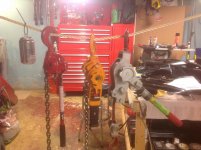
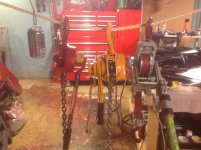
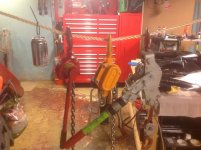
from right to left, (these are extra's in like new condition)

Ratcliff (original model), Harrington (compact handle), Lincoln (convertible, compact handle)

R- 1 1/2 ton (3 ton double line same size), H - 1 1/2 ton, L - 3/4 ton single line - 1 1/2 ton double line

image.jpg
 
Last edited:
To avoid these ads, REGISTER NOW!
Top Bottom
