To avoid these ads, REGISTER NOW!

Whitworth Extractor Sockets - Do They Exist?

YoshiMoshi3

Well-known member
Joined
Nov 2, 2022
Messages
498
1767656250527.png
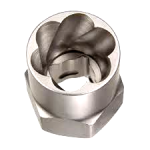
Something like this, or the wedge type, except Whitworth sizes. Does anyone make them, if so can you include a link to them?
 
To avoid these ads, REGISTER NOW!

jayemm

Well-known member
Joined
Dec 18, 2018
Messages
1,527
Location
up high down low
Why Whitworth size. A rounded off bolt or nut doesn't have a certain size depending how damaged it is. You just pick the one that fits the best and hammer it on and remove. In some cases you may have to "profile" the fastener with a file or grinder if it fits between 2 adjacent socket sizes.
Forgot to add, since this style is tapered, hammering it on too hard can cause the socket to split. If you're already familiar with these, then I've never seen them offered in Whitworth sizes.
 
Last edited:
OP
Y

YoshiMoshi3

Well-known member
Joined
Nov 2, 2022
Messages
498
Well like you say, you want various sizes of extractor sockets. I have both metric and SAE. When I round out a bolt, I grab the socket that is tightest on the damaged fastener, it should give me the best chance of unfastening the damaged fastener. Sometimes this is a SAE extractor socket on what was originally a metric bolt. Whitworth sockets would give me more sizes to choose from, and possibly getting an even more tighter fit than otherwise possible.
 
OP
Y

YoshiMoshi3

Well-known member
Joined
Nov 2, 2022
Messages
498

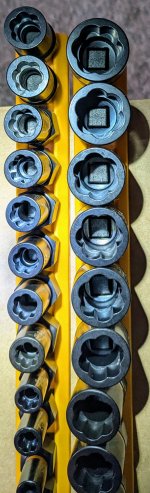
GEARWRENCH 28 Pc. 1/4" & 3/8" Drive Bolt Biter™ Impact Extraction Socket Set - 84784 has plus and minus sizes so should be ideal.
Interesting. Does anyone here own the GW bolt biters? Can anyone confirm if the minus sizes are actually smaller sizes or just has more aggressive flutes than the non minus sizes?
 
OP
Y

YoshiMoshi3

Well-known member
Joined
Nov 2, 2022
Messages
498
I wonder if the GW extractors are worth it for the minus sizes.

I haven't used any of the GW ones.
 

ChevyEFI

Well-known member
Joined
Sep 2, 2012
Messages
8,735
Location
Phoenix, AZ
I wonder if the GW extractors are worth it for the minus sizes.

I haven't used any of the GW ones.
They're not a precision tool. They are taper-cut to grab, and if adequately force-applied, they fit. If you have a 3/8 missing, you grab the 5/16 and hammer it on. There's no reason to get SAE, mm, and WWorth sets.
 
To avoid these ads, REGISTER NOW!

Dave455

Well-known member
Joined
Mar 19, 2013
Messages
5,806
Location
Sussex, England
To answer the O.P. - I have never seen one, and I very much doubt it.

All other things being equal, there is less demand for Whitworth sizes than the others, so proportionally less demand for a relatively specialist tool.

There are probably other reasons. You generally need these sockets when a relatively soft fastener has rounded. But where might you find Whitworth? Older fasteners, sure, but these are generally of quite high quality and not prone to rounding like some modern ones.

Aerospace use, again, sure, but again these are high quality fasteners, and usually correctly torqued. I’ve removed engine components that have sat around an airfield for decades without needing extractor sockets.

The most common use for Whitworth is probably pipe threads, but by definition you are not going the be able to use a socket.

And as Chevy EFI correctly says, these are not precision tools, pick the nearest SAE or Metric and use that!
 
OP
Y

YoshiMoshi3

Well-known member
Joined
Nov 2, 2022
Messages
498
They're not a precision tool. They are taper-cut to grab, and if adequately force-applied, they fit. If you have a 3/8 missing, you grab the 5/16 and hammer it on. There's no reason to get SAE, mm, and WWorth sets.
I thought extractor sockets worked similar to this - If you have a 6 point 10 mm bolt or nut that has rounded out and a regular 6-point chrome socket will not work.

3/16 W = 11.3 mm
10.5 mm
0 BA = 10.49 mm
13/32 " = 10.31875 mm
10 mm
3/8 " = 9.525 mm
9.5 mm
1 BA = 9.27 mm
  1. Use a 12 point 10 mm chrome socket and try that, the 12 point may give you a bite
  2. Go down to next size, in this case 3/8 ". Try a 6 point chrome first.
  3. Try a 3/8 " 12 point socket
  4. Try a 10 mm extractor socket
  5. Try a 3/8 " extractor socket
Sometimes when you go down to the next smallest size, it's a SAE size or a Whitworth size (likely no extractor sockets).

After discovering GW bolt biters had minus sizes, it seems like they are supposed to be slightly smaller. I wonder if they be on hand to increase probability of successful extraction without having to weld. Something like this:

  1. Use a 12 point 10 mm chrome socket and try that, the 12 point may give you a bite
  2. Go down to next size, in this case 3/8 ". Try a 6 point chrome first.
  3. Try a 3/8 " 12 point socket
  4. Try a 10 mm extractor socket
  5. Try a 10 mm - socket from GW
  6. Try a 3/8 " extractor socket
  7. Try a 3/8 " - socket from GW
Two more attempts to extract.

Flutes look the same

I measured from the tip of the flutes.

19mm is 18.8mm
19mm- is 18.4mm
11/16" is 17.1mm
11/16"- is 16.9mm

1000005574.jpg
Beautiful, thanks for confirming that they smaller in size, and not just more aggressive flutes!
 

rust in the eye

Well-known member
Joined
Oct 2, 2017
Messages
2,777
Location
Chicagoland
This is academic, right?
When using sockets for damaged bolt heads original size goes out the window.
Anything you can hammer on, inch, metric, torx that has a chance to grip. These helical sockets aren't fussy about size.
Oh, see above.
 
Last edited:

ChevyEFI

Well-known member
Joined
Sep 2, 2012
Messages
8,735
Location
Phoenix, AZ
I thought extractor sockets worked similar to this - If you have a 6 point 10 mm bolt or nut that has rounded out and a regular 6-point chrome socket will not work.

3/16 W = 11.3 mm
10.5 mm
0 BA = 10.49 mm
13/32 " = 10.31875 mm
10 mm
3/8 " = 9.525 mm
9.5 mm
1 BA = 9.27 mm
  1. Use a 12 point 10 mm chrome socket and try that, the 12 point may give you a bite
  2. Go down to next size, in this case 3/8 ". Try a 6 point chrome first.
  3. Try a 3/8 " 12 point socket
  4. Try a 10 mm extractor socket
  5. Try a 3/8 " extractor socket
No. You left out steps, and included unnecessary ones.

When using these sockets, you don't have "a failed 10mm stud with adequate length." You have an undersized "what's left" and not a lot of it in length.

And no, you don't need a comprehensive, incremental array. 10mm is too big on 10mm, when you use them. You're at an 8mm extractor. Hammered on, the flutes bite. If they bit, but it slips, you're going for 6mm. Hammered on, spun, done.

Buy a starter set and use the next size that works. They're a consumable, never meant to be run into the ground in organization or precisely selected.

GW markets plenty of things they think might sell profitably, that aren't really necessary in the real world. If they could profitably sell you underwear with a comprehensive tap and die chart you can't read/use without your head so far up your *** as to reach the peripheral pertuberance, they would.
 
To avoid these ads, REGISTER NOW!
Top Bottom