To avoid these ads, REGISTER NOW!

Whitworth Socket Sizes, 5/32 W

YoshiMoshi3

Well-known member
Joined
Nov 2, 2022
Messages
498
Anyone know what the across the flats (AF) dimension is for a 5/32 whitworth socket is?
 
To avoid these ads, REGISTER NOW!

Dave455

Well-known member
Joined
Mar 19, 2013
Messages
5,806
Location
Sussex, England
There isn’t one.

5/32 exists as a screw thread only. No nut or bolt head size was ever published. (Edit - in the 20th century! See below).
 
Last edited:

Stubby1743

Well-known member
Joined
Jul 16, 2023
Messages
721
Location
UK
The across the flats size of Whitworth nuts and bolt heads changed during WW2 with the sizes getting smaller.

1.5 x the thread diameter + a constant of 0.15" gives the across the flats wrench/socket size. Unfortunately, I'm not sure whether this applies to the pre or post WW2 sizing.

Edit: I must have bee typing this as Dave posted his reply above. He is no doubt correct.
 

Dave455

Well-known member
Joined
Mar 19, 2013
Messages
5,806
Location
Sussex, England
Understand that, at those small sizes, a bolt and nut would normally be a BA thread.

A couple of small sizes of nut exist, but only for those cases where every other thread is BSW or BSF.

The only reason the small BSW threads exist is for screwing in to cast iron, hence no nuts are needed, and the screw head would be slotted.

I think I found 5/32 screws holding a name plate on a lathe casting once.
 

Dave455

Well-known member
Joined
Mar 19, 2013
Messages
5,806
Location
Sussex, England
The across the flats size of Whitworth nuts and bolt heads changed during WW2 with the sizes getting smaller.

1.5 x the thread diameter + a constant of 0.15" gives the across the flats wrench/socket size. Unfortunately, I'm not sure whether this applies to the pre or post WW2 sizing.

Edit: I must have bee typing this as Dave posted his reply above. He is no doubt correct.
Yes, absolutely correct.

Pre war, BSW bolts used bigger heads than BSF. After the war the smaller sizes were standardised for both, although this only regularised what had been standard practice in the motor industry.

You still won’t find a 5/32 nut or bolt head though. 5/32 was only ever produced as a screw,
 

Dave455

Well-known member
Joined
Mar 19, 2013
Messages
5,806
Location
Sussex, England
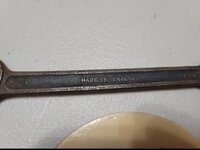
Triumph made a 5/32 W 1000004328.jpg1000004329.jpgopen end wrench for a bolt/but but I am unsure of the AF dimension
Well that’s boggled me, to an extent!

What I think might be going on here, is that a lot of motorcycle manufacturers used cycle threads. These were a “constant pitch” series of threads, that were easy to cut on lathes with fixed leadscrew gearing.

Cycle threads used standard Whitworth bolt head sizes, and I have only ever used standard spanners, but it looks like they used a 5/32 at one time.

I suspect the answer will lie in the cycle thread standards. I will look.
 

Dave455

Well-known member
Joined
Mar 19, 2013
Messages
5,806
Location
Sussex, England
Well, I checked the limited info I have on cycle threads, and all I can find is a reference that they use the “standard BS size” of nut.

The only published chart I can find, doesn’t list a nut size for 5/32, so at this point I have no idea what Triumph did. I suspect it was based on something though.

I can find some references to 5/32 BSW nuts, but they are all of new manufacture, and probably manufactured by people who don’t know what they are doing. The sizing of these seems to be all over the place - see reference to not knowing what they are doing!!
 

Dave455

Well-known member
Joined
Mar 19, 2013
Messages
5,806
Location
Sussex, England
Don’t like mysteries where these things are concerned, so have done a bit of research.

The only reference I can find to 5/32 wrenches / spanners relates either to Triumph branded tools, or to a set of pressed steel tools by Terrys.

So, Triumph obviously used nuts in this size at some point. Whether this was on Bicycles or Motorbikes, we can’t be sure, but I am about 80% sure it would have been a nut for a cycle thread.

The small sets of Terrys tools were predominantly designed for cycle use too, so no surprise they included a size used by Triumph. If the size had been used by other manufacturers I am sure I would have found tools by other makers.

The a/f size they picked would not have been random, and my guess is that they used a size that was included in one of the older standards. 5/32 Whit was not included in BS1083 from the 1950’s, or even BS190 from the 1920’s, so my guess would be one of the Victorian standards.

The fact that cycle threads originated in this era sort of supports that theory. And BA threads were first proposed in 1884, so I suspect that 5/32 Whit was obsolescent from then on,

So, what we have is a size that is a common Whitworth screw size, that was obsolete as a Whitworth nut size by the 1920’s, but possibly lived on as a nut for a cycle thread for some years.

The cycle and motorcycle industry in the U.K. was never forward looking. BSA continued to use cycle threads until the late 1950’s, and adopted BSW/BSF threads just as the rest of the country was adopting Unified!

As to what the actual size was, we still don’t know. It will be recorded somewhere, and the British Standards Institute will certainly know.
 
OP
Y

YoshiMoshi3

Well-known member
Joined
Nov 2, 2022
Messages
498
Don’t like mysteries where these things are concerned, so have done a bit of research.

The only reference I can find to 5/32 wrenches / spanners relates either to Triumph branded tools, or to a set of pressed steel tools by Terrys.

So, Triumph obviously used nuts in this size at some point. Whether this was on Bicycles or Motorbikes, we can’t be sure, but I am about 80% sure it would have been a nut for a cycle thread.

The small sets of Terrys tools were predominantly designed for cycle use too, so no surprise they included a size used by Triumph. If the size had been used by other manufacturers I am sure I would have found tools by other makers.

The a/f size they picked would not have been random, and my guess is that they used a size that was included in one of the older standards. 5/32 Whit was not included in BS1083 from the 1950’s, or even BS190 from the 1920’s, so my guess would be one of the Victorian standards.

The fact that cycle threads originated in this era sort of supports that theory. And BA threads were first proposed in 1884, so I suspect that 5/32 Whit was obsolescent from then on,

So, what we have is a size that is a common Whitworth screw size, that was obsolete as a Whitworth nut size by the 1920’s, but possibly lived on as a nut for a cycle thread for some years.

The cycle and motorcycle industry in the U.K. was never forward looking. BSA continued to use cycle threads until the late 1950’s, and adopted BSW/BSF threads just as the rest of the country was adopting Unified!

As to what the actual size was, we still don’t know. It will be recorded somewhere, and the British Standards Institute will certainly know.
What are the Victorian standards? I've never heard of them.
 

dscheidt

Well-known member
Joined
Apr 26, 2017
Messages
2,892
The fact that cycle threads originated in this era sort of supports that theory. And BA threads were first proposed in 1884, so I suspect that 5/32 Whit was obsolescent from then on,

So, what we have is a size that is a common Whitworth screw size, that was obsolete as a Whitworth nut size by the 1920’s, but possibly lived on as a nut for a cycle thread for some years.

The cycle and motorcycle industry in the U.K. was never forward looking. BSA continued to use cycle threads until the late 1950’s, and adopted BSW/BSF threads just as the rest of the country was adopting Unified!

As to what the actual size was, we still don’t know. It will be recorded somewhere, and the British Standards Institute will certainly know.

Meccano bolts are 5/32 whit. I know most of hte nuts were square, but I think there were hex ones, too.
 
To avoid these ads, REGISTER NOW!

neophyte

Well-known member
Joined
Apr 23, 2012
Messages
9,662
Location
Pennsylvannia
Don’t like mysteries where these things are concerned, so have done a bit of research.

The only reference I can find to 5/32 wrenches / spanners relates either to Triumph branded tools, or to a set of pressed steel tools by Terrys.

So, Triumph obviously used nuts in this size at some point. Whether this was on Bicycles or Motorbikes, we can’t be sure, but I am about 80% sure it would have been a nut for a cycle thread.

The small sets of Terrys tools were predominantly designed for cycle use too, so no surprise they included a size used by Triumph. If the size had been used by other manufacturers I am sure I would have found tools by other makers.

The a/f size they picked would not have been random, and my guess is that they used a size that was included in one of the older standards. 5/32 Whit was not included in BS1083 from the 1950’s, or even BS190 from the 1920’s, so my guess would be one of the Victorian standards.

The fact that cycle threads originated in this era sort of supports that theory. And BA threads were first proposed in 1884, so I suspect that 5/32 Whit was obsolescent from then on,

So, what we have is a size that is a common Whitworth screw size, that was obsolete as a Whitworth nut size by the 1920’s, but possibly lived on as a nut for a cycle thread for some years.

The cycle and motorcycle industry in the U.K. was never forward looking. BSA continued to use cycle threads until the late 1950’s, and adopted BSW/BSF threads just as the rest of the country was adopting Unified!

As to what the actual size was, we still don’t know. It will be recorded somewhere, and the British Standards Institute will certainly know.
Once a standard exists, there is always a chance that some manufacturer will use that standard again, simply to avoid using a “non-standard” size.
 

Dave455

Well-known member
Joined
Mar 19, 2013
Messages
5,806
Location
Sussex, England
What are the Victorian standards? I've never heard of them.
Well, Whitworth threads originated in the 1840’s.

Up till that time, anybody making screws did their own thing. But Joe Whitworth‘s “standardised” threads meant that bolts and screws could be mass produced by specialists, and simply bought in. Much more efficient.

The initial “standard“ was simply what Joe Whitworth described, but they were widely adopted

When BA threads were introduced the process was a lot more organised, but none of these threads became a “British Standard” till the early 20th century when the British Standards Institute was formed.

That doesn’t mean they were not “standard” long before.
 

Dave455

Well-known member
Joined
Mar 19, 2013
Messages
5,806
Location
Sussex, England
Meccano bolts are 5/32 whit. I know most of hte nuts were square, but I think there were hex ones, too.
Correct! I should have thought of that. I suspect the thread form was chosen because the relatively coarse thread was easier for children to use. Or perhaps because it was common at the time of introduction?

5/32 Whit screws are not uncommon, only the nuts!
 
OP
Y

YoshiMoshi3

Well-known member
Joined
Nov 2, 2022
Messages
498
So there are manufacturers of 5/32 W combo wrenches, does anyone make a 5/32 W socket?
 

snapmom

Well-known member
Joined
Sep 4, 2008
Messages
3,520
Location
Florida
Here is a 5/32w socket, from the Packard Merlin Rolls-Royce toolkit, no makers name
 

Attachments

  • IMG_1067.jpeg
    IMG_1067.jpeg
    955.8 KB · Views: 13
  • IMG_1066.jpeg
    IMG_1066.jpeg
    933.3 KB · Views: 13
  • IMG_1065.jpeg
    IMG_1065.jpeg
    941.7 KB · Views: 11

snapmom

Well-known member
Joined
Sep 4, 2008
Messages
3,520
Location
Florida
.387 (in. inches)
AT-8015 (model number)
5/32W (size)

Its 3/8 drive and 12 points.
would date about 1944-1945
very hard to find.
 
To avoid these ads, REGISTER NOW!
Top Bottom
