YoshiMoshi3
Well-known member
- Joined
- Nov 2, 2022
- Messages
- 520
Anyone know what the across the flats (AF) dimension is for a 5/32 whitworth socket is?


Yes, absolutely correct.The across the flats size of Whitworth nuts and bolt heads changed during WW2 with the sizes getting smaller.
1.5 x the thread diameter + a constant of 0.15" gives the across the flats wrench/socket size. Unfortunately, I'm not sure whether this applies to the pre or post WW2 sizing.
Edit: I must have bee typing this as Dave posted his reply above. He is no doubt correct.
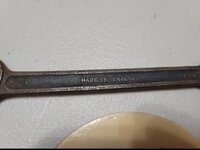
 open end wrench for a bolt/but but I am unsure of the AF dimension
Well that’s boggled me, to an extent!Triumph made a 5/32 W
13.3mm or .525” AF according to google aiAnyone know what the across the flats (AF) dimension is for a 5/32 whitworth socket is?
What are the Victorian standards? I've never heard of them.Don’t like mysteries where these things are concerned, so have done a bit of research.
The only reference I can find to 5/32 wrenches / spanners relates either to Triumph branded tools, or to a set of pressed steel tools by Terrys.
So, Triumph obviously used nuts in this size at some point. Whether this was on Bicycles or Motorbikes, we can’t be sure, but I am about 80% sure it would have been a nut for a cycle thread.
The small sets of Terrys tools were predominantly designed for cycle use too, so no surprise they included a size used by Triumph. If the size had been used by other manufacturers I am sure I would have found tools by other makers.
The a/f size they picked would not have been random, and my guess is that they used a size that was included in one of the older standards. 5/32 Whit was not included in BS1083 from the 1950’s, or even BS190 from the 1920’s, so my guess would be one of the Victorian standards.
The fact that cycle threads originated in this era sort of supports that theory. And BA threads were first proposed in 1884, so I suspect that 5/32 Whit was obsolescent from then on,
So, what we have is a size that is a common Whitworth screw size, that was obsolete as a Whitworth nut size by the 1920’s, but possibly lived on as a nut for a cycle thread for some years.
The cycle and motorcycle industry in the U.K. was never forward looking. BSA continued to use cycle threads until the late 1950’s, and adopted BSW/BSF threads just as the rest of the country was adopting Unified!
As to what the actual size was, we still don’t know. It will be recorded somewhere, and the British Standards Institute will certainly know.
The fact that cycle threads originated in this era sort of supports that theory. And BA threads were first proposed in 1884, so I suspect that 5/32 Whit was obsolescent from then on,
So, what we have is a size that is a common Whitworth screw size, that was obsolete as a Whitworth nut size by the 1920’s, but possibly lived on as a nut for a cycle thread for some years.
The cycle and motorcycle industry in the U.K. was never forward looking. BSA continued to use cycle threads until the late 1950’s, and adopted BSW/BSF threads just as the rest of the country was adopting Unified!
As to what the actual size was, we still don’t know. It will be recorded somewhere, and the British Standards Institute will certainly know.
That's why AI answers have no place on this forum.13.3mm or .525” AF according to google ai

Once a standard exists, there is always a chance that some manufacturer will use that standard again, simply to avoid using a “non-standard” size.Don’t like mysteries where these things are concerned, so have done a bit of research.
The only reference I can find to 5/32 wrenches / spanners relates either to Triumph branded tools, or to a set of pressed steel tools by Terrys.
So, Triumph obviously used nuts in this size at some point. Whether this was on Bicycles or Motorbikes, we can’t be sure, but I am about 80% sure it would have been a nut for a cycle thread.
The small sets of Terrys tools were predominantly designed for cycle use too, so no surprise they included a size used by Triumph. If the size had been used by other manufacturers I am sure I would have found tools by other makers.
The a/f size they picked would not have been random, and my guess is that they used a size that was included in one of the older standards. 5/32 Whit was not included in BS1083 from the 1950’s, or even BS190 from the 1920’s, so my guess would be one of the Victorian standards.
The fact that cycle threads originated in this era sort of supports that theory. And BA threads were first proposed in 1884, so I suspect that 5/32 Whit was obsolescent from then on,
So, what we have is a size that is a common Whitworth screw size, that was obsolete as a Whitworth nut size by the 1920’s, but possibly lived on as a nut for a cycle thread for some years.
The cycle and motorcycle industry in the U.K. was never forward looking. BSA continued to use cycle threads until the late 1950’s, and adopted BSW/BSF threads just as the rest of the country was adopting Unified!
As to what the actual size was, we still don’t know. It will be recorded somewhere, and the British Standards Institute will certainly know.
My football club has new American owners who have been using AI.That's why AI answers have no place on this forum.
Well, Whitworth threads originated in the 1840’s.What are the Victorian standards? I've never heard of them.
Correct! I should have thought of that. I suspect the thread form was chosen because the relatively coarse thread was easier for children to use. Or perhaps because it was common at the time of introduction?Meccano bolts are 5/32 whit. I know most of hte nuts were square, but I think there were hex ones, too.
Beautiful, what is written on it.Here is a 5/32w socket, from the Packard Merlin Rolls-Royce toolkit, no makers name


