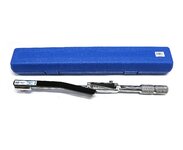
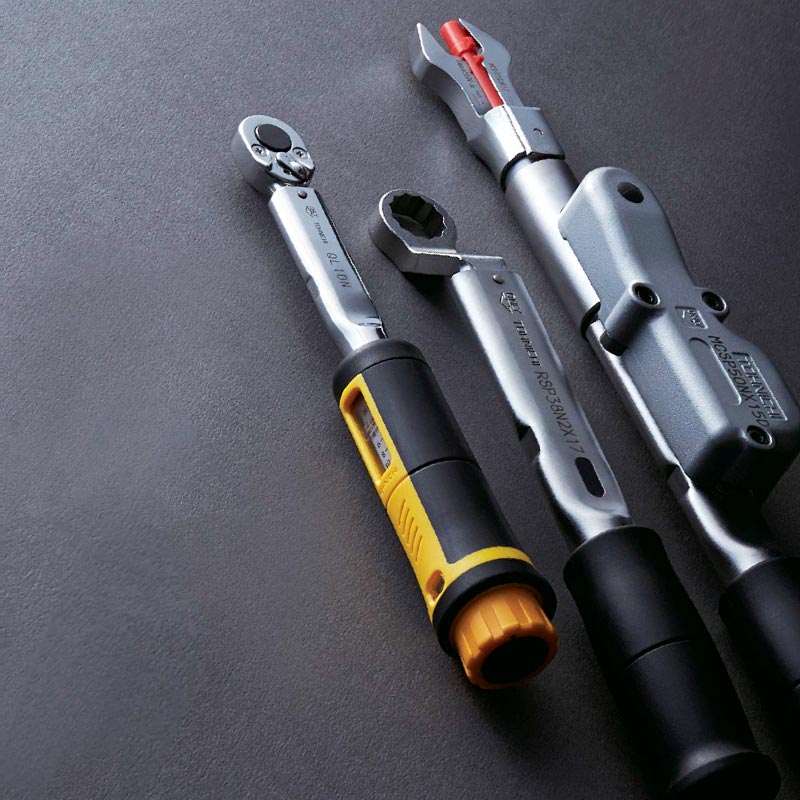
I have several. They're rarely used.
They are TOTALLY HATEFUL for generating torque on fasteners. Everything about the tool is simple, reliable, and with designed-in accuracy. Everything about the USE of the tool is complex, leading to inaccuracy and non-repeatability. Line-of-sight matters. Hand position matters. Ability to pull smoothly matters. Overall, they're an accurate tool that's a mess to use. When I was a kid, I remember torquing bolts on an Olds, at something like 120 ft/lbs. I couldn't get through the whole series without my arm getting so tired that it shook on the last few bolts. And with my arm shaking, it's impossible to hold the desired torque, or to read the scale. I then tried a "clicker" and couldn't believe how much easier it was--partly because of additional leverage, partly because of the ratchet, and mostly because I didn't have to hold the torque long enough to verify by eyesight with the stupid pointer-and-scale.
Where these deflecting-beam torque wrenches shine is in TESTING torque, not generating torque. They're fabulous as test instruments, verifying torque after another tool has tightened the fastener, verifying the other torque wrench itself, or determining the bearing preload, or whatever.
I mostly use them for determining friction in a short-block--how much torque to turn the crankshaft when the pistons (with rings) and cam are in place. Measuring bearing preload via torque-to-rotate is another good use.
Show me a deflecting-beam torque wrench only rated to 7% accuracy, I'll show you a cheap-junk imported piece of ****. Properly-made deflecting beams tend to be as-accurate or more accurate than most any other type in common use. But as said, the engineered-in accuracy of the tool is "sabotaged" by the difficulty in using it correctly. (Operator error vs. tool error)