
JackOfDiamonds
Well-known member
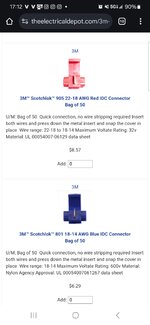
When doing car wiring or stereo installs, I've come to realize these things have a bad reputation, had people tell me "just don't use those scotchlock things whatever you do", even heard some people say anyone who uses them is automatically a "hack":

Where does this idea come from? Do people not know how to use them, so they don't work, and then people write them off after a bad experience? Except I can't even figure out how you could use them wrong...they are pretty much foolproof, which is one of their benefits.
What IS the "community approved" superior method to tap wires...cut the wires, solder them, and wrap them with tape? Seems more of a hack to me. Wire nuts...I certainly hope not, not in a high-vibration environment. Crimp connectors...sure but why is that better? You can screw those up too.
In my engineering life, these and similar connectors are pretty normal. They fit in the family of "insulation displacement connectors". Such connectors are used by the millions to attach ribbon cables and other assemblies, and rated for millions of hours, vibration, etc. I have seen these be approved in situations where soldering and crimp connectors were specifically not allowed. So why do people consider these bad?
"Scotchlock hate" sort of looks like a low-voltage version of the "Wago hate" idea that Wago 221 connectors aren't as good as wire nuts for residential wiring...even though Wago connectors are objectively superior to wire nuts in every way except cost, and approved as such in every official realm.
Where does this idea come from? Do people not know how to use them, so they don't work, and then people write them off after a bad experience? Except I can't even figure out how you could use them wrong...they are pretty much foolproof, which is one of their benefits.
What IS the "community approved" superior method to tap wires...cut the wires, solder them, and wrap them with tape? Seems more of a hack to me. Wire nuts...I certainly hope not, not in a high-vibration environment. Crimp connectors...sure but why is that better? You can screw those up too.
In my engineering life, these and similar connectors are pretty normal. They fit in the family of "insulation displacement connectors". Such connectors are used by the millions to attach ribbon cables and other assemblies, and rated for millions of hours, vibration, etc. I have seen these be approved in situations where soldering and crimp connectors were specifically not allowed. So why do people consider these bad?
"Scotchlock hate" sort of looks like a low-voltage version of the "Wago hate" idea that Wago 221 connectors aren't as good as wire nuts for residential wiring...even though Wago connectors are objectively superior to wire nuts in every way except cost, and approved as such in every official realm.

 so that may be why I do not have much of a problem.