To avoid these ads, REGISTER NOW!

Why do Scotchlocks have such a bad reputation?

JackOfDiamonds

Well-known member
Joined
Jul 31, 2020
Messages
706
Location
Idaho (USA)
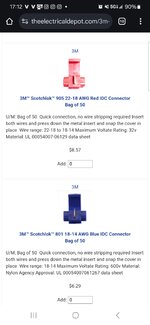
When doing car wiring or stereo installs, I've come to realize these things have a bad reputation, had people tell me "just don't use those scotchlock things whatever you do", even heard some people say anyone who uses them is automatically a "hack":

1731518831563.png

Where does this idea come from? Do people not know how to use them, so they don't work, and then people write them off after a bad experience? Except I can't even figure out how you could use them wrong...they are pretty much foolproof, which is one of their benefits.

What IS the "community approved" superior method to tap wires...cut the wires, solder them, and wrap them with tape? Seems more of a hack to me. Wire nuts...I certainly hope not, not in a high-vibration environment. Crimp connectors...sure but why is that better? You can screw those up too.

In my engineering life, these and similar connectors are pretty normal. They fit in the family of "insulation displacement connectors". Such connectors are used by the millions to attach ribbon cables and other assemblies, and rated for millions of hours, vibration, etc. I have seen these be approved in situations where soldering and crimp connectors were specifically not allowed. So why do people consider these bad?

"Scotchlock hate" sort of looks like a low-voltage version of the "Wago hate" idea that Wago 221 connectors aren't as good as wire nuts for residential wiring...even though Wago connectors are objectively superior to wire nuts in every way except cost, and approved as such in every official realm.
 
To avoid these ads, REGISTER NOW!

WildBill

ALLIANCE MEMBER
Joined
Aug 20, 2021
Messages
2,007
Location
PNW
They damage the wire you are tapping and cause corrosion problems. Having replaced about a million of them that were causing issues on stereo, alarm, and trailer wiring they should never be used. Look into these https://www.posi-products.com/index.html to do the same thing faster and better, without damaging wires or causing a place for corrosion to form.
 
OP
J

JackOfDiamonds

Well-known member
Joined
Jul 31, 2020
Messages
706
Location
Idaho (USA)
In terms of damage, insulation displacement do less damage than just about anything else. The displacer makes the bare minimum cut in the insulation, and the remaining insulation remains in contact with the displacer almost like a gasket. The very reason people say they are bad, is the reason they are considered good. The alternative of cutting the wire and using a crimp connector, leaves the entire wire diameter laid bare and exposed for moisture to wick in. We don't want to make tiny slices in the insulation that are partially sealed, because that's "damaging" the wire, so instead we should cut the wire completely, and that's not damaging it? Make it make sense.

I have to admit my absolute standard for trailer wiring is soldering followed by good, waterproof shrink tubing. But for under dashboards and so on, scotchlock is the best.
 

kbuhagiar

Well-known member
Joined
Dec 27, 2005
Messages
1,744
Location
Escondido, CA
ScotchLoks are OK if - IF - used correctly. Problem is the have been misapplied and misused (by trailer and stereo installation hacks, mostly) for so long that they have developed a bad reputation.

The biggest problem is incorrect sizing; most folks do not even know that there are several different sizes to choose from.
If they are sized correctly to the wire gauge they are less likely to fail.

I had an acquaintance several years ago who did auto wiring on the side. He would add a 20% premium to any wiring jobs if he saw any ScotchLoks anywhere on the harness.
 

johnre

Well-known member
Joined
Dec 1, 2016
Messages
1,049
Location
Portland, OR
The alternative of cutting the wire and using a crimp connector, leaves the entire wire diameter laid bare and exposed for moisture to wick in.
You can now get crimp style connectors that have a heat shrink plastic sleeve with heat-set epoxy on the inside, such that not only is the tubing shrunk down tight around the wire, but the outside of the wire insulation is epoxy bonded to the inside of this sleeve. That's all I use now, whether it's in a moisture area or not.

I do recommend these over Scotchlock. In addition to all the other criticisms of Scotchlock in this thread - valid in my opinion - Scotchlock doesn't allow for much conductor area in contact. In contrast, crimped connectors have a lot of conductor surface - and therefore less current density - in the metal-to-metal connection.
 
Last edited:

WildBill

ALLIANCE MEMBER
Joined
Aug 20, 2021
Messages
2,007
Location
PNW
In terms of damage, insulation displacement do less damage than just about anything else. The displacer makes the bare minimum cut in the insulation, and the remaining insulation remains in contact with the displacer almost like a gasket. The very reason people say they are bad, is the reason they are considered good. The alternative of cutting the wire and using a crimp connector, leaves the entire wire diameter laid bare and exposed for moisture to wick in. We don't want to make tiny slices in the insulation that are partially sealed, because that's "damaging" the wire, so instead we should cut the wire completely, and that's not damaging it? Make it make sense.

I have to admit my absolute standard for trailer wiring is soldering followed by good, waterproof shrink tubing. But for under dashboards and so on, scotchlock is the best.
The problem is they don't just displace the insulation, they damage the wire strands and let moisture in. There are many alternatives, including the ones I linked, that don't cause these issues.
 

wyb2

Well-known member
Joined
Dec 27, 2012
Messages
188
Location
Southern NH
What IS the "community approved" superior method to tap wires...cut the wires, solder them, and wrap them with tape? Seems more of a hack to me.
Heat shrink instead of tape makes it pretty non-hacky.

Wire nuts...I certainly hope not, not in a high-vibration environment.
Yeah definitely not wire nuts

Crimp connectors...sure but why is that better? You can screw those up too.

If you get the ones with heat-shrink insulation, that’s a big plus for crimp connectors. In my experience, the scotch lock things don’t really support the insulation around the connection, so any mechanical stress (or moisture) goes right into the electrical joint, which has likely cut a few strands of the base wire. Also you can pull-test a crimp connection.
 

garfunkle24

Well-known member
Joined
Mar 18, 2008
Messages
3,429
Location
Saskatoon, Canada
Because they're ****.

Crimp connectors are better because they don't make a hard section of wire (like soldering does) where the wire is likely to break due to lack of strain relief.

In theory, a good crimp actually displaces oxygen in the wire though I doubt this matters in practice. It's also hard to screw up a crimp using a good ratcheting crimper.

Good quality heatshrink is the rest of the answer.
 
Last edited:

MovingAlong

Well-known member
Joined
Aug 17, 2013
Messages
1,218
In my engineering life, ...

But for under dashboards and so on, scotchlock is the best.

The difference between theory and practice. In theory there is no difference.

Folks who have experience "redoing" more connectors than one person could ever "do" are trying to share with you the reality they see in practice. Wouldn't dismiss their actual real-world experiences so quickly... :thumbup:
 

LopezBart

Well-known member
Joined
Oct 13, 2023
Messages
2,538
Location
Lopez Island, WA
Wire connectors are used in a variety of different environments, and the user experience will vary greatly as a result. A boat trailer used in salt water service is rather a different matter than under dash in a commuter vehicle; high vibration environments are a different matter again. For many of us, the added expense of using good quality connectors in all environments is trivial compared to the irritation of dealing with corroded connections, often when we're away from the shop.
 

Norcal

Well-known member
Joined
Mar 16, 2008
Messages
13,754
I would call those Scotch taps, Scotchlocks were a wire connector that had a soft vinyl shell that are a ***** remove.
 

f121

Well-known member
Joined
Dec 8, 2018
Messages
2,077
Location
UK
Utter junk. Had to repair so many looms that have had alarms/immos lashed in with scotch locks, usually causing a no start. Lots of trailer sockets fitted with them, best case they just don’t work, often they melt and take the loom with them.
 
To avoid these ads, REGISTER NOW!

no704

Well-known member
Joined
Apr 27, 2016
Messages
5,215
Having installed thousands of these into cars as a young man, I apologize! They usually are ok underdash, I would never use one under a hood or on a trailer. Even worse are the knockoff ones. Anything I do now is solder and heat shrink if it is not possible to terminate at a terminal block or proper plug.
 

American Locomotive

Well-known member
Joined
Jan 8, 2017
Messages
10,953
Location
Rhode Island
When doing car wiring or stereo installs, I've come to realize these things have a bad reputation, had people tell me "just don't use those scotchlock things whatever you do", even heard some people say anyone who uses them is automatically a "hack":

1731518831563.png

Where does this idea come from? Do people not know how to use them, so they don't work, and then people write them off after a bad experience? Except I can't even figure out how you could use them wrong...they are pretty much foolproof, which is one of their benefits.

What IS the "community approved" superior method to tap wires...cut the wires, solder them, and wrap them with tape? Seems more of a hack to me. Wire nuts...I certainly hope not, not in a high-vibration environment. Crimp connectors...sure but why is that better? You can screw those up too.

In my engineering life, these and similar connectors are pretty normal. They fit in the family of "insulation displacement connectors". Such connectors are used by the millions to attach ribbon cables and other assemblies, and rated for millions of hours, vibration, etc. I have seen these be approved in situations where soldering and crimp connectors were specifically not allowed. So why do people consider these bad?

"Scotchlock hate" sort of looks like a low-voltage version of the "Wago hate" idea that Wago 221 connectors aren't as good as wire nuts for residential wiring...even though Wago connectors are objectively superior to wire nuts in every way except cost, and approved as such in every official realm.
This idea comes from the fact that they don't stand up in automotive environments. It's that simple. They might work okay inside an electrical cabinet of a stationary machine, but they don't hold up in cars.

Under the dash inside the car, they can sometimes hold up, but vibration and shaking will often cause them problems after a while. Under the hood, underneath the car, or on a trailer, they will let you down. If you live in the salt belt, forget about it - any exterior wire you Scotchlok will be toast after the 2nd winter. I'm not talking just the connection - the whole wire you tapped into will be toast as the corrosion snakes its way up the wire.

In the automotive realm, the proper way to splice wires is to cut, crimp, and heatshrink with sealant filled shrink. That's how harness wires come from the factory. Soldering is probably what most home gamers do because proper automotive-grade crimping tools are expensive.
 

Firebrick43

Well-known member
Joined
May 12, 2015
Messages
14,031
Location
West central Indiana
"Scotchlock hate" sort of looks like a low-voltage version of the "Wago hate" idea that Wago 221 connectors aren't as good as wire nuts for residential wiring...even though Wago connectors are objectively superior to wire nuts in every way except cost, and approved as such in every official realm.
Every one covered the scorned and pitiful scotchlock.

Wire nuts have better pull test and lower resistances than 221 wagos. Its a matter of much more surface contact and spring force by the wirenut vs the low contact area of the wago. The only thing objectively better is ease of use with the wago.
 

sparky 1971

Well-known member
Joined
Oct 9, 2018
Messages
7,969
Location
Central Iowa
I've used thousands of these for long rows of strip lights where I just pulled the wires all the way through the fixtures with no joints. I know of no failures. I've had several that wouldn't go on properly out of the box, but after that, nothing.


When I was in high school I worked for Uhaul installing trailer hitches and wiring. Those blue pieces of **** they had had us using were an entirely different story and were junk the day they left the factory. The failure rate on those was probably around 25% but it has been 35 years ago so I may not remember everything correctly.
 

u3b3rg33k

Well-known member
Joined
Dec 18, 2017
Messages
4,048
Every one covered the scorned and pitiful scotchlock.

Wire nuts have better pull test and lower resistances than 221 wagos. Its a matter of much more surface contact and spring force by the wirenut vs the low contact area of the wago. The only thing objectively better is ease of use with the wago.
The problem is the user. almost anyone can reliably and repeatedly use a wago properly. far fewer can wire nut properly.
 

Chukster

Well-known member
Joined
Jan 25, 2012
Messages
2,593
Location
Cary, NC
They damage the wire you are tapping and cause corrosion problems. Having replaced about a million of them that were causing issues on stereo, alarm, and trailer wiring they should never be used. Look into these https://www.posi-products.com/index.html to do the same thing faster and better, without damaging wires or causing a place for corrosion to form.

Corrosion problems happen with intrusion of moisture, dirt, contaminants, etc. A Scotch-lok inside the passenger cabin shouldn't experience those. But don't ever use S-Ls outside the vehicle.

IDC connections are soooo common; it's a mature technology.


It's funny how people use things inappropriately and then say the product is bad.
 

Norcal

Well-known member
Joined
Mar 16, 2008
Messages
13,754
I've used thousands of these for long rows of strip lights where I just pulled the wires all the way through the fixtures with no joints. I know of no failures. I've had several that wouldn't go on properly out of the box, but after that, nothing.


When I was in high school I worked for Uhaul installing trailer hitches and wiring. Those blue pieces of **** they had had us using were an entirely different story and were junk the day they left the factory. The failure rate on those was probably around 25% but it has been 35 years ago so I may not remember everything correctly.
Until the requirement for ballast disconnects they were a PITA, but for long rows of fixtures they were a installing electricians dream.
 

Debcrow

Well-known member
Joined
May 14, 2019
Messages
4,040
Location
New Mexico
I have used them with no problems. Always use the correct one for the wire size.
And I live here in the wet southwest :) so that may be why I do not have much of a problem.
However, I seal all electrical splice/joints no matter what the type. Shrink wrap, electrical tape, liquid electrical tape in the tube, even silicon seal if I have nothing else available.
 

Firebrick43

Well-known member
Joined
May 12, 2015
Messages
14,031
Location
West central Indiana
The problem is the user. almost anyone can reliably and repeatedly use a wago properly. far fewer can wire nut properly.
:headscrat:headscrat:headscrat Maybe, just Maybe, that is why I stated? "The only thing objectively better is ease of use with the wago.".

ISO definition of usability
"is the extent to which a product can be used by specified users to achieve specified goals with effectiveness, efficiency, and satisfaction in a specified context of use."
 
Last edited:

sparky 1971

Well-known member
Joined
Oct 9, 2018
Messages
7,969
Location
Central Iowa
Until the requirement for ballast disconnects they were a PITA, but for long rows of fixtures they were a installing electricians dream.
I still use them with the ballast disconnects, I just keep a spool of black and white #16 TFN solid on the lift, cut into short pieces, one end would get stuck in the disco and the other end into the tap n' run (that's what we call the "scotchlocks).
 

john.k

Well-known member
Joined
Jun 4, 2024
Messages
1,049
Been on the market a long time ..........I used them 60 years ago,so they cant be all bad.
 

WildBill

ALLIANCE MEMBER
Joined
Aug 20, 2021
Messages
2,007
Location
PNW
Corrosion problems happen with intrusion of moisture, dirt, contaminants, etc. A Scotch-lok inside the passenger cabin shouldn't experience those. But don't ever use S-Ls outside the vehicle.

IDC connections are soooo common; it's a mature technology.


It's funny how people use things inappropriately and then say the product is bad.
Tell that to all the corroded under dash wiring I have replaced because of them. I'm pretty sure something in them makes wire corrode, I've never seen any other type of connection cause 8-10" of wiring inside the insulation turn green and brittle under a dashboard. Plus they damage the wires 98% of the time. Apparently every single one I've seen in use was installed incorrectly, and I bet I have removed at least 10k of them. I used to fill a coffee can with them before tossing them out, no idea how many times I filled it but it was a lot.

I am not saying IDC connectors are all bad, just Scotchlock. I use IDC style connectors all day on ribbon cables in industrial test equipment, no issue.

Here's an IDC product for your car that actually works and doesn't cause corrosion, I used thousands of them on Harley Davidsons over 10 years without any issue. Don't even need tools to install it. https://www.posi-products.com/posiplug.html
 

mike93lx

ALLIANCE MEMBER
Joined
Dec 9, 2013
Messages
37,494
Location
Richmond, VA
I'm another one that has used them without any issue. Not my go to, but sometimes they are by far the simplest solution

I believe the folks that say they have pulled out corroded wiring, but also feel like a lot of people latch onto the hate without any first hand experience, either way
 

ColoradoMech

Active member
Joined
Feb 12, 2023
Messages
43
Location
Denver Colorado
Im probably in the minority but if I want to tap into a wire i will do it as a regular wire connection. I will cut it, strip the ends and insert an additional wire into one end of an uninsulated **** connector then crimp and used adhesive lined heat shrink. Ill add a 2nd larger piece of heat shrink or some wire loom depending on the application. It's the long and more expensive way however if I'm tapping into a wire I want the connection to be secured, Ive fixed enough electrical problems caused by ****** connections to not want to deal with it. If I want to remove whatever I connected, Ill just cut the additional wire off and wrap it in some quality electrical tape or just cut and completely redo the connection again with just the original wires. Obviously this all depends on the situation and how much room/slack you have to work with.
 

rdoty

ALLIANCE MEMBER
Joined
Feb 7, 2018
Messages
639
Location
Massachusetts
Most of the Insulation Displacement Connectors I'm familiar with go at the end of a cable, have a mechanical structure around the IDC engagement point, and are engineered as part of an overall system. Example include Ethernet connectors, computer and electronic ribbon cables, and telephony applications. They are commonly used with 24 ga and smaller wire and are used for signalling rather than carrying power.. These IDC connectors work well.

Common Scotchlok connectors used in automotive applications tend to be poorly matched to the wire they are used with, are used with 16 ga, 14 ga and even 12 ga wire, have little mechanical support other than the piece of steel cutting through the insulation, and have no moisture control. They are commonly expected to carry significant amounts of power. As previously noted, if the wrong connector is used they can damage the conductors in the wire. They are often poorly installed, making the situation even worse. And, of course, most of the "Scotchloks" in use are actually low cost/low quality clones, often poorly made.

There are enough differences between Scotchloks and engineered IDC systems for electronics that I don't feel they can be directly compared.
 

xjfish

Well-known member
Joined
Feb 22, 2014
Messages
1,293
Scotchloks are garbage for automotive wiring. They are only OK in the rust belt if you need to create wiring problems that I need to sort out for you, likely later, due to corrosion or a poor connection. Aftermarket copycats are even worse.

Someone recently posted about their father using wire nuts and sealing them for trailer connections, this is a better idea in that application if you can not soldier... Just use heat shrink 3-way **** connections
 

nadogail

Well-known member
Joined
Jan 23, 2009
Messages
31,946
Location
Coronado, CA
Well it has been over 55 years since I installed a radio in a car. I am sure that all of the connectors have improved since then.

The connectors we had then were “good enough” for the Fire Trucks and Industrial Tow Tractors we installed VHF two way radios in.
 

mikedodge

Well-known member
Joined
Jun 27, 2017
Messages
2,779
They get a bad rep because people treat them as one size fits all or not installed properly and then whatever they're being used to connect doesn't work right or they use them under vehicles or other places that are prone to corrosion.

I've used them and never had problems and I've seen far worse damage from people who think they are pros and use whatever knife they can find to skin a wire and then wrap another wire around it and either solder it or not and cover it with electrical tape. Which is also as likely to corrode or come loose and cause problems if it wasn't soldered. And if you're removing someones hack job and trying to get back to stock it's far easier to pull off a scotchlock and cover the wire then trying to clean up whatever other mess they came up with to splice that extra wiring in.
 

JSutter

Well-known member
Joined
Jan 11, 2019
Messages
151
I used to install car phones and remote starters among other electronics. Those and T taps were always a no no.
 
To avoid these ads, REGISTER NOW!
Top Bottom