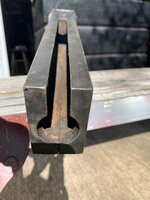
Prentiss vise I presume? But I have seen them with cracks and no obvious hammer marks.
Seller is high as a giraff's @@#$*&This one s made by American Scale company. Seller is asking $100, which seems kinda tall to me considering the condition. If I bought something like this, I'd do a cosmetic restoration, and rarely use it. I have two other vises for actual work.
I believe that Ron has the answer. It's a cold shut.-A bit disappointing to hear that. I've got a #10 swivel jaw that cleaned up fairly nice. No hammer or pipe marks but didn't check closely for cold shut. It's a coachmaker type so it shouldn't get as much stress as others. It's about 100 years old, suggested by someone in the vise thread, would like to see it survive for another generation or two.
I've seen plenty of Prentiss pics with no marks and the crackI’ve never seen tail ends cracked like that without seeing a bunch of hammer marks on the top of the slide. Cast iron is brittle. If you pound on it, it might crack. Certain vise brands seem more prone to cracking because of the manufacturing processes mentioned in previous posts. But the lesson here is don’t pound on a cast iron vise.
Thanks for your input sharing your experiences with Prentiss vises. My claims seem incorrect. That certainly indicates some inherent flaw in the castings doesn’t it?I've seen plenty of Prentiss pics with no marks and the crack
I second this theory. I have seen too many pristine slides with cracks. It is a pity.I believe that Ron has the answer. It's a cold shut.
For those that don't know, a cold shuts occur when two relatively cold streams of molten metal from different gates meet and do not fuse together properly during the casting process.
If memory serves, an old member named Carla who was what I'd call an expert, said Prentiss had a problem with their cooling process.Thanks for your input sharing your experiences with Prentiss vises. My claims seem incorrect. That certainly indicates some inherent flaw in the castings doesn’t it?
I have a couple of Prentiss vises without cracks and could take some close up pics if we determine that pics would be enough to identify that condition.So if you guys saw the underside, could you positively identify a cold shut condition?
-If it was the same person then I remember her from Practical Machin*st. She was well regarded there.Carla was a fantastic machinist and wonderful person so willing to share her experience. She died more than a few years ago. R.I.P. Carla.
-Sometimes you can, sometimes it's difficult to identify. Magnification (10x or better) is often required as, like many things, the severity of a defect is by degrees. The more blatant, the easier it is to see and with less magnification. A cold shut for molded plastic can display flow lines of molten material that can be sort of expected for something in a liquid state. It can appear similar to an odd looking seam where there shouldn't be one. For metal casting. especially for thicker cross sections, it's not as visible. The outward surface may appear uniform but the middle of the section may not have joined properly and a stress fracture from uneven temperatures may eventually propagate to the surface. Cleaning off the oxidation/rust to get a clean look at things may even defeat the purpose because, depending upon the abrasive, it may just "smear" the surface instead of cleanly cutting off the material. Smearing the material is similar, for lack of a better analogy, to just pushing material and it can cover defects like spreading butter on bread. If the cold shut has already caused a crack to appear then you almost have to break it wide open and inspect the cross section of the crack itself for the flawed surfaces. It's a **** shoot sometimes IME.So if you guys saw the underside, could you positively identify a cold shut condition?
-First off, thanks for posting your method. I haven't done welding as part of my daily duties in 30 years, lost the touch along the way but that's what I would have tried 30 years ago.I've probably done this repair more than a dozen times, and have not had any re-crack.
Here are two Prentiss slides showing the underside casting seam. The one that split is from a model 92 vise probably from the early teens. The other slide is from a Prentiss model 181 vise and is quite a bit older. There are several differences in the slide designs.
The newer vise has additional steel tying the slide sides at the spindle end, wider side sections, and also an additional thickness at the rear of the slide. The #92 cracked despite those features. The #181 slide is a bit thicker in the spine and is a much cleaner casting. It has not cracked and does not look like it ever will. Both have been beat similarly by Buba topside at some point in time. Ed.
But how do you explain the vises, especially Prentiss vises, with the crack but no signs of abuse, or even use, that have the crack?I disagree with those who assessed this as cold shut foundry defect. It may be but I don't see evidence of cold shut. Cold shut wouldn't normally appear directly down the center in such a defined area. more likely to be off center and discontinue at some spot.
Back to the original question, "why do vises crack like this" because gray iron was utilized. Gray iron is flake graphite and once a crack is propagated the crack continues like a crack in a windshield. If a user was abusing the vise in any number of ways a crack could be initiated.
This one s made by American Scale company. Seller is asking $100, which seems kinda tall to me considering the condition. If I bought something like this, I'd do a cosmetic restoration, and rarely use it. I have two other vises for actual work.
fin of sand left on the parting line of the core initiates a crack in gray iron. With flake graphite in gray iron it's more prone to cracks. Whereas the spheroidal nodules of ductile iron negates cracks,But how do you explain the vises, especially Prentiss vises, with the crack but no signs of abuse, or even use, that have the crack?
We've seen lots of pictures of them like that over the years on here. There have been pictures of vises with that crack that appear to have never even been used.
fin of sand left on the parting line of the core initiates a crack in gray iron. With flake graphite in gray iron it's more prone to cracks. Whereas the spheroidal nodules of ductile iron negates cracks,
Gray flake iron was the standard material for cast vises, from the time cast vises took over from traditional forged wrought iron blacksmith keg vises, up until maybe WWII.-Why do you insist that these were made from gray cast iron? Do you have some inside information or have done a metallurgical analysis/inspection? Gray cast iron seems a poor choice for something subjected to stress/deformation, like a vise, when better material choices were available. I'm not challenging you, I'm asking why/how you're so certain about this.
-Source of this info?Gray flake iron was the standard material for cast vises, from the time cast vises took over from traditional forged wrought iron blacksmith keg vises, up until maybe WWII.
Grey flake iron was the standard type of “cast iron” being used for most cast iron.-Source of this info?
Parker made a line of "semi-steel" vises, but it wasn't an alloy. A steel bar was embedded in the spine of the slide.Other vise manufacturers sometimes label their vises as “semi-steel”, were an amount of steel was added to molten iron, to produce a stronger iron alloy.
“Ductile iron” was patented in the 1930s and 1940s, so it wasn’t being used for vises before then.