To avoid these ads, REGISTER NOW!

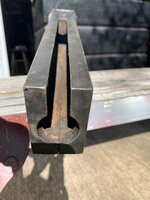
Why do vises crack like this?

MushCreek

Well-known member
Joined
Jan 14, 2015
Messages
9,743
Location
Upstate South Carolina
I see a lot of old vises that are in OK condition, except for a lengthwise crack in the back of the moving part. They seem to split right down the middle. like this one. Repairable? Usable? Junk? The one shown is an old American Scale Co.

vise.jpg
 
To avoid these ads, REGISTER NOW!

Oregon rock crusher

Well-known member
Joined
Jun 28, 2016
Messages
1,900
Location
West of Salem
I think some vise molds were of a poor design and as molten metal poured in from the sides, it met in the middle, and full consolidation failed. Often revealed and accentuated by BFH abuse. Drilling through both sides, threading the hole, and securing them with a cap screw recessing the head, or set screw work pretty well. Two fairly easy ways to do it.

One is to clamp the tail sides together before drilling, threading, and inserting a long set screw, coating in threadlocker and burying the head. The other is to recess the head of a socket head cap screw after overdrilling the threads out of one side which will allow the bolt to pull the two sides together. Two or three points on long splits like the OP's. There isn't that much force to re-spread the split under normal vise operating pressure. JB weld or Devcon can make the split less noticeable without concealing the repair. Welding is a possibility but generally more noticeable. Ed.
 
Last edited:
OP
M

MushCreek

Well-known member
Joined
Jan 14, 2015
Messages
9,743
Location
Upstate South Carolina
This one s made by American Scale company. Seller is asking $100, which seems kinda tall to me considering the condition. If I bought something like this, I'd do a cosmetic restoration, and rarely use it. I have two other vises for actual work.
 

RoninB4

Well-known member
Joined
Jul 22, 2020
Messages
3,480
Location
Under My House
Prentiss vise I presume? But I have seen them with cracks and no obvious hammer marks.

-A bit disappointing to hear that. I've got a #10 swivel jaw that cleaned up fairly nice. No hammer or pipe marks but didn't check closely for cold shut. It's a coachmaker type so it shouldn't get as much stress as others. It's about 100 years old, suggested by someone in the vise thread, would like to see it survive for another generation or two.
 

AEAdam

Well-known member
Joined
May 27, 2023
Messages
2,711
Location
SE PA
The location of that crack doesn't seem consistent with the types of stresses that would result from tightening it. I also don't see why that crack would form there from using the upper surface as an anvil.

I feel like we're seeing a manufacturing defect. I'd like to see the inside of that section. I'd bet there'd be some sort of seam or weak spot.

In terms of repairing it, I disagree it can be repaired. You can fill that crack to be sure, but that won't restore the strength it once had. But again, judging from where it is, does it even need to be repaired?
 

senlow

Well-known member
Joined
Apr 26, 2008
Messages
2,228
Location
Wheat Ridge, Colorado
-A bit disappointing to hear that. I've got a #10 swivel jaw that cleaned up fairly nice. No hammer or pipe marks but didn't check closely for cold shut. It's a coachmaker type so it shouldn't get as much stress as others. It's about 100 years old, suggested by someone in the vise thread, would like to see it survive for another generation or two.
I believe that Ron has the answer. It's a cold shut.

For those that don't know, a cold shuts occur when two relatively cold streams of molten metal from different gates meet and do not fuse together properly during the casting process.
 

IRQVET

Well-known member
Joined
Jun 29, 2015
Messages
1,188
Location
Forgotten Coast (FL)
Possibly a weak spot in the casting followed by misuse gets my vote. Something like that should be able to get welded up fairly easily, just clean the weld area really good and preheat the area prior to welding it up.
 

Shiftless

Well-known member
Joined
Mar 9, 2014
Messages
14,464
Location
East Bay SFO
I’ve never seen tail ends cracked like that without seeing a bunch of hammer marks on the top of the slide. Cast iron is brittle. If you pound on it, it might crack. Certain vise brands seem more prone to cracking because of the manufacturing processes mentioned in previous posts. But the lesson here is don’t pound on a cast iron vise.
 

1982fxr

Well-known member
Joined
Jan 7, 2012
Messages
9,991
Location
Phoenix
I’ve never seen tail ends cracked like that without seeing a bunch of hammer marks on the top of the slide. Cast iron is brittle. If you pound on it, it might crack. Certain vise brands seem more prone to cracking because of the manufacturing processes mentioned in previous posts. But the lesson here is don’t pound on a cast iron vise.
I've seen plenty of Prentiss pics with no marks and the crack
 

Ohmthis

Well-known member
Joined
Jan 20, 2013
Messages
3,000
Location
Outside of Louisville KY
I have an old Morgan Chicago vise that was given to me with a crack like that. It was spread out and could only be opened so far. I ground the crack, pulled it apart, preheated it on my grill, and tightened welded it back together peening the weld. It has held up amazingly well and is my most used vise. I thought it cracked because someone beat the hell out of it.
 

tool_scrounge

Well-known member
Joined
Jul 20, 2010
Messages
4,169
Location
Southern California
I believe that Ron has the answer. It's a cold shut.

For those that don't know, a cold shuts occur when two relatively cold streams of molten metal from different gates meet and do not fuse together properly during the casting process.
I second this theory. I have seen too many pristine slides with cracks. It is a pity.
 

1982fxr

Well-known member
Joined
Jan 7, 2012
Messages
9,991
Location
Phoenix
Thanks for your input sharing your experiences with Prentiss vises. My claims seem incorrect. That certainly indicates some inherent flaw in the castings doesn’t it?
If memory serves, an old member named Carla who was what I'd call an expert, said Prentiss had a problem with their cooling process.

But what the guys are talking about here makes sense and maybe they are actually talking about the same issue?
 

1982fxr

Well-known member
Joined
Jan 7, 2012
Messages
9,991
Location
Phoenix
So if you guys saw the underside, could you positively identify a cold shut condition?
 
To avoid these ads, REGISTER NOW!

Shiftless

Well-known member
Joined
Mar 9, 2014
Messages
14,464
Location
East Bay SFO
So if you guys saw the underside, could you positively identify a cold shut condition?
I have a couple of Prentiss vises without cracks and could take some close up pics if we determine that pics would be enough to identify that condition.
 

RoninB4

Well-known member
Joined
Jul 22, 2020
Messages
3,480
Location
Under My House
So if you guys saw the underside, could you positively identify a cold shut condition?
-Sometimes you can, sometimes it's difficult to identify. Magnification (10x or better) is often required as, like many things, the severity of a defect is by degrees. The more blatant, the easier it is to see and with less magnification. A cold shut for molded plastic can display flow lines of molten material that can be sort of expected for something in a liquid state. It can appear similar to an odd looking seam where there shouldn't be one. For metal casting. especially for thicker cross sections, it's not as visible. The outward surface may appear uniform but the middle of the section may not have joined properly and a stress fracture from uneven temperatures may eventually propagate to the surface. Cleaning off the oxidation/rust to get a clean look at things may even defeat the purpose because, depending upon the abrasive, it may just "smear" the surface instead of cleanly cutting off the material. Smearing the material is similar, for lack of a better analogy, to just pushing material and it can cover defects like spreading butter on bread. If the cold shut has already caused a crack to appear then you almost have to break it wide open and inspect the cross section of the crack itself for the flawed surfaces. It's a **** shoot sometimes IME.
 

seber

Well-known member
Joined
May 31, 2016
Messages
4,190
Location
Deep East Tx.
I agree it is a cold shut problem but unless you are willing to take a chance, I would not weld it. The common repair for cast iron is brazing. Preheating is still advised but there is less risk of stress fracturing. Brass has very similar strength characteristics to cast iron at C30 so the repair is only a cosmetic defect.
 

PierceA

Well-known member
Joined
Aug 6, 2020
Messages
471
Location
SE Michigan
I repair this type of crack from the underside. I unscrew the dynmic completely, then clean the crack thoroughly from the top and bottom. I blow out the crack with compressed air. I then clamp the slide in another vise, in the normal upright position. I look to see that the crack will close completely. Sometimes the crack closes very well, other times it needs additional cleaning.. Once I'm satisified with the crack closing completely, I remove the part and turn it over, and clamp it again in a vise to close the crack.
I usually will drill a 'stop crack' hole right at the end of the crack..

Then, I use an oxy-acetylene torch to heat the part thoroughly. The cracked area is usually less than 1/2" thick so it will heat to a dull red if a rosebud tip is used on the torch.. I heat from the inside and from underneath.
When I see the dull red glow, I set the torch aside, and grab my stick welder. I have a quantity of stainless steel welding rod. It seems to cool slower than say a 6013 or 6011 rod's weld. I weld only about 1"-1.5", then reheat, and then use a needle scaler to peen the welded area.. Then I repeat the process. I often will start with the end of the crack, and work my way to the end of the slide.. A weld tends to shrink when it cools [often causing cracks in cast iron if not reheated and peened] but I feel that this shrinking helps close the crack fully.

The 'nice' thing about this method is that no welds are visible, just hopefully a very narrow thin crack.

I've probably done this repair more than a dozen times, and have not had any re-crack.

PierceA
 

RoninB4

Well-known member
Joined
Jul 22, 2020
Messages
3,480
Location
Under My House
I've probably done this repair more than a dozen times, and have not had any re-crack.
-First off, thanks for posting your method. I haven't done welding as part of my daily duties in 30 years, lost the touch along the way but that's what I would have tried 30 years ago.

-Secondly, because the slide end doesn't/shouldn't experience much stress I wouldn't expect to see a crack reappear. Perhaps your contribution will encourage someone else to try your methods. Thanks for posting.
 

Neighbor

Well-known member
Joined
Feb 23, 2010
Messages
137
I disagree with those who assessed this as cold shut foundry defect. It may be but I don't see evidence of cold shut. Cold shut wouldn't normally appear directly down the center in such a defined area. more likely to be off center and discontinue at some spot.

Back to the original question, "why do vises crack like this" because gray iron was utilized. Gray iron is flake graphite and once a crack is propagated the crack continues like a crack in a windshield. If a user was abusing the vise in any number of ways a crack could be initiated.
 

JradM

Well-known member
Joined
Sep 4, 2019
Messages
1,811
Location
Alberta
I'm wondering if the casting is thinner in the middle. It does seem odd that it generally follows the centerline - but then it occurred to me that 90-degree corners would just have a lot more metal.

Obviously it's machined on the outside, so you get clean flat surfaces. I bet they're not machined in the inside, meaning it likely has slightly radiused inside-corners. That would make the middle inch or so the thinnest part (depending on how gentle or sharp those radii are).

That doesn't explain why there's a crack in the first place, but if there's a crack - it WOULD explain why it's always down the middle.
 

Oregon rock crusher

Well-known member
Joined
Jun 28, 2016
Messages
1,900
Location
West of Salem
Here are two Prentiss slides showing the underside casting seam. The one that split is from a model 92 vise probably from the early teens. The other slide is from a Prentiss model 181 vise and is quite a bit older. There are several differences in the slide designs.

The newer vise has additional steel tying the slide sides at the spindle end, wider side sections, and also an additional thickness at the rear of the slide. The #92 cracked despite those features. The #181 slide is a bit thicker in the spine and is a much cleaner casting. It has not cracked and does not look like it ever will. Both have been beat similarly by Buba topside at some point in time. Ed.
 

Attachments

  • IMG_6079.jpg
    IMG_6079.jpg
    389.6 KB · Views: 48
  • IMG_6105.jpg
    IMG_6105.jpg
    362.1 KB · Views: 48
Last edited:

RoninB4

Well-known member
Joined
Jul 22, 2020
Messages
3,480
Location
Under My House
Here are two Prentiss slides showing the underside casting seam. The one that split is from a model 92 vise probably from the early teens. The other slide is from a Prentiss model 181 vise and is quite a bit older. There are several differences in the slide designs.

The newer vise has additional steel tying the slide sides at the spindle end, wider side sections, and also an additional thickness at the rear of the slide. The #92 cracked despite those features. The #181 slide is a bit thicker in the spine and is a much cleaner casting. It has not cracked and does not look like it ever will. Both have been beat similarly by Buba topside at some point in time. Ed.

-Interesting changes in design, will have to check my #10 again. The frequency of cracked slides that display no signs of abuse, to me, is an indicator of something wrong at the foundry level. But without an analysis of the casting material itself, mold design, and process it's all just speculation. I'm not a casting engineer but there a number of factors that can greatly affect the quality of the casting, especially in a gravity fed casting. The #181 shows that, in spite of being older, they were doing something right that could stand up to Bubba treatment. Thanks for posting the photos.
 

1982fxr

Well-known member
Joined
Jan 7, 2012
Messages
9,991
Location
Phoenix
I disagree with those who assessed this as cold shut foundry defect. It may be but I don't see evidence of cold shut. Cold shut wouldn't normally appear directly down the center in such a defined area. more likely to be off center and discontinue at some spot.

Back to the original question, "why do vises crack like this" because gray iron was utilized. Gray iron is flake graphite and once a crack is propagated the crack continues like a crack in a windshield. If a user was abusing the vise in any number of ways a crack could be initiated.
But how do you explain the vises, especially Prentiss vises, with the crack but no signs of abuse, or even use, that have the crack?

We've seen lots of pictures of them like that over the years on here. There have been pictures of vises with that crack that appear to have never even been used.
 

ecotec

Well-known member
Joined
Oct 5, 2010
Messages
5,408
This one s made by American Scale company. Seller is asking $100, which seems kinda tall to me considering the condition. If I bought something like this, I'd do a cosmetic restoration, and rarely use it. I have two other vises for actual work.

I do not see how that would be worth the time.

On a long enough timeline, you should be able to find much better vises for cheaper.

Use what you already have as a baseline. Anything that you buy after that should be better and cheaper. Ideally, you should be able to take it home and bolt it to a bench.

I have two big Wilton bullet vises. I need one, but I have two. For a vise to even turn my head, at this point, it would have to be an original paint Wilton with a swivel.

I try to buy vintage with original lightly used original finishes.
 
Last edited:

Neighbor

Well-known member
Joined
Feb 23, 2010
Messages
137
But how do you explain the vises, especially Prentiss vises, with the crack but no signs of abuse, or even use, that have the crack?

We've seen lots of pictures of them like that over the years on here. There have been pictures of vises with that crack that appear to have never even been used.
fin of sand left on the parting line of the core initiates a crack in gray iron. With flake graphite in gray iron it's more prone to cracks. Whereas the spheroidal nodules of ductile iron negates cracks,
 

RoninB4

Well-known member
Joined
Jul 22, 2020
Messages
3,480
Location
Under My House
fin of sand left on the parting line of the core initiates a crack in gray iron. With flake graphite in gray iron it's more prone to cracks. Whereas the spheroidal nodules of ductile iron negates cracks,

-Why do you insist that these were made from gray cast iron? Do you have some inside information or have done a metallurgical analysis/inspection? Gray cast iron seems a poor choice for something subjected to stress/deformation, like a vise, when better material choices were available. I'm not challenging you, I'm asking why/how you're so certain about this.
 

neophyte

Well-known member
Joined
Apr 23, 2012
Messages
9,537
Location
Pennsylvannia
-Why do you insist that these were made from gray cast iron? Do you have some inside information or have done a metallurgical analysis/inspection? Gray cast iron seems a poor choice for something subjected to stress/deformation, like a vise, when better material choices were available. I'm not challenging you, I'm asking why/how you're so certain about this.
Gray flake iron was the standard material for cast vises, from the time cast vises took over from traditional forged wrought iron blacksmith keg vises, up until maybe WWII.
Some vises still seem to be made from grey flake iron, with higher end vises made for actual industrial use being made out of better cast iron types like ductile iron.
There were exceptions, such as Armstrong vises, which were made from malleable iron, and certain smaller “wrought iron” vises, as well as certain vises made from stronger and more durable “Semi-Steel” and Meehanite iron alloys, but these vises were usually yhe exceptions, and literature on the vises or even the vises themselves, are usually labelled with the fact that a “better” iron alloy was used.
 

neophyte

Well-known member
Joined
Apr 23, 2012
Messages
9,537
Location
Pennsylvannia
-Source of this info?
Grey flake iron was the standard type of “cast iron” being used for most cast iron.
There were methods of producing “better” types of iron, such as malleable iron, going back to the 1830s in the USA, but these mostly weren’t used for vises and other large objects because changing the iron structure required a separate heat treatment treatment, which would be costly, especially large thick items.
Items made from better alloys, or with special heat treatments were almost always advertised as such.
The information has come up over on the two long vise threads.
Armstrong of Bridgeport, (not the hand tool company), specifically mentions malleable iron being used in their advertisements.
Other vise manufacturers sometimes label their vises as “semi-steel”, were an amount of steel was added to molten iron, to produce a stronger iron alloy.
“Ductile iron” was patented in the 1930s and 1940s, so it wasn’t being used for vises before then.
If you’ve seen vises with chunks missing, or or giant cracks, it usually indicates the “iron” is and was brittle, which is usually an indication of grey flake iron.
Even better brands of woodworking vises are usually made from brittle iron alloys, even nowadays, which is the reason the vises have broken parts, or get cracked when dropped.
 

TailGunner3000

Well-known member
Joined
Sep 5, 2019
Messages
362
Location
New Jersey
Other vise manufacturers sometimes label their vises as “semi-steel”, were an amount of steel was added to molten iron, to produce a stronger iron alloy.
“Ductile iron” was patented in the 1930s and 1940s, so it wasn’t being used for vises before then.
Parker made a line of "semi-steel" vises, but it wasn't an alloy. A steel bar was embedded in the spine of the slide.

Ductile iron was invented in 1943.
 
To avoid these ads, REGISTER NOW!
Top Bottom