To avoid these ads, REGISTER NOW!

Why doesn’t the snow melt?

dscheidt

Well-known member
Joined
Apr 26, 2017
Messages
2,884
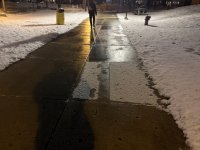
Walked across a college campus tonight right after a light snow. They put so much salt down the snow was all melted. Except there were a few squares where the snow had not melted. There’s no way the salt tractor could have done that. So what’s the difference? There are some areas in that sidewalk that have had a square or two replaced, I don’t pay enough attention to know whether these are those or not

IMG_5035.jpeg
 
To avoid these ads, REGISTER NOW!

rlitman

Well-known member
Joined
Oct 18, 2010
Messages
24,581
Location
Long Island
Maybe the replacement squares are a different thickness? That's a weird effect for sure, but it has to be related to heat from the ground, or stored in the slabs.
 

mm08822

Well-known member
Joined
Jan 13, 2012
Messages
5,866
Location
NJ
It could be the spreader feed was interrupted in that area. Any salt solution on the other slabs drained off at the expansion joints into the soil. The tire and foot prints provided carry-over from other slabs.

Freaky for sure!
 

Lassen Forge

Well-known member
Joined
Apr 26, 2014
Messages
15,056
Location
The romantic hills of central Umbria, Italy,
"Salt" has an effective temperature range, if it's below this it won't work. For some reason those slabs are colder than the ones around it. Thicker? IDK... but generally thats why you get weird results like this.

The type of chloride (Sodium, Calcium, potassium, etc.) depends on 3 things. (1) how cold will it get, (2) what kind of damage will the pavement sustain, and (3) how much environmental damage is acceptable. Generally, the more effective the de-icer is at lower temps, the more damage it will do, either to the pavement (spalling) or the environment (kill the plants, lawn, contaminate groundwater, etc.) or both.

NaCl (Sodium Chloride, aka rock or table salt) is good to about 15F. KCL (Potassium Chloride) to 12F. MgCl (Mag Chloride) is a power hitter at -20F, but like it's cousin CaCl (calcium chloride, -25F) be ready to do concrete repairs. (CMA - Calcium Magnesium Acetate - is used commercially, but is good to only +20F. ) Urea (like your diesel truck's blue juice) is good to +15F, but is relatively safer.

BTW - NaCl is cheap, CaCl and MgCl cost more.

So the bottom line is whatever they're using as a deicer is right on the cusp of how cold the walkway and ambient temp is, and the 1-2º difference is the difference between melt and ice rink. They don't want to break up the concrete, and they don't want to kill the landscaping,

(BTW - When I lived in snow country (where the snow was "sierra cement", 3-4' deep and cold) I USUALLY did a blend of MgCl and NaCl... it seemed to cut the ice pretty well, and not eff up my concrete walkways TOO bad, and worked well on the gravelly ice paths out in the yard to the old shop.)
 

rlitman

Well-known member
Joined
Oct 18, 2010
Messages
24,581
Location
Long Island
"Salt" has an effective temperature range, if it's below this it won't work. For some reason those slabs are colder than the ones around it. Thicker? IDK... but generally thats why you get weird results like this.

The type of chloride (Sodium, Calcium, potassium, etc.) depends on 3 things. (1) how cold will it get, (2) what kind of damage will the pavement sustain, and (3) how much environmental damage is acceptable. Generally, the more effective the de-icer is at lower temps, the more damage it will do, either to the pavement (spalling) or the environment (kill the plants, lawn, contaminate groundwater, etc.) or both.

NaCl (Sodium Chloride, aka rock or table salt) is good to about 15F. KCL (Potassium Chloride) to 12F. MgCl (Mag Chloride) is a power hitter at -20F, but like it's cousin CaCl (calcium chloride, -25F) be ready to do concrete repairs. (CMA - Calcium Magnesium Acetate - is used commercially, but is good to only +20F. ) Urea (like your diesel truck's blue juice) is good to +15F, but is relatively safer.

BTW - NaCl is cheap, CaCl and MgCl cost more.

So the bottom line is whatever they're using as a deicer is right on the cusp of how cold the walkway and ambient temp is, and the 1-2º difference is the difference between melt and ice rink. They don't want to break up the concrete, and they don't want to kill the landscaping,

(BTW - When I lived in snow country (where the snow was "sierra cement", 3-4' deep and cold) I USUALLY did a blend of MgCl and NaCl... it seemed to cut the ice pretty well, and not eff up my concrete walkways TOO bad, and worked well on the gravelly ice paths out in the yard to the old shop.)
To add a bit to this, sodium chloride rock salt works both as an abrasive (like sand) to improve traction on ice as well as an ice melt. It works relatively well on roads also because the physical action of tires grinding it up helps with the melting, but it's mainly popular because it's cheap in large quantities. Don't expect it to melt anything on a sidewalk anywhere near 20F.
 
To avoid these ads, REGISTER NOW!

Artemis11235

New member
Joined
Jan 29, 2026
Messages
1
There's a possibility that they didn't salt the sidewalks at all - steam tunnels run under sidewalks typically, and they carry enough heat to keep the sidewalks clear. There are exceptions, as you've seen. Are all the sidewalks on your campus clear? Don't know how big your campus is, but there might be some sidewalks that are not melted at all?

It was like this at my uni, and some friends and I used this phenomenon to map out the steam tunnels in preparation for choosing an entrance. It took four of us with crowbars to pry up the long rectangular entrance plate and pivot it to the side. We wandered (hunched) around down there for maybe 45 minutes. Nothing to see but a wide variety of pipes, but we sure had fun with the whole experience.

We did this before 9/11, so no smart phones, and I didn't take my (film) camera.
 
OP
D

dscheidt

Well-known member
Joined
Apr 26, 2017
Messages
2,884
There's a possibility that they didn't salt the sidewalks at all -

No. They use so much salt on the sidewalks, every spring there’s a strip of dead grass along them, and the grounds crew reseed it, and some places, rip out a strip to put down new sod. When this happened, the melting was from salt put down for the last snow fall, a week before.

I’m guessing it is a temperature difference, probably from a void or different base preparation.

The school does have some sort of district heating, I don’t know if it’s steam or hot water, it does have chilled water for ac. But the ducts don’t run under sidewalks, except incidentally where they cross under them.

The college I went to had some cool brick vaulted steam tunnels. They’d been blocked with concrete block in all the buildings, though. The pipes were covered in asbestos, and the only way in were a couple concrete pads that had to be lifted with a crane. I did get in to one spur, which had been abandoned because the boiler house moved. The maintenance people used it to store junk.
 

ArcReactorKC

Well-known member
Joined
Jun 1, 2019
Messages
2,237
Location
Out in the county NE of KCMO
I recall a couple of businesses that I had to access their underground tunnels from a removable square of the sidewalk, it was very hard to tell that it was any different. Possibly there is manhole access underneath.
 
To avoid these ads, REGISTER NOW!
Top Bottom