To avoid these ads, REGISTER NOW!

WHY IS MY BENCH GRINDER WHEEL SO OFF

topher5150

Active member
Joined
Nov 3, 2017
Messages
31
Location
Grandville, Mi
I scored this old Dayton bench grinder, with drill bit sharpener attachment for $40. I got it home cleaned the arbors and ran it for a sec with nothing on it and ran smooth. I put the grinding wheel on it hit the switch and it about jumped off the bench.
I took an drill bit, clamped it to the drill bit attachment and to the plate in front of the wheel, and both surfaces of the wheel it maybe made contact with about half the wheel.
Do I have a bad wheel or is there something wrong with the grinder itself?
 

Attachments

  • grinder.jpg
    grinder.jpg
    124.6 KB · Views: 77
To avoid these ads, REGISTER NOW!

bdbecker

ALLIANCE MEMBER
Joined
Nov 18, 2015
Messages
5,556
Location
Iowa
Is this a new wheel, or one you got with the grinder?

If it came with the grinder, do yourself a favor and toss it in the trash. No telling how it was handled prior to your ownership and exploding grinder wheels are a real thing.

If it's a new wheel, did you install the correct bushings for the shaft size?
 

PCustoms

Well-known member
Joined
Jul 23, 2011
Messages
22,619
Location
VT
-shut caps lock off
-throw trash wheel of unknown history in trash
-buy new wheel with correct ID to match shaft or wheel with bushings to fit snug on shaft
 

bdbecker

ALLIANCE MEMBER
Joined
Nov 18, 2015
Messages
5,556
Location
Iowa
Grinding wheels usually come with a series of plastic bushings that allow you install wheels on a variety of grinders. Basically, they take up any difference between the shaft diameter and arbor hole diameter to ensure that the wheel is centered on the shaft when tightening the nut.

I'd highly recommend getting rid of the old wheel and swapping in a new one, which should come with bushings.
 

JradM

Well-known member
Joined
Sep 4, 2019
Messages
1,814
Location
Alberta
It does sound like a bushing problem. Maybe someone had the wheel clamped in a position where it was relatively centered - otherwise it would have vibrated from when you first turned it on. Without a bushing though, it could have moved once you tried to use it.

Does it vibrate now? If you're saying it runs steady but only makes contact with the wheel half the time... that seems weird! A wheel that far out of square ought to be vibrating like crazy.

Replacing the wheel is the "right" answer. Depending on your risk tolerance you could try a diamond bench grinder dressing tool to make it circular again - just don't do that until you know the wheel is riding centered on the shaft.
 

bdbecker

ALLIANCE MEMBER
Joined
Nov 18, 2015
Messages
5,556
Location
Iowa
@JradM - He removed the wheels to clean up the shafts, and it ran smoothly with nothing installed. The vibration only came when the wheel was reinstalled on the grinder. My guess is that the bushing was lost during the removal process and the wheel is no longer centered on the shaft.
 

rust in the eye

Well-known member
Joined
Oct 2, 2017
Messages
2,759
Location
Chicagoland
Agreed with this^ that the bushings may have been lost.
@ OP Don't be running this in this condition. Shaking those grinding wheels like that is asking for them to disintegrate. That could end very badly.
 

RoninB4

Well-known member
Joined
Jul 22, 2020
Messages
3,515
Location
Under My House
-The previous posts are correct in saying that the wheel needs to fit the spindle properly with VERY little (.003 or so) difference between the OD of the spindle and the ID of the wheel bushing. There should also be thick paper covering the wheel hub (with spindle holes) called blotters. This to prevent the steel shoulder and washer from contacting the wheel material. The blotters act as a sort of protective cushion to tighten on, grinding wheels are brittle and can fracture when pressed by steel. After confirming that the wheel runs fairly free of excessive vibration the next thing to do is to dress the wheel true or you're ground surfaces will look like a plowed field. Any wheel I've put on a grinder, whether bench/surface/or OD requires the wheel to be dressed. Different wheel can/will require different types of dressers that depend upon the wheel material composition and the finish you require. This can be done with the following:

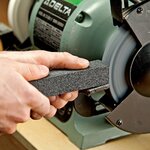
Hand held stone (rough). There are several types of these, not all are suitable for bench grinder wheels
)Stone.jpeg


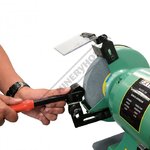
Rotary/Star type (slightly better finish), Creates a lot of dust, wear breathing protection so it doesn't get in your lungs.
Rotary.jpg

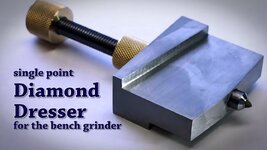
Diamond (better but not recommended for bench grinders unless you really know what you're doing)
Diamond.jpg


-Wheels can be carborundum, silicon carbide (used for non-ferrous materials), aluminum oxide (my personal choice), or diamond (not a good choice for a bench grinder). Several grits per wheel, a coarse wheel (32) will grind cooler/faster than a finer grit (60). Hope this helped someone.
 
To avoid these ads, REGISTER NOW!

driftpin

Well-known member
Joined
Dec 22, 2016
Messages
11,227
Location
Miami-Dade/Broward Co. Florida
I bought a Home Depot wheel for my bought-new 8" grinder, it made the machine jump around like sea-monkeys. I returned it (Diablo brand)

I bought a Weiler wheel, and it was as-smooth as it could be/should be.
 

alfadan

Well-known member
Joined
Mar 9, 2007
Messages
2,107
Location
Augusta, ks
If you do get this sorted, you can mount the wheels and make a sharpie line on each to see their relative position and feel for vibration. Moving one of the wheels say 90 degrees at a time and maybe 45 as you get closer, you can balance it out pretty good.
 

neophyte

Well-known member
Joined
Apr 23, 2012
Messages
9,585
Location
Pennsylvannia
It’s better if you can find a wheel that just balances, but if the issue seems to be an out of balance wheel, there are balancing kits you can get to make the wheels run smoother and more balanced if you need maximum precision and kack of vibration.


rlitman

Well-known member
Joined
Oct 18, 2010
Messages
24,591
Location
Long Island
Is this a new wheel, or one you got with the grinder?

If it came with the grinder, do yourself a favor and toss it in the trash. No telling how it was handled prior to your ownership and exploding grinder wheels are a real thing.

If it's a new wheel, did you install the correct bushings for the shaft size?
First and foremost: learn how to "ring" a grinding wheel. It may save your life. There's no telling how a wheel was abused in the STORE, so I'd have equal trust in a new vs old wheel, with one caveat.

For inspecting a grinding wheel (off the machine!), follow these steps).
1) look all around the exposed surface of the wheel for visible cracks or signs of metal embedded in the wheel. Aluminum has a nasty habit of melting and forcing it's way into the abrasive, and when heated up by subsequent grinding operations, it can force a wheel to split. Yes, there are special wheels made for grinding aluminum, but they look very different, because they're shiny on the surface with binders and much less abrasive (they're more abrasive loaded plastic than bonded abrasive "stones").
2) support the wheel on a pencil and tap on the side near the edge with a hammer. It should ring like a bell (or crystal stemware). Any cracks at the circumference will make it thonk instead.

Once you have a verified uncracked wheel, pick out the bushings that get it to fit best on the arbor. If you're lacking them, you can roll up some paper or masking tape. They're only there to center the wheel temporarily until the flanges clamp it into place. Even a slightly off-center wheel can easily be balanced! That's because weight imbalance at the center (near the arbor) has far less influence on the balance than weight imbalance near the circumference. So you don't need a press fit here. Close is good enough.

Next, tighten the nut onto the wheel between the flanges, and spin it manually. Look closely at the sides of the wheel. They should run fairly true, even if the wheel is way off center, because the sides are held by the flanges. If the flanges are mounted on a ripped label, that's easily enough to add a wobble to the wheel that dressing cannot fix. A bent arbor would show up as a wobble, but it may be too small to easily see.

Lastly, dress the wheel to round with a star wheel dresser. Even if it started out round, and even if it seemed fine when you took it off, remounting it will change the center enough that it needs dressing again. It's like re-chucking something in a 3-jaw chuck in the lathe, and expecting it to remain on-center.
 

RoninB4

Well-known member
Joined
Jul 22, 2020
Messages
3,515
Location
Under My House
It’s better if you can find a wheel that just balances, but if the issue seems to be an out of balance wheel, there are balancing kits you can get to make the wheels run smoother and more balanced if you need maximum precision and kack of vibration.

-Balancing arbors may very well help a larger wheel (larger than 8") but really shouldn't be necessary for the smaller wheels used on a bench grinder. In all my years running surface grinders (7" wheels) I've never used a balancing arbor or felt the need to. For the bigger wheels on large wet grinders (up to 18" wheels) I very much felt the need to balance them. There's also diamond wheel balancing and truing but that's a topic for another time.

The other post regarding checking for a cracked wheel (thank you rlitman) is something I forgot to mention but a VERY important check to make BEFORE mounting a wheel. I've seen the results of an exploded wheel and it's pretty scary. Story from decades ago was a jig grinder hand that came in and fired up the machine to warm it up to operating temp, like he did every morning. An invisible crack in the mounted wheel made it explode as the spindle spooled up to 60,000 RPM. A chunk of the mounted wheel was thrown through his chest and he was dead before he hit the ground. Hadn't even had his first coffee break.

Handle grinding wheels with much care, they're more fragile than you think they are. That's why I only buy wheels from known industrial supply houses that know how to be careful and pad them for shipping. With Amazon or other places that are less concerned with safety than shipping who knows how many times that wheel has been bounced, dinged, or had weight stacked on it during the shipping process.

I might suggest tapping with a piece of hardwood (tool handle) instead of a hammer to "ring" the wheel. ALL wheels should be checked, even if new. Second hand wheels should be regarded with suspicion. I've always been in the habit of standing out of the possible debris stream when starting up a grinder, it may save you one day.

Also correct is that once a wheel is removed (unless the arbor is removed with it) the wheel will need to be dressed every time it gets mounted, even on the same spindle. Hope this helps someone.
 

rlitman

Well-known member
Joined
Oct 18, 2010
Messages
24,591
Location
Long Island
...I might suggest tapping with a piece of hardwood (tool handle) instead of a hammer to "ring" the wheel. ALL wheels should be checked, even if new. Second hand wheels should be regarded with suspicion. I've always been in the habit of standing out of the possible debris stream when starting up a grinder, it may save you one day...
I find I get a better ring with something hard, but a handle should work just fine. I wasn't clear about it above, but strike it like you'd tap a glass vase to get it to ring. NOT like you'd strike the Liberty Bell. LOL. You'll end up applying quite a bit more impact while you're dressing the wheel later.

YES, stand well out of the plane of the wheel when starting. Especially on that first start.

Yikes, 60,000 RPM? Seems like a zero too much to me though. I don't see how any stone could hold up to that. I have some tools at 65,000, 85,000 and even 100,000 RPM, but they're tiny turbine grinders with 1/8" and smaller collets. On the 65,000 one, I saw a steel shafted burr start to blur into a cone from imbalance. That was very nearly a brown pants moment. I now only use these with solid carbide burrs and those steel shaft burrs go into the 24,000 RPM grinder.
 

RoninB4

Well-known member
Joined
Jul 22, 2020
Messages
3,515
Location
Under My House
Yikes, 60,000 RPM? Seems like a zero too much to me though. I don't see how any stone could hold up to that. I have some tools at 65,000, 85,000 and even 100,000 RPM, but they're tiny turbine grinders with 1/8" and smaller collets. On the 65,000 one, I saw a steel shafted burr start to blur into a cone from imbalance. That was very nearly a brown pants moment. I now only use these with solid carbide burrs and those steel shaft burrs go into the 24,000 RPM grinder.

-Some of the jig grinder spindles will go to 120,000-175,000 RPM and your tooling better be up for it. I don't recall how fast the last Moore head went but it sounded like a turbine as it spooled up the diamond/Borazon bits. You're right, it certainly does cause a "pucker" the moment you hear something you shouldn't as it gains RPM.
 

larry_g

Well-known member
Joined
Apr 28, 2007
Messages
16,876
Location
oregon

Keith fenner did a 3 part series on tuning up a poor quality grinder. Watch it and glean what is needed to have a good grinder. It has more than just balancing wheels. He goes through measuring to find untrue parts and making new ones.

lg
no neat sig line
 
To avoid these ads, REGISTER NOW!
Top Bottom