To avoid these ads, REGISTER NOW!

Why Snap-On?

Status
Not open for further replies.

Wrenchinfool

Well-known member
Joined
Dec 19, 2014
Messages
210
Location
Cleveland Ohio
does it come with Auto-Reverse? Mine does, it has already been replaced once.

One of my on gripes with snappy is my 1/2 drive rachet broken at least a dozen times and replaced twice in 7years.. Flex head half drive with 225 lbs at max leverage = broken and yes I have a breaker bar, but over all I still prefer them to other tool brands just my 2 cents
 
To avoid these ads, REGISTER NOW!

woody 73

Well-known member
Joined
Apr 14, 2009
Messages
11,540
Location
The Great State Up North
A long ago post but it still rings true for all time; funny story but years ago I remember a car dealer giving me a tour of his shop and the one statement he told me that stuck in the back of my head was the following.

"We only hire workers that have snap-on boxes any other boxes and we will not even give them a second look", maybe not the exact words but close enough for my old memory to recall.

Seems rather foolish in my eyes but that was his way of saying only the best will do. I am a shade tree guy and I use every brand under the tree from every country from A to Z.
 

drink

Well-known member
Joined
Nov 18, 2015
Messages
1,115
Location
Confused State
Is that an actual arm strong box? My kid would love that for Christmas

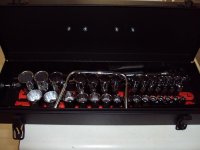
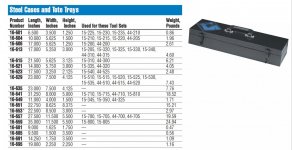
I thought you were asking about the Snap-On box but you were asking about the Armstrong. Yes, it is an Armstrong box. It is an Armstrong 16-613 steel case. I use the 17" long cases to hold both of my 3/8" drive Armstrong socket sets.

Cripe has a larger one on eBay. A box like mine might be found on eBay or you can buy one new for about $35 shipped.

http://www.ebay.com/itm/Armstrong-1...242371?hash=item5d5d3d13c3:g:8qAAAMXQRPRTIhdr
 

Attachments

  • Armstrong 16-613 Steel Case.jpg
    Armstrong 16-613 Steel Case.jpg
    150.3 KB · Views: 23
  • 3 8ths dr set nice.jpg
    3 8ths dr set nice.jpg
    55.5 KB · Views: 28
  • Armstrong 3 8 ths DR Metric Socket set.jpg
    Armstrong 3 8 ths DR Metric Socket set.jpg
    97.7 KB · Views: 32
  • Snap On Armstrong Boxes.jpg
    Snap On Armstrong Boxes.jpg
    67.9 KB · Views: 27
Last edited:

BDT/NWMN

Well-known member
Joined
Jan 22, 2012
Messages
3,762
Location
Erskine, Mn
:headscrat
I occasionally used to work alongside another guy from another company, they would be installing/repairing milking parlours and i'd be working on the milk cooling equipment. He was very proud of his Snap-On tools, but he was (in my opinion) a back stabbing incompetent *** hole. (he would tell the customer what i was doing was wrong etc as his company also had their own cooling department and wanted all the work)
So this guy coloured my opinion of Snap-On tools as to some degree i associate them with this type of person.

My thoughts vary from Yours a bit... Even a back stabbing incompetent *** hole can own quality tools, vehicles, homes, or anything else; as long as they have the money or credit to buy them.... Using Your logic; there are enough of these turds around to soil the thoughts of owning any tool, car brand, or home style ever built... I suggest just flushing the turd.
 

LXCam

ALLIANCE MEMBER
Joined
Apr 23, 2013
Messages
19,091
Location
AZ
A long ago post but it still rings true for all time; funny story but years ago I remember a car dealer giving me a tour of his shop and the one statement he told me that stuck in the back of my head was the following.

"We only hire workers that have snap-on boxes any other boxes and we will not even give them a second look", maybe not the exact words but close enough for my old memory to recall.

Seems rather foolish in my eyes but that was his way of saying only the best will do. I am a shade tree guy and I use every brand under the tree from every country from A to Z.


There is something to be said about appearances. when I was contracting and interviewed a potential new employee I always asked to see their hand tools. Some guys didn't get hired based upon what I would witness as it was very telling of their level of experience. Granted that's not always the case but in some arenas that first impression is everything. And all though I do not feel a snappy box or any other major league manufacturer makes the person a qualified tech, it goes a long way convincing others there is an understanding that quality counts.
 

blown94conv

Well-known member
Joined
Apr 2, 2007
Messages
854
Location
Berlin, CT
I have noticed that those that are serious about their trade, any trade, after a few years they invest in quality equipment. Be it lawnmowers, saws, hand tools, etc. If You come by my house to do woodwork, and have black and decker saws that I see at Home Depot for $39.95, I start to seriously doubt the level of craftmanship I will recieve. Call me an elitest, but that's also experience talking.
 

monkeyspanners

Well-known member
Joined
May 28, 2013
Messages
419
Location
Oxford, UK
:headscrat

My thoughts vary from Yours a bit... Even a back stabbing incompetent *** hole can own quality tools, vehicles, homes, or anything else; as long as they have the money or credit to buy them.... Using Your logic; there are enough of these turds around to soil the thoughts of owning any tool, car brand, or home style ever built... I suggest just flushing the turd.

I wouldn't say i am using logic at all, and would agree i am stupid for having made the connection between owner and tool. I haven't met any similarly dislikable people with such an allegiance to one brand of tools etc to form a similar association with other manufacturers (plus i hope i am somewhat wiser twenty years later)
 

iScream

Well-known member
Joined
Apr 8, 2014
Messages
777
Location
Middle TN
A long ago post but it still rings true for all time; funny story but years ago I remember a car dealer giving me a tour of his shop and the one statement he told me that stuck in the back of my head was the following.

"We only hire workers that have snap-on boxes any other boxes and we will not even give them a second look", maybe not the exact words but close enough for my old memory to recall.

Seems rather foolish in my eyes but that was his way of saying only the best will do. I am a shade tree guy and I use every brand under the tree from every country from A to Z.

I don't doubt what you're saying but I do find it hard to believe anyone stupid enough to have a policy like that could run a successful business. That's truly one of the dumbest things I've ever heard.
 

WhiffySpark

Well-known member
Joined
Oct 22, 2009
Messages
6,252
If you are routinely breaking basic hand tools, then you're either using the wrong tool for the job, abusing the tool, or need to try another approach to the task at hand. As I mentioned, I can see spending the extra money on a few select tools (bit sockets seem to be one place where Snap On is clearly superior), but is someone really ever going to break a 1/4" drive socket?

Having someone handle the warranty for you is nice, but I'm not sure it is worth the additional premium you pay on everything. Even then, the turn around time is only as good as the truck guy. If he has it on hand, you're set, but if he's got to order it, you can probably get a replacement quicker by picking up the phone and calling Snap On yourself. Many of the other tool companies will do the same for rebuild kits or other low dollar warranty replacements.

Even at 10-20% off, they're still higher than the brands I mentioned. I think people get caught up on the resale value of truck brand tools because they are so expensive up front. If you find yourself out of work, or decide its not what you want to do for a living, you need to try to get every dime you can to pay off SO. If anything, it strengthens the argument for buying a great quality industrial brand that doesn't have you coming out of pocket so much in the first place.

I worked in a few shops for summer jobs 20 years or so ago, and there were always a few guys in the shop that just didn't think you were any good unless you had a box full of truck brand tools. Yet I knew a bunch of mechanics that made their living day after day with a mis-mash of whatever got the job done right, and they weren't forking over a hundred bucks a week or so to the truck guys.

It seems like people who make their living using their tools have no issues with snapon. It's everyone else on this site who think it's over priced junk.

I've broken 1/4 sockets of various brands, some never got replaced because they weren't worth the warranty hassle. Sockets get worn out and split. Ratchets get work out and need rebuilt. Same with power tools. Everything was covered under warranty for me, you're experience may vary.

I don't buy tools to resell so I can't comment on that. I could care less about resale value to be honest. I own my tools if I need to sell something, so be it. Yes we pay for the warranty at time of purchase and my dealer is the reason I have snap on. I had other dealers at different shops that I wouldn't even buy from. Instead I went to my guys house whenever I needed something

I made my living turn wrenches, I'm sure a hobbyist has a different opinion.
 

pepgj

Well-known member
Joined
Oct 26, 2015
Messages
274
ehhh...why not snap on?

The only reason I can think of (a tolerably obvious one) are the super high MSRP numbers. Those really can be kind of silly.

It's nice to see a company worry more about quality than price, though. If people feel pride in this stuff, go for it. In terms of tools of the trade, these setups are kind of in-between in price. I've had computer workstations that cost more than just about any tech's Snap-on world, and the handtools at least had the good sense to still be worth something in five years.
 

WhiffySpark

Well-known member
Joined
Oct 22, 2009
Messages
6,252
I thought you were asking about the Snap-On box but you were asking about the Armstrong. Yes, it is an Armstrong box. It is an Armstrong 16-613 steel case. I use the 17" long cases to hold both of my 3/8" drive Armstrong socket sets.

Cripe has a larger one on eBay. A box like mine might be found on eBay or you can buy one new for about $35 shipped.

http://www.ebay.com/itm/Armstrong-1...242371?hash=item5d5d3d13c3:g:8qAAAMXQRPRTIhdr

That is awesome. I appreciate it
 

elefan

Well-known member
Joined
Sep 29, 2015
Messages
80
Location
Scandinavia
It seems like people who make their living using their tools have no issues with snapon. It's everyone else on this site who think it's over priced junk.

I've broken 1/4 sockets of various brands, some never got replaced because they weren't worth the warranty hassle. Sockets get worn out and split. Ratchets get work out and need rebuilt. Same with power tools. Everything was covered under warranty for me, you're experience may vary.

I don't buy tools to resell so I can't comment on that. I could care less about resale value to be honest. I own my tools if I need to sell something, so be it. Yes we pay for the warranty at time of purchase and my dealer is the reason I have snap on. I had other dealers at different shops that I wouldn't even buy from. Instead I went to my guys house whenever I needed something

I made my living turn wrenches, I'm sure a hobbyist has a different opinion.

I have ratchets that has been used profesionally day in and day out since the late 70'ies and early 80'ies.. This goes for sockets and wrenches too. Only the wrenches are somewhat worn after abusing the open end instead of using the right tool for the job. . They're all Stahlwille.
What im trying to say is that if you wear out a ratchet, either you're using it wrong or the ratchet isnt really that good.

Honestly i dont really think stahlwille is that great. I just think snap on is really good at selling themselves and excell in pretty tools. I do own some american made snap on also.
 

WhiffySpark

Well-known member
Joined
Oct 22, 2009
Messages
6,252
I have ratchets that has been used profesionally day in and day out since the late 70'ies and early 80'ies.. This goes for sockets and wrenches too. Only the wrenches are somewhat worn after abusing the open end instead of using the right tool for the job. . They're all Stahlwille.
What im trying to say is that if you wear out a ratchet, either you're using it wrong or the ratchet isnt really that good.

Honestly i dont really think stahlwille is that great. I just think snap on is really good at selling themselves and excell in pretty tools. I do own some american made snap on also.

I've abused ratchets plenty of times. I've actually only had an issue with one. I ripped apart the flex part of it :lol:

I have been meaning to get my go to 3/8 ratchet rebuilt, just out of maintenance. I've abused that one more times than I can count. I've used it to hold a bolt with a 1/2 inch gun on the other side numerous times lol
 

Bruce57

Well-known member
Joined
Feb 16, 2014
Messages
323
Location
Central Ohio
My first mechanic's job was in small motorcycle shop in 1975. The owner insisted on using Snap-On tools on the customers bikes. I had some Craftsman stuff that he wouldn't let me use. He showed me how much better the Snap on fit fasteners and said "no customer's bikes leave here looking like they have been worked on" (a reference to rounded fasteners). I guess it made an impression on me. That's when I started buying Snap-on and I still have and use tools I bought back then and they still work well for me. Much but not all of my tools are Snap-on. Some things they don't do as well as others and I don't go much for their re-branded stuff. There are plenty of other good tools on the market, and as often expressed in this forum tools don't make the mechanic. I just like the quality, fit, and feel of their ratchets, sockets, screwdrivers, and wrenches. Most of what I buy is gently used so I don't pay full retail. Some people spend a lot of money on hobbies, premium vehicles, expensive clothing, etc. I guess my vice is expensive tools. I just like 'em.
 

edl

Well-known member
Joined
Jan 29, 2006
Messages
809
Location
Southeast, US
http://www.strategy-business.com/article/9598?gko=ec35a

Published: January 1, 1998 / First Quarter 1998 / Issue 10 (originally published by Booz & Company)
MARKETING, MEDIA & SALES
How Snap-on Tools Ratchets Its Brand
The way to create a world-class brand is to give customers what they need, when they need it, and never let them out of your sight.

by Glenn Rifkin


PDF


Radical marketers have a lot to teach their more traditional big-business cousins.

The Snap-on Tools Corporation, for example, has created a business model that combines the top-drawer cachet of a Louis Vuitton, the credit philosophy of a Wells Fargo and the convenience of the Good Humor Man, an odd but compelling amalgam that has put the company at the pinnacle of its market, significantly distancing it from the competition.

And though Snap-on's legendary brand status in the $20 billion automotive tool and equipment business is the result of a decidedly offbeat marketing approach, the company's experience offers lessons about quality, distribution and customer loyalty that apply as much to selling watches, shirts and computers as they do to selling tools.

From its base in Kenosha, Wis., Snap-on has ridden America's love affair with the automobile to solid sales and profits since getting its start 78 years ago, racking up record earnings of $131 million in 1996 on revenues of $1.49 billion.

Its history of success is replete with the usual mix of serendipity, good management, savvy financial decisions and a dedicated and motivated work force. But Snap-on traces its good fortune to three other key ingredients: an unwavering commitment to high-quality, premium-priced products for a large but clearly defined marketplace; an unusual credit system that gives its customers access to those products; and a well-oiled delivery system, employing an army of franchise dealers, that takes the product right to the customer's door.

Though Robert A. Cornog, Snap-on's chief executive, insists that the company is a conservative Midwestern operation, it has thrived while many of its rust-belt brethren have struggled. The difference, many say, is its highly unusual marketing. To sell their wares, Snap-on's 5,700 franchise dealers and sales representatives steer their ubiquitous white vans -- actually rolling retail stores stocked with more than $100,000 worth of inventory -- to 335,000 automobile dealerships, service stations and independent garages around the United States and abroad. Another 325 vans are driven by Snap-on technical representatives, who back up the dealers and their increasingly complex product line with training and expertise.

Each franchise dealer owns his own truck, combs his territory and vis-its his 200 to 300 customers every week, on a rotation as regular as clockwork.

"The whole corporation is based on one thing: all the dealers getting up in the morning, getting behind the steering wheel and seeing that first customer," said Joseph Holmes Van Mater Jr., a veteran Snap-on dealer in Atlantic Highlands, N.J. "It's all face to face, one on one."

Like many of his peers, Mr. Van Mater is the son of a Snap-on dealer. Even third-generation Snap-on dealers are not uncommon, a testament to the company's strong commitment to its sales channel.

With this time-tested formula, Snap-on embodies the coveted tenets of customer intimacy and consistency, building a strategic web of individual relationships over nearly eight decades that is as complex as a global computer network but as simple as its core selling proposition: providing products that help customers make money.

Well before its competition realized it, Snap-on understood that its main customer, the successful independent garage owner, was an astute businessman. To him, time literally was money and if he could get reliable tools without having to leave work to buy them, he would gladly pay a higher price and become a repeat customer.

In consistently placing a premium on quality and keeping nearly all of its production in United States factories and under tight controls, Snap-on has built up valuable equity and fashioned a case study in successful brand management.

To tool lovers, Snap-on is the gold standard, not unlike Rolex, Rolls-Royce or Chivas Regal in their respective markets. Snap-on offers cachet, credibility and a mark of unspoken excellence that draws mechanics to spend thousands of dollars on its tools and another small fortune on the storage cases, carts, chests and wall units that it also makes.
 

edl

Well-known member
Joined
Jan 29, 2006
Messages
809
Location
Southeast, US
The average auto mechanic will accumulate $20,000 to $30,000 worth of tools in a career, and many spend far more. Most covet and care for their tools in the same way as gunslingers in the Old West treated their pearl-handled pistols. It isn't unusual to find mechanics who quietly wax and shine their tool cases and etch their initials into the tools themselves.

Snap-on makes "the best stuff," said Ray Magliozzi, an auto repair shop owner in Cambridge, Mass., and co-host with his brother, Tom, of "Car Talk," the popular auto repair call-in show on National Public Radio. "They charge the heck out of you, but it really does work better." Mr. Magliozzi said that he has purchased more than $100,000 worth of Snap-on tools in his 25-year career and still uses the ones from his first toolbox.

Like the more highly visible Federal Express or United Parcel Service, Snap-on is essentially a composite of routes and drivers and deliveries, put together with the goal of bringing products and services directly to the customer on a regular basis. In its bare-bones essentials, the company is a throwback to the era of the neighborhood ice cream truck, milkmen who delivered before dawn and physicians who made house calls.

But it would be a mistake to conclude that Snap-on has a throwback mentality. Like other thriving marketers, Snap-on has built on its platform of success, making a series of acquisitions over the past decade to extend its reach into such businesses as software-based diagnostic systems and management information systems. Mr. Cornog points out that more than 40 percent of Snap-on's products now have a software component imbedded in them.

Snap-on's quest is to become the one-stop shopping source for auto mechanics when it comes to tools, electronic equipment, information systems and other products. Having already achieved much of that goal, according to analysts who track the market, Snap-on is currently integrating its diagnostic capabilities and management information products into a single computerized system. That would allow garages and service centers to more efficiently do complex diagnostic engine work, produce invoices, keep track of inventory and update accounting records. The system went into service in 1997.


While stepping into high technology, Snap-on continues to stay true to its core constituency, believing it can build on its basic business model and shepherd the auto mechanic into the 21st century.

But this requires a "serious transformation," according to Martin Silverman, a partner in the Chicago office of Booz-Allen & Hamilton, who has consulted on technology issues with Snap-on for the past five years.

"You don't sell diagnostic systems and software the same way you sell hand tools," Mr. Silverman said. "This is not about the feel of the tool in your hand, or the fit and finish. It's about functionality, and it requires the field force to get an understanding of a different kind of tool."

Snap-on's success so far in diagnostic equipment sales illustrates the strength of its business model, a model that Mr. Silverman said can, in fact, be copied by companies targeting specific professional markets. A shirt manufacturer could well create a mobile delivery system and outfit busy executives right in their offices, he suggested. Snap-on succeeds, Mr. Silverman said, because it truly respects its customer, the auto mechanic, and because it has recognized its franchised dealers as partners, extensions of the core business whose success determines the company's success.

Like other non-traditional marketers, such as Harley-Davidson, which sees itself selling a lifestyle more than a motorcycle, Snap-on has a self-image that would surprise many outsiders.

In essence, according to Mr. Cornog, Snap-on is an upscale retail operation disguised as a manufacturer. But unlike the affluent shoppers who favor Louis Vuitton or Gucci, Snap-on's clientele is a distinctly blue-collar, lower-to-middle-income aggregation with limited access to credit.

Realizing this, Snap-on also became a financial services company when its sales force began extending credit to mechanics as far back as the Great Depression. In much the same way, Wells Fargo, many years later, carved out a new lending niche for itself by deciding to take a chance on small business.


In Snap-on's case, a mechanic could buy an expensive set of wrenches, sockets and screwdrivers by paying $20 or $30, with no interest, on each weekly sales call. Today, Snap-on dealers continue to offer interest-free credit on most sales, and the company, through its financial services arm, offers formal loans for more expensive equipment. Interest is charged on those loans, but customers will qualify who might not receive credit elsewhere.

"The most important thing that takes place in that relationship is the credit," said Branko M. Beronja, Snap-on's senior vice president for diagnostics. "Most of the customers we do business with cannot afford to pay cash for what they buy. The credit and convenience we provide, often with no credit check, creates the relationship with the dealer. There are a lot of shops that would not be in business today were it not for a Snap-on dealer who extended them the credit to buy their tools."
 

edl

Well-known member
Joined
Jan 29, 2006
Messages
809
Location
Southeast, US
And if Snap-on is indeed a retail company, it is, by measures of sales per square foot, among the most successful in business. A single Snap-on van, with an average of 160 square feet of cargo space, typically produces $350,000 to $400,000 in annual revenue for its dealer. Mr. Van Mater, one of the company's most successful dealers, had gross sales in excess of $600,000 in 1996. He said he carries 2,000 of the company's more than 14,000 products at any one time, with prices ranging from 75 cents for a spark plug gapper to $40,000 for a computerized diagnostic system. Snap-on's trademark red tool cabinets, all remarkably durable and some running the length of a garage wall, can sell for $10,000 or more.

The selling proposition has remained the same since Joseph Johnson invented the interchangeable socket wrench and founded the company in 1920, eager for a way to market the product to the burgeoning automotive industry. Realizing that this radical new product could be appreciated only if it was seen, Mr. Johnson sent his first two salesmen, Stanton Palmer and Newton Tarble, out on the road.

Believing they had a premium product to sell, the pair took a swatch of green pool table felt, laid it out on a table in the auto repair shops along Chicago's Michigan Avenue and displayed the shiny, innovative handles and sockets to awed mechanics. Their marketing slogan, "Five Do the Work of Fifty," struck a chord and the pair sold 650 sets in their first 16 days.

Ever since, Snap-on has stayed tightly focused on its core customer base, avoiding forays into even related markets like construction or home improvement. Company executives claim no deep insight; they simply had not penetrated the full value of their target market, so why stray into distracting side businesses?

That focus has resulted in a dominant share of the mobile van automotive tool market, according to James Lucas, an analyst with NatWest Securities in Baltimore. Assigning dollar figures to that market is difficult, Mr. Lucas said, but measured by number of vans on the road, Snap-on owns 60 percent of the business. Snap-on's nearest competitor, Mac Tools, a division of Stanley Works, has 13 percent.

Snap-on's marketing has always steered away from huge advertising and promotional expenditures, relying instead on direct selling built upon an avowed respect for the company's oft-maligned customers. By producing high-quality tools, ergonomically designed for long hours of daily use, Snap-on sent out the message that its customers were professionals, as crucial to the American culture and lifestyle as physicians. Like doctors, they deserved the best equipment to perform their jobs.

Snap-on's success, says Mr. Silverman, begins with the premise that "the warranty is an afterthought and it is taken for granted that the tool is beyond compare." Snap-on offers a lifetime warranty on most of its wrenches, pliers, screwdrivers and other tools. But its continuing commitment to manufacture the tools by hand, in the United States, using only the highest-grade steel and other components, has rendered the warranty nearly irrelevant. Auto mechanics boast of having intact sets of Snap-on tools from 25 or more years ago, when they first entered the trade.

"For the automotive technician who has a Chevy on the lift that he's promised to the customer by 4, he isn't much interested in the warranty if the tool breaks at 3," Mr. Silverman said. "With Snap-on, they know the quality is so high, the tool isn't going to break. If I made my living repairing cars, the one thing I don't want to factor into my productivity equation is my warranty."

By charging premium prices -- 10 percent more than direct competitors like Mac Tools, SPX and Danaher, and more than double what mass merchants like Sears charge -- Snap-on rightly bet that customers would acknowledge that the best is worth paying extra for.

"Don't underestimate the power of ego when marketing to male-dominated industrial work forces," NatWest's Mr. Lucas said. "Testosterone does sell."

And while auto mechanics have long been cast by Hollywood and the media as an unscrupulous and unsavory lot, Snap-on has waged its own personal battle on their behalf, in deeds and marketing campaigns. The proverbial "grease monkeys," with blackened hands and dirty coveralls, have returned the favor with their business.

During the Depression, for example, Snap-on salesmen, sensing the angst of these struggling mechanics, began compiling "wish lists," asking customers what they would buy if they had the money -- and then extended them the credit to make at least some of the purchases. In so doing, Snap-on not only sold more tools than the company could have anticipated, but created route lists, purchase records and data for territorial sales statistics. By supporting its customer base so directly, Snap-on actually exited the Depression with a modest profit. It also created a foundation of relationship-selling that remains its strength today.

This devotion has become a brand trademark. Though the company has never spent a dollar on traditional brand-enhancement advertising, it committed $2 million in 1994 for a tribute campaign for the "automotive technician." In a series of national print ads, Snap-on featured real mechanics in their shops, sans grease and oil, explaining their dedication to their craft in their own words. The tag line of each ad read, "It takes a lot to be an auto technician."

Though most mechanics profess to be unmoved by such platitudes, the campaign has in fact resonated with the already loyal customer base. Thousands of garages and dealerships have even framed the ads and hung them in their shops.

Not coincidentally, 1994 was the year that Snap-on ceased giving out its traditional calendar featuring provocatively posed female models holding Snap-on tools. Mr. Van Mater admits that cries of protest were heard from the ranks of the not particularly politically correct mechanics. But with more and more women attending to the servicing of the family car, the calendars were no longer an image either the dealers or the company wanted associated with Snap-on.

And though one would have to search far afield to find a more cynical, wisecracking customer base than the 1.25 million automobile, truck and airplane mechanics who make up Snap-on's target market, a visit to virtually any garage or service station vividly illustrates Snap-on's inextricable place in its customers' hearts and minds.

One would be hard pressed to find an automotive service bay without a prominently displayed Snap-on tool case or a mechanic without an extensive set of Snap-on tools in his collection.

"Snap-on is to tools what Xerox is to copiers," said Tom Morabito, the owner and head technician at Amtruck, a small independent garage in Boston.

Added Don Posey, a veteran mechanic at a Boston repair shop, "You feel the balance of the wrench in your hand, and when you use it in a real tight space, you can see and feel the difference."
 
To avoid these ads, REGISTER NOW!

edl

Well-known member
Joined
Jan 29, 2006
Messages
809
Location
Southeast, US
As is the case with other premium brands, the connection Snap-on has forged with its customers reaches beyond the pragmatic to the personal, to the desire to own the best. "It's jewelry, it's adornment," said Mr. Magliozzi of "Car Talk." "It enhances your own self-image and impresses your customers."


And yet, the Snap-on customer is not necessarily emotionally linked to the brand itself, as say Harley-Davidson owners might be to their motorcycles, Mr. Silverman said. Auto technicians will quickly buy a competitive product if it solves a particular problem. But having established a bond of trust with the local Snap-on dealer and with the company's products, the customer remains likely to give a far higher percentage of his business to Snap-on.

"If Snap-on tried to appeal to emotion, that would be off-putting to the technician's business sensibility," Mr. Silverman said. "This is a relationship pull, not an emotional pull."

For mechanics, in fact, the weekly visit from the Snap-on dealer is a welcome respite, Mr. Magliozzi said. "For those of us who fix cars for a living, tools are like toys and the Snap-on guy is like the Pied Piper. He arrives with all those things that make you happy."

Despite the assumption that most mechanics, after years in business, would have full tool boxes and few new tool requirements, there is a steady flow of new cars, new designs and new equipment needs.

"Not a day goes by without learning something new," Mr. Magliozzi said. "And new tools are required all the time."

Indeed, thanks to the growing complexity of automobiles over the past decade -- a period marked by the extensive computerization of cars -- mechanics can never have enough equipment. The intense focus on both safety and emission controls has turned auto servicing into a high-technology endeavor. Yesterday's grease monkey must be as adept now with software as he is with wrenches and brake calipers.

Today, 87 percent of all systems on new vehicles are computerized, compared with just 18 percent in 1990. Pushed by the penchant of Japanese auto makers for annual redesigns, engines and control systems now change constantly industrywide. It was Snap-on's recognition of this shift early on that made it decide to push hard, through acquisitions and its own research and development, to get a foothold in the diagnostics business.

Snap-on acknowledges, too, that the growth in its hand tool business has slowed in recent years, making it all the more important for its dealers to sell diagnostic equipment.

"I sell something new to at least 100 people every week," Mr. Van Mater said. "The range of what a small independent garage is going to run into these days is phenomenal. There are computer controls; a simple oxygen sensor now requires three or four different-size sockets."

The push toward more complex diagnostic equipment has even lured Snap-on into new, uncharted territory. In early 1997, the company opened its first retail outlet, in Albuquerque, N.M., expressly to offer local dealers a place to send customers for new product demonstrations, training and sales. As the equipment gets larger and more sophisticated, it becomes more difficult to sell off the back of a van. The storefront also gives tool aficionados who are not professional mechanics a place to buy Snap-on tools for themselves or as gifts.

Mr. Cornog conceded that Snap-on is walking a thin line in testing the consumer market. He insisted that the company would never undermine or dilute the dealers' position in the marketplace. In fact, the company has always defaulted back to the dealer if any strategic decision might weaken that position. Thus, Snap-on is moving very slowly in this regard, with plans to open just two more stores, in Detroit and Torrance, Calif., in 1998. Commissions from consumer sales will be pooled and spread among the local dealers.

In the end, Snap-on executives understand what nearly eight decades of brand development and management has created. That, in itself, is a mark of the best brands, a long-term corporate memory that retains what spawned the success in the first place.

"Our customers buy solutions," Snap-on's Mr. Beronja said. "When they buy a wrench, they are actually buying a turned bolt or screw. When they buy a drill bit, they are buying a hole."
 

edl

Well-known member
Joined
Jan 29, 2006
Messages
809
Location
Southeast, US
Selling The Snap-On Way

It takes a thick skin to be a Snap-on dealer.

Ask Steve Pino, a 15-year Snap-on veteran who spends his week visiting 300 garages and automotive dealers in the Allston-Brighton section of Boston and in the nearby suburb of Watertown, where he grew up.

On a sun-drenched October morning, Mr. Pino steers his familiar white, 20-foot Snap-on van through the narrow side streets and crowded industrial alleyways of Allston, all crammed with auto repair shops. Every week, the 39-year-old Mr. Pino visits the owners and mechanics in each shop. And at every stop, he hears a litany of barbs and insults hurled in his direction as the mechanics put down their work and head toward the van.

The ribbing he takes is all good-natured, a staple of the male-dominated automotive repair trade. And Mr. Pino dishes out as much as he gets while simultaneously showing off the latest sets of tools from the van.

For the mechanics, the arrival of the Snap-on van is, in actuality, a treat, a welcome 15-minute break from the grueling work underneath the hood of an ailing car or truck. But it would be bad form to deviate from the usual griping about high prices and tough times. Mr. Pino, after years of such banter, hardly notices the abuse.

The mechanics who work in Allston reflect the demographics of the blue-collar neighborhood, a rich mix of ethnic and racial profiles, from Jamaica to Ireland to the Far East.

The men all seem to like and trust Mr. Pino, who not only remembers everyone's name but also what each of them needs in the way of tools. If he has to jog his memory, he can tap into an on-board laptop computer and call up the company's customer data base.

For the young newcomers as well as the grizzled veterans, Snap-on is the tool of choice in a crowded market.

"Snap-on has excellent tools, but they also have more presence than anyone else," said Tom Morabito, a veteran mechanic and owner of Amtruck, a local garage that repairs trucks. "The competition simply doesn't seek out every shop like Snap-on does. They probably only cover about 60 percent of Snap-on's territory." With their resources stretched thin, the competition's trucks can't visit as often. And that, Mr. Morabito said, "definitely has an effect on your decision-making."

By contrast, the ubiquitous presence of Snap-on trucks and a vast product line give the company the perfect lure for a time-strapped shop owner struggling with a balky fastener on an engine or other repair problem.

Ray Magliozzi, an auto repair shop owner in nearby Cambridge and co-host of "Car Talk" on National Public Radio, remembers his old Snap-on dealer, Tony Pino, who drove a Snap-on van for 30 years before retiring, and who happens to be Steve Pino's father.

"He was the best damn salesman in the world," Mr. Magliozzi recalled. "He was never in a hurry. He would watch you struggling with some part and he would say nonchalantly, 'We have a tool that makes that much easier.' And he would be right. It would work in minutes and you would buy it without even asking how much it cost."

For a young mechanic, buying a new set of Snap-on wrenches or sockets is like snapping up the latest pair of Nike Air Jordans for a 14-year-old. Before a new tool ever touches a cracked engine block, it will have the mechanic's initials etched in it.

And if tools are toys for mechanics, then Mr. Pino's van is a wondrous F.A.O. Schwarz on wheels. Inside the 200-square-foot cargo area is a tool lover's fantasyland -- every wrench, screwdriver, pliers, socket set, hammer and chisel one could imagine, covering every available square inch, walls and ceiling included. Crammed cleverly into the space are various Snap-on tool cases and diagnostic equipment for emissions testing. All told, Mr. Pino has more than $160,000 worth of inventory on board at any given time. He can always order from Snap-on's catalogue of 14,000 products, but he knows there is no better way to close a sale than to have the tool that a mechanic needs right there on the truck.

In the independent garages, which are the bread and butter of Snap-on's core customer base, mechanics must buy their own tools. Because they work on all makes, models and years of cars, they need a wider variety of tools than do their counterparts at auto dealerships. They all learn quickly that Snap-on products are the most expensive, but that they are also of the highest quality, likely to last a lifetime and be the best and easiest to use.

For a novice mechanic earning $200 a week, however, a tool chest full of Snap-ons represents an investment of $10,000 or more. If not for dealers like Mr. Pino, such tools would be virtually unattainable.

But Mr. Pino is a dealer who is also a banker, willing to follow a time-honored Snap-on tradition of extending credit to customers who would be unable to get such financing anywhere else.

At one stop, a young Vietnamese mechanic climbs on board, shyly hands Mr. Pino a crumpled $20 bill and then makes his way down the narrow aisle in the van, ********* a shrink-wrapped ratchet kit.

"What can I get for you today, Pham?" Mr. Pino asks as he turns to his computer on a nearby shelf and searches the data base for Pham's name. He records the payment, grabs a receipt from his on-board printer and says, "You're almost all paid up, Pham. How about this new ratchet set? It's on sale this week."

Pham shakes his head. "Not this week," he says as he exits the van slowly. Mr. Pino smiles and says, "No problem. We'll see you next week."

Throughout the day, Mr. Pino collects small cash payments such as these from a string of mechanics. He regularly extends credit without interest for items under $1,000. "I try to collect $10 for every $100 worth of credit each week," he explains.

For larger purchases, such as the $10,000 storage units or the expensive diagnostic equipment that Snap-on is now encouraging him to sell, Mr. Pino arranges for financing, with competitive interest rates, through the company's financial services group.

He admits to losing up to $5,000 annually "on the deadbeats," but he says the majority of his customers are good people, reliable, honest and trustworthy. And Mr. Pino knows that he couldn't possibly produce the $7,000 to $9,000 in sales that he now gets each week if he did not extend credit.

Without much discussion, he sells a series of hand tools, nearly $1,000 worth, before lunch. Clad in a red Snap-on jacket, the youthful-looking Mr. Pino maintains an upbeat posture throughout the day, an attitude that reflects his pleasure at being his own boss, setting his own hours and bringing in a comfortable six-figure income each year.

"I'm a tool junkie myself," he says. "I like the stuff I sell. And what else could I be doing that lets me make this kind of money and be home by 4:30 every day?"
Reprint No. 98105


Authors
Glenn Rifkin, [email protected]
Glenn Rifkin has covered technology for the New York Times and has written for the Harvard Business Review and Fast Company. He is coauthor of Radical Marketing (HarperBusiness, 1999) and The CEO Chronicles (Knowledge Exchange, 1999).
 

bmrtoyo

Well-known member
Joined
Dec 31, 2015
Messages
46
Location
pacific northwest
First of all, I'm not trying to start anything with this. I'm sure some of you guys have really strong opinions about this, and I'm sure it's been asked before. But I'd really like to know, from you who own and love them, why Snap-On?

I'm a 23-year-old gearhead. I don't have enough cash to afford nice tools most of the time, so I think I'm pretty good at making do with ****. I've never owned Snap-On, I have mostly Craftsman and Harbor Freight junk. I work on cars for a hobby, and I'm a machinist-in-training. So I know my perspective is very different from you lucky guys who work on cars for a living. But here's what I think:

As far as quality goes, I've used Snap-On once or twice, and you don't have to tell me the quality is awesome. I know it's there, and when people say they don't break, I believe it. But then again Craftsman (for example) has a lifetime warranty, so why does that matter?

As far as effectiveness goes, isn't a wrench a wrench? With the relatively common hand tools, do they do the job any better than others?

As far as price/availability goes, I just don't get it. I've looked at their website, and the prices are...staggering. $400 for a 3/8" socket set. $15,000 for a roll cab. (I could build a garage for the cost of some of their toolboxes!) $1500 for a set of wrenches. Are the prices cheaper when you buy them off the truck? Do you haggle or get a discount? Do they let you buy on credit or something?

not trying to start anything ? thats like going to youre mother in laws and saying " whats up you ole bat ? lol :lol_hitti:evil:
 

bmrtoyo

Well-known member
Joined
Dec 31, 2015
Messages
46
Location
pacific northwest
Quite surprised that this thread didn't break down into a fanboy vs. basher fight. Pretty good information and advice. To me the reality is this - Snap On makes from very good to the best in tools in many categories and re-badges some very good tools from other manufacturers. Snap On provides on-premises sales service and in-person warranty service often provided quickly after a phone call (and yes, there are some bad and terrible reps on the job giving a bad name to Snap On). And Snap On provides financing on those tools. For many mechanics making a living with their tools this can mean the difference between a good day at work and a really, really crappy day since time lost costs money and bosses can be real ******* (insert appropriate curse here).

For the rest of us the meaning of all that can be lost or not understood. If you do heavy DIY work on your own and family vehicles, some Snap On tools are indispensable. One example for me is the brake line (flare nut) wrenches. You'll have to come to your own conclusions.

:beer:
Snap On flare wrenches fit nice and snug ,, nothing worse than a crappy flare wrench to muck youre day up :Violent:
 

bmrtoyo

Well-known member
Joined
Dec 31, 2015
Messages
46
Location
pacific northwest
used Snap-on boxes are not cheap either.

old Snap-on boxes command absurd prices on Ebay, even the ones that are rusty and banged up. a small box - 1/4" drive set size - 6-1/2", x 3" x 1" - if your timing was right you might be able to snag a beat-up one for about $35.

old Proto boxes are #2 on actual sale prices. S-K runs a very close third place.

older Craftsman steel boxes (with "Craftsman" molded into the lid) are commanding pretty respectable prices as well lately.

i like snap on but ive got an old proto pro top box ive been using since 81 ,and its still just fine , toolwise , proto ,s&k , mac ,matco ,and my older craftsman set , im not a flat rate slave ,but ive put my stuff through their share of work .
 

edl

Well-known member
Joined
Jan 29, 2006
Messages
809
Location
Southeast, US
yea

we always talk about the tools from the user's end...thought it was kinda neat to hear the story from mfg's end

enjoy
 

anndel

Well-known member
Joined
Oct 28, 2015
Messages
3,270
Location
Hawaii, USA
Selling The Snap-On Way

It takes a thick skin to be a Snap-on dealer.

Ask Steve Pino, a 15-year Snap-on veteran who spends his week visiting 300 garages and automotive dealers in the Allston-Brighton section of Boston and in the nearby suburb of Watertown, where he grew up.

On a sun-drenched October morning, Mr. Pino steers his familiar white, 20-foot Snap-on van through the narrow side streets and crowded industrial alleyways of Allston, all crammed with auto repair shops. Every week, the 39-year-old Mr. Pino visits the owners and mechanics in each shop. And at every stop, he hears a litany of barbs and insults hurled in his direction as the mechanics put down their work and head toward the van.

The ribbing he takes is all good-natured, a staple of the male-dominated automotive repair trade. And Mr. Pino dishes out as much as he gets while simultaneously showing off the latest sets of tools from the van.

For the mechanics, the arrival of the Snap-on van is, in actuality, a treat, a welcome 15-minute break from the grueling work underneath the hood of an ailing car or truck. But it would be bad form to deviate from the usual griping about high prices and tough times. Mr. Pino, after years of such banter, hardly notices the abuse.

The mechanics who work in Allston reflect the demographics of the blue-collar neighborhood, a rich mix of ethnic and racial profiles, from Jamaica to Ireland to the Far East.

The men all seem to like and trust Mr. Pino, who not only remembers everyone's name but also what each of them needs in the way of tools. If he has to jog his memory, he can tap into an on-board laptop computer and call up the company's customer data base.

For the young newcomers as well as the grizzled veterans, Snap-on is the tool of choice in a crowded market.

"Snap-on has excellent tools, but they also have more presence than anyone else," said Tom Morabito, a veteran mechanic and owner of Amtruck, a local garage that repairs trucks. "The competition simply doesn't seek out every shop like Snap-on does. They probably only cover about 60 percent of Snap-on's territory." With their resources stretched thin, the competition's trucks can't visit as often. And that, Mr. Morabito said, "definitely has an effect on your decision-making."

By contrast, the ubiquitous presence of Snap-on trucks and a vast product line give the company the perfect lure for a time-strapped shop owner struggling with a balky fastener on an engine or other repair problem.

Ray Magliozzi, an auto repair shop owner in nearby Cambridge and co-host of "Car Talk" on National Public Radio, remembers his old Snap-on dealer, Tony Pino, who drove a Snap-on van for 30 years before retiring, and who happens to be Steve Pino's father.

"He was the best damn salesman in the world," Mr. Magliozzi recalled. "He was never in a hurry. He would watch you struggling with some part and he would say nonchalantly, 'We have a tool that makes that much easier.' And he would be right. It would work in minutes and you would buy it without even asking how much it cost."

For a young mechanic, buying a new set of Snap-on wrenches or sockets is like snapping up the latest pair of Nike Air Jordans for a 14-year-old. Before a new tool ever touches a cracked engine block, it will have the mechanic's initials etched in it.

And if tools are toys for mechanics, then Mr. Pino's van is a wondrous F.A.O. Schwarz on wheels. Inside the 200-square-foot cargo area is a tool lover's fantasyland -- every wrench, screwdriver, pliers, socket set, hammer and chisel one could imagine, covering every available square inch, walls and ceiling included. Crammed cleverly into the space are various Snap-on tool cases and diagnostic equipment for emissions testing. All told, Mr. Pino has more than $160,000 worth of inventory on board at any given time. He can always order from Snap-on's catalogue of 14,000 products, but he knows there is no better way to close a sale than to have the tool that a mechanic needs right there on the truck.

In the independent garages, which are the bread and butter of Snap-on's core customer base, mechanics must buy their own tools. Because they work on all makes, models and years of cars, they need a wider variety of tools than do their counterparts at auto dealerships. They all learn quickly that Snap-on products are the most expensive, but that they are also of the highest quality, likely to last a lifetime and be the best and easiest to use.

For a novice mechanic earning $200 a week, however, a tool chest full of Snap-ons represents an investment of $10,000 or more. If not for dealers like Mr. Pino, such tools would be virtually unattainable.

But Mr. Pino is a dealer who is also a banker, willing to follow a time-honored Snap-on tradition of extending credit to customers who would be unable to get such financing anywhere else.

At one stop, a young Vietnamese mechanic climbs on board, shyly hands Mr. Pino a crumpled $20 bill and then makes his way down the narrow aisle in the van, ********* a shrink-wrapped ratchet kit.

"What can I get for you today, Pham?" Mr. Pino asks as he turns to his computer on a nearby shelf and searches the data base for Pham's name. He records the payment, grabs a receipt from his on-board printer and says, "You're almost all paid up, Pham. How about this new ratchet set? It's on sale this week."

Pham shakes his head. "Not this week," he says as he exits the van slowly. Mr. Pino smiles and says, "No problem. We'll see you next week."

Throughout the day, Mr. Pino collects small cash payments such as these from a string of mechanics. He regularly extends credit without interest for items under $1,000. "I try to collect $10 for every $100 worth of credit each week," he explains.

For larger purchases, such as the $10,000 storage units or the expensive diagnostic equipment that Snap-on is now encouraging him to sell, Mr. Pino arranges for financing, with competitive interest rates, through the company's financial services group.

He admits to losing up to $5,000 annually "on the deadbeats," but he says the majority of his customers are good people, reliable, honest and trustworthy. And Mr. Pino knows that he couldn't possibly produce the $7,000 to $9,000 in sales that he now gets each week if he did not extend credit.

Without much discussion, he sells a series of hand tools, nearly $1,000 worth, before lunch. Clad in a red Snap-on jacket, the youthful-looking Mr. Pino maintains an upbeat posture throughout the day, an attitude that reflects his pleasure at being his own boss, setting his own hours and bringing in a comfortable six-figure income each year.

"I'm a tool junkie myself," he says. "I like the stuff I sell. And what else could I be doing that lets me make this kind of money and be home by 4:30 every day?"
Reprint No. 98105


Authors
Glenn Rifkin, [email protected]
Glenn Rifkin has covered technology for the New York Times and has written for the Harvard Business Review and Fast Company. He is coauthor of Radical Marketing (HarperBusiness, 1999) and The CEO Chronicles (Knowledge Exchange, 1999).

My story is similar to yours. For me it was Blake back in 1986-1988 when I wrenched while going to college. He see me stuggling and would say I have something that will make that easy, try it out for a week or 2 and if you like it, I'll sell you a brand new one.
 

jonti48310

Well-known member
Joined
Nov 11, 2013
Messages
238
I didn't really get it either at first and owned only craftsman and harbor freight like yourself. But once you start using the tools a lot and find yourself in tough situations, you realize how awesome they are. You really will never understand unless you buy some yourself.

^^^^This
 

shoggoth80

Well-known member
Joined
Feb 28, 2013
Messages
854
Location
Seattle
Wow, some serious ads going on here.

Why Snap On? You like the products. The products work well for you. You like the convenience of a dealer driving to you. Warranty/durability. These are all fine reasons. You may be a pro, or you may just like nicer tools. Given that, there is not a shortage of options.

Why not Snap On? Cost starting out. Other tools perform similarly well for less money, and with similar warranty. You may be a pro, or you may be a DIY.

I have Snap On, and not Snap on in both my home boxes, and work boxes. Mostly though, it's Snappy ratchets at home, and some wrenches, mid-deep impacts, and swivels at work. The ratchets are some of the more ergonomic ones in my arsenal.

I use a bit of everything, I fix a bit of everything.
 

skipnay

Well-known member
Joined
Dec 11, 2014
Messages
600
Location
PA
I have been buying more of Snap on, Mac, Matco, Cornwell and so on. Craftsman has left a bad taste in my mouth. After going through numerous people at times to get things fixed. Now they don't even have a store in my town. Sure K-mart carries them but they don't have anything. Every time I do go to another town to get things warrantied they don't have it in stock anyway.

I need tools that will take abuse, and won't break on a regular basis. Yes I am buying most used and a few every now and then new. Though I can get my uncle to get them replaced in a week off most of the tool trucks. Craftsman has turned into cheap china tools to me and I can't take it anymore.
 

stikman56

Well-known member
Joined
Jun 12, 2014
Messages
3,127
Ain't any of them selling the best of everything. I use what works well with no regard to what's stamped on it. Some Snap-On stuff ***** as I have witnessed.
 

Laszlo

New member
Joined
Jul 20, 2018
Messages
1
Location
CA
I'm not a mechanic. I'm not even handy with tools. I'm a photographer and the tools I use regularly are cameras, lenses, tripods. strobe lights and such. However, I did buy a brand new Snap On 3/8 ratchet for almost $100. I used it once last year and then again just a few minutes ago to tighten a plastic nut on a toilet seat. I can hear all you true mechanics laughing at me. I don't NEED a Snap On wrench any more than I need a Buggati Veyron to go grocery shopping.

But...my father, a welder, owned the same Snap On ratchet and used it from 1956 to 1979. My brother now owns it and has used it many times for home repairs and to work on his Mercedes. It's as functional now as it was in '56. On the ratchet head it is marked "On Off". Craftsman ratchets don't tell you that. I liked that feature ever since I was a kid of eight watching my father work. I like how it feels in my hand, smooth, rounded, and shiny. The pleasure it brings me just to touch this tool far outweighs any issue of practicality. It put me in a very good mood as I tightened the toilet seat. Being in a good mood as you work is very important, sometimes crucial. I have learned this with my camera gear, much of which is insanely expensive ($4500 for a Zeiss lens). That Zeiss lens is also not NEEDED—there are lenses costing 1/10th as much which are real good— but boy does it ever make me feel good when I see the crisp, clean, sharp results the Zeiss produces.

If I were a professional mechanic doing the difficult and frustrating things that mechanics do every day, I would want my tools to bring me that inner glow of satisfaction, that sense of competency and confidence that can't be measured in dollars.
 
Last edited:

chrismenke

Well-known member
Joined
Mar 2, 2014
Messages
1,131
Location
Sam's Clam Disco, CA
It's amazing how much more civil the original thread was back in 11 then today. Me thinks the ********* snaponists and inversely the harborfteightane's should just draw a line and get out their biggest weapons and have it out once and for all. :)

And in order for it to be a fair fight, it needs to happen in a Harbor Freight Parking lot with two Snap On trucks in the driveway...in case an opponent from either side needs to warranty one of their biggest weapons.
 

Professional Tool User

Well-known member
Joined
Apr 9, 2018
Messages
1,835
Location
BC
Snap on tools aren't necessarily the best across the board. A lot of their stuff is rebranded. There are certain tools that are easy to break like small punches and I have broken my Snap on ones before. Snap on or any other tool truck is more about the level of service you are getting from the tool truck than the quality of the tool. To me it would be a Snap on guy that doesn't give me any warranty issues even if I abused the tool and just gets me back on my feet.
 
Status
Not open for further replies.
To avoid these ads, REGISTER NOW!
Top Bottom