Selling The Snap-On Way
It takes a thick skin to be a Snap-on dealer.
Ask Steve Pino, a 15-year Snap-on veteran who spends his week visiting 300 garages and automotive dealers in the Allston-Brighton section of Boston and in the nearby suburb of Watertown, where he grew up.
On a sun-drenched October morning, Mr. Pino steers his familiar white, 20-foot Snap-on van through the narrow side streets and crowded industrial alleyways of Allston, all crammed with auto repair shops. Every week, the 39-year-old Mr. Pino visits the owners and mechanics in each shop. And at every stop, he hears a litany of barbs and insults hurled in his direction as the mechanics put down their work and head toward the van.
The ribbing he takes is all good-natured, a staple of the male-dominated automotive repair trade. And Mr. Pino dishes out as much as he gets while simultaneously showing off the latest sets of tools from the van.
For the mechanics, the arrival of the Snap-on van is, in actuality, a treat, a welcome 15-minute break from the grueling work underneath the hood of an ailing car or truck. But it would be bad form to deviate from the usual griping about high prices and tough times. Mr. Pino, after years of such banter, hardly notices the abuse.
The mechanics who work in Allston reflect the demographics of the blue-collar neighborhood, a rich mix of ethnic and racial profiles, from Jamaica to Ireland to the Far East.
The men all seem to like and trust Mr. Pino, who not only remembers everyone's name but also what each of them needs in the way of tools. If he has to jog his memory, he can tap into an on-board laptop computer and call up the company's customer data base.
For the young newcomers as well as the grizzled veterans, Snap-on is the tool of choice in a crowded market.
"Snap-on has excellent tools, but they also have more presence than anyone else," said Tom Morabito, a veteran mechanic and owner of Amtruck, a local garage that repairs trucks. "The competition simply doesn't seek out every shop like Snap-on does. They probably only cover about 60 percent of Snap-on's territory." With their resources stretched thin, the competition's trucks can't visit as often. And that, Mr. Morabito said, "definitely has an effect on your decision-making."
By contrast, the ubiquitous presence of Snap-on trucks and a vast product line give the company the perfect lure for a time-strapped shop owner struggling with a balky fastener on an engine or other repair problem.
Ray Magliozzi, an auto repair shop owner in nearby Cambridge and co-host of "Car Talk" on National Public Radio, remembers his old Snap-on dealer, Tony Pino, who drove a Snap-on van for 30 years before retiring, and who happens to be Steve Pino's father.
"He was the best damn salesman in the world," Mr. Magliozzi recalled. "He was never in a hurry. He would watch you struggling with some part and he would say nonchalantly, 'We have a tool that makes that much easier.' And he would be right. It would work in minutes and you would buy it without even asking how much it cost."
For a young mechanic, buying a new set of Snap-on wrenches or sockets is like snapping up the latest pair of Nike Air Jordans for a 14-year-old. Before a new tool ever touches a cracked engine block, it will have the mechanic's initials etched in it.
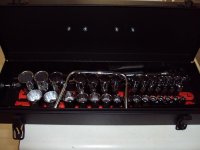
And if tools are toys for mechanics, then Mr. Pino's van is a wondrous F.A.O. Schwarz on wheels. Inside the 200-square-foot cargo area is a tool lover's fantasyland -- every wrench, screwdriver, pliers, socket set, hammer and chisel one could imagine, covering every available square inch, walls and ceiling included. Crammed cleverly into the space are various Snap-on tool cases and diagnostic equipment for emissions testing. All told, Mr. Pino has more than $160,000 worth of inventory on board at any given time. He can always order from Snap-on's catalogue of 14,000 products, but he knows there is no better way to close a sale than to have the tool that a mechanic needs right there on the truck.
In the independent garages, which are the bread and butter of Snap-on's core customer base, mechanics must buy their own tools. Because they work on all makes, models and years of cars, they need a wider variety of tools than do their counterparts at auto dealerships. They all learn quickly that Snap-on products are the most expensive, but that they are also of the highest quality, likely to last a lifetime and be the best and easiest to use.
For a novice mechanic earning $200 a week, however, a tool chest full of Snap-ons represents an investment of $10,000 or more. If not for dealers like Mr. Pino, such tools would be virtually unattainable.
But Mr. Pino is a dealer who is also a banker, willing to follow a time-honored Snap-on tradition of extending credit to customers who would be unable to get such financing anywhere else.
At one stop, a young Vietnamese mechanic climbs on board, shyly hands Mr. Pino a crumpled $20 bill and then makes his way down the narrow aisle in the van, ********* a shrink-wrapped ratchet kit.
"What can I get for you today, Pham?" Mr. Pino asks as he turns to his computer on a nearby shelf and searches the data base for Pham's name. He records the payment, grabs a receipt from his on-board printer and says, "You're almost all paid up, Pham. How about this new ratchet set? It's on sale this week."
Pham shakes his head. "Not this week," he says as he exits the van slowly. Mr. Pino smiles and says, "No problem. We'll see you next week."
Throughout the day, Mr. Pino collects small cash payments such as these from a string of mechanics. He regularly extends credit without interest for items under $1,000. "I try to collect $10 for every $100 worth of credit each week," he explains.
For larger purchases, such as the $10,000 storage units or the expensive diagnostic equipment that Snap-on is now encouraging him to sell, Mr. Pino arranges for financing, with competitive interest rates, through the company's financial services group.
He admits to losing up to $5,000 annually "on the deadbeats," but he says the majority of his customers are good people, reliable, honest and trustworthy. And Mr. Pino knows that he couldn't possibly produce the $7,000 to $9,000 in sales that he now gets each week if he did not extend credit.
Without much discussion, he sells a series of hand tools, nearly $1,000 worth, before lunch. Clad in a red Snap-on jacket, the youthful-looking Mr. Pino maintains an upbeat posture throughout the day, an attitude that reflects his pleasure at being his own boss, setting his own hours and bringing in a comfortable six-figure income each year.
"I'm a tool junkie myself," he says. "I like the stuff I sell. And what else could I be doing that lets me make this kind of money and be home by 4:30 every day?"
Reprint No. 98105
Authors
Glenn Rifkin,
[email protected]
Glenn Rifkin has covered technology for the New York Times and has written for the Harvard Business Review and Fast Company. He is coauthor of Radical Marketing (HarperBusiness, 1999) and The CEO Chronicles (Knowledge Exchange, 1999).